Woman with a Parasol — Camille Monet in the wind
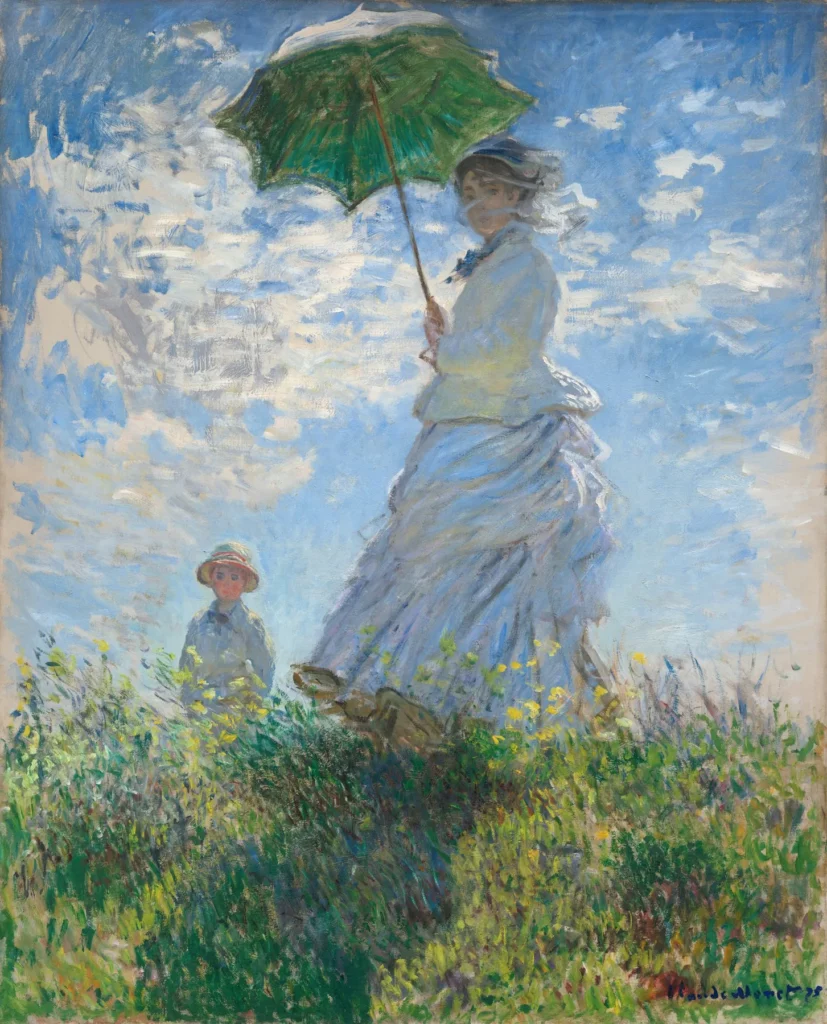
Claude Monet — the painter who pursued light for sixty years →Seen from below, a woman in white stands against a blue sky streaked with cloud. She tilts a green parasol back over her shoulder; a veil drifts across a face we can barely make out. Her skirt billows, the grass bends at her feet. A little lower down, half hidden by the slope, a small boy in a round hat looks our way.
Woman with a Parasol catches a moment in the summer of 1875, on a hillside outside Argenteuil. The woman is Camille, Claude Monet’s wife; the boy is their son Jean, seven or eight years old. The painter, standing below them on the slope, is working fast.
The National Gallery of Art gives it a fuller title, Woman with a Parasol — Madame Monet and Her Son; in France it is known as La Femme à l’ombrelle. It has become one of the defining images of the National Gallery of Art’s Impressionist collection.
The Stroll, a summer day at Argenteuil
In France the canvas also goes by a plainer title: La Promenade, The Stroll. The word fits the scene: a summer outing with nothing in particular happening, on the hills above Argenteuil, the town on the Seine where the Monets had lived since the end of 1871.
Yet this is no casual sketch. The canvas is more than three feet tall, an ambitious size for a scene caught on the spot, and Monet most likely painted it outdoors in a single session of a few hours. Figures on this scale were usually painted in the studio; Monet set his up in the grass, facing the wind.
He thought it finished enough to show the following spring. In April 1876, Woman with a Parasol was among the eighteen canvases he sent to the second Impressionist exhibition, at Paul Durand-Ruel’s gallery.
A portrait without a likeness
The sitters are family, yet this is not really a portrait. Camille’s face is veiled and blurred, reduced to a few touches of flesh and shadow; Jean’s is hardly sharper. Monet is not after a likeness. He is after a moment.
What holds his attention is a figure caught in light and wind, at one particular instant of one particular day. The low viewpoint heightens the effect: Camille towers over the hill, outlined against the sky like an apparition, and we look up at her the way you look up at someone passing by.
Painting the gust
The National Gallery of Art stresses how quickly the picture was made: Monet worked in broad strokes, so fast that patches of bare canvas still show through. The gesture is visible everywhere, and it follows the movement of what it depicts.
In the sky, the clouds are laid down in quick, almost scratched strokes. Camille’s veil flies off to the right, her skirt swells, the blue bow at her collar lifts. In the foreground the grass is a scatter of green and yellow dashes thrown in every direction, as if flattened by a gust.
Color never stays put. The white dress turns blue in shadow and yellow where the sun strikes it; the rim of the green parasol flares with a stroke of white; in the grass, a few dabs of yellow are enough to conjure wildflowers. That is the lesson of painting outdoors: a color depends on the light that falls on it.
Camille, then Suzanne
Camille Doncieux met Monet in the mid-1860s and became one of his favorite models, beginning with Woman in the Green Dress of 1866. She died in 1879 at Vétheuil, aged thirty-two, a year and a half after the birth of their second son, Michel.
In 1886, eleven years after the Washington canvas, Monet returned to the motif at Giverny with a new model, Suzanne Hoschedé, the daughter of the woman who would become his second wife. He painted two versions, one figure turned to the right, the other to the left; both now hang at the Musée d’Orsay in Paris.
Suzanne’s face is even more effaced, the figure lonelier. Many writers have seen Camille’s memory in these two canvases: Monet going back to the motif of 1875 and finding he could not recover it.
From Georges de Bellio to Paul Mellon
The provenance published by the National Gallery of Art traces the painting’s journey. In 1876 Monet sold it to Georges de Bellio, a Romanian-born physician living in Paris and one of the earliest and most loyal collectors of the Impressionists. He also owned Impression, Sunrise, which his daughter would later give to the Musée Marmottan Monet in Paris.
After de Bellio’s death it passed to his daughter Victorine and her husband, Ernest Donop de Monchy. It later belonged to the chocolate magnate and collector Georges Menier, who lent it to a Paris exhibition in 1924. In 1965 the Menier collection was sold at auction in Paris, at the Palais Galliera.
The American collector Paul Mellon acquired it through the dealer Hector Brame, and in 1983 he and his wife gave it to the National Gallery of Art. That is how one of the most French of all Impressionist images came to rest in Washington.
By then the canvas had left its mark on other painters. John Singer Sargent, who is thought to have seen it in 1876, remembered it in Two Girls with Parasols at Fladbury (1889), now at the Metropolitan Museum of Art in New York.
Where to see Woman with a Parasol in DC
The painting hangs at the National Gallery of Art in Washington, in the West Building, Gallery 85. The canvas measures 39 3/8 by 31 7/8 inches (100 × 81 cm) and is signed at lower right “Claude Monet 75.”
Admission to the museum is free. The National Gallery offers a high-resolution open access image on the object’s page, and if your travels take you to Paris, the Musée d’Orsay holds the two 1886 variations.
Further Reading
Institutional Documentation
- Woman with a Parasol — Madame Monet and Her Son — National Gallery of Art — the full record, with every owner since 1876.
See also on Hors Cadre
- The National Gallery of Art in Washington — what to see, hours, getting there — free admission, entrances, masterpieces: everything to plan a visit in DC.
- Claude Monet — the painter who chased light for sixty years — a portrait of the painter, from Argenteuil to the Water Lilies.
— M