Washington Crossing the Delaware — America painted on the Rhine
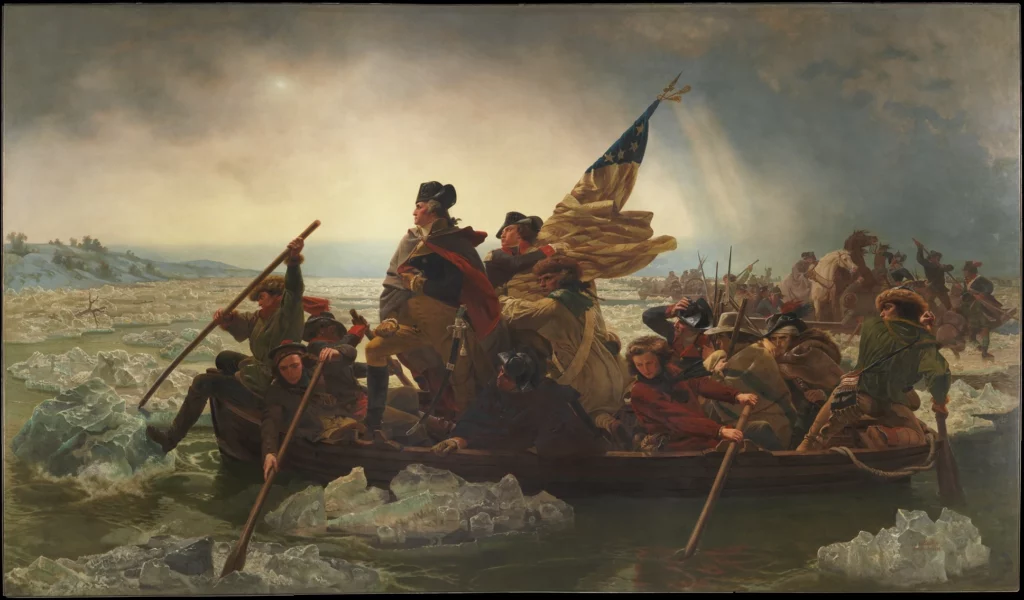
Emanuel Leutze — the German painter who pictured America →He stands in the bow, one knee bent, eyes on the far shore, cloak snapping in the wind. Around him, a dozen men pull at the oars, shove aside slabs of ice, brace themselves against the current. Behind him an officer grips a starry flag. Over the dark river, the sky is only beginning to break.
Few images are as deeply lodged in the American imagination. Printed in schoolbooks, on posters and stamps, endlessly parodied, Emanuel Leutze’s Washington Crossing the Delaware has become the unofficial picture of the Revolutionary War. At the Metropolitan Museum of Art it fills an entire wall of the American Wing: more than 12 feet high and over 21 feet wide.
The irony is that it was painted in Germany, on the banks of the Rhine, by a German-born artist, with a flag that did not yet exist on the night it shows.
Christmas night, 1776
The event itself is real. By the end of 1776, Washington’s Continental Army was exhausted, beaten in New York, thinned by desertion. On the night of December 25–26, the general moved his troops across the Delaware River, from Pennsylvania into New Jersey, through ice and foul weather.
At dawn his men surprised the garrison at Trenton. The victory was small in scale and enormous in consequence: it revived a revolution that had seemed lost. That turning point is what Leutze set out to paint, some seventy-five years later.
An American picture made in Düsseldorf
Emanuel Leutze was born in 1816 in Schwäbisch Gmünd, in southern Germany. Brought to the United States as a child, he grew up in Philadelphia, then returned to Europe to study in Düsseldorf, whose academy drew a steady stream of American painters. It was there, by the Rhine, that he planned his great canvas in the late 1840s. According to a text published by the Met, he researched it closely: eyewitness accounts, weather reports, even a replica of Washington’s uniform requested from the US government.
He used American visitors and fellow students as models. One of them, Worthington Whittredge, later a Hudson River School landscape painter, stood in for Washington himself. The icy river owes a good deal to the Rhine.
The first version, finished in 1850, was soon damaged by a fire in the studio. Once repaired, it was bought by the Kunsthalle Bremen, and it was destroyed in an Allied bombing raid in 1942. The Met’s canvas is a second version, which Leutze began almost immediately.
A nation in one boat
Washington sits at the dead center of the composition, the one still point in a scene of struggle. Just behind him, the man holding the flag is traditionally identified as young Lieutenant James Monroe, the future president.
Around them Leutze assembled a cross-section of the young nation: soldiers in uniform, men in frontier dress, a farmer, a sailor, a Black oarsman, a man in a Scottish bonnet. Every one of them is absorbed in the work at hand; only the general looks ahead.
Light does the rest. Heavy on the right, the sky clears toward the left, toward the shore they are heading for; a shaft of light breaks through just behind the flag, and a last star still shines above the ice, as if the outcome were already written.
Leutze’s liberties
The picture never claimed to be reportage, and historians have long listed its inaccuracies. The crossing took place in the dead of night, in snow and freezing rain; Leutze paints a breaking dawn, the image of a nation being born. The Stars and Stripes with thirteen stars in a circle was adopted only in June 1777, six months after the crossing. Washington’s troops crossed in large, flat-bottomed Durham boats, far bigger than this rowboat. And standing up in a small craft among ice floes would have been reckless.
The historian David Hackett Fischer offers one defense of that last detail: the men may have stood to keep out of the freezing water sloshing in the bottom of the boats. Either way, Leutze was after a symbol rather than a record: a leader upright in the storm, carried by a united people.
New York, 1851 and 1864
When it went on view in New York in the fall of 1851, the painting caused a sensation; more than 50,000 people came to see it. The businessman Marshall O. Roberts bought it for $10,000.
In 1864, in the middle of the Civil War, it became the centerpiece of the Metropolitan Sanitary Fair, a vast charity exhibition held in New York to raise money for wounded Union soldiers. It hung between two monumental landscapes of the West and the Andes: Albert Bierstadt’s The Rocky Mountains, Lander’s Peak and Frederic Church’s The Heart of the Andes.
In 1897, after passing through several owners, it was given to the Metropolitan Museum by the banker John Stewart Kennedy.
A frame rebuilt from a photograph
For more than a century the canvas sat in a plain frame that, in the words of Met curator Carrie Rebora Barratt, “minimized” it. During the renovation of the American Wing, the museum decided to restore its 1864 appearance, guided by a photograph of the Sanitary Fair installation.
Eli Wilner’s New York workshop recreated that gilded frame in carved wood and gold leaf, crowned by an eagle, with a ribbon bearing the words used to eulogize Washington: “First in War, First in Peace, and First in the Hearts of his Countrymen.” The canvas was cleaned at the same time.
Since the American Wing reopened its galleries in January 2012, the painting has once again hung between the great landscapes of Bierstadt and Church, just as it did in 1864.
Seeing Washington Crossing the Delaware at the Met
The painting hangs at the Metropolitan Museum of Art in New York, in the American Wing, Gallery 760. The canvas measures 149 by 255 inches (378.5 × 647.7 cm) and sits in its reconstructed 1864 gilded frame.
A few rooms away, in the same wing, Gallery 767 shows Winslow Homer’s The Gulf Stream: another boat in peril, but with no hero and no flag. The Met offers a high-resolution, public domain image of Leutze’s canvas.
Further Reading
Institutional Documentation
- Washington Crossing the Delaware — The Metropolitan Museum of Art — the museum’s record, with provenance and a downloadable image.
See also on Hors Cadre
- The Metropolitan Museum of Art — what to see, hours, tickets — our visitor’s guide to the Met, from the American Wing to the Temple of Dendur.
- Emanuel Leutze — the German painter who pictured America — his life between Düsseldorf and Washington, up to the Capitol mural.
— M