Berthe Morisot with a Bouquet of Violets — Manet’s portrait in black
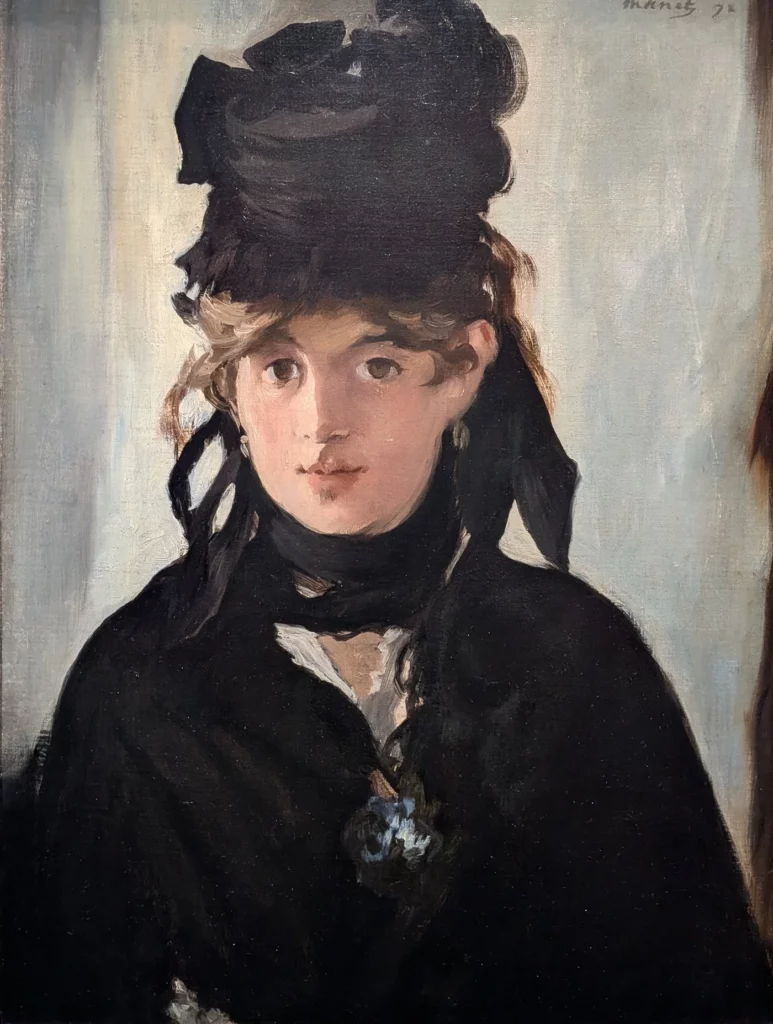
Édouard Manet — From the *Luncheon* Scandal to His Last Painting →A tall black hat tied with ribbons, chestnut strands escaping across the forehead, a black scarf wrapped tight around the neck. The face, lit from the side, is split in two by light and shadow. And two huge, very dark eyes look straight at us without blinking. At upper right, in a quick hand, the painter signed: “Manet 72.”
The sitter is no stranger. Berthe Morisot is a painter herself, one of the first women to join the Impressionist circle, and Manet’s friend of four years. He has painted her several times already. But never like this.
Paul Valéry, who later married a niece of Berthe Morisot, summed up what many feel in front of this small picture at the Musée d’Orsay: “I do not rank anything in Manet’s work higher than a certain portrait of Berthe Morisot dated 1872.”
1872, back to painting
The picture came out of a dark period. During the Franco-Prussian War, Manet stayed in Paris and served in the National Guard during the siege. He stopped painting. After the city surrendered in January 1871 he left Paris, returning once the Commune had been crushed.
According to the Musée d’Orsay, he truly took up his brushes again at the end of 1871. This portrait of Berthe Morisot, painted a few months later, is among the first great successes of that return.
It is small, just under 22 inches high, and very freely painted: the gray-blue background is brushed in broad strokes, the scarf and coat dashed off in a few wide touches of black. All the care goes into the face.
Two painters
Manet and Berthe Morisot met in 1868, through the painter Henri Fantin-Latour. She was twenty-seven. Trained by Joseph-Benoît Guichard and then with Corot, she had been exhibiting at the Salon since 1864: a rare career for a young woman from the Parisian bourgeoisie.
Manet asked her to pose right away. She first appears in the foreground of The Balcony, shown at the 1869 Salon, and he painted her several more times through 1874: in black, with a fan, in mourning, veiled.
Theirs remained a friendship between painters, built on admiration and mutual influence. In 1874 Berthe Morisot took part in the first Impressionist exhibition, in which Manet did not participate. That same year she married his younger brother, Eugène Manet.
A study in black
The Musée d’Orsay sees the portrait as a virtuoso display of black. Manet, a great admirer of Spanish painting and of Velázquez, knew how to bring to life a color others considered dead: here the black of the hat, the scarf and the coat are never quite the same.
The lighting is unusual for him. Where he often bathed his sitters in an even light, here he lights Berthe Morisot harshly from the side, so that her face, as the museum puts it, becomes all light and shadow. Her gaze gains an almost dramatic intensity.
He also took a liberty with reality. Berthe Morisot’s eyes were green; Manet painted them black, to match the rest of the picture. Finally, the museum reads the portrait as a lesson to his friend, whose own painting was then growing lighter as she moved toward Impressionism.
Face, signature, bouquet
Three details deserve a pause. First the face, divided by the light: cheek and forehead lit on the left, the other half in brown shadow, and between them a nose modeled in a few touches.
Then the signature, at upper right, set directly on the gray-blue background: “Manet 72,” like a note scribbled in the corner of a letter.
Finally the bouquet, promised by the title and hard to find. It is tucked into the opening of her coat, at the bottom of the canvas: a few touches of blue and green, barely visible against the black. That same year Manet gave Berthe Morisot a small still life, now in a private collection, showing a bouquet of violets, a fan and a folded letter: a token of friendship built from the props of her portraits.
From The Balcony to the portrait in black
The Balcony, also at the Musée d’Orsay, shows how far Manet had come. In 1869 Berthe Morisot was just one figure in a brightly colored scene inspired by Goya’s Majas on a Balcony; critics found the colors provocative, and the caricaturist Cham mockingly advised closing the shutters.
Three years later Manet stripped everything else away. No balcony, no harsh green, no companions: a single woman, half-length, in black, with light on her face. The first picture staged a group; the second looks only at her.
From Duret to the Musée d’Orsay
Manet passed the picture on to the critic and collector Théodore Duret, one of the Impressionists’ earliest champions. According to the work’s published history, Berthe Morisot herself bought it back in 1894, when Duret’s collection was sold, reclaiming the portrait her brother-in-law had painted of her twenty-two years earlier.
The painting then stayed with her descendants, her daughter Julie Manet and later the Rouart family. The Musée d’Orsay acquired it in 1998, with support from the Fonds du Patrimoine, the Meyer Foundation, the China Times Group and a sponsorship campaign organized by the Japanese daily Nikkei.
Where to see the painting
Berthe Morisot with a Bouquet of Violets hangs at the Musée d’Orsay in Paris, on the ground floor, in Room 14, among Manet’s works. The canvas measures 21 7/8 by 16 inches (55.5 × 40.5 cm): it is smaller than most people expect, and it works best seen head-on, at eye level.
The museum also holds several paintings by Berthe Morisot herself, including The Cradle, shown at the 1874 Impressionist exhibition: a single visit lets you see both the sitter and the painter.
Further Reading
Institutional Documentation
- Berthe Morisot au bouquet de violettes — Musée d’Orsay — the museum’s record, with its analysis and acquisition history.
- Musée d’Orsay— the museum’s official website, with hours and tickets.
See also on Hors Cadre
- Berthe Morisot — the painter who lived inside Manet’s paintings — a portrait of the painter, from her beginnings to Impressionism.
- Édouard Manet — from the Déjeuner scandal to his last canvas — a portrait of the painter, from Olympia to A Bar at the Folies-Bergère.
— M