The National Gallery of Art in Washington — what to see, hours, getting there
On the National Mall stands a museum where you can see a Leonardo, a Vermeer and a Raphael without paying a dollar or booking anything. The National Gallery of Art in Washington is free, almost every day of the year, and it is one of the world’s great museums of painting.
Its story comes down to a single gesture. In 1936 the financier Andrew W. Mellon, a former secretary of the Treasury, offered the nation his collection of paintings and sculpture, along with a building to house it. Congress accepted the gift the following year. Other great collectors then added their own holdings to that first group, so much so that the museum describes itself as a “collection of collections.”
Today the National Gallery holds more than 150,000 works, spread across two very different buildings and a sculpture garden. The older one, the West Building, houses European and American painting up to the early twentieth century: that is where visitors who come for the old masters and the Impressionists will want to start.
The National Gallery at a glance
| Address | West Building : 6th Street et Constitution Avenue NW, Washington, DC 20565 ; East Building : 4th Street et Constitution Avenue NW |
| Subway | Archives–Navy Memorial–Penn Quarter, about a 6-minute walk from the West Building |
| Hours | Daily, 10 am–5 pm |
| Closed | December 25 and January 1 |
| Admission | Free |
| Reservation | Not needed for the collection, exhibitions or guided tours |
| Official Website | nga.gov |
Free admission covers temporary exhibitions too. The museum has no parking garage, apart from a few spaces for visitors with disability permits: it is best to come by Metro or on foot from the Mall.
A gift to the nation
Andrew W. Mellon had assembled one of the largest private collections in the United States. In 1936 he offered it to the country: 126 paintings and 26 sculptures, along with the funds to build a museum. Congress accepted in 1937 and set aside land for the building on the National Mall, at the foot of Capitol Hill.
The architect John Russell Pope designed a neoclassical building in pink Tennessee marble, lit by large skylights. Neither Mellon nor Pope lived to see it: both died in August 1937. On March 17, 1941, Paul Mellon, the donor’s son, formally presented the museum to President Franklin D. Roosevelt, who accepted it on behalf of the nation.
Other collectors followed suit: the brothers Samuel and Rush Kress, the Wideners, Chester Dale, Lessing J. Rosenwald, and then Mellon’s own children, Paul Mellon and Ailsa Mellon Bruce. In 1967 they funded a second building. Designed by the architect I. M. Pei, the East Building, all sharp edges and triangular volumes, was dedicated on June 1, 1978, by President Jimmy Carter. It is devoted to modern and contemporary art.
The latest addition, the Sculpture Garden, designed by the landscape architect Laurie Olin, opened to the public in May 1999. It displays some twenty modern sculptures around a fountain that becomes an ice rink in winter.
Must-See Works
The route below focuses on the West Building, home to the great European and American masters. All the galleries listed are on the Main Floor, except Degas’s Little Dancer, on the Ground Floor. Works sometimes move: the floor plan, available at the entrances and online, helps you find your way.
1. Ginevra de’ Benci, Leonardo da Vinci (about 1474–78)
A pale, sixteen-year-old Florentine sat for this portrait on the occasion of her upcoming marriage. She stands out against a juniper bush, ginepro in Italian, a play on her name. It is the only painting by Leonardo da Vinci in the Americas. For a long time its author was forgotten: a 1780 catalogue attributed it to Lucas Cranach. The museum acquired it in 1967 from the Prince of Liechtenstein. The panel, painted on both sides, is just 15 inches high. Gallery 6.
2. The Alba Madonna, Raphael (about 1510)
The Virgin seated in a landscape, with the Christ Child and the young Saint John the Baptist gathered around a reed cross: Raphael set the scene in a tondo, a round painting about three feet across, with perfect harmony. The work is named for the Dukes of Alba in Spain, who once owned it, before it joined the imperial collections in St. Petersburg and later Andrew Mellon’s. Gallery 20.
3. Woman Holding a Balance, Johannes Vermeer (about 1664)
A woman in a fur-trimmed blue jacket holds a small, empty balance, in front of a painting of the Last Judgment on the wall. The gesture is suspended; the light glides in from the window. It is one of the few Vermeers in the United States, and one of the most meditative. The canvas is tiny: under 16 inches high. Gallery 50A.
4. Self-Portrait, Rembrandt (1659)
At fifty-three, a few years after his bankruptcy, Rembrandt painted himself without flattery: knitted brows, sunken cheeks, sad eyes fixed on us. Only the finely detailed face emerges into the light; everything else dissolves into shadow. The portrait stayed for generations in a great British family before being sold in 1928 and crossing the Atlantic. It entered the museum with the Mellon collection. Gallery 51.
5. Watson and the Shark, John Singleton Copley (1778)
In Havana harbor, in 1749, a naked teenager struggles in the water as a shark bears down on him and nine sailors try to save him. The scene is true: Brook Watson, fourteen, lost his right leg below the knee, then went on to become an important merchant and, briefly, Lord Mayor of London. He commissioned the painting from Copley, America’s most important colonial painter, who had settled in England in 1774. Shown at the Royal Academy in 1778, the canvas caused a sensation. Gallery 60B.
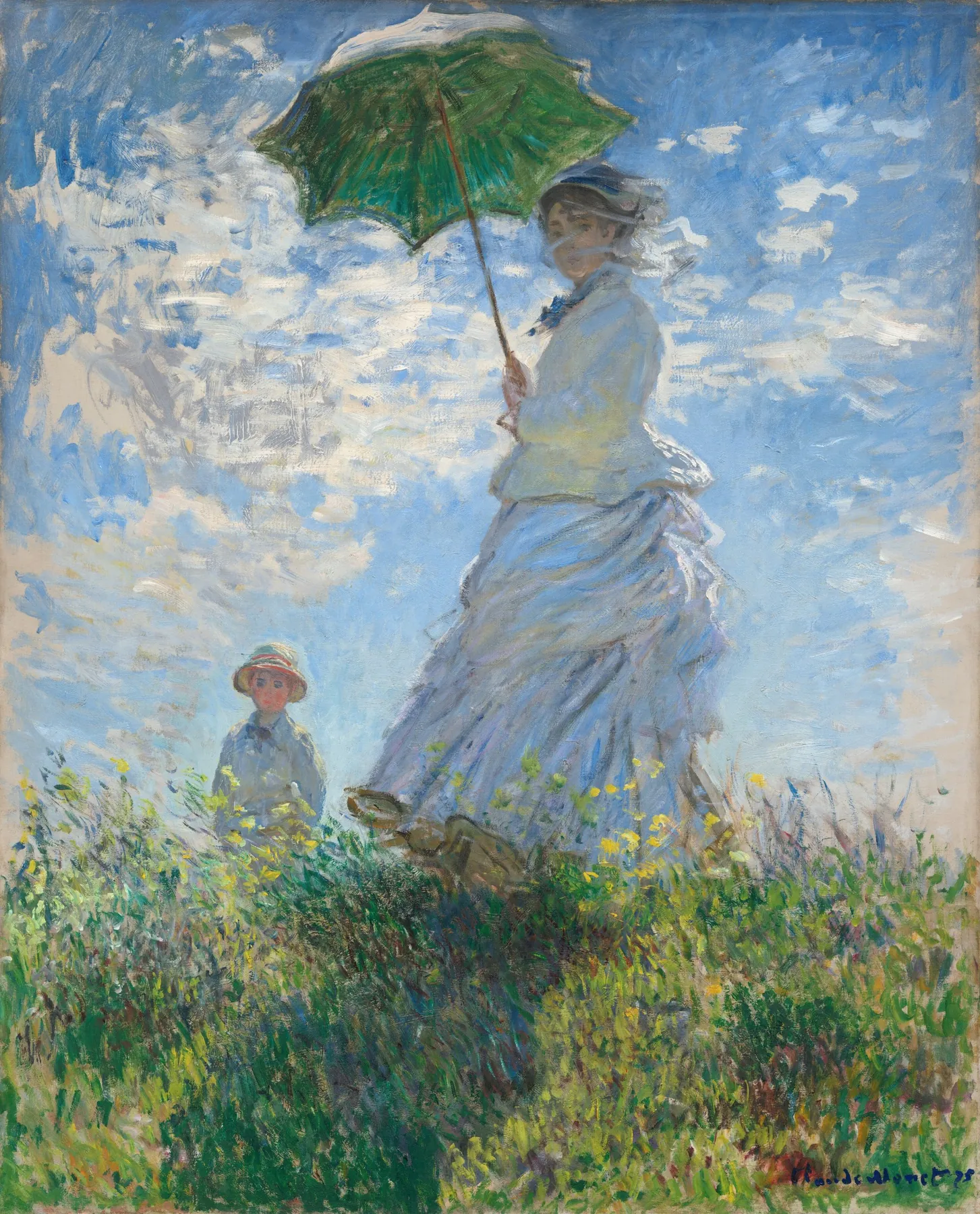
6. Woman with a Parasol — Madame Monet and Her Son, Claude Monet (1875)
On a hillside, probably near Argenteuil, where the family was then living, Camille Monet turns toward the painter, parasol in hand, while their son Jean stands a little way behind. The wind stirs her veil and the grass, the clouds race by: everything is movement and light. Monet worked so fast that he left bare canvas showing in places: the picture is one of the emblems of Impressionism. It was given to the museum in 1983 by Paul Mellon and his wife. Gallery 85.
7. Self-Portrait, Vincent van Gogh (1889)
Painted at Saint-Rémy-de-Provence, less than a year before his death, this portrait shows Van Gogh in a painter’s smock, palette in hand, his face tense and his gaze fixed, against a dark background. It came to the museum with the collection of John Hay Whitney. Gallery 83, where it hangs near a self-portrait by Gauguin from the same year.
8. Little Dancer Aged Fourteen, Edgar Degas (1878–81)
The only sculpture Degas exhibited in his lifetime, at the 1881 Impressionist exhibition in Paris. The National Gallery owns the original in wax, with real hair, a fabric tutu, a bodice and a silk ribbon. The bronzes seen in other museums were cast after the artist’s death. Ground Floor, Gallery 3.
9. Whistler and Homer: two faces of America
In two neighboring galleries, 68 and 69, two paintings sum up nineteenth-century America. Winslow Homer’s Breezing Up (A Fair Wind) shows boys under sail in the optimistic America of the 1876 centennial. James McNeill Whistler’s Symphony in White, No. 1: The White Girl, painted in Paris in 1861–62, caused a stir at the Salon des Refusés. One painter stayed in America; the other made his life in Europe.
How to visit the National Gallery
How long does it take to visit the National Gallery?
Two to three hours are enough for the West Building route above. A full day lets you add the East Building and the Sculpture Garden. Since admission is free, splitting the visit over several days is an easy option.
When is the best time to avoid the crowds?
Weekdays, ideally early in the morning. Spring weekends, during Washington’s cherry blossom season, are often the busiest.
Is the National Gallery really free?
Yes. Admission is always free, including temporary exhibitions and guided tours, and no reservation is needed. Only some events require registration, which is also free.
What day is the National Gallery closed?
The museum is open every day except December 25 and January 1.
Which entrance should you use?
The accessible entrances are the West Building’s 6th Street entrance, the East Building’s main entrance and the Sculpture Garden entrance. The Mall entrance, on Madison Drive, leads straight into the West Building’s rotunda. The 7th Street entrance is closed until further notice.
Are there guided tours?
Yes, free ones, as well as self-guided itineraries and audio tours.
Where can you eat at the National Gallery?
Several dining spots are spread across the campus, including a café in the Sculpture Garden.
Around the Museum
The National Gallery sits at the heart of the National Mall, the great esplanade linking the Capitol to the Washington Monument, lined with Smithsonian museums that are nearly all free as well.
A few minutes’ walk away, the Freer Gallery of Art houses Whistler’s Peacock Room, a London dining room turned work of art, along with a vast collection of Asian art. The Capitol rises at the east end of the Mall, and the National Air and Space Museum stands across from the East Building. One afternoon is barely enough to take in two of these museums back to back.
Further Reading
Institutional Documentation
- Plan Your Visit — National Gallery of Art — current hours, entrances and directions.
- Our History — National Gallery of Art — the museum’s history told by the institution.
- Photo Credit : National Gallery of Art, Washington
See also on Hors Cadre
- Symphony in White, No. 1 — Whistler’s woman in white — the story of the picture painted in Paris and shown at the Salon des Refusés.
- Breezing Up — America under full sail — Winslow Homer’s painting of centennial-era America.
— M