The Art Institute of Chicago — what to see, hours, tickets
On Michigan Avenue, two bronze lions stand guard before a stone palace. Inside, on the second floor, a Parisian would feel almost at home: a street near the Gare Saint-Lazare in the rain, a Sunday on the island of La Grande Jatte, Van Gogh’s bedroom in Arles, a night at the Moulin Rouge. The Art Institute of Chicago holds one of the finest Impressionist and Post-Impressionist collections in the world.
Founded in 1879, the museum now holds nearly 300,000 works, from antiquity to contemporary art. It is also home to two icons of American painting, Edward Hopper’s Nighthawks and Grant Wood’s American Gothic, which millions of people know without ever having seen them in person.
Founded in 1879, the museum now holds nearly 300,000 works, from antiquity to contemporary art. It is also home to two icons of American painting, Edward Hopper’s Nighthawks and Grant Wood’s American Gothic, which millions of people know without ever having seen them in person.
The Art Institute at a glance
| Address | 111 South Michigan Avenue, Chicago, IL 60603 (entrée de la Modern Wing : 159 East Monroe Street) |
| Transit | Adams/Wabash station (Loop lines), steps away; CTA buses and Metra trains nearby |
| Hours | Monday, Wednesday, Friday, Saturday and Sunday: 11 am–5 pm; Thursday: 11 am–8 pm |
| Closed | Tuesdays, plus Thanksgiving, Christmas and New Year’s Day |
| Adults | $32 (visitors from outside Illinois) |
| Reduced | $26 (seniors 65 and over, students, teens 14–17); lower rates for Chicago and Illinois residents with proof of residence |
| Free admission | Children under 14, Chicago teens under 18, members |
| Official Website | artic.edu |
Your ticket is valid all day, with re-entry. It covers the entire collection and all non-ticketed exhibitions; some major exhibitions require an additional ticket. Advance tickets are encouraged but not required.
A palace born of a world’s fair
The museum was founded in 1879 as the Chicago Academy of Fine Arts, both a school and an exhibition space. It took its current name three years later. Chicago, then rebuilding after the Great Fire of 1871, wanted cultural institutions to match its economic power.
The opportunity came in 1893 with the World’s Columbian Exposition. The Michigan Avenue building, designed in the Beaux-Arts style by the Boston firm Shepley, Rutan and Coolidge, was built for the fair and then handed over to the museum, which opened it on December 8, 1893. The bronze lions flanking the entrance arrived soon after and became a symbol of both the museum and the city.
The collections grew thanks to Chicago’s great families. In 1913 the museum hosted the Armory Show, the landmark exhibition of European avant-garde art, and its purchases from the show launched the modern art collection. In 1924 the bequest of the collector Bertha Honoré Palmer brought fifty-two Impressionist and Post-Impressionist paintings; the following year the Helen Birch Bartlett Memorial Collection brought, among others, A Sunday on La Grande Jatte.
The museum has kept growing. In 2009 it opened the Modern Wing, designed by the Italian architect Renzo Piano: 264,000 square feet that enlarged the museum by about a third and house modern and contemporary art under soft, filtered daylight.
Must-See Works
For a first visit, the heart of the museum is on the second floor of the main building, in galleries 200 to 250, devoted to Impressionist and Post-Impressionist painting. The two American icons are a little farther on, in the American art galleries. Gallery numbers sometimes change: the museum map and app let you check them on the day of your visit.
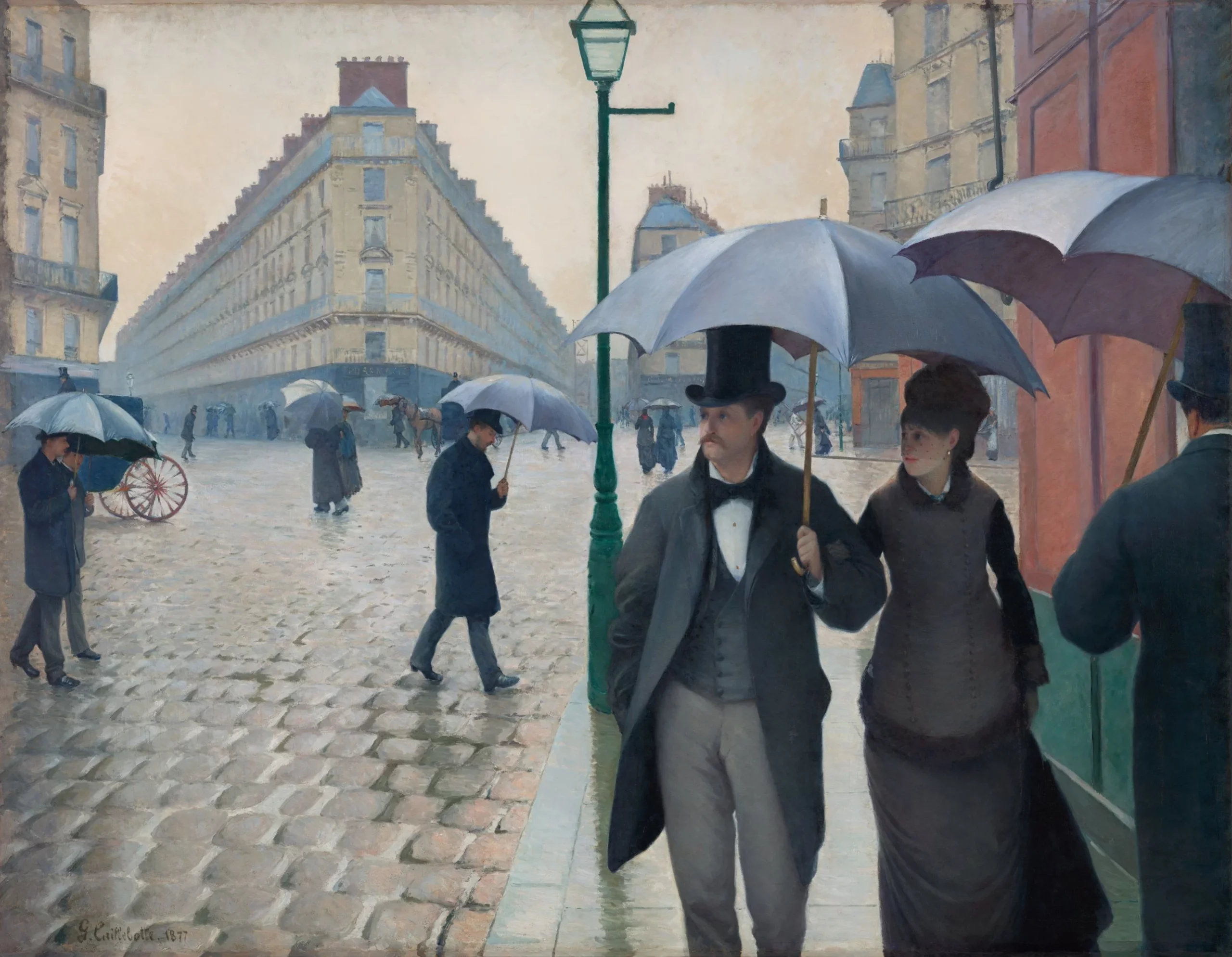
1. Paris Street; Rainy Day, Gustave Caillebotte (1877)
At a broad intersection near the Gare Saint-Lazare, elegant Parisians cross paths under their umbrellas. Caillebotte paints not a single raindrop: he suggests the rain through open umbrellas and reflections on the wet paving stones. It is his most ambitious painting, nearly seven feet high and more than nine feet wide, shown in April 1877 at the third Impressionist exhibition, on rue Le Peletier, under the title Rue de Paris; temps de pluie. Gallery 201.
2. A Sunday on La Grande Jatte — 1884, Georges Seurat (1884–86)
Motionless strollers on the banks of the Seine, parasols, a monkey on a leash: Seurat’s great canvas is the defining work of Pointillism. Up close, the figures dissolve into dots and dashes of complementary colors; from a distance, they come back together in afternoon light. In 1888–89 Seurat even added a painted border of dots. Gallery 240.
3. The Bedroom, Vincent van Gogh (1889)
A bed, two chairs, a washstand, lavender-blue walls: the bedroom of the Yellow House in Arles, where Van Gogh had moved in the fall of 1888. He painted three versions; Chicago’s is the second, made in 1889. The first is in the Van Gogh Museum in Amsterdam; the third, smaller one, painted for his mother and sister, is in the Musée d’Orsay in Paris. Gallery 241.
4. Stacks of Wheat (End of Summer), Claude Monet (1890–91)
Outside his house at Giverny, Monet painted the stacks of wheat, fifteen to twenty feet tall, over and over, at every hour and in every season. The Art Institute holds the largest group of these Stacks of Wheat in the world, which lets you see, from one canvas to the next, what Monet was really after: not the stacks, but the changing light. Gallery 243.
5. At the Moulin Rouge, Henri de Toulouse-Lautrec (1892–95)
A table of regulars, dancers, and in the foreground a woman’s face lit by a greenish, almost unsettling glow, the electric light the cabaret was built to show off. In the background Toulouse-Lautrec painted himself, a tiny figure beside his tall cousin, the physician Gabriel Tapié de Céleyran. Gallery 242.
6. The Child’s Bath, Mary Cassatt (1893)
A mother washes the feet of the child on her lap, and our gaze plunges down onto the scene from above. Mary Cassatt, the only American invited to exhibit with the Impressionists, painted it after seeing a major exhibition of Japanese prints in Paris in 1890: hence the flattened space and decorative patterns. Gallery 273.
7. Nighthawks, Edward Hopper (1942)
A neon-lit diner at night on a deserted street corner. Three customers at the counter, a server in white, and a silence you can almost hear. Hopper drew inspiration from a restaurant on Greenwich Avenue in New York, without painting its portrait: it is an image of urban loneliness that has become one of the most reproduced in American art. The museum acquired it in 1942, the year it was painted. Gallery 262. Because the work is still under copyright, it is described here rather than reproduced.
8. American Gothic, Grant Wood (1930)
A farmer holding a pitchfork and a stern-faced woman stand before a wooden house with a Gothic window. Grant Wood used his sister and his dentist as models. Shown at the Art Institute’s annual exhibition in 1930, the painting won a $300 prize and was bought by the museum: it became famous almost overnight, and later one of the most parodied images in the world. Gallery 263. Like Nighthawks, it is described here without being reproduced.
How to visit the Art Institute
How long does it take to visit the Art Institute?
Two to three hours let you see the Impressionists and the main American galleries without rushing. You need a full day to also explore the Modern Wing, the arts of Asia or the famous Thorne Miniature Rooms. Since your ticket is good all day, nothing stops you from taking a break outside and coming back.
When is the best time to avoid the crowds?
Weekday mornings, right at the 11 am opening, are usually the quietest. On Thursdays the museum stays open until 8 pm.
What day is the Art Institute closed?
The museum is closed every Tuesday, as well as on Thanksgiving, Christmas and New Year’s Day.
Is the Art Institute free?
It is for children under 14, Chicago teens under 18 and members. Illinois residents also enjoy free evenings on certain Thursdays, from 5 to 8 pm, with dates posted on the museum’s website. Visitors from elsewhere pay $32.
Can you take photos?
Yes, without flash and for personal use, in all permanent collection galleries, except for a few works marked with signs. Selfie sticks and tripods are not allowed.
Is the museum wheelchair accessible?
Yes. Wheelchairs and strollers are available free of charge at both checkrooms, no reservation needed. The checkroom is free too, and required for large bags.
Where can you eat at the Art Institute?
The Café serves sandwiches, salads and desserts, and the Modern Bar, in the Modern Wing, offers lighter fare and coffee or tea.
Around the Museum
The Art Institute sits on the edge of Grant Park, facing the Loop. A pedestrian bridge links the Modern Wing to neighboring Millennium Park, where Anish Kapoor’s great polished-steel sculpture Cloud Gate, which Chicagoans call “the Bean,” reflects the skyline.
Farther south, Buckingham Fountain marks the center of Grant Park, and Lake Michigan is a few minutes’ walk away. To keep exploring the city that invented the skyscraper, architecture cruises on the Chicago River leave about fifteen minutes’ walk from the museum.
Further Reading
Institutional Documentation
- Visit — The Art Institute of Chicago — current hours, admission and directions.
- History — The Art Institute of Chicago — the museum’s history told by the institution.
- Photo Credit : The Art Institute of Chicago
See also on Hors Cadre
- La Grande Jatte — the manifesto of Pointillism — the story of Chicago’s signature painting.
- Gustave Caillebotte — painter of modern Paris — a portrait of the painter of Paris Street; Rainy Day.
— M