La Grande Jatte — The Manifesto of Pointillism
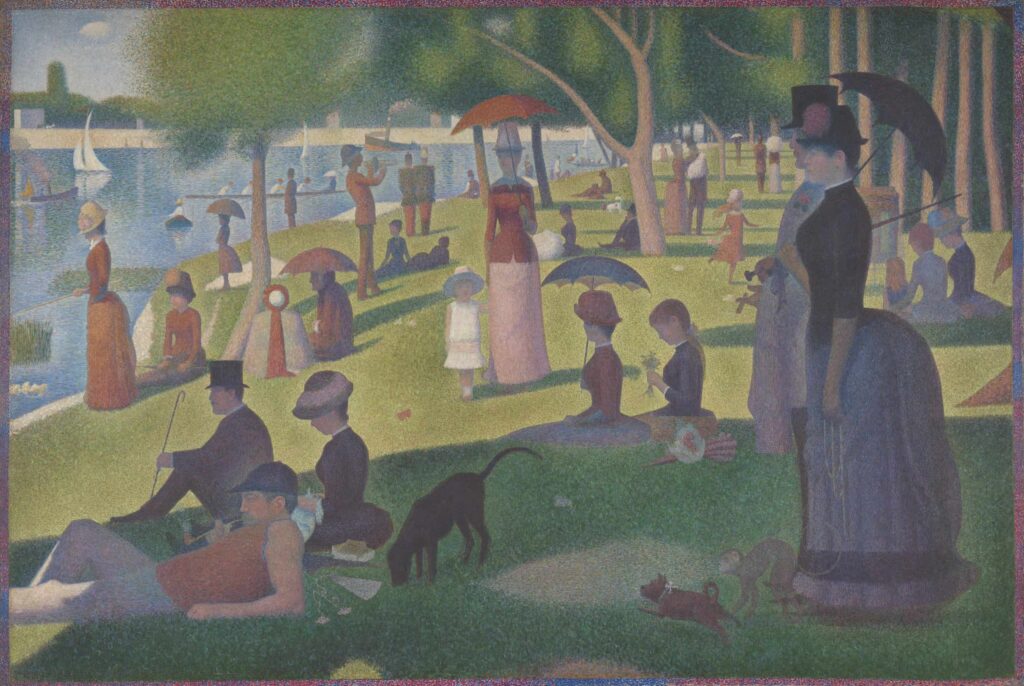
Georges Seurat — The Science of Color →Come closer: the figures dissolve into a myriad of tiny colored dots. Step back: the scene comes back into focus, revealing a summer Sunday along the banks of the Seine, where a crowd of Parisians dressed in their Sunday best strolls, rests, and gazes at the water under a still sun. Between these two distances lies the entire mystery of Georges Seurat’s*A Sunday Afternoon on the Island of La Grande Jatte* —one of the world’s most famous paintings and the manifesto of a pictorial revolution: Pointillism.
Painted between 1884 and 1886, this monumental canvas—measuring over two meters by three—is Seurat’s absolute masterpiece and the seminal work of Neo-Impressionism. On this immense surface, the artist applied, dot by dot, touches of pure color, the result of two years of relentless and methodical work. The result is a scene of fascinating strangeness: a crowd of walkers frozen in place, motionless and solemn, bathed in an unreal light, as if petrified in an eternal Sunday.
What strikes one first is the contrast with Impressionism. Whereas Monet sought to capture the fleeting moment, the changing light, and the movement of life, Seurat freezes everything in place. His figures do not move; time seems suspended; the scene has the motionless solemnity of an ancient frieze. Seurat does not paint a moment: he paints the timeless. He contrasts the spontaneity of Impressionism with methodical construction and permanence.
Presented in 1886 at the eighth and final Impressionist exhibition, *La Grande Jatte* caused a scandal and marked a turning point. It baffled, irritated, and fascinated. It signaled the end of Impressionism and the beginning of a new direction. Now housed at the Art Institute of Chicago, it has become a universal icon, endlessly reproduced, referenced, and parodied.
This article explores the secrets of this work—what it depicts, why its figures are so strangely frozen, what the Pointillist technique used to create it entails, what it reveals about Parisian society at the time, how it sparked a groundbreaking scandal, and how this Sunday on the Banks of the Seine has become one of the most recognizable images in the entire history of art.
The Painting — What It Depicts
*A Sunday Afternoon on the Island of La Grande Jatte* is a very large oil-on-canvas painting: approximately 207 centimeters high by 308 centimeters wide—nearly ten feet wide—a monumental surface that envelops the viewer.
The scene takes place on the Île de la Grande Jatte, an island in the Seine located in the western suburbs of Paris, between Neuilly and Courbevoie, not far from where the La Défense neighborhood stands today. In Seurat’s day, it was a popular spot for Sunday strolls and recreation among Parisians, who came there to relax by the water, far from the hustle and bustle of the city.
The painting depicts about forty figures gathered on the shaded riverbank, beneath the trees, facing the Seine. A wide variety of figures can be seen: an elegant couple in the foreground on the right, a woman holding a parasol, a man lying casually in the grass, a nanny, children, a little girl dressed in white who is either running or standing in the center, strollers, soldiers, and fishermen. Dogs wander among the groups, and a small monkey on a leash accompanies the couple in the foreground. On the Seine, in the background, rowboats and sailboats glide by.
The composition is meticulously ordered. The figures—depicted sometimes in profile, sometimes from the front, and sometimes from behind—are arranged in a masterful balance between areas of light and shadow, the vertical lines of the tree trunks and standing figures, and the horizontal lines of the riverbank and the water. Nothing is left to chance: each figure occupies a precise place within an almost architectural arrangement. This composition has been compared to an ancient frieze or to the rational balance of a painting by Poussin.
A Frozen Crowd — Solemnity and Timelessness
The most striking and perplexing aspect of *La Grande Jatte* is the stillness of its figures. None of them are really moving. They all seem frozen, petrified, captured in a pose they would hold for eternity. This stiffness, this hieratic quality, is one of Seurat’s major aesthetic choices—and one of the keys to the work.
The figures are treated as simplified, geometric, almost schematic silhouettes. The woman with the parasol in the foreground, seen in profile, has the austerity of an ancient Egyptian figure. The bodies are reduced to simple volumes, with sharply defined contours and stylized poses. There is none of the agitation, blurriness, or movement that the Impressionists sought to capture. Everything is calm, orderly, and still.
This artistic choice gives the scene a strange, timeless, almost unreal quality. This Sunday by the Seine is not a specific moment captured on the spot: it is a vision outside of time, a scene suspended in a silent eternity. The strollers at La Grande Jatte have a spectral quality, like motionless souls in a frozen paradise. The silence that emanates from the canvas is striking.
This timeless quality was intentional on Seurat’s part. He admired the grand, calm, and solemn compositions of Puvis de Chavannes, as well as ancient friezes, Renaissance frescoes, and the classical order of Poussin. He wanted to imbue a modern, everyday scene—Parisians out for a stroll—with the dignity and permanence of the great works of the past. By freezing his figures in time, he lifts them out of the realm of the anecdotal and the fleeting, enshrining them in eternity. It is in this way that *La Grande Jatte* transcends the simple genre scene to attain an almost sacred dimension.
Millions of dots — the pointillist technique
*La Grande Jatte* is the most systematic and accomplished application of the technique Seurat invented: Pointillism, or Divisionism. It is here that his mastery of color finds its fullest expression.
As we have seen, the principle consists of not mixing colors on the palette, but rather applying them pure to the canvas in a multitude of small, juxtaposed dots, which must recombine in the viewer’s eye through optical mixing. To paint sunlit grass, for example, Seurat places dots of green and yellow side by side, as well as dots of orange and blue, which, when viewed from a distance, produce a sensation of a luminous, vibrant green that is more intense than a solid green.
On this immense canvas, Seurat applied this principle with incredible patience, covering the surface with countless tiny brushstrokes. It was during the second year of work, in 1885–1886, that he adopted the almost uniformly sized dots that characterize Pointillism. The work was extremely slow: each square centimeter required dozens of carefully placed dots. It took two full years to complete the work.
Seurat also makes use of the principles of simultaneous contrast discovered by the chemist Chevreul: he places complementary colors side by side so that they enhance one another, intensifies the contrasts at the boundaries between light and shadow, and makes the edges of the forms shimmer. Everything is calculated to produce the maximum brightness and colorful vibrancy.
It is important to note one nuance, however. Pure optical mixing, as Seurat had hoped, does not occur exactly under real viewing conditions: from a distance, the dots tend to blend into a slightly grayish hue rather than a vibrant color. But the result is no less admirable: the surface of *La Grande Jatte* has a shimmering, velvety, vibrant quality that is absolutely unique. Seurat’s scientific rigor, even if imperfect in its theoretical foundations, produced an incomparable beauty.
In fact, the very name of the technique stems from a mockery. Critics scoffed at this style of painting made up of “periods, commas, and semicolons”—and it was from this sarcasm that the term “Pointillism” was born, a term that has stuck with us to this day.
The contrast with Impressionism
*La Grande Jatte* can be fully understood in contrast to Impressionism, which it both embodies and transcends. The subject matter is Impressionist; the style is not at all.
In terms of subject matter, Seurat remained close to the Impressionists: the banks of the Seine, Sunday leisure activities, and outdoor light were favorite subjects of Monet, Renoir, and Sisley. The Île de la Grande Jatte itself had been painted by Monet and others. Seurat thus follows in the tradition of painting modern life and natural light.
But in terms of his method, he diverged radically from it. Impressionism was the art of the moment: Monet would set up his easel in front of the scene and paint quickly, using rapid, spontaneous brushstrokes to capture a fleeting light before it changed. His *Woman with a Parasol*, from the same period, seems truly swept up by the wind and movement. The Impressionist sought to capture the fleeting, the ephemeral, and the immediate sensation.
Seurat does the exact opposite. He does not paint from life but in his studio, slowly reconstructing the scene from his numerous studies. He seeks not the fleeting moment but the eternal; not movement but stillness; not spontaneity but methodical construction. Where Monet dissolves forms in light, Seurat solidifies them, orders them, and freezes them in place. Impressionism was instinct and sensation; Seurat’s Neo-Impressionism is method and reflection.
That is why the Impressionists themselves turned their backs on *La Grande Jatte*. When the painting was exhibited at their eighth exhibition in 1886, many of them saw it as a betrayal of their principles. Monet, Renoir, and Sisley even refused to participate in that exhibition, which featured Seurat’s work. *La Grande Jatte*, in its own way, signaled the end of Impressionism and the dawn of a new era.
A portrait of society in its time
Beyond its technical skill and aesthetic appeal, *La Grande Jatte* is also a record of late 19th-century Parisian society—a subtle yet precise portrait of the social classes and customs of its time.
Seurat brought together representatives of different social classes on his riverbank. We see the bourgeoisie dressed in their Sunday best—the elegant couple in the foreground, the women with parasols, the strollers in formal attire—but also more working-class figures: the man lying in the grass in the foreground, wearing a tank top and a cap, is clearly a laborer or a man of the people, resting nonchalantly. Soldiers, nannies, children, and fishermen round out this social panorama.
This coexistence of different social classes in a single recreational setting was characteristic of the society of the time. The Île de la Grande Jatte, an accessible Sunday getaway, brought together the bourgeoisie and the working class, each coming to enjoy their weekly day off. Seurat captured this social mix with the neutrality of an observer, without satire or apparent idealization.
Certain details have given rise to various interpretations. The couple in the foreground on the right—where a very elegant woman is holding a small monkey on a leash—has been interpreted by some commentators as an ironic allusion: the word for “monkey” could, in the slang of the time, refer to a woman of loose morals, which would make this elegant woman a courtesan accompanied by her patron. But these interpretations remain hypothetical. Seurat, a secretive and taciturn painter, rarely commented on his intentions, and it is prudent not to overinterpret a work whose power lies first and foremost in its mystery.
One thing is certain: *La Grande Jatte* offers a striking image of a Parisian Sunday during the Belle Époque—a moment of collective leisure transformed, through Seurat’s art, into a timeless vision.
The Scandal of 1886 and the Birth of Neo-Impressionism
*La Grande Jatte* was presented to the public in May 1886, during the eighth and final Impressionist exhibition in Paris. It was Camille Pissarro, impressed by Seurat’s experimental work, who had secured his admission—as well as Signac’s—to the group’s exhibition.
The impact was considerable—and the reception, tumultuous. The stiffness of the figures, the strangeness of the technique, and the methodical, cold nature of the work bewildered and repelled some of the public and the critics. People mocked this painting made up of tiny dots; they ridiculed these figures, as stiff as toy soldiers. For many, it was an oddity, a dead end, a negation of all the life and spontaneity that Impressionism had brought.
But the work also found its defenders. The young art critic Félix Fénéon, a man of keen intellect and brilliant writing, immediately understood the significance of what Seurat was doing. He devoted decisive articles to the work and coined—to describe this new style of painting—the term that would endure: Neo-Impressionism. A movement began to form around Seurat, including Signac and, for a time, Pissarro, and soon attracted followers throughout Europe.
*La Grande Jatte* was then exhibited that same year at the Salon des Indépendants, where it dominated the exhibition, and then in 1887 at the Salon des XX in Brussels, where it sparked the same sense of wonder and drew a circle of Belgian painters into Neo-Impressionism. From Paris, the movement spread to Belgium, the Netherlands, Germany, and Italy. A single painting, the result of two years of solitary work, had given rise to an international artistic movement.
The Painted Border and the Concern for Totality
One detail that reveals Seurat’s method deserves attention: the treatment of the edges of the painting and its frame. Here again, nothing is left to chance, and the painter extends his pursuit of perfection right to the very edges of the canvas.
Seurat painted a border of dots around the scene, using colors chosen to harmonize with the adjacent areas of the painting and extend its contrasting effects. This pointillist border provides a transition between the image and its surroundings and is an integral part of the work. The painter wanted to control the relationship between the painting and its surroundings, so that nothing would disrupt the delicate color balances he had calculated.
He took this even further by paying close attention to frames. Seurat advocated for painted frames—often in dark tones or chosen to complement the artwork—rather than traditional gilded frames, whose warm color distorted the perception of the painting’s colors. This approach to framing, which he shared with other artists of his time such as Degas, reflects his uncompromising standards: for Seurat, the effect of a work did not end at its painted surface but encompassed its entire visual environment.
This concern for totality is characteristic of Seurat’s approach. Nothing was to escape his control: neither the composition, nor the color, nor the brushstroke, nor the border, nor the frame. Everything contributed to a desired, calculated, and masterful effect. It is this desire to bring order to everything that makes Seurat such a unique artist—a man who dreamed of a form of painting entirely governed by laws, and who, paradoxically, achieved through this rigor a poetry of inexhaustible depth.
The Seurat Family in Chicago
The physical journey of *La Grande Jatte*, from Seurat’s studio to a major American museum, is a story worth telling—especially since things could have turned out quite differently.
When Seurat died in 1891, the painting remained in his family. It was not until 1900 that the painter’s brother, Émile Seurat, sold the work—for the modest sum of eight hundred francs, which speaks volumes about how little Seurat’s value was recognized at the time. The painting then passed through the hands of several owners and collectors.
In 1924, *La Grande Jatte* was acquired by the Art Institute of Chicago through the Helen Birch Bartlett Collection. The major American museum, which at the time boasted an exceptional collection of Impressionist and Post-Impressionist art, thus added one of the major masterpieces of modern painting to its holdings. Since then, the painting has hardly ever left Chicago—the museum now refuses to loan it out, due to its fragility and its status as an iconic work.
A word about this fragility. Over time, some of the colors in *La Grande Jatte* have changed. Seurat had used a new yellow pigment, zinc yellow, whose instability was unknown at the time: under the effect of light, some of these yellow brushstrokes have turned brown or ochre. The work we see today therefore no longer possesses quite the luminous brilliance it had when Seurat first painted it. It is one of the ironies of fate for this painter, who sought to base his art on science: the chemistry of his pigments played a trick on him that his calculations had not foreseen.
Legacy — A Universal Icon
Few works have achieved the level of fame that *La Grande Jatte* has. Over time, it has become one of the most recognizable images in the entire history of art, reproduced, referenced, and reinterpreted in countless contexts.
The work has inspired theater and music. The musical *Sunday in the Park with George* (1984), by Stephen Sondheim and James Lapine, imagines the creation of the painting and Seurat’s inner life, and was a huge success, winning the Pulitzer Prize. In the musical, the painting itself becomes the very subject of a reflection on artistic creation, sacrifice, and the act of seeing.
The movie industry has also taken it up. In the film *Ferris Bueller’s Day Off* (1986), a memorable scene takes place at the Art Institute of Chicago, where one of the characters gazes intently at *La Grande Jatte*, his eyes fixed on the dots that make up a figure’s face, until the image dissolves into abstract splotches. This scene helped popularize the work among generations of viewers.
Beyond these appearances, *La Grande Jatte* is everywhere: on posters, postcards, merchandise, and in countless parodies and tributes. Its instantly recognizable composition—the frozen crowd, the woman with the parasol, the still Sunday by the water—has become part of our shared visual culture.
But behind this iconic familiarity, we must rediscover the work’s original boldness: in 1886, *A Sunday on the Banks of the Seine* was a revolution, the manifesto of a new style of painting that grounded art in science and, unwittingly, paved one of the paths by which painting would enter the 20th century.
How to View the Work Today
*A Sunday Afternoon on the Island of La Grande Jatte* is housed at the Art Institute of Chicago (United States), where it is one of the most famous and most-visited works. The museum no longer loans it out due to its fragility; therefore, it is in Chicago—and only there—that one can admire the original.
To discover Seurat in Paris:
The Musée d’Orsay houses several works by Seurat, including a study painted for *La Grande Jatte*—which offers insight into the composition’s development—as well as *Le Cirque* (his final painting), seascapes, and remarkable Conté pencil drawings. It is the essential place to explore Seurat’s work in France.
The numerous preparatory studies for *La Grande Jatte* —sketches, drawings, and painted panels—are scattered among several major museums around the world (the Metropolitan Museum of Art in New York, as well as American and European museums), bearing witness to the considerable amount of work that went into the creation of the final painting.
As for the Île de la Grande Jatte itself, it still exists on the Seine, between Neuilly and Levallois—now a residential neighborhood with a public park, a far cry from the idyllic walking spot that Seurat painted.
Further Reading
Institutional sources cited
- Art Institute of Chicago, entry for *A Sunday on La Grande Jatte*.
- Panorama de l’art (RMN), analysis of *A Sunday at La Grande Jatte*.
- Encyclopædia Universalis, article “Georges Seurat.”
Sources and Reference Studies
- Félix Fénéon, Writings on Neo-Impressionism, 1886.
- Paul Signac, *From Eugène Delacroix to Neo-Impressionism*, Paris, 1899.
- John Rewald, Georges Seurat, and Post-Impressionism.
Institutional Documentation
- Art Institute of Chicago — the institution that houses the artwork (image under CC0).
- Musée d’Orsay, Paris — studies for *La Grande Jatte* and *Le Cirque*, and other drawings.
See also on Hors Cadre
- Georges Seurat — The Science of Color — A Portrait of the Artist, His Method, and His Invention of Pointillism.
- Camille Pissarro—the patriarch of the Impressionists —the Impressionist who secured Seurat’s admission to the 1886 exhibition and briefly embraced Pointillism.
- Claude Monet—the master of Impressionism —the painter of the fleeting moment, whose approach Seurat countered with stillness and method.
— M