Symphony in White, No. 1 — Whistler’s woman in white
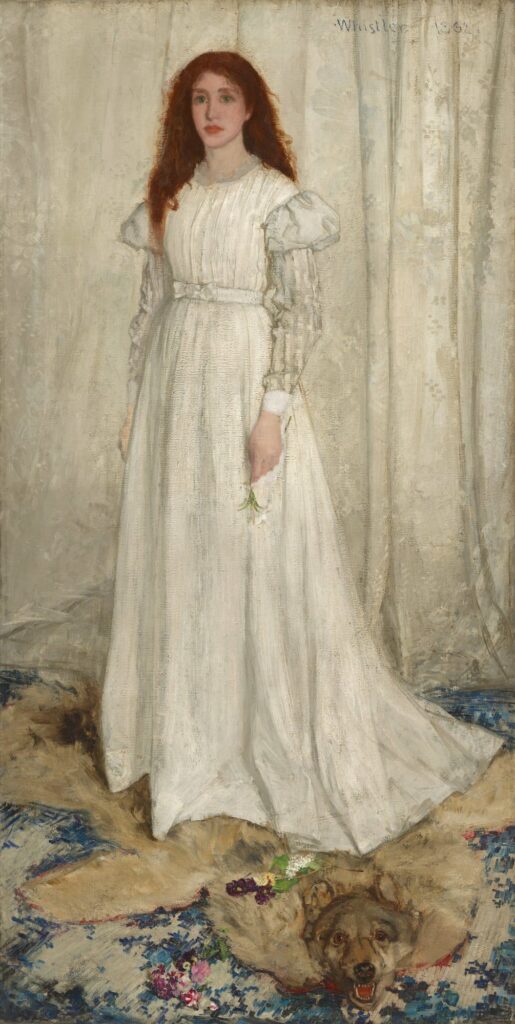
James McNeill Whistler — the American who painted like a composer →A young woman stands facing us, life-size. Her long copper hair falls loose over her shoulders. Her dress is white, the curtain behind her is white, and this almost total whiteness is broken only by a few notes: an animal pelt spread over a blue carpet, flowers dropped at her feet, a lily hanging from her hand. Her gaze does not meet ours. She does nothing, and yet we cannot look away.
The model’s name was Joanna Hiffernan. She was neither an aristocrat nor a celebrity but a young Irish woman with no social standing, Whistler’s partner and principal model. The National Gallery of Art in Washington, which owns the picture, notes that it puzzled its first viewers: a full-length portrait on this scale was then reserved for people of rank.
Rejected in London in 1862 and in Paris in 1863, the canvas finally found its place at the Salon des Refusés, where it caused a scandal alongside Manet. Today it bears the title Whistler gave it later, Symphony in White, No. 1, and the nickname that stuck: The White Girl.
A studio on the Boulevard Pigalle
It is tempting to imagine this picture painted in London, where Whistler had settled in 1859. Yet the University of Glasgow’s catalogue raisonné establishes that it was begun in Paris, late in 1861, in a studio on the Boulevard Pigalle.
Whistler worked on it all winter. Early in 1862 he made a short trip to London, where he described the project to his friend the illustrator George du Maurier: a figure “standing against a window which filters the light through a transparent white muslin curtain.” By February he was back in Paris; in April the American art agent George A. Lucas noted that he had just packed up his “femme blanche.”
It had been a hard winter. Before it was over Whistler fell ill, and a Miss Chapman blamed his condition on the white lead he was using in quantity for the picture. The Glasgow catalogue reports her account without treating it as established. Her brother, a doctor, at any rate prescribed a stay in the Pyrenees.
Jo
Joanna Hiffernan, known to her friends as Jo, shared Whistler’s life through the 1860s. She was far more than a model: the National Gallery of Art, which devoted an exhibition to her in 2022, The Woman in White, speaks of a collaborator and of a professional and personal relationship that lasted more than two decades. It was she who, in one letter, reported that the painter John Everett Millais found their picture “splendid.”
Jo also posed for Gustave Courbet, then close to Whistler. Jo, the Beautiful Irish Woman, painted by Courbet in 1865-66 and now at the Metropolitan Museum of Art in New York, shows her combing her hair before a mirror, the same copper mane spread over her shoulders. Between Paris and London, between Courbet and Whistler, this young woman about whom so little is known stands at the heart of modern painting in the 1860s.
White on white
The picture’s wager is first of all technical. Painting a white figure against a white background meant giving up contrast, the mainspring of portrait painting. Whistler replaced it with countless nuances: cool whites and warm whites, the creamy whites of the dress, the grayer whites of the curtain, bluish whites in the shadows of the folds.
The space is strangely flat. The floor seems to tilt up toward us, and the pelt lies on the carpet like a shape without depth. Smarthistory connects this tipped perspective to the Japanese prints Whistler was beginning to discover. The figure herself is almost motionless, set like a prop on a stage.
The light, for its part, is gentler than one might expect. Whistler had promised du Maurier a figure lit from the right that would make the picture “one gorgeous mass of brilliant white.” The Glasgow catalogue notes that the final lighting is nothing so dramatic: the description probably matched an earlier state of the canvas, which the painter then softened.
Everything nevertheless invites us to look for a story. What do the fallen flowers mean, the lily, the absent gaze, the white dress? The face remains unreadable, and that is exactly what Whistler wanted: an image that holds us through its beauty, not its narrative.
London, 1862: “The Woman in White”
In 1862 the Royal Academy rejected the picture, while accepting two other works by Whistler. The painter was not discouraged. In June the canvas went on view at a private gallery at 14 Berners Street, run by Matthew Somerville Morgan.
The gallery knew how to make the most of the rejection. It showed the painting as The Woman in White, and its catalogue noted, by way of advertisement, that it had been rejected at the Academy. The title echoed Wilkie Collins’s best-selling novel The Woman in White, published two years earlier, and the critic of the Athenaeum did not miss the connection.
Whistler protested in a letter to the paper: “My painting simply represents a girl dressed in white standing in front of a white curtain,” he wrote, adding that he had never read the novel. At the same time he privately relished the publicity. “It is affiched all over the Town,” he boasted to Lucas.
Paris, 1863: the Salon des Refusés
The following year Whistler tried the Paris Salon. On May 1, 1863, Fantin-Latour told him the picture had been rejected. That spring the jury turned away so many works that Emperor Napoleon III authorized an exhibition of the rejected pieces, which opened on May 15 in the Palais de l’Industrie on the Champs-Élysées. The canvas hung there as Dame blanche, not far from Manet’s entries, among them Le Déjeuner sur l’herbe.
Both painters enjoyed a succès de scandale. The critic Jules-Antoine Castagnary thought he saw in the young woman a bride on the morning after her wedding night. Courbet, according to one witness, called it “une apparition,” an apparition — much to the annoyance of Whistler, who wanted nothing spiritual or narrative in his painting.
The most important text came from Paul Mantz, in the Gazette des Beaux-Arts. He found the head clumsy and not pretty, and the blue carpet out of place, but called the picture “le morceau capital du salon des hérétiques,” the centerpiece of the heretics’ salon. Above all, he described it as a “symphonie du blanc,” a symphony of white. The phrase would go far. Baudelaire, Manet and Legros, according to Fantin, admired the canvas too.
An unlucky painting
The picture returned to Paris in 1867, for the Exposition Universelle, in the American section. Whistler complained that it hung in a cramped corridor, and Mantz, now more severe, found the head “d’une laideur insupportable,” unbearably ugly.
Around 1872 the canvas was damaged. Whistler set about repairing it, called it his “unlucky painting” in a letter to a friend, and could not finish in time for a London exhibition. X-rays have shown that he reworked the face and hands extensively at that point. The frame, painted with a wave pattern and signed with the butterfly, dates from the same period.
In the meantime Whistler had fully adopted the vocabulary of music. He painted two more Symphonies in White and renamed the first Symphony in White, No. 1, a title under which, curiously, it was never exhibited in his lifetime. In 2022 all three Symphonies were brought together for the first time in the United States, in Washington.
In front of the canvas
Three details reward a closer look. At upper right, the signature, “Whistler. 1862.,” is spelled out in full: the butterfly had not yet become his mark. On the floor, the pelt on the blue carpet is handled with a quick, almost sketchy touch that contrasts with the care lavished on the dress.
The face and hands, finally, do not quite date from the same moment as the rest. X-rays have shown that Whistler reworked them extensively in 1872, ten years after the dress. The young woman of 1862 thus wears features restored to her by a painter nearing forty, already the author of the Nocturnes.
Where to see the painting
Symphony in White, No. 1: The White Girl belongs to the National Gallery of Art in Washington, on the National Mall. It arrived in 1943 with the Harris Whittemore Collection, named for the Connecticut collector who had bought it in 1896 from the painter’s nephew.
The canvas measures 83 7/8 by 42 1/2 inches (213 × 107.9 cm). Installations change, so it is wise to check before your visit that the picture is on view in the American galleries of the West Building.
The museum offers a high-resolution image in open access on the artwork’s record.
Further Reading
Institutional Documentation
- Symphony in White, No. 1: The White Girl — National Gallery of Art — the catalogue record and a high-resolution image.
- The White Girl — The Paintings of James McNeill Whistler, University of Glasgow — the catalogue raisonné entry, with the painter’s correspondence.
- Photo Credit : National Gallery of Art, Washington
See also on Hors Cadre
- James McNeill Whistler — the American who painted like a composer — a portrait of the painter, from Lowell to Paris.
- The Peacock Room — Whistler’s peacock — nearly fifteen years later, an entire room turned into a work of art.
— M