“The Woman with the Hat” — the painting that gave rise to Fauvism
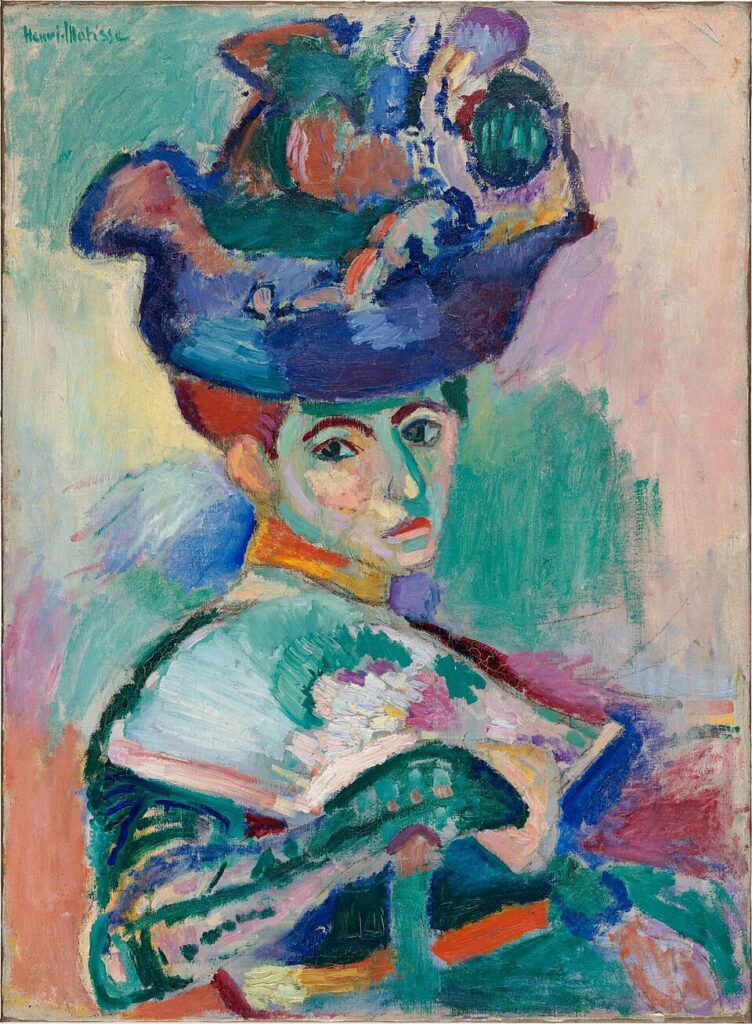
Henri Matisse — The Liberation of Color →An elegant woman, seated, dressed in the latest fashion, her torso in profile, her head turned toward us, wearing an extravagant hat. On the surface, it appears to be a classic society portrait. Except that her face is streaked with green and orange, the shadows are violet and blue, her hair is brick red, and the hat bursts into a kaleidoscope of pure colors. In 1905, faced with this painting, the Parisian public cried scandal, sneered, and even—it is said—attempted to tear it to shreds. This portrait of a bourgeois woman wearing a hat had just given birth to the first avant-garde movement of the 20th century: Fauvism.
Henri Matisse’s *Woman with a Hat* is one of the most important paintings in modern art—not because of its size (barely more than 80 centimeters tall) or the complexity of its subject (a simple portrait), but because of the breakthrough it represents. With this painting, Matisse pushes color beyond any fidelity to reality. The face is not painted to resemble skin: it is painted to express, through arbitrary colors, an energy, a presence, a vibration. In a single painting, it marks the birth of 20th-century painting.
Presented at the 1905 Salon d’Automne, in the room that brought together Matisse and his friends Derain and Vlaminck, the work was at the center of the scandal that gave the movement its name: it was upon seeing these canvases with their unrestrained colors that the critic Louis Vauxcelles referred to them as “fauves,” or wild beasts. The portrait of Amélie Matisse, the painter’s wife, thus became, unwittingly, the unintended manifesto of a revolution.
This article reveals the secrets behind this manifesto-like painting—why Matisse painted a green face, what the famous anecdote about “black” reveals, how the 1905 scandal unfolded, which American collectors saved Matisse by purchasing the work that everyone mocked, and how this portrait of a woman wearing a hat changed the course of art history.
The Painting — What It Depicts
*The Woman with the Hat* is a modestly sized oil on canvas: 80.6 centimeters high by 59.7 centimeters wide. It is a classic, almost intimate portrait format.
The subject, too, could not be more classic: a formal portrait. The subject—Amélie Parayre, the painter’s wife—is depicted seated, her torso in profile, her head turned three-quarters toward the viewer. She possesses all the hallmarks of an elegant bourgeois woman of the early 20th century: a dark dress, a gloved hand holding an object (a fan or a purse), and, above all, an imposing feathered hat—a spectacular headdress in the latest Parisian fashion. She occupies nearly the entire space of the canvas, in the tradition of high-society portraiture.
Everything about the composition, therefore, falls within the most conventional genre: a lady of high society, posing in her dressing gown, just as portrait painters used to paint by the hundreds for their wealthy clientele. If Matisse had stopped there, *Woman with a Hat* would be just another portrait, quickly forgotten.
But it is in the execution that everything changes. For this highly conventional subject is painted in a way that, in 1905, had no precedent. The formal portrait becomes a pretext for an unrestrained explosion of color. The form remains recognizable—we can clearly make out a woman, a hat, and a dress—but the color has completely broken free from reality. It is this tension between a mundane subject and a revolutionary treatment that gives the work its power.
A green face — an arbitrary color
The most shocking element for the public in 1905—and the most significant for art history—is the treatment of the face. In it, Matisse completely abandons “local” color—that is, the actual color of things—in favor of an arbitrary, expressive, and autonomous color.
Amélie’s face is not painted in the expected flesh tones. It is rendered in harmonious shades of green and orange, with a long green line running down the center of her face to represent the shadow of her nose. The contours and modeling of the face are no longer rendered with gradations of pink and brown, as in traditional portraiture, but with patches of pure, contrasting colors—green for the shadows, orange and pink for the highlights. The hair is brick red, while the hat and the background are a mosaic of blue, green, red, and yellow brushstrokes.
This use of color, unconnected to reality, is the painting’s great innovation—and the defining characteristic of Fauvism. For Matisse, color no longer has to imitate the appearance of the world: it must express, create emotion, and organize the surface of the painting. A face can be green if the overall chromatic balance of the composition requires it. The colors—vibrant and contrasting—no longer merely describe; they vibrate, they set the rhythm, and they build the composition.
His contemporaries could not understand this approach. To them, painting a face in green was either an act of provocation or a sign of incompetence: who would ever think of depicting a cheek in emerald green? But Matisse knew exactly what he was doing. He had realized that color, set free, could reveal a truth deeper than imitation—the truth of sensation, of energy, of life. Where the public saw mere daubing, there was a skillfully executed revolution. Amélie’s green face is one of the defining moments of modern art.
“Something Dark” — The Telling Anecdote
A famous anecdote sums up Matisse’s boldness in this painting better than anything else. It is said that when asked about the actual color of the dress his wife was wearing on the day he painted her, Matisse simply replied, “Black.”
Black. According to the painter himself, Amélie was posing in a black outfit—the most understated, most neutral color there is. And from that black dress, Matisse created an explosion of greens, blues, reds, and yellows. The contrast between the real model (a woman in black) and the painting (a chromatic kaleidoscope) speaks volumes about the freedom the painter allowed himself.
This response, though brief, is a true manifesto. It shows that, for Matisse, color no longer owes anything to observation. It is not a matter of reproducing what the eye sees, but of creating an autonomous pictorial reality, governed by its own laws—those of harmony, contrast, and expression. Is the dress black? It doesn’t matter. What matters is the balance of colors on the canvas, the vibration they produce together, and the emotion they evoke.
This anecdote also sheds light on the very essence of Fauvism. The Fauvists are distinguished precisely by the fact that color becomes more important than the subject. The subject—a woman, a hat, a dress—is now nothing more than a starting point, a pretext. The true subject of the painting is color itself—its energy, its freedom. “Black”: in two words, Matisse sums up the revolution he has just accomplished.
The 1905 Salon d’Automne and the Birth of Fauvism
*Woman with a Hat* was presented to the public in the fall of 1905 at the Salon d’Automne in Paris, held at the Grand Palais. There, Matisse exhibited in the same room—Room VII—alongside several young painters who shared his bold use of color: André Derain, Maurice de Vlaminck, Albert Marquet, Henri Manguin, Charles Camoin, and Kees van Dongen.
Hanging together, these paintings formed a collection of unprecedented chromatic intensity: landscapes in impossible colors, portraits in arbitrary hues, and swaths of pure color applied without any concern for realism. Amid this riot of colors stood, by contrast, a sculpture of a child—classical and demure in style—by the sculptor Albert Marque.
It was this contrast that inspired the art critic Louis Vauxcelles, writing in the magazine *Gil Blas*, to coin the phrase that has since become famous. Seeing this traditional sculpture surrounded by such wild paintings, he wrote:
“It’s Donatello among the wild beasts.”
— Louis Vauxcelles, *Gil Blas*, 1905
The word “fauves”—wild beasts—was coined. It was immediately adopted to refer to this group of painters known for their unbridled use of color, and Room VII became, in the visitors’ parlance, “the cage of wild beasts.” Thus was born Fauvism, the first avant-garde movement of the 20th century—without a theoretical program or a manifesto, simply through the coming together of a few painters determined to liberate color. Vauxcelles, a rather conservative critic who had little understanding of such boldness, had unwittingly christened one of the founding movements of modern art. Three years later, in 1908, the same Vauxcelles would similarly give his name to Cubism.
The scandal—a jar of paint thrown in the public’s face
In the “Salon des Fauves,” it was Matisse’s *Woman with a Hat* that drew the brunt of the ridicule and outrage. The painting became the symbol of the scandal.
The reactions were unusually harsh. Critics competed to come up with scornful descriptions: there was talk of a “jar of paint thrown in the public’s face,” of “shapeless doodles,” and of “haphazard splashes of garish color.” The critic Marcel Nicolle, writing in the *Journal de Rouen*, described these paintings as the barbaric and naive play of a child amusing himself with a box of paints. To the majority of the public and the press, Matisse was either a madman, a charlatan, or incompetent.
Gertrude Stein, the future writer and collector—who was nonetheless a supporter of modern art—left a striking account of the hostility the work provoked:
“Visitors would snicker as they looked at the painting, and we tried to tear it up.”
— Gertrude Stein, on *The Woman with the Hat*
So people were literally trying to damage the painting. This violence speaks to the magnitude of the aesthetic shock: in 1905, painting a green face was such a transgression that some viewers went so far as to want to destroy the work. The public felt attacked, mocked, and targeted.
Not everyone, however, was hostile. The writer André Gide, who was more open-minded, wrote in the *Gazette des Beaux-Arts* that when he heard people exclaim, “This is madness!” in front of Matisse’s works, he felt like replying that, on the contrary, it was perfectly rational. For such was the truth that the public could not see: beneath the apparent wildness lay a rigorous reflection on color, the result of extensive research. The scandal of 1905 is the classic misunderstanding of the avant-garde—radical innovation mistaken for incompetence.
In any case, the scandal had a decisive effect: it brought Matisse out of obscurity. Overnight, the former law clerk turned painter became a well-known figure, the recognized leader of a new school. As is often the case, the scandal proved to be the most effective career launch.
The Steins—The Collectors Who Saved Matisse
Amid the laughter and insults, *The Woman with the Hat* nevertheless found a buyer—and not just any buyer. Shortly after the Salon, the painting was purchased by an American family living in Paris: the Steins.
Leo Stein and his sister Gertrude Stein, joined by their brother Michael and his wife Sarah, were cultured and curious young Americans who were in the process of building one of the first major collections of modern art. Their apartment on Rue de Fleurus in Paris would soon become a legendary salon where avant-garde artists and writers—from Matisse to Picasso—would gather. The purchase of *La Femme au chapeau* in 1905 truly marked the beginning of their modern art collection.
This purchase was crucial for Matisse. Buying, at full price, the painting that all of Paris had mocked was an act of faith in a rejected artist. It provided Matisse with much-needed financial support—he was living in dire straits at the time, with a wife and children to support—and, even more importantly, recognition. The Steins became his first major patrons, purchasing other works from him and introducing him to their international circle.
The role of collectors in the birth of modern art is exemplified here. Without the visionary eye of a few art lovers—the Steins in Paris, and soon Shchukin and Morozov in Russia—Matisse and his contemporaries might not have been able to survive the hostility of their time. These collectors purchased, supported, and defended works that the public rejected, enabling the artists to continue their artistic exploration. *Woman with a Hat* owes its survival—and its posthumous fame—in part to the aesthetic courage of the Stein family.
Amélie, the Woman and the Model
Behind this manifesto-like painting is a real woman: Amélie Parayre, Matisse’s wife. She was the model for *Woman with a Hat*, just as she was for many of the painter’s other works.
Amélie Parayre had married Matisse in 1898. An energetic and devoted woman, she believed in her husband’s genius from the very beginning and supported him through the most difficult years, when painting brought in no income and the family lived in poverty. She even went so far as to open a millinery shop to provide for the household and allow Henri to paint. Her commitment was one of the conditions that allowed Matisse his creative freedom.
It is striking that it was she—his partner and his support—who posed for the most revolutionary painting of his career. The choice of such a close, intimate subject contrasts with the radical nature of the treatment. Matisse does not seek to create a lifelike or flattering portrait of his wife: he uses her face as a canvas for chromatic experimentation. Amélie, beneath her feathered hat, becomes the subject of an exploration of pure color.
This choice can be seen as an expression of trust and complicity. To dare to do something so bold—to transform his wife’s face into a mosaic of random colors—required a relationship built on deep understanding. Amélie agreed to be “disfigured” in this way in the service of art—proof that she understood, better than the Salon’s audience, what her husband was accomplishing. The formal portrait of an elegant bourgeois woman is also, implicitly, a tribute to the woman who made this revolution possible.
From Paris to San Francisco
The journey of *The Woman with the Hat*, from the Steins’ apartment to a California museum, illustrates how modern French art spread throughout the world in the 20th century.
After the Steins purchased it in 1905, the painting initially remained within the family. More specifically, it became part of the collection of Michael and Sarah Stein—Gertrude’s brother and sister-in-law—who were among Matisse’s most loyal supporters. Sarah Stein, in particular, was a passionate admirer of the painter and played an important role in promoting his work.
The Steins of this branch eventually settled in California, taking part of their collection with them. And so *Woman with a Hat* crossed the Atlantic and then the American continent, eventually arriving on the West Coast of the United States. The painting then became part of the collection of Elise S. Haas, a prominent San Francisco patron of the arts.
Today, *Woman with a Hat* is housed at the San Francisco Museum of Modern Art (SFMOMA), thanks to a bequest from Elise Haas. There, it is one of the most famous and admired works in the collection. The painting that made the Parisian public of 1905 snicker and fume has become a global icon of modern art, one of the treasures of a major American museum—the ultimate reversal of fortune for a work that its contemporaries wanted to tear to shreds.
How to View the Work Today
*The Woman with the Hat* is housed at the San Francisco Museum of Modern Art (SFMOMA) in the United States, where it is on display among the masterpieces of the modern art collection.
To see works by Matisse in Paris:
The Centre Pompidou (National Museum of Modern Art) houses France’s largest collection of works by Matisse, spanning all his periods, from Fauvism to his cut-out gouaches.
The Musée d’Orsay presents the roots of Fauvism—the Impressionists and Post-Impressionists (Cézanne, Van Gogh, Gauguin, Seurat) whose legacy Matisse drew upon before taking the liberation of color even further.
The Matisse Museum in Nice and the Matisse Departmental Museum in Le Cateau-Cambrésis (his hometown) offer the most comprehensive overviews of his work in France.
To place *The Woman with the Hat* in context, one might also look at other Fauvist works from 1905—the Collioure landscapes by Matisse and Derain, and the paintings by Vlaminck—scattered throughout major museums of modern art (the Centre Pompidou, MoMA, Tate Modern, and numerous international collections).
Further Reading
Institutional sources cited
- San Francisco Museum of Modern Art (SFMOMA), entry for *Woman with a Hat*.
- Centre Pompidou, Henri Matisse exhibition.
- Encyclopædia Universalis, articles “Henri Matisse” and “Fauvism.”
Sources and Testimonials Cited
- Gertrude Stein, *The Autobiography of Alice Toklas* (account of the 1905 Salon).
- Louis Vauxcelles, review of the Salon d’Automne, Gil Blas, 1905.
- André Gide, *Gazette des Beaux-Arts*, December 1905.
Leading Modern Studies
- Hilary Spurling, *Matisse* (a two-volume biography), 1998–2005.
- Jack Flam, *Matisse: The Man and His Art*, Cornell University Press, 1986.
- John Elderfield, *Fauvism*, catalog, MoMA, 1976.
Institutional Documentation
- San Francisco Museum of Modern Art (SFMOMA) — the institution that houses the work.
- Centre Pompidou, Paris — French collection of Matisse works.
See also on Hors Cadre
- Henri Matisse—The Liberation of Color —A Portrait of the Artist, His Life, and His Quest for Liberated Color.
- “The Dance”—Matisse’s “Primitive Round Dance “—the 1910 masterpiece in which Matisse pushes color and form to their limits.
- Vincent van Gogh — color as a cry — the expressive use of color that paved the way for Fauvism.
— M