Dance — Matisse’s Primitive Round Dance
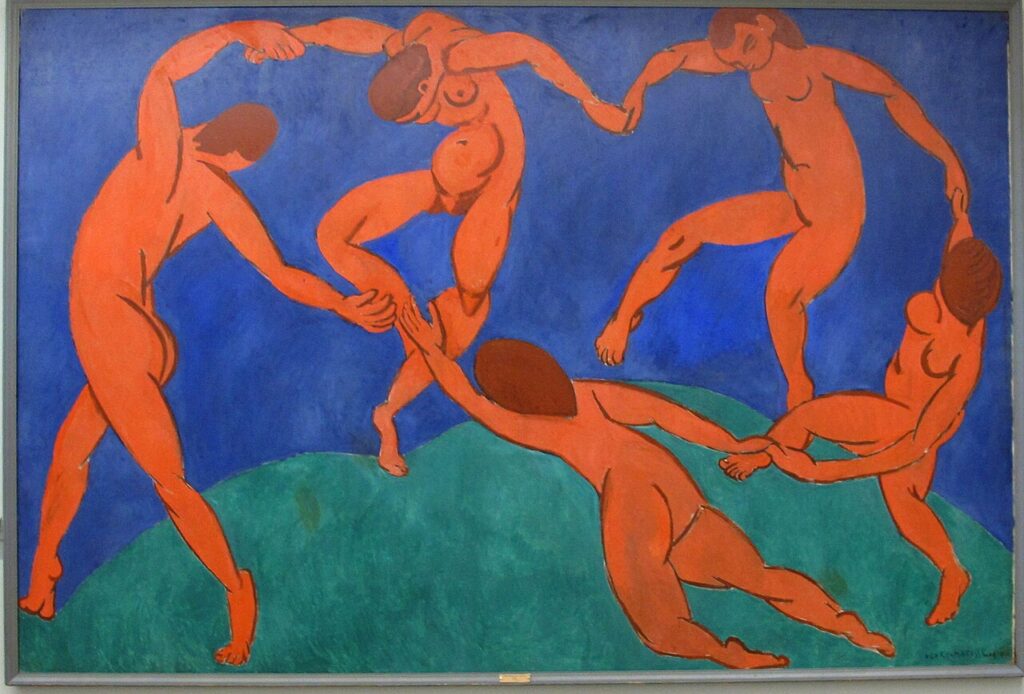
Henri Matisse — The Liberation of Color →Five naked bodies, painted in brick red, hold hands and spin in a frenzied circle. Beneath their feet, a green hill; above, a deep blue sky. Nothing else. No setting, no details, no story. Just three colors, five figures reduced to large arabesques, and all the dizzying energy of movement captured in the utmost simplicity. This is Henri Matisse’s *La Danse* —one of the most famous images of 20th-century art, and one of its defining moments.
Painted in 1910 for a Russian collector, this monumental canvas—nearly four meters wide—is, according to the consensus among art historians, a defining moment in Matisse’s career and in the development of modern painting. With this work, Matisse pushes to its limits the dual revolution he had begun five years earlier with Fauvism: the liberation of color and the radical simplification of form.
For *La Danse* is a work of almost inconceivable audacity for its time. In 1910, painting red bodies dancing against a blue and green background, with no regard for realism whatsoever, and reducing the entire composition to a few curved lines and three blocks of pure color, was nothing short of provocative. The audience at the Salon d’Automne, where the work was exhibited, cried scandal. But this painting, deemed barbaric, is in fact one of the most skillfully constructed of its time.
This article reveals the secrets of *La Danse* —the extraordinary commission by Moscow collector Sergei Shchukin— the significance of this round dance inspired by a Catalan farandole, the role of the three colors and the five figures, the existence of two distinct versions, the scandal of 1910, and how this pivotal work helped shape 20th-century art.
A commission for a Moscow palace
The Dance was not born of free inspiration, but of a commission—one of the most visionary in the history of modern patronage. The patron was Sergei Shchukin (1854–1936), a fabulously wealthy Moscow textile merchant and one of the greatest art collectors of his time.
Shchukin had discovered the French avant-garde during his stays in Paris, and he had built up an extraordinary collection of modern works—Monet, Gauguin, Cézanne, and above all Matisse and Picasso, whom he bought at a time when almost no one understood them. His Moscow collection, open to visitors, was one of the first places in the world where one could see the most innovative French paintings brought together in one place. Without Shchukin and his colleague Ivan Morozov, a significant portion of modern art might never have found buyers during its most difficult years.
Deeply moved by Matisse’s *Le Bonheur de vivre*, Shchukin commissioned the painter on March 31, 1909, to create two large decorative panels intended to adorn the stairwell of his Moscow mansion, the Trubetskoy Palace. The first would be *La Danse* (paid for at 15,000 francs), and the second *La Musique*. The two paintings, conceived as a pair, were intended to accompany visitors as they ascended the staircase: first *La Danse*, representing energy and movement, then *La Musique*, representing contemplation and harmony.
Matisse designed these panels according to a precise staircase-like logic. *La Danse*, placed on the first floor, was meant to evoke momentum, rhythm, and a surge of energy; *La Musique*, on the second floor, was meant to evoke calm and contemplation. Together, they formed a comprehensive decorative program, a symbolic ascent toward harmony—exactly the ideal of balance and serenity that Matisse placed at the heart of his art. The works were delivered to Moscow in late 1910, following their exhibition in Paris.
The Painting — What It Depicts
*La Danse* is an oil on canvas of monumental dimensions: 260 centimeters high by 391 centimeters wide, or more than ten square meters. It is a mural-sized work, designed to be viewed from a distance, as seen from a staircase.
The composition is radically simple. Five nude female figures are holding hands and forming a circle on the top of a hill. The framing is tight: the dancers occupy almost the entire space of the canvas, sometimes spilling out of the frame, which accentuates the impression of movement and contained energy. No scenery, no props, and no narrative elements distract the viewer’s gaze. Only the bodies, the earth, and the sky.
The five dancers are engaged in a circular farandole. On the left, a taller figure leads the circle, his body leaning forward. At the bottom, in the foreground, two dancers watch as their hands slip apart—a crucial detail: at this precise moment, the chain of hands breaks, creating tension, a breaking point that energizes the entire composition and gives the dance its frenetic, almost unstable character. The viewer’s eye is drawn to this gap between the two hands that do not quite meet.
The bodies are rendered as broad, flowing arabesques, devoid of anatomical detail and reduced to their essential lines. Matisse outlines each figure with a contour that sets the red silhouette against the background. The forms are simplified to the point of abstraction, yet remain perfectly recognizable: we instantly recognize bodies in motion, outstretched arms, and leaping legs. This is the essence of Matisse’s art: achieving maximum expression with minimal means.
Three colors, five sizes
The most striking aspect of *La Danse* is its use of a limited color palette. The entire work is based on just three colors, applied as pure, flat areas.
Blue fills the upper part of the canvas: it is the sky, but a sky without nuance, without clouds, without shading—a deep, dense, almost nocturnal blue. Green fills the lower part: it is the hill, the earth, also rendered as a uniform solid color. And against these two backgrounds, the five figures stand out in brick-red, a warm, earthy hue that obviously has nothing to do with the actual color of human skin.
This choice of three colors is not a limitation; it is a concentration. By limiting his palette, Matisse compels each color to convey the maximum expressive power. The contrast between the warm red of the bodies and the cool blue-green of the background creates an intense visual vibration—an energy that seems to emanate from the dancers themselves. Color does not merely describe the world; it directly creates the emotion, the rhythm, and the warmth of the dance.
This is the culmination of the liberation of color that began with Fauvism. Here, color is completely freed from its descriptive function. No one has red skin; no sky is that shade of blue. But the harmony of the three colors produces a truth superior to that of imitation: the truth of vital energy, of momentum, of the communion of bodies in motion.
This reduction to the essentials also gives the work a universal, almost primitive dimension. The simplified figures, the circle dance motif, and the bare landscape are reminiscent of the art of ancient civilizations or early cultures, which fascinated artists in the early 20th century. *La Danse* evokes a primal state of humanity, a communion between man and nature, freed from the artifice of modern civilization. The dancers’ nudity contributes to this return to a primal innocence.
From Collioure to *The Joy of Living* — The Origins of the Ronde
The motif of the circle did not appear by chance in Matisse’s work. It has a specific origin, both biographical and artistic.
The direct inspiration came from a real-life scene. During his stays in Collioure, a small port on the Catalan coast where he had painted his first Fauvist works in 1905, Matisse had witnessed fishermen’s dances—notably the sardana, a traditional Catalan farandole in which the dancers hold hands in a circle. This joyful, communal folk dance had left a lasting impression on him. In *La Danse*, we see echoes of those linked bodies spinning to the rhythm of the music.
But the motif had already found its way into his work a few years earlier. In 1906, Matisse painted *Le Bonheur de vivre* (now in the Barnes Foundation), a vast Arcadian composition that caused a scandal at the Salon des Indépendants. This painting depicts a paradisiacal landscape populated by languid figures, lovers, and musicians—and, in the center, in the distance, a small circle of dancers. It is this farandole—initially a secondary element in *The Joy of Living*—that Matisse would isolate, enlarge, and bring to the foreground to make it the sole subject of *The Dance*.
This passage reveals Matisse’s method: he isolates a motif, concentrates it, and simplifies it until it becomes a self-contained work with tenfold the power. The small, distant circle in *The Joy of Living*—just one detail among many in a rich composition—becomes the beating heart of a monumental painting in which nothing else remains. This is precisely the essence of Matisse’s entire artistic approach: moving toward the essential, stripping away to intensify.
The theme of dance and the circle would remain one of the recurring motifs throughout his entire body of work. Matisse returned to this theme in the 1930s with the large murals of *La Danse*, commissioned by the American collector Albert Barnes for his foundation in Pennsylvania—a monumental and distinctive work in which he further developed the motif on an entirely different scale.
The two versions—1909 and 1910
There are actually two main versions of *La Danse*, which are often confused and must be distinguished from one another.
The first version, titled *La Danse I*, was painted in 1909. Matisse conceived it as a study, an initial response to Shchukin’s commission. It is rendered in light, soft, almost pastel colors—pale pinks for the bodies, light tones for the background. Matisse viewed it as an exploration of luminosity, but it did not fully satisfy him: it seemed too timid, not intense enough. This first version is now in the collection of the Museum of Modern Art (MoMA) in New York.
The second version, *La Danse II* —the one most often referred to simply as *La Danse* —was painted in 1910. This is the final version, the one that would be delivered to Shchukin. In this version, Matisse abandons light tones in favor of vivid, saturated, intense colors: the brick-red of the bodies, the deep blue of the sky, and the rich green of the hill. The contours are more defined, the bodies more powerful, and the movement more energetic. Everything that was sketched out in the first version is brought here to a fever pitch. It is this version that is housed at the Hermitage Museum in Saint Petersburg.
Comparing the two versions is instructive. It shows how Matisse worked: not by accumulating details, but by intensifying them. From one version to the next, he does not complicate the composition—he simplifies it further while reinforcing the power of the colors and lines. The shift from pale pink to brick red, from light blue to deep blue, transforms a graceful scene into a primitive and powerful vision. It is in this contrast that the full extent of Matisse’s boldness in 1910 is revealed.
The 1910 Salon d’Automne Scandal
Before being shipped to Moscow, *La Danse II* was presented to the Parisian public at the 1910 Salon d’Automne, alongside *La Musique*. The reaction was intense.
Five years after the Fauvist scandal of 1905, Matisse once again provoked outrage. Visitors and critics were shocked by the figures’ explicit nudity, by the colors deemed garish, and by the apparent simplicity of the treatment—many saw in it clumsiness, laziness, or even gratuitous provocation. How could a painter dare to present as a finished work what, in the eyes of the 1910 public, resembled a crude sketch? There was talk of regression, a return to the art of the “savages,” and a complete abandonment of craftsmanship.
This rejection was not without consequences for Matisse. The scandal even shook his patron: Shchukin, initially alarmed by the boldness of the paintings and by the reactions in Paris, hesitated for a moment to accept them—particularly because of the nudity, which he feared he would have to display on his staircase in front of his visitors and young daughters. He eventually confirmed the commission, however, and welcomed the two panels to Moscow, where they would remain until the Revolution.
In hindsight, this scandal appears to be a classic avant-garde misunderstanding: what the public in 1910 took for clumsiness was in fact extreme mastery, a skillfully constructed simplification. What appeared to be a crude drawing was in fact the culmination of decades of research into line, color, and form. *La Danse*, deemed barbaric in its day, is now recognized as one of the most rigorous and influential compositions in all of modern art.
Dance and Music — A Dialogue
“Dance” can only be fully understood in relation to its counterpart, “Music,” which was conceived and painted at the same time for the same staircase in Moscow. The two works form a diptych, a dialogue.
*La Musique*, which is almost the same size (260 × 389 cm), follows the same principles: three colors (blue, green, brick-red), simplified nude figures, and a minimalist background. But whereas *La Danse* is movement, energy, and circular momentum, *La Musique* is stillness, contemplation, and concentration. The figures do not dance here: they are seated or standing, isolated from one another, playing an instrument or singing. The violinist and the singers are frozen in silent concentration.
The contrast between the two panels is deliberate. Matisse juxtaposes dynamism and stillness, the collective and the individual, noise and silence. Following the logic of Shchukin’s staircase, visitors first ascended toward *La Danse* —energy, celebration, the movement of intertwined bodies—and then toward *La Musique* —calm, introspection, contemplation. A symbolic ascent from the body to the spirit, from agitation to serenity.
This connection between dance and music is essential, because music creates the rhythm that animates the dance. The two works complement each other like two sides of the same experience: the fulfillment of the human being through immersion in creation, in art, and in communion with others and with nature. This is one of Matisse’s major themes: the art of fulfillment and harmony.
A seminal work of modern art
Beyond its inherent beauty, *La Danse* occupies a pivotal place in the history of 20th-century art. It is one of the works that ushered painting into the modern era.
Its radical nature stems from several simultaneous breaks with convention. First, the extreme simplification of form: by reducing figures to pure arabesques, Matisse approaches the boundaries of abstraction without ever quite crossing them. Second, the autonomy of color: the three pure blocks of color do not imitate anything; they exist for their own sake and for their effect. Finally, the affirmation of the painting as an organized decorative surface, rather than as a window onto reality. *La Danse* does not depict an illusionistic space: it organizes a flat surface through the interplay of lines and colors.
These principles foreshadow much of the art to come. The liberation of color paves the way for Expressionism and color abstraction. The simplification of forms inspires generations of artists in search of the essential. And the rhythm of the curved lines, along with the unapologetically decorative style, foreshadow the major compositions of Matisse’s later years—the cut-out gouaches, in which he would take this quest for a pure form, sharply cut out against the color, even further.
“The Dance ” is thus a transitional point: between the Fauvism of 1905 and the decorative and abstract art of the 20th century, between representational painting and constructive painting. Five bodies, three colors, a circle: in this disarmingly simple image, Matisse has distilled a large part of the modern revolution.
From the Shchukin Palace to the Hermitage
The story of the final version of *La Danse*, from the Moscow Palace to the Hermitage Museum, mirrors the upheavals of 20th-century Russian history.
From 1910 to 1918, the work adorned the staircase of Sergei Shchukin’s mansion in Moscow, alongside *Music*, as part of the decorative scheme envisioned by the collector. The Shchukin Collection, open to visitors, became a key hub for the dissemination of French modern art in Russia—it was there that young Russian avant-garde artists discovered Matisse, Picasso, Gauguin, and Cézanne.
The 1917 Revolution changed everything. In 1918, Shchukin’s collection was nationalized by the Bolshevik regime. Ruined, the collector went into exile in Paris, where he died in 1936 without ever seeing his paintings again. His collection became the property of the Soviet state. For decades, these avant-garde works—deemed “bourgeois” and “decadent” by the Stalinist regime—were partially withheld from the public.
After a series of reorganizations, the Shchukin and Morozov collections are now divided between two major museums: the Pushkin Museum in Moscow and the Hermitage Museum in Saint Petersburg. *Dance* and *Music* are now housed at the Hermitage, where they rank among the most admired works in the modern art collection. The fate of this painting—commissioned by a Russian, painted by a Frenchman, scandalous in Paris, exiled to Moscow, and saved from the purges—sums up the adventure of modern art in the 20th century.
How to View the Work Today
*The Dance* (1910 version) is housed at the Hermitage Museum in Saint Petersburg (Russia), where it is on display alongside its counterpart, *Music*, in the galleries dedicated to French modern art from the Shchukin and Morozov collections.
The first version, *La Danse I* (1909), which features lighter colors, is housed at the Museum of Modern Art (MoMA) in New York, where it can be compared to the final version.
To see works by Matisse in Paris:
The Centre Pompidou (National Museum of Modern Art) houses the largest collection of Matisse’s works in France, covering all periods of his career.
The Museum of Modern Art in Paris houses a large mural version of *La Danse* (known as *La Danse de Paris* or *La Danse inachevée*, 1931–1933), created during the period of the Barnes commission—a monumental testament to Matisse’s return to the theme of the round dance, a must-see for anyone interested in this motif.
Matisse’s other major masterpieces are housed at the MoMA and the Barnes Foundation (United States), the Tate Modern (London), the Matisse Museum in Nice, and the Musée du Cateau-Cambrésis.
Further Reading
Institutional sources cited
- The Hermitage Museum, Saint Petersburg, entries on “Dance ” and “Music.”
- Panorama de l’art (RMN), a review of *La Danse*.
- Encyclopædia Universalis, article “Henri Matisse.”
Sources and Studies Cited
- Documentation on the Shchukin Collection (1913 catalog, Hermitage and Pushkin inventories).
- Exhibition catalog : Icons of Modern Art: The Shchukin Collection, Louis Vuitton Foundation, Paris, 2016–2017.
Leading Modern Studies
- Hilary Spurling, *Matisse* (a two-volume biography), 1998–2005.
- Pierre Schneider, *Matisse*, Flammarion, Paris, 1984.
- Jack Flam, *Matisse: The Man and His Art*, Cornell University Press, 1986.
Institutional Documentation
- The Hermitage Museum, Saint Petersburg — houses the final version from 1910.
- Centre Pompidou, Paris — French collection of Matisse works.
See also on Hors Cadre
- Henri Matisse—The Liberation of Color —A Portrait of the Artist, His Life, and His Quest for Liberated Color.
- Paul Gauguin — color set free — the solid swaths of color and the farandole that set the stage for the round dance motif.
- Musée d’Orsay — what to see, hours, tickets — for Matisse’s Impressionist and Post-Impressionist influences.
— M