Musée d’Orsay — What to See, Hours, Tickets
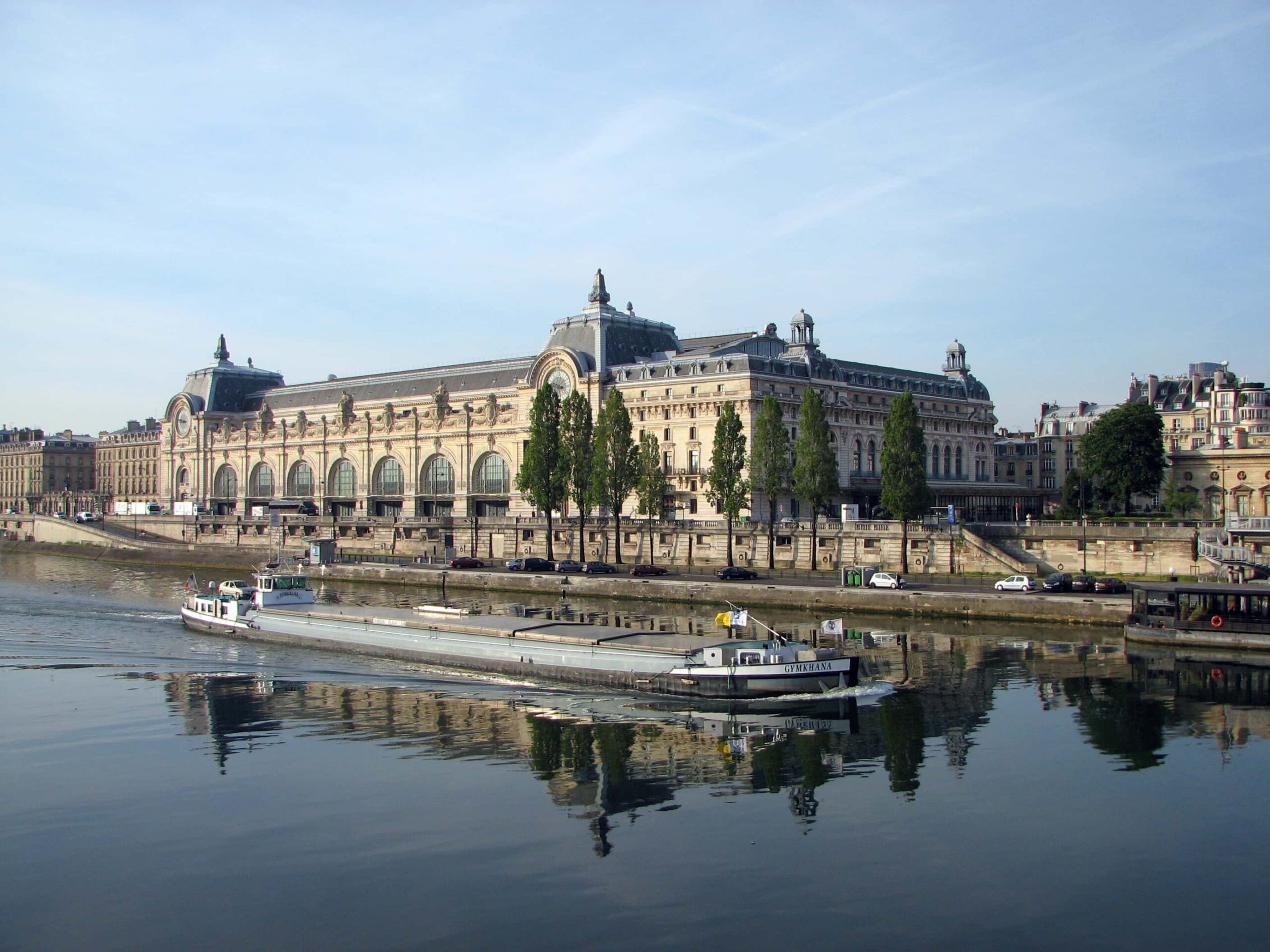
Located on the left bank of the Seine, across from the Tuileries Garden, in a monumental former railway station built forthe 1900 World’s Fair, the Musée d’Orsay houses the world’s largest collection of Impressionist and Post-Impressionist paintings. Opened to the public on December 9, 1986, it features nearly 4,000 works on permanent display—paintings, sculptures, photographs, graphic arts, and decorative arts—covering the period from 1848 to 1914.
This is where visitors come to see, gathered in one place, the absolute masterpieces of Manet, Monet, Renoir, Degas, Cézanne, Van Gogh, Gauguin, Pissarro, Morisot, Sisley, Caillebotte, Toulouse-Lautrec, Seurat, Millet, Courbet, Whistler —and dozens of other major figures in 19th- and early 20th-century art. A collection unmatched anywhere in the world, showcasing this pivotal period in Western painting.
The building itself is an architectural masterpiece. Designed by architect Victor Laloux for the Orsay train station (the terminus of the Paris-Orléans line), it was threatened with demolition after the station closed in 1939, saved at the last minute in the 1970s, and then transformed into a museum by the Italian architects Gae Aulenti, ACT Architecture, and the set designer Italo Rota. The 138-meter-long central nave, the large transparent clock on the 5th floor, and the terraces overlooking the Seine: all of these elements make the Musée d’Orsay as much an architectural experience as it is a pictorial one.
The Musée d’Orsay at a Glance
| Address | Esplanade Valéry Giscard d’Estaing, 75007 Paris |
| Subway | Solferino (Line 12) or RER C (Musée d’Orsay) |
| Hours | Tue–Sun 9:30 a.m.–6:00 p.m., late night on Thursdays until 9:45 p.m., closed Mondays |
| Rates | €16 online / €14 at the door |
| Official Website | musee-orsay.fr |
Must-See Works
The museum is organized across five levels around the large central nave. The chronological tour begins on the ground floor (Realism, Academic painting, early Impressionism) and continues on the 5th floor (Impressionism and Post-Impressionism—the most-visited gallery). Here are the key works, movement by movement.
1. *Luncheon on the Grass* — Édouard Manet (1863)
On the ground floor, the Manet Room. A scandalous painting from the 1863 Salon des Refusés, the symbolic starting point of modern painting. A nude woman is having lunch in the woods with two men in contemporary attire—a composition that shocked critics and the public alike, and marked the definitive break with academic painting. Imposing dimensions (208 × 264 cm), Victorine Meurent’s direct gaze, a flat palette without chiaroscuro. Learn more about “Luncheon on the Grass” by following this link.
2. Olympia — Édouard Manet (1863)
The Manet Gallery as well. Manet’s second scandal, exhibited at the Official Salon of 1865. A nude Parisian prostitute gazes at the viewer, accompanied by her Black maid, Laure, and her black cat. An outright provocation against the conventions of the mythological nude. The work was purchased from Manet’s widow in 1890 thanks to a fundraising campaign launched by Monet among his artist friends (19,415 francs raised). Discover *Olympia* by following this link.
3. Poppies — Claude Monet (1873)
5th floor, Impressionist Gallery. Field of Poppies in the Argenteuil Plain. Madame Monet and their son Jean. An iconic work of Impressionism, completed in just a few hours outdoors. A loose brushstroke, light captured in the moment, an ordinary subject elevated to a pictorial motif. It is this type of work that defines the movement.
4. Dance at the Moulin de la Galette — Pierre-Auguste Renoir (1876)
5th floor. An absolute masterpiece by Renoir and one of the most famous Impressionist paintings. A scene of a popular dance in Montmartre on a Sunday afternoon. Dappled light filtering through the trees, a joyful crowd, vibrant colors. Monumental size (131 × 175 cm). In this painting, Renoir proves that modern life can be depicted with the same ambition as that of the great masters of the past.
5. *The Cradle* — Berthe Morisot (1872)
5th floor, Morisot Room. The first major Impressionist work with a maternal theme, presented at the first Impressionist exhibition in April 1874 at Nadar’s studio. Edma Morisot, Berthe’s sister, watches over her sleeping daughter Blanche. Intimate format (56 × 46 cm). A seminal work: all modern maternal painting (Cassatt, Renoir, Vuillard) traces its roots to it. Discover Berthe Morisot’s birthplace by following this link.
6. The Fourteen-Year-Old Dancer — Edgar Degas (1880–1881)
5th floor, Degas Room. A 98-cm bronze sculpture, a copy of an original wax statue (presented in 1881 at the 6th Impressionist Exhibition) dressed in a real tulle tutu and wearing real ballet slippers. Degas’s most revolutionary work, which scandalized critics in 1881 with its mix of materials and raw realism. Model: Marie van Goethem, a student at the Paris Opera.
7. *Starry Night* — Vincent van Gogh (1888)
5th floor, Van Gogh Gallery. View of the Rhône in Arles under a sky studded with swirling stars. Painted in September 1888 during his Arles period—one of Van Gogh’s most creative. Note: Do not confuse this with the famous *Starry Night* (1889, MoMA, New York), painted later from the window of the asylum in Saint-Rémy-de-Provence. The painting at the Musée d’Orsay isthe original in the series.
8. The Card Players — Paul Cézanne (1890–1895)
5th floor, Cézanne Gallery. Two peasants in silhouette, seated at a table, playing cards. There are five versions in total (Orsay, Metropolitan Museum of Art in New York, Courtauld, London; Barnes, Philadelphia; and the Royal Collection, Qatar—the latter sold for $250 million in 2011, an all-time record for an art sale at the time). The Orsay version is one of two featuring two figures.
9. The Origin of the World — Gustave Courbet (1866)
Courbet Room, ground floor. The most radical female nude of the 19th century. Commissioned in 1866 by the Ottoman diplomat Khalil Bey, kept hidden for a century, and exhibited publicly for the first time at the Musée d’Orsay in 1995. Uncompromising realism, an intimate scale, and the subject’s direct gaze. A seminal work of modern nude painting.
10. The Large Clock and the Central Nave
More than just a work of art— it’s a place. The grand nave, 138 meters long and a remnant of the original 1900 train station, features monumental 19th-century sculptures (Carpeaux, Rodin, Bourdelle, Maillol). On the 5th floor, behind the large transparent clock, a panoramic view of the Seine, the Louvre, and Montmartre— one of the most beautiful views in Paris. A must-see for photos.
How to Visit the Museum
Recommended duration: Allow 2.5 to 3 hours to tour the permanent collections, especially the Impressionist gallery on the 5th floor. If a temporary exhibition is on view, add 1 to 1.5 hours. For enthusiasts, a full half-day (4 hours) is necessary to see everything in depth.
Best time to visit: The Musée d’Orsay is one of the most visited museums in Europe (4 million visitors per year). To avoid the crowds:
- Tuesday morning right when it opens (9:30 a.m.): the least crowded time slot of the week
- Thursday evening late-night hours (until 9:45 p.m.): a subdued atmosphere, sparse crowds
- Definitely avoid: summer weekends, rainy days, and the first Sunday of the month (free admission, so it’s crowded)
Hours:
- Tuesday through Sunday: 9:30 a.m. – 6:00 p.m.
- Thursday Evening Hours: 9:30 a.m. – 9:45 p.m. (last admission at 9:00 p.m.)
- Closed: Mondays, May 1, December 25
- Last admission: 1 hour before closing
- Exit the galleries: 30 minutes before closing time
2026 Rates:
- Full price: €16 (online) / €14 (at the door)
- Reduced rate: €11 (for EU students aged 18–25 and job seekers)
- Evening rate (Thursdays starting at 6 p.m.): 10 €
- Free: under 18, EU residents under 26, the first Sunday of the month (reservation required), recipients of basic social assistance, journalists
- “Children & Friends ” Rate: €5 for adults accompanying a child under 18 (limit of 2 adults per child)
Reservations: Strongly recommended online at musee-orsay.fr — time slots are required for both paid tickets and free admission on the first Sunday of the month. The wait in line at the museum can be up to 1 hour and 30 minutes during peak season.
Audio guide: available in 10 languages, for an additional fee of approximately €5. The Orsay app is also available (iOS and Android), with free audio tours that can be downloaded before your visit.
Guided tours: The museum offers several options—an introductory tour (1.5 hours, €8 + admission), themed tours (Impressionists, sculpture, Art Nouveau), sign language tours, and family workshops. See the official website for the schedule.
Accessibility for people with disabilities: The museum is fully accessible (elevators, ramps, wheelchairs available for loan at the reception desk, adapted guided tours). Free admission for people with disabilities and their companions.
Food service:
- Café de l’Horloge (2nd floor) — view of the big clock, quick meals
- Café Campana (5th floor) — designed by the Campana brothers, Art Nouveau ambiance
- Museum Restaurant (1st floor) — a fine-dining restaurant beneath the painted ceilings of the former train station building. Reservations recommended
Photography: permitted in the permanent collections (no flash, no tripods). Prohibited in most temporary exhibitions (as indicated on the exhibit labels).
Current Exhibitions
The Musée d’Orsay schedules three to five major temporary exhibitions each year, generally devoted to a painter or a theme from the period 1848–1914. At the time of this writing (May 2026), three exhibitions are on view:
- Renoir and Love: The Joy of Modernity (1865–1885) — March 17 through July 19, 2026. A major retrospective on Renoir’s joyful Parisian period. Time-stamped reservations required. Includes *The Dance at the Moulin de la Galette* (on permanent display) and more than 100 works from around the world.
- Renoir the Draftsman — March 17 through July 5, 2026. The first exhibition entirely devoted to Renoir’s drawings, sketches, studies, and watercolors. About 100 works on paper.
- Youssef Nabil. Dreaming Again — May 19 through September 13, 2026.Contemporary art exhibition featuring photographic dialogues between Egyptian artist Youssef Nabil and the museum’s collections.
Upcoming events: Check the official website, musee-orsay.fr, regularly—the 2026–2027 program is announced on a quarterly basis.
Around the Museum
The Musée d’Orsay is located in the neighborhood with the highest concentration of artistic heritage in Paris. Don’t miss these attractions within a 15-minute walk:
- Musée de l’Orangerie (5-minute walk through the Tuileries) — Monet’s *Water Lilies* in the two oval rooms designed by the artist, and the Walter-Guillaume Collection (Renoir, Cézanne, Modigliani, Soutine)
- Tuileries Garden (3 min) — a royal promenade between the Place de la Concorde and the Louvre, featuring sculptures by Rodin and Maillol
- Louvre Museum (a 10-minute walk via the Léopold-Sédar-Senghor footbridge) — to complete the chronology: Antiquity and Western painting up to 1848 at the Louvre, then 1848–1914 at the Musée d’Orsay
- Rodin Museum (15 min) — the Hôtel Biron, the sculptor’s studio and collection, rose garden, and monumental sculptures (The Thinker, The Gates of Hell)
- Left Bank of the Seine (on site) — walk along the river, view of the Louvre, cultural barges
- Saint-Germain-des-Prés Church (10 min) — the oldest abbey in Paris, a historic literary district
You can spend an entire day exploring “modern art”: the Orsay Museum in the morning, lunch at Café Campana, the Orangerie in the early afternoon, and a stroll through the Tuileries to the Louvre at the end of the day. Three museums, one day, two centuries of Western painting covered.
— M