The Venus of Urbino — Titian
Titian — the Prince of Painters →A young naked woman, reclining on a bed in a Venetian palace, holds the viewer’s gaze with quiet assurance: Titian’s Venus of Urbino is the most famous nude of the Renaissance and one of the most discussed images in the whole history of art. Through its assumed sensuality, its direct gaze and its composition, it defined a model — that of the reclining female nude — which would run through the centuries, all the way to Manet’s Olympia, three hundred years later.
Painted in 1538, when Titian was around fifty and at the height of his art, this work was commissioned by a young Italian nobleman, the future Duke of Urbino, to whom it owes its name. Taking up a model invented by his master Giorgione, Titian transformed it radically, making the nude pass from the ideal distance of myth to the troubling intimacy of an encounter. Now held in the Uffizi Gallery in Florence, the work continues to fascinate by its beauty, its sensuality and the questions it raises.
This article offers an analysis of this major work: its description, its source in Giorgione’s Venus, the debates over its identity and meaning, its sensuality and its gaze, and its considerable legacy up to modern art.
The work — a reclining Venus
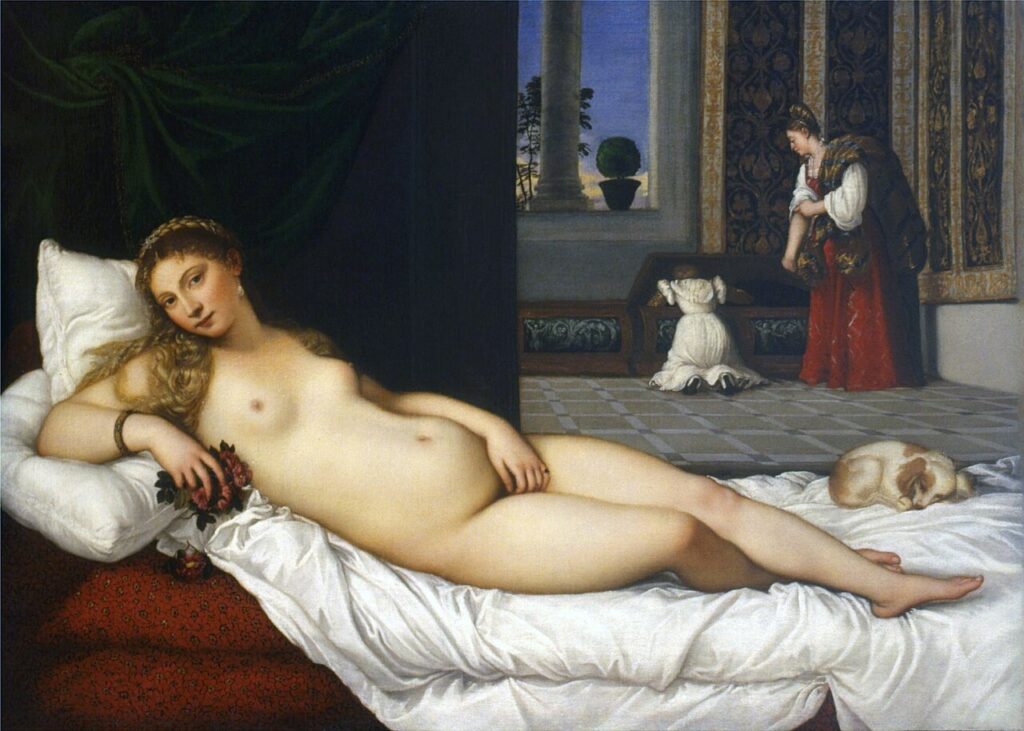
The Venus of Urbino depicts a reclining naked woman, in a composition of apparent simplicity but great richness of detail. Every element deserves attention, for all contribute to the meaning and power of the work.
The main figure is a young naked woman, stretched out on a bed or divan with white sheets, in a luxurious interior. She is slightly raised, leaning on her right arm, her head resting on a cushion, her long loose hair falling over her shoulder. In her right hand she holds a small bunch of roses — a traditional attribute of Venus, goddess of love. Her left hand rests on her pubis, in a gesture at once modest and suggestive, which both hides and emphasises. But what strikes one most is her gaze: her eyes wide open, she looks directly at the viewer, with a calm and conscious assurance, establishing a troubling and immediate contact.
The setting places the scene in a contemporary palatial interior, that of a rich Venetian Renaissance home. At the woman’s feet, a small dog — a spaniel — sleeps, curled up on the bed. In the background, the space opens onto a neighbouring room, where two servants busy themselves around a large chest, a cassone, from which they take out garments. On a windowsill one makes out a pot containing a shrub, probably a myrtle, another plant associated with Venus. A large dark green curtain, hung vertically, divides the space and underlines, by its line, the figure of the woman.
This composition, in which the nude occupies the foreground while the background opens onto a domestic scene, creates a remarkable contrast and depth. It roots the figure in a concrete, real setting, that of the everyday life of a patrician house, far from any idealised mythological landscape. This way of placing a naked woman in a contemporary interior, under the direct gaze of the viewer, was of considerable daring and novelty. Titian deploys here all his art of colorito: the sensual naturalism of the flesh, the richness of the fabrics, the subtle play of light on skin and drapery, in a harmony of warm and vibrant colours.
From Giorgione’s Venus
The Venus of Urbino does not arise from nowhere: it belongs to a tradition and takes up a precise model, that invented by Giorgione, Titian’s master and friend of his youth. Understanding this filiation illuminates the originality of the work.
The starting model is the Sleeping Venus, also called the Dresden Venus, painted by Giorgione around 1508-1510. This work, one of the first great depictions of the reclining female nude of the Renaissance, shows Venus asleep, stretched out in an idealised pastoral landscape, her eyes closed, in an attitude of peaceful and innocent abandon. Titian knew this work intimately: after Giorgione’s early death in 1510, it was he who is said to have completed it, painting notably the landscape. He thus had a direct and profound knowledge of it.
Nearly thirty years later, Titian took up this model of the reclining nude, but to transform it radically. Where Giorgione’s Venus sleeps, innocent, in an idealised nature, Titian’s is wide awake. She opens her eyes, and above all, she looks at the viewer, establishing a direct contact with him. Titian also transports her from a mythological landscape into a contemporary domestic interior, a real palace chamber, peopled with servants and everyday objects. This double change — the open eyes and the direct gaze, the shift from the ideal landscape to the real interior — entirely transforms the meaning of the image.
This passage from mythological distance to the intimacy of the encounter was revolutionary. Giorgione’s Venus belonged to the world of dream and myth; one contemplated her as a distant goddess, asleep, out of reach. Titian’s, awake, looking at us, set in a recognisable setting, enters our world; she is no longer an ideal vision but a concrete and troubling presence, who directly addresses the one who looks at her. Titian thus makes the female nude pass from one register to another, from the mythological sacred to the sensitively human, opening a new path. This transformation, together with the pictorial mastery of the Venetian master then at the height of his art, makes the work a decisive landmark.
Venus, wife or courtesan?
The identity and meaning of the figure have, for centuries, been the object of endless debate. Is it the goddess Venus, a young wife, a courtesan, or a poetic fantasy? This ambiguity is part of the richness of the work.
The very title of “Venus” is not Titian’s. The patron, the young Guidobaldo della Rovere, future Duke of Urbino, referred to the work in his correspondence simply as “the naked woman”. It was the biographer Vasari who, seeing the painting some years later, called the figure “Venus”, giving it the name under which it passed into posterity. Now there is, in the painting, almost no explicit mythological attribute: no wings, no retinue of divinities, only the roses and the myrtle, discreet allusions to Venus. The figure could therefore just as well be a real woman as a goddess.
A widespread interpretation sees in the work a celebration of conjugal love, even a gift or a model linked to marriage. Several symbolic elements point in this direction: the small dog sleeping at the woman’s feet is, in Renaissance iconography, a symbol of conjugal fidelity; the roses and the myrtle evoke Venus and love; the chest, the cassone, was a piece of furniture traditionally associated with the trousseau and with marriage. According to this reading, the work might have been intended to celebrate a union, or to offer a young wife a model of beauty and love. The patron had indeed recently married, and his father had previously acquired a clothed portrait of the same model.
Other interpretations are possible and have been defended. Some have seen in the figure a courtesan, a woman of the Venetian demi-monde, rather than a wife; others, a simple erotic fantasy commissioned by a young man wanting a nude by the hand of the great Titian. The frankness of the gaze, the sensuality of the pose, the intimate character of the scene nourish these readings. This irreducible ambiguity — goddess or woman, wife or courtesan, sacred love or profane desire — is at the heart of the fascination the work exerts. Titian created an image that escapes any single interpretation, oscillating between the ideal and the real, the sacred and the sensual, and it is precisely this richness that makes it inexhaustible.
Sensuality and gaze
What made the power, and the scandal, of The Venus of Urbino is its assumed sensuality, embodied in particular by the direct gaze of the figure. This dimension, daring for its time, is at the heart of the work.
The sensuality of the work is obvious and fully assumed. The naked body, offered to the gaze, is painted with a naturalism and warmth that celebrate carnal beauty without evasion. The languid pose, the softness of the flesh, the play of light on the skin, all contribute to a voluptuous sensuality. The gesture of the left hand, hiding the pubis, paradoxically draws attention to that area, while the descending line of the body and even the edge of the green curtain guide the eye in the same direction. Titian fully assumes the erotic dimension of his subject, without veiling it under elaborate mythological pretexts.
But it is the gaze that gives the work its singular power. Unlike sleeping nudes or those turning their eyes away, Titian’s Venus looks directly at the viewer. This gaze, frank, calm, conscious, transforms the relationship between the work and the one who contemplates it. The woman is not merely an object passively offered to the gaze: she looks back, with an assurance that gives her a troubling presence and autonomy. Some have noted the contrast between this direct gaze, almost chaste in its frankness, and the sensuality of the pose, a tension that adds to the ambiguity and power of the image.
This daring did not go unnoticed. For contemporaries, the work was daring enough to be kept in a semi-private space of the ducal residence. Later, a Duke of Urbino would say he was shocked by the subject, keeping the work, he confided, only because it was by the hand of the famous Titian. Across the centuries, the work continued to provoke unease and sometimes indignation; a nineteenth-century writer even called it one of the most indecent paintings. These reactions testify to the transgressive power of a work which, by placing a frank nude and a direct gaze in a real domestic setting, boldly blurred the boundary between idealised art and carnal reality. It is this very daring that makes its modernity.
The matrix of the modern nude
The influence of The Venus of Urbino on the history of art was immense. The work became the matrix of a whole tradition of the reclining female nude, whose lineage extends over centuries, up to modern art.
The model created by Titian — the naked woman reclining, in the foreground, looking at the viewer — was taken up and declined by countless artists over the centuries. From his own time, painters drew on it. Later, the greatest masters took up this theme of the reclining nude: in Spain, Velázquez with his Rokeby Venus, then Goya with his famous Maja desnuda; in France, Ingres and many others. Each, in his own way, dialogued with the model invented by Titian, extending or transforming this image of the reclining female nude. The Venus of Urbino had become an inescapable reference, an archetype of the representation of the female body.
But the most famous and significant reprise is undoubtedly that of Édouard Manet, with his Olympia, painted in 1863, more than three centuries after Titian’s Venus. Manet, who had studied and copied the Venus of Urbino at the Uffizi, openly took up its composition: the naked woman reclining, the hand on the pubis, the direct gaze towards the viewer, the animal at the foot of the bed, the servant in the background. But he transformed it radically to make of it a profoundly modern and provocative work. The Renaissance goddess becomes a Parisian prostitute of the nineteenth century; the gaze, frank in Titian, becomes in Manet direct and cold, almost defiant; the faithful little dog is replaced by a black cat. This transposition, which caused a scandal, subverted the classical model to question the society of its time.
This dialogue between Titian’s Venus and Manet’s Olympia perfectly illustrates the way great works nourish one another across the centuries. It echoes Picasso’s famous remark: great artists do not merely copy, they appropriate and transform. Manet does not copy Titian: he cites him the better to subvert him, making his reprise a manifesto of modernity. This bridge between the Renaissance and modern art, between Venice and Paris, between the sixteenth and nineteenth centuries, testifies to the inexhaustible fecundity of Titian’s work. The Venus of Urbino is not only a masterpiece of the Renaissance: it is a living source, which has never ceased to nourish creation up to our time.
Where to see the artwork
The Venus of Urbino is held at the Uffizi Gallery in Florence, one of the greatest museums in the world and the sanctuary of Italian Renaissance painting. The work entered the Medici collections in the seventeenth century, through a marriage alliance, and has not left Florence since. It is today one of the most admired masterpieces there, displayed among the great works of the Renaissance. To plan a visit, it is helpful to consult the official website of the Uffizi Gallery.
Further Reading
Institutional Documentation
- Gallerie degli Uffizi, Florence — the museum where the work is held.
- Titian, reference monographs and catalogues.
See also on Hors Cadre
- Titian — the Prince of Painters — the painter’s portrait, to set the work within his career.
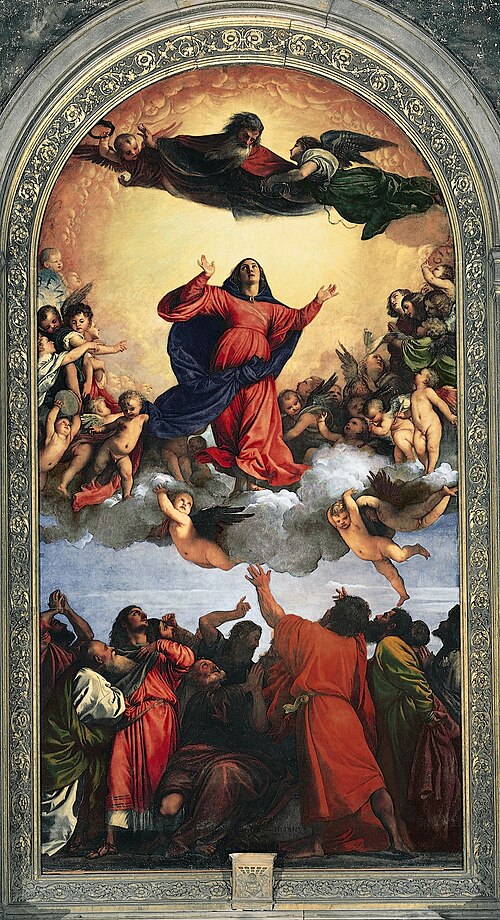
- The Assumption of the Virgin — the work of his recognition, in 1518.
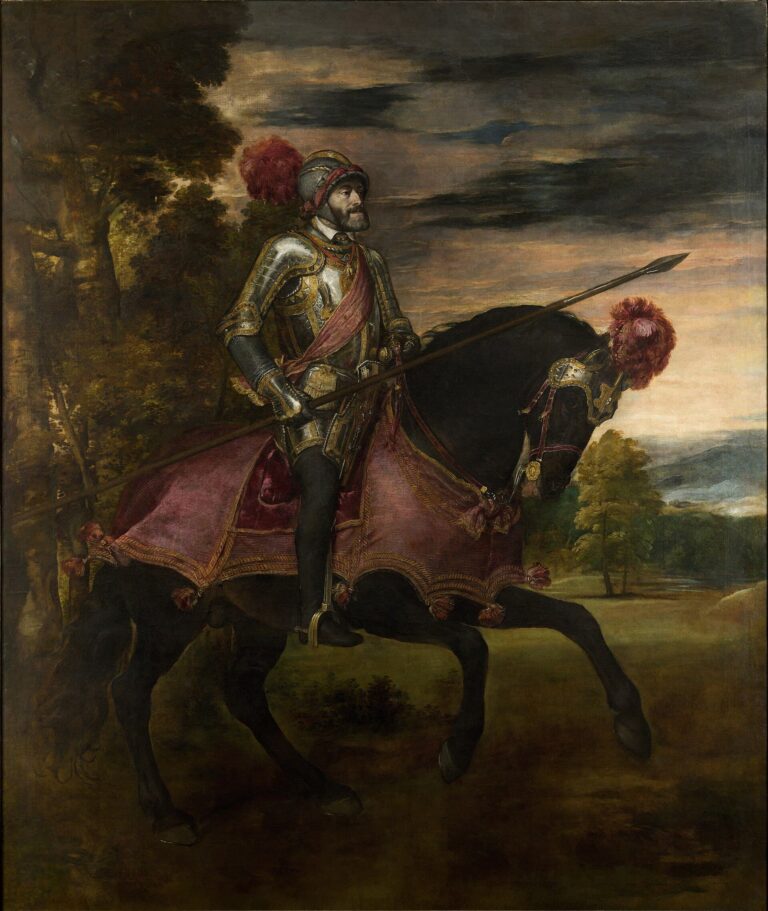
- Charles V on Horseback — the equestrian portrait of the emperor (cluster work, to activate).
- Édouard Manet — whose Olympia openly takes up and subverts the Venus of Urbino.
— M