The Assumption of the Virgin — Titian
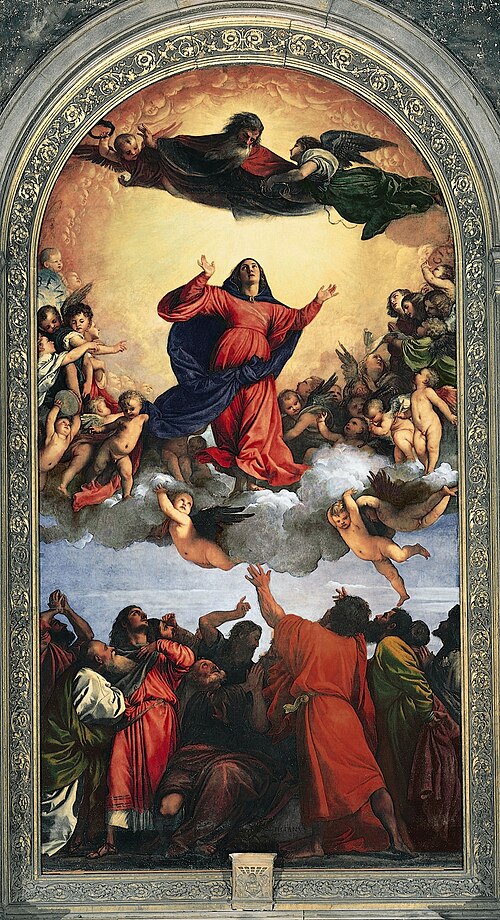
Titian — the Prince of Painters →Above the high altar of one of the largest churches in Venice, an immense altarpiece nearly seven metres high unfolds a celestial vision: the Virgin Mary, borne by a host of angels, rises towards God in a blaze of golden light, while below the apostles, astonished, stretch out their arms towards her. Titian’s Assumption of the Virgin, unveiled in 1518, is the work that consecrated the painter’s genius and opened a new era in Venetian art.
Painted when Titian was around thirty, this monumental work was his first great public commission, and it caused a sensation. By its colossal scale, the power of its colouring and the daring of its ascending movement, it broke with traditional religious painting and imposed a new manner, dramatic and brilliant. Remarkably, the work has remained for more than five centuries in the place for which it was conceived, on the high altar of the Frari basilica, where it can still be admired in its original setting.
This article offers an analysis of this founding work: its subject, its composition in three registers, the pictorial revolution it brought about, its art of colour and light, and the decisive role it played in Titian’s recognition.
The subject — the Assumption of the Virgin
The work depicts the Assumption of the Virgin Mary, one of the great subjects of Christian art. Understanding this subject illuminates the conception and the power of the work.
The Assumption designates, in the Catholic tradition, the raising of the Virgin Mary to heaven, body and soul, at the end of her earthly life. According to this belief, Mary, after her death, did not know the corruption of the tomb but was raised by God to celestial glory, where she was crowned queen of heaven. It is a moment of triumph and joy, the glorification of the Virgin, not a scene of mourning. This subject, dear to Marian devotion, was especially fitting for the high altar of a great church, as the culminating point of the faithful’s contemplation.
Titian chose to depict the very moment of the ascension, in all its dynamism. The Virgin is not figured motionless or already arrived in heaven, but caught in full flight, rising towards God, borne by the angels. This dynamic conception, which makes the painting the unfolding of an action in progress rather than a static image, was one of the great choices of the work. The viewer witnesses the miracle taking place, carried along by the ascending movement that structures the whole composition.
This choice matched the joyful and triumphal character of the subject. Far from dark and meditative depictions, Titian makes his Assumption an explosion of life, colour and light, celebrating the glorification of the Virgin. It is a work of exaltation, in which celestial joy bursts forth, in which movement and light convey the spiritual triumph. This interpretation, at once faithful to the dogma and profoundly alive, would give the work its power and its novelty, breaking with the conventions of the religious painting of its time.
A composition in three registers
The composition of The Assumption of the Virgin is organised in three superimposed registers, which structure the work and convey the ascensional movement of the subject. This organisation, of great clarity, is also of unprecedented dramatic power.
The lower register, at the base of the painting, depicts the earthly plane. There one sees the apostles, gathered, witnessing the miracle of the Assumption. Far from being frozen in serene contemplation, they are caught in agitation, astonishment, wonder: they gesticulate, stretch out their arms towards the sky, raise their eyes, in varied and dramatic attitudes. Some are depicted in bold foreshortening. These animated figures, larger than life, express the human reaction to the wonder, and create a physical and emotional link between earth and heaven. Two apostles dressed in red, in the foreground, form with the Virgin a kind of pyramid that guides the eye upwards.
The central register is occupied by the Virgin Mary herself, the heart of the work. She rises on a cloud borne by a multitude of cherubs and little angels, in an ascending movement. Dressed in a red tunic and a blue mantle, her arms open or raised, her face turned towards the sky, she radiates a serene beauty and strength. Despite the power of her figure, her gaze expresses purity and fervour. The angels surrounding her seem to accompany and explain her, linking the earthly world of the apostles to the celestial world towards which she rises.
The upper register, in the arched part of the painting, figures heaven, the divine glory. God the Father appears there, arriving from the depths of the infinite in a majestic movement, welcoming the Virgin, while an angel prepares to crown her. This zone bathes in a brilliant golden light, symbol of the divine presence. The three registers — the agitated earth of the apostles, the ascension of the Virgin, the celestial glory of God — are articulated in a composition of remarkable unity and dynamism, in which everything contributes to the vertical thrust, to the rise towards the light. The ascending push of the composition echoes the soaring Gothic architecture of the church.
A pictorial revolution
The Assumption of the Virgin was not only a beautiful work: it marked a rupture, a revolution in Venetian painting. By its daring, it opened a new path and established Titian as an innovator of genius.
The most striking rupture concerns the treatment of the figures and of movement. Venetian painting, in the tradition of Giovanni Bellini, Titian’s master, favoured serenity, meditative stillness, the calm contemplation of holy figures. Titian breaks radically with this tradition. His apostles are agitated, in movement, expressive, caught in dramatic gestures; his Virgin surges upwards; the whole composition is run through with a dynamism, an energy, a tension that were new in Venice. This animation, this expressive force, sometimes called terribilità, contrasted with the softness of the tradition and heralded a new era.
This daring reflects Titian’s awareness of the most recent developments of the High Renaissance, not only in Venice but also in Florence and Rome. The great masters of central Italy, such as Raphael and Michelangelo, had developed an art of movement, grandeur, power of the figures. Titian, while remaining faithful to the Venetian genius for colour, integrated these lessons, creating a new synthesis between Venetian colour and the dynamic grandeur of the High Renaissance. Remarkably, the influence may have been reciprocal: it has been suggested that Raphael himself, shortly after, drew inspiration from the ascending movement of the Assumption in one of his works.
Through this work, Titian also heralded, more than a century in advance, the Baroque. Movement, dynamism, spectacular staging, the dramatic unity of the composition, the use of light: all this prefigured the great Baroque compositions of the seventeenth century. The Assumption thus appears as a pivotal work, which closes one tradition and opens another. Unveiled in 1518, it made Titian, still young, the emblematic figure of the High Renaissance in Venice, and the master destined to dominate the painting of the city for half a century.
Colour and light
If the Assumption strikes one by its movement and its composition, it is perhaps above all through colour and light that it reveals Titian’s genius. Colouring here is the very engine of emotion and spirituality.
Titian deploys in this work all the power of Venetian colorito. The colours are brilliant, rich, resonant. Red, in particular, plays a structuring role: it recurs at every level of the composition — in the garments of the apostles, in the Virgin’s tunic, all the way to the mantle of God at the summit. These reds, declined in subtle nuances, from brilliant vermilion to deep crimson, create a vertical link that guides the eye from earth to heaven, unifying the composition and underlining the ascending movement. The blue of the Virgin’s mantle, the gold of the divine sky, complete this powerful harmony. In Titian, colour is not a mere covering: it carries meaning, emotion, spiritual movement.
Light plays an equally essential role, and Titian made a remarkably intelligent use of it. The summit of the painting, where God resides, bathes in an intense golden light, symbol of divine glory. Now Titian conceived this golden zone in relation to the real light: the natural light entering through the windows of the church’s apse comes to join and extend the painted light, creating the illusion that the divine light of the painting is real, that it truly emanates from heaven. This harmony between painted light and real light, designed for the precise location of the work, testifies to Titian’s genius and his sense of the integration of painting into its architectural setting.
This mastery of colour and light transforms the theological dogma into an intense sensory and emotional experience. The viewer does not merely contemplate a religious scene: they are seized, moved, carried away by the brilliance of the colours, the radiance of the light, the movement of the whole. Titian makes painting a means of direct emotion, capable of conveying and arousing spiritual fervour. It is this sensory power, together with the depth of the subject, that overwhelmed contemporaries and continues to overwhelm today. Great artists and writers, over the centuries, have expressed their emotion before this work.
Recognition
The Assumption of the Virgin holds a special place in Titian’s career: it is the work of his recognition, the one that definitively established him as the greatest painter in Venice. Its history is inseparable from this significance.
The work was commissioned from Titian by the Franciscan friars of the basilica of Santa Maria Gloriosa dei Frari, to adorn the high altar of their immense church. It was a commission of the highest importance: the high altar of a great church was the most prestigious and visible location there was. Titian, still young but already official painter of the Republic, was staking his reputation on it. He conceived a work to match the place and the stakes: a colossal altarpiece, with figures larger than life, designed to be seen from afar, across the whole length of the church, from the entrance.
The daring of the work is said to have at first disconcerted the patrons. Accustomed to more traditional and serene depictions, the friars are said to have been troubled by the scale of the figures, the violence of the movement, the novelty of the composition. An anecdote reports that their anxiety dissipated when they learned that a powerful personage — a representative of the emperor — wished to acquire the work: understanding then the value of what they possessed, they kept it. Whether accurate or embellished, this story captures well the innovative and disconcerting character of the work for its contemporaries, and its swiftly recognised value.
The unveiling of the altarpiece, in May 1518, was an event. The work imposed itself as a masterpiece and made Titian the dominant figure of Venetian painting. His reputation, now assured, would never cease to grow, leading him towards the most prestigious commissions, all the way to the courts of emperors and kings. The Assumption thus marks the true beginning of Titian’s great career, the moment when the young painter became the master. It remains, in his immense body of work, one of the most admired creations, and one of the most important altarpieces of the whole Renaissance.
Where to see the artwork
The Assumption of the Virgin is held where it has always been, or nearly: on the high altar of the basilica of Santa Maria Gloriosa dei Frari, in Venice, in the San Polo district. Exceptionally for a work of this importance, it has remained in its original location for more than five centuries, which allows one to discover it in the setting for which it was conceived, in harmony with the Gothic architecture of the church and the light of the apse. On entering the basilica, the visitor glimpses the work in the distance, framed by the arch of the choir, in a spectacular effect intended by Titian. It is also in this church that the painter was buried. To plan a visit, it is helpful to consult information about the Frari basilica.
Further Reading
Institutional Documentation
- Basilica of Santa Maria Gloriosa dei Frari, Venice — The Assumption of the Virgin, in situ on the high altar.
- Titian, reference monographs and catalogues.
See also on Hors Cadre
- Titian — the Prince of Painters — the painter’s portrait, to set the work within his career.
- The Venus of Urbino — the most famous nude of the Renaissance (cluster work, to activate).
- Charles V on Horseback — the equestrian portrait of the emperor (cluster work, to activate).
- Raphael — master of the High Renaissance, whose art dialogues with Titian’s.
— M