Charles V on Horseback — Titian
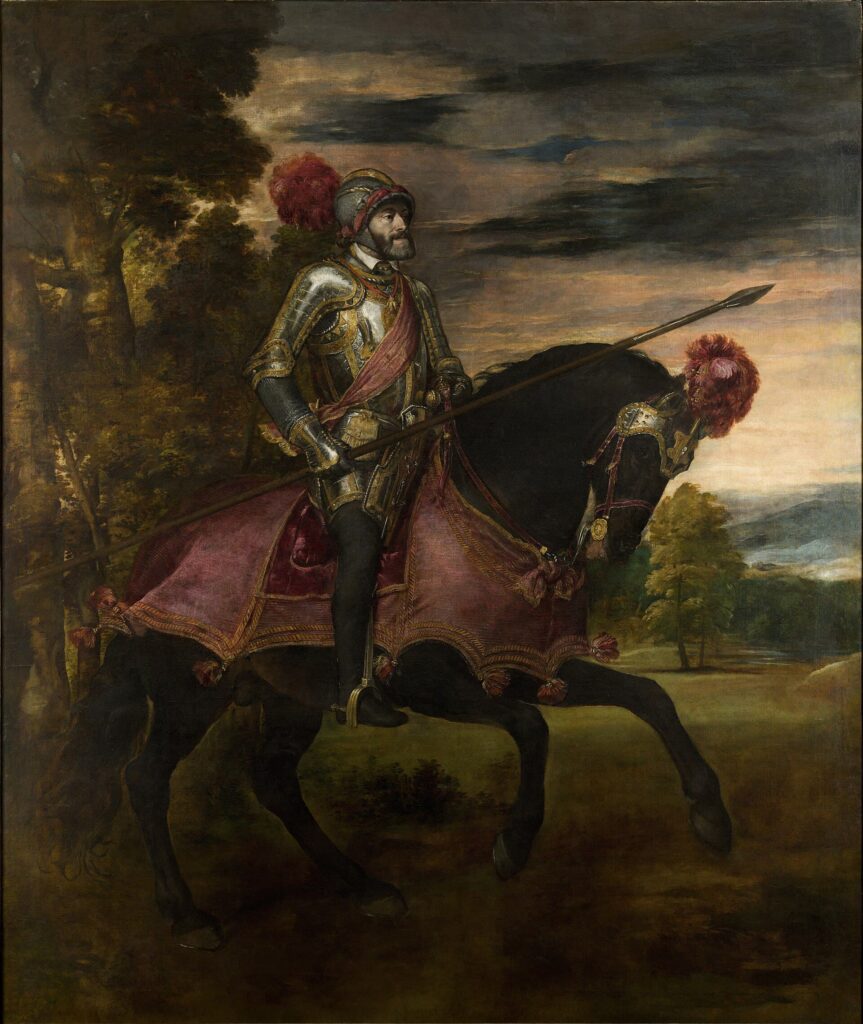
Titian — the Prince of Painters →Alone in a twilight landscape, clad in his gleaming armour, a long lance in hand, the emperor advances on horseback, sovereign and grave: Titian’s Equestrian Portrait of Charles V at Mühlberg is one of the most famous portraits in the history of art and the birth certificate of the modern equestrian portrait. In a single image, Titian redefined the representation of power, creating a model that would dominate the official art of the European monarchies for centuries.
Painted in 1548, at the court of Charles V, this portrait commemorates the emperor’s victory over the Protestant princes at the battle of Mühlberg the previous year. But Titian does not paint a battle: he depicts the emperor alone, in a majestic and meditative solitude, within a vast landscape bathed in the light of sunset. Combining the tradition of the ancient equestrian portrait, the ideal of medieval chivalry and the Venetian genius for colour, he created a work of exceptional power and novelty. Now held in the Prado Museum, it remains one of the summits of the art of the portrait.
This article offers an analysis of this major work: the context of the victory of Mühlberg, the description of the work, its symbolism of the soldier of Christ, the synthesis it achieves between chivalry and Antiquity, and its considerable influence on the royal portrait.
The victory of Mühlberg
The portrait was born of a precise political and military event: Charles V’s victory at the battle of Mühlberg. Understanding this context illuminates the meaning and ambition of the work.
Charles V, Holy Roman Emperor and King of Spain, was the most powerful sovereign of his time, at the head of an immense empire on which, it was said, the sun never set. But his reign was marked by a major challenge: the rise of Protestantism, which divided Germany and threatened the unity of Christendom and imperial authority. In April 1547, at the battle of Mühlberg, on the banks of the Elbe, the armies of Charles V crushed the Schmalkaldic League, the coalition of Protestant princes. This resounding victory appeared as a triumph of the emperor and of the Catholic cause.
To celebrate this victory, Charles V invited Titian to his court at Augsburg at the end of 1547. The choice of Titian was no accident: the Venetian painter was already the emperor’s appointed portraitist, whom he deeply admired and had even ennobled. Charles V held him in such high esteem that he hardly wished to be portrayed by anyone else. It was therefore to Titian, the greatest painter of the age, that the emperor entrusted the task of immortalising his victory in a great equestrian portrait, intended to celebrate his glory and fix its image for posterity.
Titian created the work at Augsburg during 1548. Remarkably, he depicted the emperor with the armour he had actually worn at Mühlberg, an armour damascened with gold, whose existence is attested since it is still held in Madrid today. This concern for accuracy, this desire to root the work in the reality of the event, contrasted with the more fanciful depictions other artists gave of the same battle. Titian sought to create an image at once truthful and grandiose, worthy of the event and of the man.
The work — the emperor on horseback
What strikes one immediately in Charles V on Horseback is the majestic solitude of the figure and the absence of any battle scene. Titian makes the bold choice of depicting the emperor alone, in a moment of gravity, rather than in the clamour of combat.
The emperor is depicted on horseback, in profile, advancing to the right. He wears the armour of the battle, gleaming, damascened with gold, rendered by Titian with admirable minuteness and brilliance. In his right hand he holds a long lance, held in the manner of a cavalryman’s weapon, while a pistol is fixed to his saddle. A red sash, the imperial colour, crosses his armour. His mount, a powerful bay horse, richly caparisoned in red, advances at a contained pace. The emperor’s face, grave, focused, expresses dignity and resolution. The whole exudes an impression of controlled power, of sovereign majesty.
Around this central figure, Titian unfolds a vast landscape, bathed in the golden and reddening light of sunset. One makes out the banks of the Elbe, the scene of the battle, but no combat is depicted: no troops, no enemies, no mêlée. The emperor is alone, isolated in the immensity of the landscape and the twilight sky. This choice is essential: by setting aside the depiction of the battle itself, Titian concentrates all attention on the figure of the emperor, and gives the scene a dimension that goes beyond the military anecdote. It is not a moment of action that is shown, but a timeless image of power and majesty.
Light plays, as always in Titian, a crucial role. The sunset sets the sky and the landscape ablaze with warm, golden and reddening tones, creating an atmosphere at once glorious and grave, almost melancholy. This twilight light haloes the figure of the emperor with a particular aura, and gives the whole a depth and a poetry that transcend the mere official portrait. The Venetian genius for colouring, the mastery of light and atmosphere, are here fully at the service of the grandeur of the subject. Titian creates an image that is at once a document, a political manifesto and a work of art of striking beauty.
The soldier of Christ
Beyond the celebration of a military victory, the portrait is charged with a strong religious and symbolic meaning. Charles V is depicted there as the defender of the faith, the soldier of Christ fighting for Christendom.
The victory of Mühlberg was not only a military victory: it was presented as a triumph of the Catholic cause against Protestant heresy. Charles V saw himself as the champion of Christendom, the defender of the unity of the faith in the face of the Reformation that was tearing it apart. Titian’s portrait conveys this dimension. The emperor is figured there as a miles christianus, a soldier of Christ, taking up arms to defend the true faith. This religious interpretation was essential to the meaning of the work and to the image Charles V wished to give of himself.
Several elements of the painting reinforce this meaning. The long lance the emperor holds has been linked to the iconography of Saint George, the knight-saint slaying the dragon — the dragon traditionally symbolising evil, heresy. Charles V thus appears as a new Saint George, riding against the forces of division and error. This link inscribes the portrait in a long tradition of Christian imagery of the knight defender of the faith. The emperor is not only a victorious military leader: he is a hero of Christendom, invested with a sacred mission.
This religious dimension accords with the gravity and solitude of the figure. The emperor, alone before the vast landscape and the twilight sky, appears as invested with an immense, almost crushing responsibility, that of defending the faith and maintaining the unity of Christendom. The portrait thus goes beyond mere glorification to attain a spiritual and meditative dimension. Titian was able to give the image of power a depth that distinguishes it from ordinary propaganda, mingling into it the sense of the sacred, of mission, and of the solitude of the sovereign before his task.
Chivalry and Antiquity
Titian’s genius, in this portrait, was to fuse several traditions into a new and powerful image. He combined the ideal of medieval chivalry and references to ancient classicism, creating the model of the modern equestrian portrait.
The work bears the imprint of the medieval and chivalric tradition. The equestrian portrait, the image of the knight in armour, referred to the chivalric ideal dear to the European aristocracy, and particularly to the House of Burgundy, of which the Habsburgs were the heirs. Charles V, who bore the Order of the Golden Fleece, inherited from Burgundy, connected himself to this ideal of Christian chivalry. Titian’s portrait thus celebrates the emperor as the last great knight, defender of the faith, in the lineage of the champions of the Middle Ages.
But Titian added references to ancient classicism, which gave the portrait an imperial dimension in the Roman sense. The equestrian portrait was, in Antiquity, a genre reserved for emperors and great leaders: the equestrian statue of the Roman emperor Marcus Aurelius, in Rome, was its most famous model. By depicting Charles V on horseback, Titian inscribed him in this ancient imperial tradition, making of him a new Caesar. Charles V was indeed readily compared to the Roman emperors, in a deliberate continuity between the Roman Empire and the Holy Roman Empire. The purple colour, symbol of imperial power since Antiquity, reinforces this reference.
By combining these two traditions — medieval chivalry and ancient imperial majesty — Titian created a new and masterly synthesis. His portrait was neither a simple knight’s portrait nor a simple imperial effigy in the antique manner: it united the two, making Charles V at once the Christian knight and the Roman emperor, the defender of the faith and the master of the world. This synthesis, carried by Titian’s pictorial genius, resulted in what is considered the first great modern equestrian portrait, a model of unequalled richness and power, destined to set the standard for centuries.
Ideal and reality
As is often the case in official portraits, the image Titian gives of Charles V is idealised. The confrontation between this glorious image and historical reality illuminates the very nature of the portrait of power.
The emperor is depicted as a vigorous rider, master of his mount, riding proudly across the battlefield. Yet the reality was different. Charles V, at this time, suffered from gout, a painful and disabling disease that had afflicted him for several years and made walking and riding difficult. Historians believe that the emperor, at the battle of Mühlberg, probably could not ride valiantly as the painting shows, and that he was likely carried on a litter. The triumphant equestrian portrait thus partly belongs to idealisation and political staging.
This idealisation is not a lie but the very nature of the official portrait, which aims to create an image, to construct a figure of power, rather than to document reality faithfully. Titian had to offer the emperor, and posterity, a glorious and exemplary image, a model of the virtues of the warrior sovereign. He therefore transfigures reality, erasing weakness and illness to show only majesty and strength. In this he creates an archetype of the portrait of power, in which the sovereign is depicted not as he is, but as he must appear, in all his grandeur.
Yet it would be reductive to see in the work a mere flattery. For Titian also introduces a note of gravity, of solitude, almost of melancholy, that nuances the triumph. The emperor alone, in the twilight landscape, on the evening of a victory, also appears as a man weighed down by the burden of his charge, meditating on his mission and perhaps on the vanity of human things. This psychological depth, this humanity perceptible beneath the majesty, are the mark of Titian’s genius, who was able to make of a portrait of propaganda a true work of art, rich and nuanced. The twilight that bathes the scene is not only glorious: it is also the symbol of passing time, of the end that approaches. A few years later, Charles V would abdicate and retire to a monastery.
The matrix of the royal equestrian portrait
The influence of Charles V on Horseback on the history of art was considerable. The work became the model of reference for the equestrian portrait of sovereigns, a matrix from which the greatest portraitists of the following centuries drew inspiration.
In creating this portrait, Titian had invented a formula of remarkable effectiveness and power for representing power: the sovereign on horseback, in majesty, in a landscape, combining warrior strength and royal dignity. This formula perfectly answered the needs of the European monarchies, anxious to construct and spread a glorious image of their sovereigns. The equestrian portrait thus became, in Titian’s wake, one of the major genres of the official portrait, the privileged means of celebrating kings and princes.
The greatest painters of the following centuries drew directly on Titian’s work. The Fleming Rubens, a great admirer of Titian, took up the formula of the equestrian portrait in several of his works. Van Dyck, his pupil, made it the model of his portraits of the sovereigns of England, such as Charles I. In Spain, at the very court where the Charles V was held, Velázquez created superb equestrian portraits of the royal family. Later still, Goya placed himself in this lineage. Through these heirs, the model created by Titian dominated the European portrait of power for nearly three centuries, testifying to the extraordinary fecundity of his invention.
Today, Charles V on Horseback is recognised as one of the greatest portraits in history and as a founding work. It perfectly illustrates Titian’s genius: his ability to create images of lasting power and novelty, to fuse traditions into new formulas, to unite the grandeur of the subject and psychological depth. A portrait of the most powerful man of his time, it is also a meditation on power, glory and the solitude of the sovereign. It remains, in Titian’s immense body of work, one of the summits of his art of the portrait, the one that earned him the redefinition, for centuries, of the very image of power.
Where to see the artwork
The Equestrian Portrait of Charles V at Mühlberg is held in the Prado Museum in Madrid, one of the greatest museums in the world, which possesses an exceptional ensemble of works by Titian, inherited from the Spanish royal collections. The painting, which belonged to the Spanish Habsburgs, descendants and successors of Charles V, is today one of the most admired masterpieces there. It survived a fire that ravaged in the eighteenth century the palace where it was held, which explains certain alterations to its lower part, since restored. The Prado, with its many Titians, is the place par excellence to discover this work and the art of the Venetian master. To plan a visit, it is helpful to consult the official website of the Prado Museum.
Further Reading
Institutional Documentation
- Museo del Prado, Madrid — the museum where the work is held.
- Titian, reference monographs and catalogues.
See also on Hors Cadre
- Titian — the Prince of Painters — the painter’s portrait, to set the work within his career.
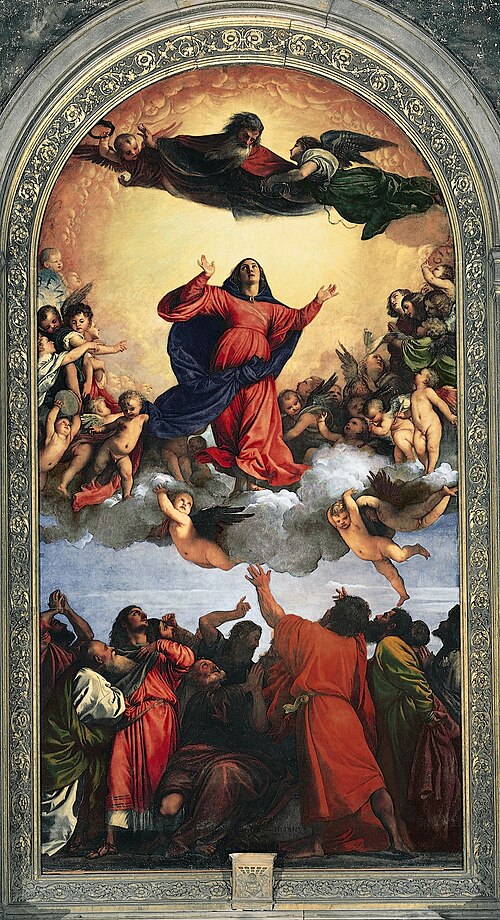
- The Assumption of the Virgin — the work of his recognition, in 1518.
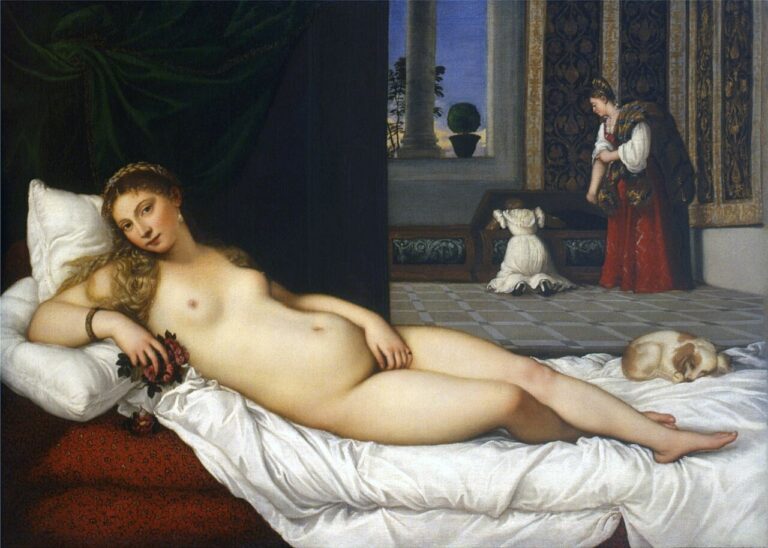
- The Venus of Urbino — the most famous nude of the Renaissance.
- Tintoretto — the Fury of Venice — his great Venetian heir, another master of the portrait and of large-scale composition.
— M