The Lacemaker — Vermeer’s Smallest Masterpiece
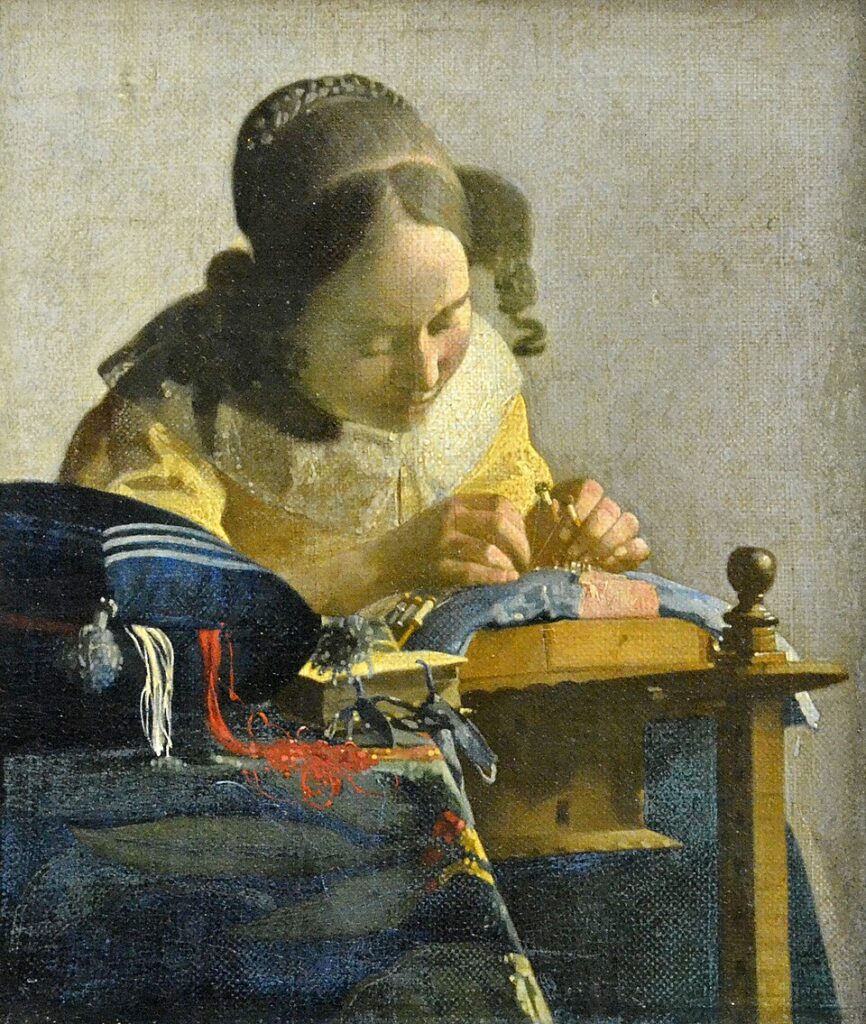
Vermeer — the inventor of interior light →A young woman is bent over her work. Wearing a yellow dress and with her hair neatly styled, she holds two bobbins between her fingers and stares with utter concentration at the lace she is making. In front of her, on a cushion, white and red threads seem to cascade in a slight blur. Behind her, nothing —a light-colored wall, undecorated, without windows, without the slightest distraction. The entire scene converges on that tiny point where her fingers manipulate the thread. The whole world has been reduced to a single gesture.
The Lacemaker by Johannes Vermeer, painted around 1669–1670 and housed at the Louvre, is, in terms of its dimensions, the most modest work of all: 24.5 × 21 centimeters, barely the size of an A5 sheet of paper — the smallest painting in Vermeer’s entire body of work. And yet, this miniature is considered one of his absolute masterpieces —so much so that Salvador Dalí, who was obsessed with it, compared it to Michelangelo’s Sistine Chapel. How can a painting the size of a postcard rival the monumental frescoes of the Renaissance?
The answer lies in what Vermeer does with this tiny format: he turns it into a lesson in concentration. Whereas his contemporaries treated the subject of the lacemaker as an anecdotal genre scene, Vermeer turns it into a meditation onattention, on the work of the hands, and on the silence of a completed gesture. The entire composition —every line, every color, every blurred effect—is arranged to focus our gaze, like that of the young woman, on a single point: the fingers at work.
This article reveals the secrets of this miniature—why all the lines in the painting converge on the hands, how the blurriness in the foreground suggests the likely use of a camera obscura, why the lace-maker’s yellow dress is an authentic garment from the Vermeer household (perhaps worn by his own wife), what the subject of lace meant in 17th-century Holland, how Salvador Dalí made this work a personal obsession, and how this small panel, purchased for 28 florins in 1696, became one of the treasures of the Louvre.
The Painting — What It Depicts
The Lace Maker is an oil on canvas of an exceptionally small size— 24.5 × 21 centimeters. It is, in fact, the smallest painting in Vermeer’s entire known body of work, barely larger than an A5 sheet of paper. This miniature demands a close look: when viewing the original at the Louvre, visitors are often surprised by its small size, which contrasts with its fame.
The composition depicts an elegant young woman in an enclosed space, turned slightly to her right, bent over her work. She is completely absorbed in her task: making a piece of bobbin lace. Her carreau (the lace-maker’s work cushion) rests on a table whose surface has been tilted to make her task easier.
The details are arranged with rigorous economy:
- In one hand, she holds two spindles; the others hang down at her side
- On the blue tile, the lace pattern is pinned —we don’t see the finished lace, but the pattern in progress
- Next to it, on a second table covered with a tablecloth (a so-called “Turkish-style” rug), are a sewing box with white and red threads spilling out of it, and a book held closed by ribbons—probably a Bible or a collection of lace patterns
- Behind her, the light-colored wall— with no decorations or openings— highlights the young woman and eliminates any distractions
The young woman is wearing a yellow dress (with a lemon-yellow bodice) and a white lace collar. Her hair is neatly styled, pulled back with curls falling down the sides. Her elegance suggests that she does not belong to the world of humble artisans —she is a young woman from a good family who practices lace-making as a virtuous pastime, not as a trade.
As noted in the entry in *Panorama de l’art* (Réunion des musées nationaux), Vermeer does not seek to paint a portrait of this woman:
“The painter does not seek to paint her portrait; instead, he depicts her focused on her work.”
— Art Panorama, Analysis of *La Dentellière*
The face itself is rendered in a schematic, almost abstract manner—a play of light and shadow without any distinct details. For the subject of the painting is not the woman herself: it is her concentration, her gesture, and her focus on her work.
All lines converge at the hands
The most striking aspect of the composition in *The Lacemaker* is the way Vermeer arranges the entire painting to direct the viewer’s gaze toward a single focal point: the young woman’s hands and the spindles she is holding.
A centripetal composition. All the key elements of the composition—the tilt of the table, the angle of the lace square, the direction of the lacemaker’s gaze, the way the threads fall— converge on the fingers at the center of the painting. Vermeer does not focus on the finished lace (which, incidentally, is barely visible), nor even on the woman’s face, but on the precise point where the gesture takes place: where the bobbins cross the threads.
A hierarchy of sharpness. Vermeer takes this focus all the way into the pictorial treatment itself. The white thread held by the lacemaker is painted with greater precision and detail than her own face. This is a deliberate reversal of the traditional hierarchy: in a classical portrait, the face is the most elaborately rendered element; here, it isthe lacework. Through the painting itself, Vermeer thus reveals where the true subject of the work lies.
The gesture as subject. This approach makes *The Lace-Maker* less a genre scene than a meditation onthe act of manual creation. The lacemaker is crafting something— patiently, silently, with complete focus —and Vermeer, in painting her, performs exactly the same gesture: meticulous, concentrated work in which every detail matters. The painting is, in its own way, a disguised self-portrait of the painter at work—not through his features, but throughhis demeanor. Two artisans of precision, the lacemaker and the painter, absorbed in their work.
This celebration of concentrated work is one of the reasons for the enduring fascination this work holds. In a tiny format, without any spectacular effects, Vermeer makes visible something that is ordinarily invisible: the intensity of a moment of full attention.
Blur in the Foreground — The Camera Obscura
One of the most technically intriguing aspects of *The Lacemaker* is the treatment of the foreground, particularly the red and white threads spilling out of the sewing box. These threads are painted with a slight blur —they seem to trickle, melt, and lose their sharp contours. Yet this deliberate blurring is a clue to Vermeer’s working method.
Depth of field. By blurring certain elements in the foreground while keeping those in the middle ground (the hands, the spindles) in focus, Vermeer creates an effect of depth of field —exactly as a camera lens out of focus on the foreground would. This method of suggesting depth through blurring was unusual for Dutch Baroque painting, which generally favored uniform sharpness across the entire canvas.
The Camera Obscura Hypothesis. This analysis reinforces the hypothesis—widely supported by Vermeer scholars—that the painter used a camera obscura —an optical darkroom consisting of a lens, a mirror, and frosted glass —to observe his scenes. Such an instrument, which is in exact focus only on a single plane, naturally produces blurred areas on other planes, as well as the characteristic luminous halos found on the shiny threads in the painting.
Just like in his paintings *The Astronomer* (1668) and The Geographer (1669), Vermeer evidently undertook a meticulous study before painting The Lacemaker —the art of lace-making is depicted with remarkable precision, a sign of patient observation, perhaps aided by an optical instrument.
A necessary caveat. It should be noted that Vermeer’s use of the camera obscura remains a hypothesis —one that is well-supported, but not proven by any documentary evidence. Vermeer left no written account of his method. The instrument, if it was used, was an observational tool to aid the eye, not a mechanical copying process: the genius of the composition and the use of light remains entirely that of the painter. The camera obscura may explain the blurriness of the threads; it does not explain the presence that emanates from this miniature.
The Yellow Dress — An Authentic Garment from the House of Vermeer
The lemon-yellow dress worn by the lace-maker is not a trivial detail. This yellow bodice is, in fact, one of the recurring visual themes throughout Vermeer’s entire body of work—and a valuable clue about the painter’s models.
A recurring garment. The same yellow coat trimmed with white fur appears in several other paintings by Vermeer—it can be found in at least six of his works, worn by various female figures (The Love Letter, Woman with a Balance, Young Woman with a Water Jug, among others). This is no coincidence: it was a real garment, part of the Vermeer household’s wardrobe.
Found in the inventory. Remarkably, this yellow coat was identified inthe posthumous inventory of the Vermeer-Bolnes couple’s estate, drawn up after the painter’s death in 1675. The garment therefore did indeed exist —Vermeer had his models wear it from one painting to the next, as a prop in his home studio.
Was Catharina Bolnes the model? The presence of a family heirloom has led some historians to suggest that the model for *The Lace-Maker* —as with several of Vermeer’s other female figures—might have been Catharina Bolnes,the painter’swife, or one of his daughters. A plausible but unverifiable hypothesis: Vermeer, who worked from home surrounded by a large family (eleven surviving children), had a pool of domestic models at his disposal. As with *Girl with a Pearl Earring*,the model’s exactidentity will likely remain unknown forever—and, since this is a genre scene rather than a portrait, it ultimately matters little to the appreciation of the work.
What matters is that the yellow dress anchors the painting in a concrete domestic reality. The lacemaker is not an abstract allegory: she is a real woman, wearing real clothing, performing a real action, in the painter’s own home.
A Dutch Theme—Lace and Domestic Virtue
The subject of the lacemaker was not Vermeer’s invention. The genre scene depicting a woman at her work was a common theme in Dutch Golden Age painting, one that had been explored by several painters before him.
A common theme. Vermeer’s contemporaries, such as Caspar Netscher (who painted his own *Lace-Maker* in 1662) and Gerard Dou (a student of Rembrandt and a master of meticulous, intimate scenes), had already depicted women making lace or sewing. The subject was part of the repertoire of Dutch genre painting, which often depicted the domestic activities of the bourgeoisie.
A moral significance. In the Protestant culture of the United Provinces, women’s needlework —sewing, embroidery, lace-making—carried strong moral value. It symbolized domestic virtue, diligence, chastity, and proper conduct for a young woman. A girl engaged in her needlework was considered a virtuous girl, immune toidleness, which was regarded as the mother of all vices. The presence of the closed book (probably a Bible) next to the lacemaker reinforces this moral interpretation: manual labor and piety go hand in hand.
Going Beyond Vermeer. But whereas Netscher or Dou approached the subject in a narrative or anecdotal manner—with picturesque details, glances directed at the viewer, and at times a strongly moralizing tone—Vermeer strips everything down to the bare essentials. He eliminates all commentary, all anecdotes, and all knowing glances. He reduces the scene to its simplest form: a woman, a gesture, a light. The result is no longer a moral lesson but a pure contemplation of focusedattention at work. Vermeer takes a conventional subject and transforms it into a universal meditation —it is precisely this transcendence that makes *The Lacemaker* a masterpiece, whereas so many other paintings of lacemakers remain merely charming genre scenes.
Salvador Dalí’s Obsession
Among all the admirers of *The Lacemaker*, one of the most passionate —and most unexpected —was the Surrealist painter Salvador Dalí (1904–1989). His fascination with this small painting by Vermeer turned intoan obsession and led to one of the most remarkable episodes in the work’s history.
Absolute reverence. Dalí, who had boundless admiration for Vermeer (he considered him one of the greatest painters of all time), regarded *The Lacemaker* as the absolute pinnacle of art. He even went so far as to compare it, in terms of its power, to Michelangelo’s frescoes in the Sistine Chapel —a staggering comparison between a 24-centimeter miniature and one of the largest painted ensembles of the Renaissance.
The Copy at the Louvre (1955). In 1955, Dalí obtained special permission from the Louvre to set up his easel in front of *The Lace-Maker* to create a copy of it—a rare privilege. But Dalí did not paint a faithful copy: under his brush, Vermeer’s peaceful lacemaker was transformed into a strange composition, bristling with pointed shapes.
The Theory of Rhinoceros Horns. For Dalí had developed a wild and fascinating theory: he was convinced that the composition of *The Lacemaker* was secretly structured by logarithmic spirals identical to those… of rhinoceros horns. In his view, the taut threads,the needle, and the very focus of the scene all pointed out like so many horns. He took this obsession so far that he had himself filmed at the Vincennes Zoo painting *The Lace Maker* in front of a live rhinoceros —a performance characteristic of his paranoiac-critical method, which consisted of projecting obsessive associations of images onto reality.
This episode, both amusing and revealing, attests to the power of Vermeer’s work to captivate: a small panel that appears so peaceful was able to spark an almost mystical fascination in one of the most extravagant artists of the 20th century. Where the average visitor sees calm, Dalí saw a secret tension, a hidden geometric energy —proof that *The Lacemaker* contains far more than its modest surface suggests.
From the 1696 sale at the Louvre
The physical history of *The Lace Maker*, like that of all of Vermeer’s works, contains many gaps —but a few documented milestones make it possible to trace its journey to the Louvre.
1696: first mention. The painting appeared for the first time at an auction in Amsterdam —the famous Dissius auction of May 1696, which sold some twenty works by Vermeer (indicating that a collector, likely connected to the patron Pieter van Ruijven, had amassed a large portion of his body of work). *The Lacemaker* was sold there for 28 florins —the equivalent of about one month’s wages for a laborer at the time. This modest sum reflects Vermeer’s still-minor status.
18th–19th centuries: The painting passed through various private collections, mostly outside France, with no clear, continuous record of its whereabouts—a situation typical of the limbo in which Vermeer remained until his rediscovery in the 19th century.
1870: Acquisition by the Louvre. The painting was acquired by the French national museums in 1870 (it was actually added to the Louvre’s collection in 1870–1871) for 7, 500 francs. It was purchased from a certain Eugène Féral, a painter and collector, who had himself acquired it at the Blokhuyzen auction. The *Moniteur des arts* noted at the time that the artist had still been unknown in France some fifteen years earlier—before Théophile Thoré-Bürger rediscovered him in 1866. *The Lace Maker* is thus one of the first works by Vermeer to enter a major public collection, shortly after his rediscovery.
Since 1870: *The Lacemaker* has been on permanent display at the Louvre, in the Dutch painting galleries. There, it hangs alongside the museum’s other Vermeer, *The Astronomer* (1668), which entered the Louvre much later (in 1983, through a donation). The contrast in their fortunes is striking: this panel, sold for 28 florins in 1696, is today one of the jewels of the world’s largest museum— priceless and never likely to be put up for sale.
Legacy — From Painting to Novel to Film
Beyond Dalí’s obsession, *La Dentellière* has permeated 20th-century French culture, inspiring, in particular, a notable literary work and a film.
Pascal Lainé’s novel (1974). In 1974, French writer Pascal Lainé published a novel titled *La Dentellière*, which takes its title and inspiration from Vermeer’s painting. The novel tells the story of Pomme, a shy, quiet, and unassuming young woman—a modern “lace-maker” whose intense inner life contrasts withher modestappearance, much like the silent concentration of the figure in Vermeer’s painting. The novel won the 1974 Prix Goncourt, France’s highest literary honor.
The film by Claude Goretta (1977). The novel was adapted for the screen in 1977 by Swiss director Claude Goretta, under the same title *La Dentellière*. The film introduced the general public to a 24-year-old actress, Isabelle Huppert, in the role of Pomme—a role that launched her international career and earned her major critical acclaim. The film, with a delicacy and restraint very much in keeping with Vermeer’s spirit, extends onto the screen the painter’s meditation on discreet, absorbed individuals whose inner richness escapes the hurried gaze.
A lasting resonance. This dual legacy—literary and cinematic—shows that Vermeer’s *The Lacemaker* transcends the realm ofart history. Its depiction of a woman in deep concentration, absorbed in a patient task, has become a cultural archetype: that of a quiet inner life, ofattention that resists the distractions of the world. Three centuries after its creation, the small painting in the Louvre continuesto inspire novelists, filmmakers, and visitors, remaining true to the lesson in concentration that it embodies.
How to View the Work Today
“The Lace Maker” is on display at the Louvre Museum in Paris. Practical information:
- Address: Cour Napoléon, Pyramide, 75001 Paris
- Metro: Palais Royal – Louvre Museum (Lines 1 and 7)
- Wing: Richelieu, Level 2, 17th-century Dutch painting galleries
- Complete pricing and hours: louvre.fr — general admission ticket providing access to all permanent collections
A tip for visitors: Since *La Dentellière* is tiny (24.5 × 21 cm), it can easily go unnoticed in the vast halls of the Louvre. Take the time to get up close —it is only up close that the work reveals its secrets: the blur of the threads, the precision of the fingers, the quality of the light. Don’t expect a spectacular large-scale piece: the power of the work lies entirely in its intensity.
Also worth seeing in the same museum:
The Louvre houses several masterpieces from the Dutch Golden Age nearby:
- The Astronomer (1668) by Vermeer —the museum’s other Vermeer, depicting a male scholar leaning over his celestial globe
- Bathsheba at the Bath (1654) by Rembrandt —a masterpiece from the Amsterdam master’s mature period
- The Pilgrims of Emmaus (1648) by Rembrandt
- Works by Frans Hals, Pieter de Hooch, Jacob van Ruisdael, and the entire Dutch school
To see more Vermeer paintings:
With only 34 to 36 paintings in existence worldwide, seeing a Vermeer is always a special occasion. The major collections are housed at the Mauritshuis in The Hague (“Girl with a Pearl Earring, ” “View of Delft”), the Rijksmuseum in Amsterdam (“The Milkmaid”), the National Gallery of Art in Washington, and the Metropolitan Museum in New York.
Further Reading
Institutional sources cited
- Louvre Museum, entry on *La Dentellière*.
- Art Panorama (RMN), review of *La Dentellière*.
- Encyclopædia Universalis, article “Johannes Vermeer.”
Sources and Studies Cited
- Dissius Auction, Amsterdam, May 1696 — the first documented mention of the work.
- Salvador Dalí, writings and performances related to *La Dentellière* (paranoiac-critical method), 1950s–1960s.
Leading Modern Studies
- Walter Liedtke, *Vermeer: The Complete Paintings*, Ludion, Antwerp, 2008. A standard catalog raisonné.
- Arthur K. Wheelock Jr., *Vermeer: The Complete Works*, Harry N. Abrams, New York, 1997.
- Pascal Lainé, *La Dentellière*, novel, Gallimard, 1974 (Goncourt Prize—a work of fiction inspired by the painting).
Institutional Documentation
- Louvre Museum, Paris — the institution has owned it since 1870.
- Mauritshuis, The Hague — houses *Girl with a Pearl Earring* and *View of Delft*.
See also on Hors Cadre
- Vermeer—the inventor of interior light —a portrait of the artist, a comprehensive overview of his life and his rare works.
- *Girl with a Pearl Earring*—the “Mona Lisa of the North “—Vermeer’s signature work, his other absolute masterpiece.
- Bathsheba at Her Bath — Hendrickje, Rembrandt’s model and muse — the other great Dutch master at the Louvre, in the same section dedicated to Golden Age painting.
— M