“Girl with a Pearl Earring” — the “Mona Lisa of the North”
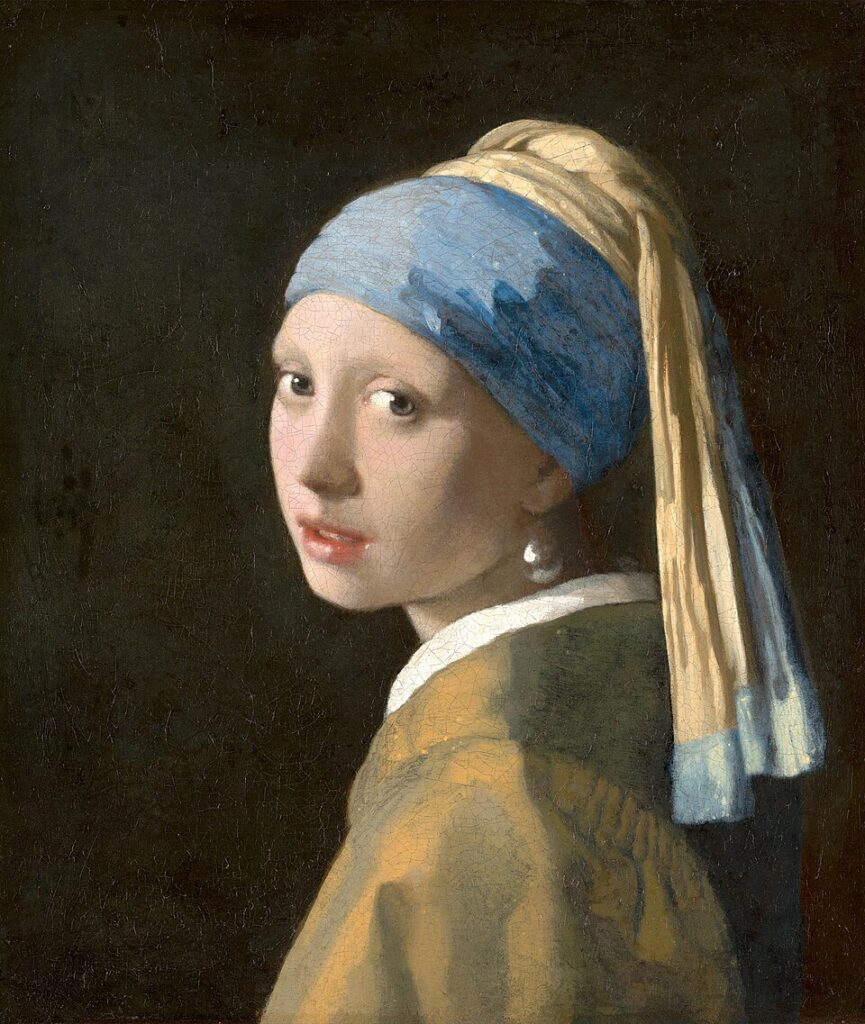
Vermeer — the inventor of interior light →A young girl turns her head toward us, looking over her shoulder. Her mouth is slightly parted, her lips moist, her large gray-blue eyes shining in the dim light. She wears a blue and yellow turban tied with two pieces of cloth, and from her ear hangs a pearl of unbelievable size, catching a glint of light. The background is black, empty, devoid of any decor or objects. Nothing tells us who she is, where she is, or at what moment she turned around. She is looking at us—and for three and a half centuries, we have been looking at her, unable to penetrate her silence.
“Girl with a Pearl Earring” by Johannes Vermeer, painted around 1665, is today one of the most famous paintings in the world. Housed at the Mauritshuis in The Hague, it is nicknamed the “Mona Lisa of the North” —by analogy with Leonardo’s enigmatic smile, and for the same reason: a face that seems on the verge of speaking, captured in a suspended moment, whose mystery defies all analysis. Small in size (only 44.5 × 39 cm), with a bare background and a restrained color palette —and yet it possesses a presence that astounds visitors the moment they catch sight of it in the museum gallery.
But this fame is recent. For two centuries, the work remained forgotten, like all of Vermeer’s art after the painter’s death in 1675. It was sold at auction in 1881 for a pittance —about two florins —by a buyer who had almost no idea what he was buying. Restored, identified as an authentic Vermeer, and bequeathed to the Mauritshuis in 1903, it slowly rose to the status of a global icon, a status bestowed upon it at the turn of the 21st century by Tracy Chevalier’s novel (1999) and the film starring Scarlett Johansson (2003).
This article reveals the secrets behind this work—why it is not a portrait but a “tronie,” why the pearl that gives it its name does not actually exist, how Vermeer used ultramarine from Afghanistan that was more precious than gold, and what the major 2018 scientific study (*The Girl in the Spotlight*) revealed about the painter’s technique and the girl’s invisible eyelashes, and why the mystery of her identity will likely never be solved —because she may never have existed.
A “tronie,” not a portrait
The first thing to understand about *Girl with a Pearl Earring* is that it is not a portrait. It is a “tronie” —a 17th-century Dutch term referring to a specific genre of painting, now little known outside the world of art history, but essential to understanding the work.
A ” tronie ” (a word that roughly means “head” or “face” in Old Dutch) is a facial portrait that depicts not a specific person, but a type, a character, or an expression. A tronie may depict an old man, a soldier, an exotic figure, or a young woman —what matters is not the model’s identity, butthe effect produced: the study of a facial expression, a lighting effect, a picturesque costume, or a universal emotion.
As stated in the Mauritshuis’s official description:
“This isn’t a portrait, but a ‘tronie’—an imaginary character.”
— Mauritshuis, official entry for the work
The tronie genre was highly prized in Dutch Golden Age painting. Rembrandt painted many of them—his old men in turbans, his studies of expressive heads. Frans Hals, Jan Lievens, and Carel Fabritius (Vermeer’s probable teacher) also produced them. The “tronie” was sold as a standalone work —the collector would buy a beautiful head, a display of virtuosity, without worrying about who was depicted.
Several clues confirm that *Girl with a Pearl Earring* is a *tronie* rather than a portrait:
1. The Exotic Costume. The young girl is wearing a blue and yellow oriental turban. However, as the Mauritshuis notes, 17th-century Dutch girls did not wear turbans. This oriental headdress is a fanciful accessory—an exotic element typical of the “tronie”—intended to transport the viewer to a different world and highlight the blue-and-yellow color scheme. It does not correspond to any actual clothing styles in 17th-century Delft.
2. The lack of context. A 17th-century portrait typically places its subject in a meaningful setting —a bourgeois interior, professional attributes, symbols of social status. Here, there is nothing: an absolutely black, empty background that isolates the face and detaches it from any identifiable social reality.
3. The Improbable Pearl. The pearl is a size that does not exist in nature (we’ll come back to this). A portrait would have depicted a real piece of jewelry; the “tronie,” however, allows forexaggeration to createa luminous effect.
This distinction completely changes the way we view the work. We tend to wonder who this young girl was —a reflex of the modern viewer accustomed to photography and portraiture. But Vermeer probably never intended to depict a specific person. He wanted to paint a presence, a moment, a gaze —a nameless figure, designed to captivate through its pictorial quality alone. The mystery of her identity is not a puzzle to be solved: it is the very nature of the tronie.
The Painting — What It Depicts
Girl with a Pearl Earring is a modestly sized oil on canvas — 44.5 × 39 centimeters, barely larger than an A3 sheet of paper. This small format is characteristic of Vermeer’s entire body of work; he never painted large canvases. This intimate scale invites a close, almost intimate, view.
The composition is radically simple. A single figure, the torso slightly turned, the head swiveled over the left shoulder toward the viewer. No background. No objects. No horizon line. The black background —which was originally a deep dark green, now darkened by the aging of the varnish and pigments— envelops the figure and makes it emerge from the darkness like an apparition.
The face occupies the center of the canvas. The young girl’s mouth is slightly parted, her moist lips highlighted by a glint of light on her lower lip. Her gray-blue eyes are wide open, sparkling, and fixed on the viewer with a gentle intensity. The point of light in each eye—a tiny touch of white—gives her gaze its characteristic liveliness. The skin is rendered with extremely smooth transitions, without hard contours, through subtle gradations from shadow to light.
The turban is the most vividly colored element in the painting. Composed of two pieces of fabric —a blue one wrapped around the head and a yellow one falling in a flap down the back—it juxtaposes Vermeer’s two signature colors: deep ultramarine blue and luminous yellow. This blue-yellow contrast structures the entire color palette of the painting.
Finally, the pearl hangs from the right ear (the left ear as seen by the viewer), catching a glint of light on its upper part and a more subdued reflection —that of the young girl’s white collar —on its lower part. This isthe element that gives the work its name, and, paradoxically, one of the most illusory (we’ll get to that).
The light comes from the left, off-screen—as in almost all of Vermeer’s works. It falls on the face, the white collar, the turban, and the pearl, leaving the right side of the face in soft shadow. There is no dramatic chiaroscuro in the style of Caravaggio or the late Rembrandt: rather, a diffuse, enveloping light that shapes without creating sharp contrasts.
The white collar deserves special attention: it forms a luminous collar that sets the face apart from the dark background and reflects light down toward the lower part of the face and the pearl. This is a highly subtle technical detail—Vermeer uses the white as a reflective surface to illuminate from below.
The Pearl That Doesn’t Exist
The most fascinating paradox of the work lies in its very title: the pearl that gives the painting its name does not really exist —neither as an actual piece of jewelry nor even as a precisely painted object.
First paradox: size. The pearl depicted is a size that does not exist in nature. A natural pearl of this size would have been, in the 17th century, a treasure of unimaginable value, reserved for royalty. Several experts believe that it is less a real pearl than a glazed Venetian glass bead —a common imitation at the time—or, more likely, a purely pictorial effect with no basis in an actual piece of jewelry. The tronie allows for this artistic freedom: the object need notexist; it must simply shine.
Second paradox: the pictorial material. When one examines the pearl closely —which the Mauritshuis’s scientific analyses made possible at very high resolution—one discovers that it is not painted as an object with defined contours. As the museum explained following the 2018–2020 study:
“The pearl is an illusion, made up of translucent and opaque strokes of white paint.”
— Mauritshuis, following the study *The Girl in the Spotlight*
In practical terms, the “pearl” consists of a few touches of white applied to the dark background of the neck and turban:
- A bright white spot in the upper left corner—the reflection of light from the window
- A more diffuse touch of white at the bottom—a reflection of the young girl’s white collar
- And between the two, almost nothing: the pearl has no outline, no line, no drawn circle. It is our eye that reconstructs the sphere from these two reflections
Vermeer, then, painted a pearl without actually painting the pearl. He painted the light reflected by the pearl, and let our brains do the rest. It is one of the most famous feats in the entire history of painting—a lesson in how human perception completes what the eye sees only partially. The most famous pearl in Western art is, literally, three white spots and an illusion.
Blue and Yellow — Pigments from Around the World
The color scheme of *Girl with a Pearl Earring* is based onthe contrast between blue and yellow —Vermeer’s signature palette. But recent scientific analyses have revealed that these seemingly simple colors were created using pigments of considerable value, sourced from around the world.
Ultramarine blue. The young girl’s blue turban is painted withnatural ultramarine —a pigment extracted from lapis lazuli, a semiprecious stone imported mainlyfrom Afghanistan (mines in the Sar-i Sang Valley). In the 17th century, genuine ultramarine was, in the words of the Mauritshuis itself, “more precious than gold” by weight. Vermeer used a significant amount of it—not only for the turban but also, in a way invisible to the naked eye, mixed into the shadows of the face to give them their distinctive freshness. This luxurious choice attests tothe painter’shigh standards and partly explains the rarity and cost of his work.
Yellow. The yellow panel of fabric hanging down from the turban is painted with yellow pigments (probably lead-tin yellow and ochres) that contrast with the blue to create the characteristic chromatic vibrancy.
A global range. The 2018 study identified the geographic origin of the pigments used by Vermeer—revealing that this painting, created in a small town in the Netherlands, incorporated raw materials from all corners of the world:ultramarine from Afghanistan, as well as pigments from Mexico (likely cochineal, an insect from which red is derived) andAsia. *Girl with a Pearl Earring* is, in its own way, a globalized object ahead of its time—a testament to the global trade in The Republic of the United Provinces, the leading trading power of the 17th century, whose ships brought back both spices and rare pigments.
Two whites for the skin. The study also revealed that Vermeer used two distinct white pigments, each with different optical properties, in areas where the skin transitions fromshadow to light —thereby achieving an effect of transparency and freshness on the face that contributes to its lifelike presence. This technical refinement demonstrates the extent to which Vermeer conceived of light not as an effect, but as a material to be built up layer by layer.
The Girl in the Spotlight — the 2018 scientific study
In February–March 2018, the Mauritshuis undertookthe most comprehensivescientific study ever conducted on *Girl with a Pearl Earring* —a project titled The Girl in the Spotlight . The painting had not been subjected toin-depth analysis since 1994, and non-invasive imaging techniques had advanced considerably over the past twenty-five years.
A public examination. Remarkably, the study was conducted in full view of museum visitors. The painting was placed in a glass enclosure in the center of a room, where an international team of researchers and curators examined it for two weeks. The public was able to observe the scientific work firsthand—an approach to transparency that is characteristic of the Mauritshuis’s policy.
State-of-the-art techniques. The researchers used a range of non-invasive imaging methods: macro-X-ray fluorescence (MA-XRF) to map the pigments, 3D digital microscopy (Hirox technology) to observe the surface at the microscopic level, hyperspectral imaging, and various scanners. No major destructive sampling was performed—the artwork remained intact.
Findings. Several findings emerged from this study:
1. The invisible eyelashes. X-ray macrofluorescence revealed the presence of tiny eyelashes around the girl’s eyes—painted brown, invisible to the naked eye, and previously thought to be absent. This discovery changes our interpretation of the work: the young girl does indeed have eyelashes, which makes her more human, more embodied, and less abstract than her smooth gaze might have suggested.
2. The original green background. Analyses have confirmed that the current black background was originally a deep, dark green, achieved by layering blue and yellow glazes that have now faded. Vermeer had likely painted a background evoking a curtain or a more atmospheric space than the black void we see today.
3. The young woman’s pose. The imaging revealed slight revisions —Vermeer adjusted the position of the turban and the outline of the figure as he was painting.
4. The global origin of pigments, as previously mentioned.
However, as museum director Martine Gosselink pointed out following the study, the mystery remains largely unsolved:
“The young woman didn’t reveal the secret of her identity, but we got to know her a little better.”
— Martine Gosselink, Director of the Mauritshuis, 2020
Scientific research has brought the work closer to us—by restoring its brushstrokes, its depth, and its original colors —without, however, dispelling its fundamental mystery. The young girl remains anonymous. And perhaps imaginary.
A Long-Forgotten Work — The 1881 Auction
Like all of Vermeer’s work, *Girl with a Pearl Earring* lay forgotten for two centuries before achieving fame. Its physical history remains partly obscure —typical of a painter whose trail went cold after his death in 1675.
17th–18th centuries: The work disappears from documentary sources. It is believed to have belonged to Vermeer’s circle of patrons in Delft, and then to have passed through various Dutch private collections without leaving a clear trail. There are no reliable records to trace its history over nearly two centuries.
1881: The work reappeared at an auction in The Hague. It was in poor condition, dirty, and misidentified. A collector, Arnoldus Andries des Tombe,purchased it for a pittance —about two florins (two florins and thirty cents, according to some sources), the equivalent of a few euros today. Des Tombe made the purchase on the advice of the art critic Victor de Stuers, who suspected that a Vermeer lay hidden beneath the grime.
Restoration and identification. Once cleaned and restored, the work turned out to be an authentic Vermeer —a discovery made all the more valuable given that the painter had just been rediscovered by Thoré-Bürger in 1866 and that his works were becoming increasingly valuable.
1903: Upon his death, Arnoldus Andries des Tombe bequeathed *Girl with a Pearl Earring*, along with eleven other paintings, to the Mauritshuis in The Hague. Having no heirs, the collector chose to donate his treasure to his city’spublic institution. The work thus entered the museum’s collection, where it has remained for more than 120 years.
A symbol of fate. A work purchased for two florins in 1881 became, a century later, one of the most famous and most reproduced paintings in the world— priceless, never put up for sale, and considered a Dutch national treasure. A reversal of fortune comparable to that of its creator, who died penniless and forgotten, only to become one of the three greatest masters of the Golden Age.
The Mystery of the Model
Who was the Girl with a Pearl Earring? This question has fascinated people ever since the painting was rediscovered, and the honest answer is: we don’t know, and we probably never will.
Several hypotheses have been put forward:
1. A Daughter of Vermeer. The painter had eleven surviving children, including several daughters. Some have suggested that the eldest, Maria—who was a teenager around 1665—might have posed for her father. It is a tempting but unverifiable hypothesis —there are no documents to support it.
2. A maid in the household. This is the premise of Tracy Chevalier’s novel (1999), which imagines a maid named Griet posing for her master amid a silent romantic tension. Pure fiction —there is no record of such a maid or such a relationship.
3. A purely fictional character. This is the most likely hypothesis given the nature of the work. Since *Girl with a Pearl Earring* is a *tronie* —a study in type rather than a portrait—it is entirely possible that Vermeer invented this face, or composed it from several models, without depicting any real person. As the Mauritshuis has noted, the girl “could be a product of Vermeer’s imagination.”
This indeterminacy is not a shortcoming: it is integral to the work’s power. Because the young girl has no name, no backstory, and no context, each viewer can project their own interpretation onto her—seeing her as shy or confident, innocent or complicit, melancholic or mischievous. The way she looks at us is like a mirror. It is precisely this openness that makes her a universal icon, comparable to the Mona Lisa —a face that everyone makes their own and that belongs to no one.
Legacy—From Novel to Global Myth
At the turn of the 21st century, *Girl with a Pearl Earring* experienced a meteoric rise that elevated it to the status ofa global icon, far beyond the circle of art lovers.
Tracy Chevalier’s novel (1999). American author Tracy Chevalier published *Girl with a Pearl Earring* (Girl with a Pearl Earring), a novel that imagines the circumstances surrounding the painting’s creation. She invents the character of Griet, a young servant in the Vermeer household, whom her master would use as his model amid a silent tension blending artistic admiration and romantic longing. The novel, translated into dozens of languages, became a global bestseller and introduced the painting to a vast audience.
The film (2003). The novel was adapted for the screen by Peter Webber, with Scarlett Johansson playing the young girl and Colin Firth playing Vermeer. The film, withits meticulousaesthetic that recreates Vermeer’s use of light, was a huge success and helped spread the image of the painting and the romantic figure of the painter from Delft worldwide.
The Reproduced Icon. *Girl with a Pearl Earring* is now one of the most reproduced works of art in the world—on posters, postcards, mugs, parodies, advertising spin-offs, and internet memes. It has joined the select circle of universally recognizable images: the Mona Lisa, The Starry Night, The Scream. This statusas a pop icon has at times overshadowed the subtlety of the original work—hence the importance of returning to the painting itself, in the gallery at the Mauritshuis.
The Value of the Original. A neuroscience study commissioned by the Mauritshuis in 2024 also demonstrated that viewing the actual artwork elicits a much stronger emotional response than viewing reproductions —the measuredappeal of the authentic painting was ten times greater than that of its copies. This provides scientific confirmation of what every visitor feels: no reproduction can replace the experience of encountering the young girl in the dim light of her gallery.
How to View the Work Today
“Girl with a Pearl Earring” is housed at the Mauritshuis in The Hague, the Netherlands. Practical information:
- Address: Plein 29, 2511 CS The Hague, Netherlands
- Directions: A 5-minute walk from The Hague Central Station (The Hague is about 1 hour by train from Amsterdam and 30 minutes from Rotterdam)
- Exhibition Hall: The young girl occupies a place of honor in the museum’s exhibition halls—she is always on display, except in rare cases when she is on loan
- Hours: Daily, usually 10 a.m.–6 p.m. (Mondays starting at 1 p.m.) — check the official website
- Price: approximately €17.50 for adults; free for those under 18
- Reservations: We recommend booking a time slot online, as the museum is small and very popular.
Also worth seeing in the same museum:
The Mauritshuis, a small museum with an exceptionally rich collection, houses several other masterpieces from the Dutch Golden Age:
- View of Delft (circa 1660–1661) by Vermeer—the landscape that inspired Proust to write about the “little patch of yellow wall”
- Diane and Her Nymphs (circa 1653–1654) by Vermeer — an early work
- The Goldfinch (1654) by Carel Fabritius — a masterpiece by Vermeer’s likely mentor, who died in the Delft explosion that same year
- Dr. Tulp’s Anatomy Lesson (1632) by Rembrandt —the master’s first major success in Amsterdam
- Several self-portraits by Rembrandt, works by Frans Hals, Jan Steen, and Paulus Potter
To see Vermeers in Paris:
The Louvre Museum has two Vermeers in its collection — The Lacemaker (circa 1669–1671), the painter’s smallest known work, and The Astronomer (1668).
Further Reading
Institutional sources cited
- Mauritshuis, The Hague, official entry for *Girl with a Pearl Earring*.
- Mauritshuis, “The Girl in the Spotlight” research project (2018–2020).
- Encyclopædia Universalis, article “Johannes Vermeer.”
Primary sources and cited studies
- Martine Gosselink (director of the Mauritshuis), press releases regarding the study *The Girl in the Spotlight*, 2020.
- Annelies van Loon et al., scientific publications from the project *The Girl in the Spotlight*, Mauritshuis / Rijksmuseum, 2020.
- Neuroscience study commissioned by the Mauritshuis (Neurensics), 2024.
Leading Modern Studies
- Walter Liedtke, *Vermeer: The Complete Paintings*, Ludion, Antwerp, 2008. A standard catalog raisonné.
- Arthur K. Wheelock Jr., *Vermeer: The Complete Works*, Harry N. Abrams, New York, 1997.
- Tracy Chevalier, *Girl with a Pearl Earring*, novel, HarperCollins, 1999 (a work of fiction; not to be confused with historical sources).
Institutional Documentation
- Mauritshuis, The Hague — owned by the institution since 1903 (bequest of the Tombe family).
- Louvre Museum, Paris — has two other Vermeers in its collection (*The Lacemaker* and *The Astronomer*).
See also on Hors Cadre
- Vermeer—the inventor of interior light —a portrait of the artist, a comprehensive overview of his life and his rare works.
- Rembrandt—the self-portrait as a chronicle of a life —the other undisputed master of the Golden Age, whose student Carel Fabritius was likely Vermeer’s teacher.
- Caravaggio—the inventor of chiaroscuro —the inventor of dramatic chiaroscuro, from which Vermeer departs in favor of diffuse light.
— M