Bathsheba at Her Bath — Hendrickje, Rembrandt’s Model and Muse
Rembrandt — The Self-Portrait as a Diary of a Life →Amsterdam, summer of 1654. Rembrandt van Rijn is forty-eight years old. He lives in his large house on Sint Antoniesbreestraat with his partner Hendrickje Stoffels, his son Titus (thirteen years old, born to the late Saskia), and soon their daughter Cornelia, with whom Hendrickje is pregnant at the time Rembrandt paints this picture. A few weeks later , Hendrickje would appear before the council of the Reformed Church of Amsterdam for “living in concubinage with the painter Rembrandt.” She would refuse to leave Rembrandt and would be excommunicated. Cornelia was born in October 1654.
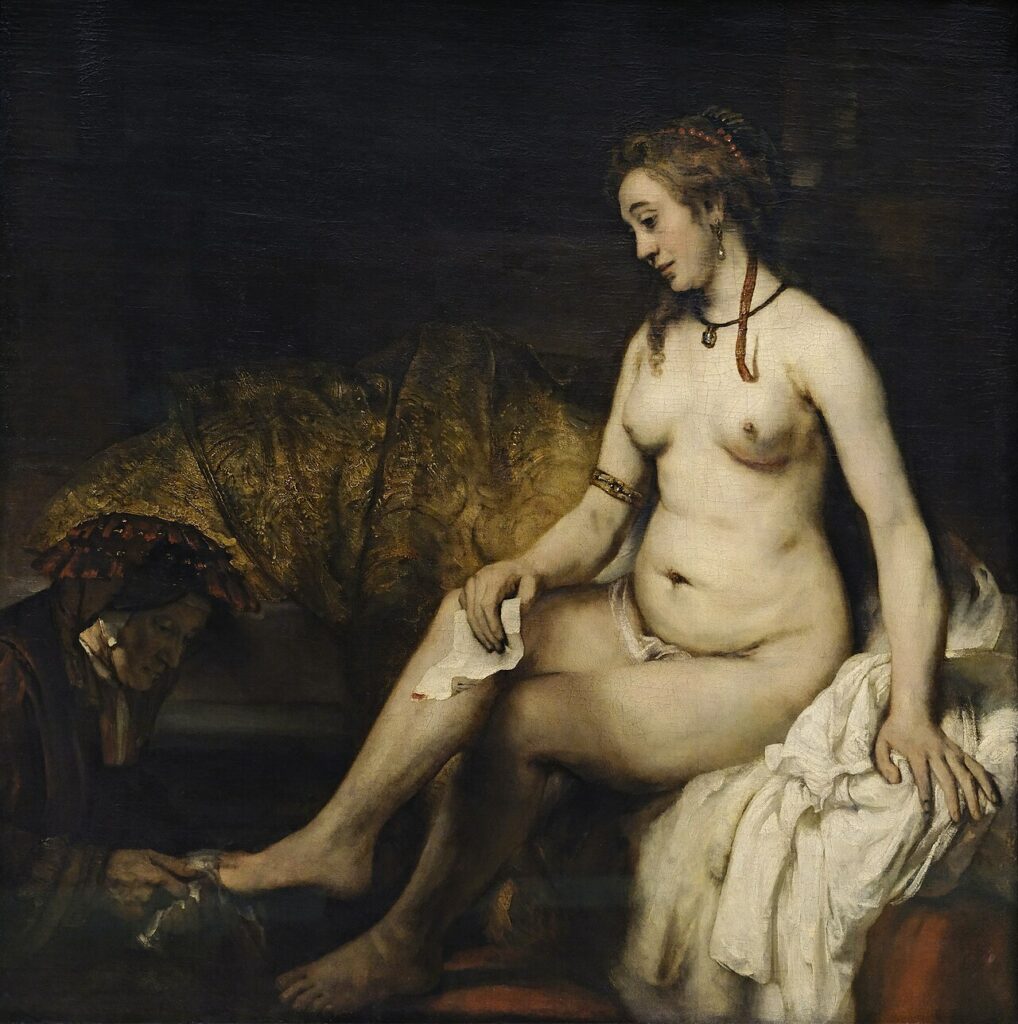
It was against this backdrop of moral, social, and financial tension that Rembrandt painted one of the most unique works in all of 17th-century Western painting— Bathsheba Bathing, Holding King David’s Letter. A square canvas measuring 142 × 142 centimeters depicting the biblical Queen Bathsheba at the moment she has just received King David’s letter summoning her to his palace to seduce her. The scene takes place in a dark interior, illuminated by warm light that falls on Bathsheba’s naked body. An old servant wipes her feet. No King David. No palace. No messenger. Just Bathsheba, alone with her letter and her inner dilemma —whether to resist the royal summons at the cost of her life, or to yield to it at the cost ofher honor and her betrayed husband.
The work is, in fact, one of the absolute masterpieces of Rembrandt’s mature period. According to the institutional consensus (the Louvre, the Rembrandt Research Project, Universalis), it was Hendrickje Stoffels herself who posed for the figure of Bathsheba. The psychological parallel between the biblical situation (Bathsheba summoned by the king, married to another man, caught in an insoluble moral dilemma) and Hendrickje’s real-life situation (the companion of a painter she cannot marry, pregnant with an illegitimate child, summoned by religious authorities) is too precise to be a coincidence. In a single work, Rembrandt superimposes a classic biblical scene and a cryptic portrait of his partner at the most dramatic moment of their life together.
The work has been housed at the Louvre Museum in Paris since Louis La Caze’s bequest in 1869. This article traces the precise origins of this painting—the unusual commission (likely no commission at all; Rembrandt painted it on his own initiative), the mature technique of thick flesh tones and internalized chiaroscuro,the documented identificationof Hendrickje Stoffels as the model,the rareiconography of the non-idealized nude in the Western tradition, and the painting’s museum history from Rembrandt’s studio to the Louvre.
1654 — The Year of Hendrickje’s Moral Dilemma
To understand the emotional depth of Bathsheba at the Bath, one must understand the personal circumstances of Rembrandt and Hendrickje Stoffels in the year 1654.
Hendrickje Stoffels (1626–1663) came to live in Rembrandt’s household around 1647–1649 as a governess for young Titus (then aged 6–8, having lost his mother, Saskia, in 1642). Born into a modest family in Bredevoort in the province of Gelderland, the daughter of a soldier who died young, Hendrickje arrived in Amsterdam penniless and found refuge with the widowed painter, who needed help raising his son.
Around 1649–1650, Hendrickje gradually became Rembrandt’s intimate companion. The age difference was twenty years (Rembrandt was 43–44, Hendrickje 23–24). The social gap was considerable—Rembrandt was one of Amsterdam’s most prosperous painters, while Hendrickje was a servant with no dowry, no formal education, and no influential family.
Why didn’t they get married? The answer is clear: the clause in the will of Saskia van Uylenburgh, Rembrandt’s first wife, who died in 1642. Saskia had stipulated in her will that Rembrandt would inherit her fortune only if he did not remarry. If Rembrandt were to remarry, Saskia’s fortune would pass directly to Titus upon his coming of age. However, Rembrandt—who had already begun to squander his capital on compulsive art purchases — could not afford to loseSaskia’s inheritance; he would have become immediately insolvent.
Rembrandt and Hendrickje thus lived together as common-law spouses for about fifteen years (around 1649–1663). This was a socially scandalous situation in 17th-century Calvinist Dutch society, where cohabitation was morally condemned bythe Reformed Church and socially marginalized.
May 1654: Hendrickje was summoned for the first time to appear before the council of the Reformed Church of Amsterdam for “living in the sin of fornication with Rembrandt the painter.” She refused to appear. June 1654: another summons. She refused again. July 1654: A third summons, to which Hendrickje this time appeared —visibly pregnant. She acknowledged her relationship with Rembrandt but refused to end it. As a result, Hendrickje was barred from receiving communion —a religious exclusion that deprived her of regular participation in Christian social life. This penalty is equivalent to a minor excommunication in Dutch Calvinism.
October 1654: Cornelia van Rijn, daughter of Hendrickje and Rembrandt, is born. The child was baptized in the Reformed Church of Amsterdam—Rembrandt was explicitly recognized as the father on the baptismal certificate. However, the child took her mother’s surname (Stoffels), in accordance with the customs of the time for children born out of wedlock.
It was in this specific context —between the religious gatherings of the spring and summer of 1654 and Cornelia’s birth in October—that Rembrandt painted Bathsheba at Her Bath. The parallel between Bathsheba’s biblical dilemma (summoned by the king, whether to betray her husband Uriah or resist) and Hendrickje’s real-life dilemma (summoned by the Church, whether to affirm her union with Rembrandt or renounce it) is too precise to be a coincidence.
Asthe American art historian Svetlana Alpers writes in her seminal work *Rembrandt’s Enterprise* (1988), regarding this painting:
“Rembrandt painted his own wife as Bathsheba during the most painful moment of their shared ordeal.”
— Svetlana Alpers, *Rembrandt’s Enterprise*, 1988*
The Biblical Account of Bathsheba
To understand the scene depicted, let’s briefly review the biblical episode on which Rembrandt based his work.
The story is told in the Second Book of Samuel, chapter 11, inthe Old Testament. Bathsheba (in Hebrew, Bat-Sheva, “daughter of the oath”) isthe wife of Uriah the Hittite, an officer inKing David’s army. David, king of Israel, watches Bathsheba from the terrace of his palace as she bathes in an inner courtyard of her own home. Overcome by desire, David sent a messenger to fetch Bathsheba and had her brought to the palace, where he slept with her.
Bathsheba becomes pregnant. To cover up the adultery, David recalls Uriah from the front lines in the hope that he will sleep with his wife and be believed to be the child’s father. But Uriah, out of military loyalty, refuses to enjoy domestic comforts while his comrades are fighting. David then orders General Joabto send Uriah to the front lines to a dangerous position from which he will not return. Uriah is killed in battle. David married Bathsheba. According to the biblical account, the child born of adultery died at birth as divine punishment. A second child, Solomon, would later be born of this union and inherit the throne of Israel.
The story of Bathsheba is one of the most frequently depicted stories in the entireOld Testament in Western painting. Before Rembrandt:
- Hans Memling (c. 1485, Stuttgart)
- Lucas Cranach the Elder (1526, Berlin)
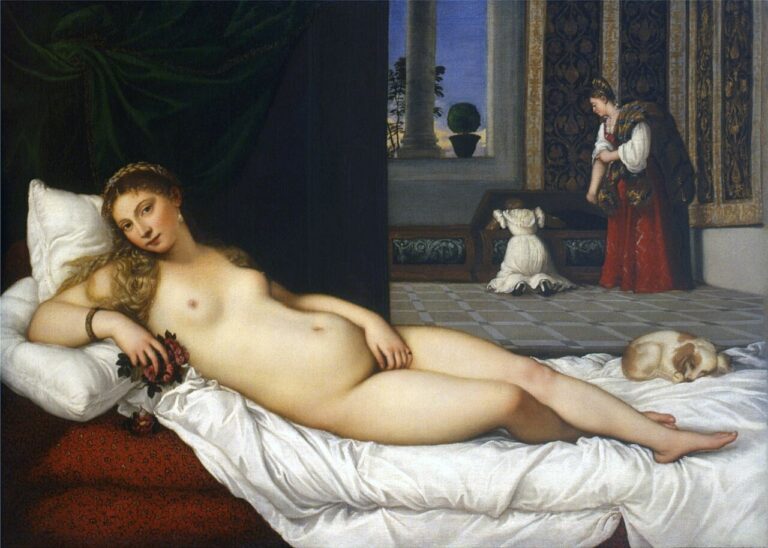
- Titian (1545, Vienna)
- Peter Paul Rubens (1635, Dresden)
- Jan Massys (1562)
Traditional iconographic convention: Painters before Rembrandt generally depicted three elements simultaneously in their portrayals of Bathsheba:
- Bathsheba, naked in her bath
- King David watching from a terrace in the background
- The messenger delivering the invitation letter
Rembrandt breaks completely with this convention. His Bathsheba features neither David nor a messenger. Just Bathsheba alone with her letter and the old servant drying her feet. A radical focus on Bathsheba’s psychology —her inner dilemma, her growing awareness of the impending tragedy.
This iconographic break is, according to the consensus among art historians, one of the great pictorial innovations of 17th-century Dutch art. Rembrandt invented the psychological biblical portrait —in which the subject is no longer the narrative of the episode butthe character’sinner state in the face ofthe event.
The Painting — What It Depicts
Bathsheba Bathing, Holding a Letter from King David is an oil on canvas measuring 142 × 142 centimeters — a square format, unusual for 17th-century European painting, which traditionally favored vertical or horizontal rectangles. This deliberate formal choice focuses the viewer’s attention on the center of the canvas.
The signature and date are painted in the lower left corner: “Rembrandt ft 1654” (where “ft” is the Latin abbreviation for fecit, “made”). The date is certain.
A composition centered on three figures:
1. Bathsheba, in the center of the painting, occupies two-thirds of the composition. Nude, seated on a crumpled white cushion (her shirt removed), her body slightly in profile, her upper body turned toward the viewer. Complex pose: her right leg is bent, and her left leg extends toward the lower right corner of the painting. Her right hand holds the open letter. Her left hand rests on her right thigh. Her face is turned to the left, her gaze fixed on an undefined point —neither the letter, nor the maid, nor the viewer. An inward gaze.
2. The elderly servant, on the right and below, is kneeling at Bathsheba’s feet. She is wiping her feet with a white cloth. Her face is partially in shadow, less well-lit than Bathsheba’s. Her face is marked by age, her features hard, and she is silently focused on her task. This creates a generational contrast with Bathsheba’s full-bodied youth.
3. In the background, on the left, hangs a rich golden brocade — a sumptuous drape with floral motifs that suggests the domestic wealth of Uriah, her husband. The brocade balances the composition on the left and reinforces Bathsheba’sisolation in the center.
Scattered physical elements:
- An open letter held by Bathsheba— the central narrative element around which the entire meaning of the painting converges
- A freestanding basin or tub, partially visible
- Precious jewelry on Bathsheba’s left arm and neck— a gold bracelet and a chain with a pendant —symbolizing the high social status ofan officer’s wife
- A crumpled white piece of fabric on which Bathsheba is sitting— a shirt she had just taken off
Lighting: Rembrandt uses his characteristic golden light to illuminate Bathsheba’s body. The light source comes from the upper left (off-screen). The body appears sculpted by this warm light, which caresses every contour of her flesh. The background is bathed in a golden-brown twilight that makes the figure emerge like a luminous bas-relief. This chiaroscuro is characteristic of Rembrandt’s late maturity.
Color palette: predominantly golden-brown, with pink skin tones accented by white and ochre, pale green on the brocade, and deep black for the hair and jewelry. No blues, no bright reds. A limited, warm palette typical of his late works.
Painting technique: considerable thickness of the paint. Rembrandt uses layered coats applied with both a palette knife and a brush. Generous impasto on the flesh tones —Bathsheba’s skin is rendered with an almost sculptural thickness, where one can physically see the layers of pigment. This technique of thick impasto isan innovation of Rembrandt’s late maturity— a legacy of the Venetians (late Titian) but taken to an unparalleled level.
Repentances visible in X-ray images. According to the Louvre Museum’s scientific fact sheet, significant repentances are visible in X-ray images of the painting. Bathsheba’s head was originally tilted less —Rembrandt altered it during the painting process to emphasizeher meditative posture andpsychological absorption. This is evidence of the painter’s ongoing artistic exploration.
Hendrickje and Bathsheba — The Documented Identification
The identification of Hendrickje Stoffels as the model for the figure of Bathsheba is widely accepted by the modern scholarly community. Several pieces of evidence point in the same direction:
1. Physical resemblance. Bathsheba’s face in the painting at the Louvre closely matches the identified portraits of Hendrickje, notably:
- Portrait of Hendrickje Stoffels (circa 1654–1656, National Gallery, London) — A bust portrait of Hendrickje, with the same facial features
- Hendrickje at the Window (1656–1657, Gemäldegalerie Berlin) — same facial structure
- Hendrickje in Bed (c. 1647, National Gallery, Edinburgh) — a younger but recognizable model
Characteristic features of Hendrickje found in Bathsheba: a round face, a firm jawline, a slightly receding chin, dark brown eyes, well-defined eyebrows, a full mouth with downturned corners, and a high, unobstructed forehead.
2. The date on the painting (1654). This is preciselythe year of Hendrickje’s religious summons and Cornelia’s birth. The thematic parallel between Bathsheba’s moral dilemma and Hendrickje’s actual situation is perfectly timed.
3. The physical condition of the model. Several historians (notably the medical analysis published by doctors Roland Coignard and Jean-Loup Brangé in *La Revue du Praticien* in 2003) have noted that Bathsheba’s left breast exhibits an abnormality: irregular swelling, localized redness, and marked asymmetry compared to the right breast. Retrospective medical diagnosis: Hendrickje likely suffered from mastitis (a breast infection) or a breast abscess resulting from a pregnancy complication. Rembrandt is said to have depicted his partner’s actualmedical condition with realistic accuracy — a valuable testament to the painter’s documentary precision.
4. The emotional dimension. The painterly tenderness with which Rembrandt depicts Bathsheba’s body —every nuance of flesh, every fold of skin, every shadow—is, according to modern biographers (Schama 2002, Bikker 2019), incompatible with an anonymous model. It is, in fact, a romantic portrait disguised as a biblical scene.
Critical reservations. Some art historians (notably Eric Sluijter in *Rembrandt and the Female Nude*, 2006) dispute this identification, arguing that it was unlikely that Rembrandt would have depicted his partner in a nude intended for public sale —which would have been socially unacceptable in 17th-century Calvinist Amsterdam. According to Sluijter, Rembrandt may have painted Bathsheba from several models or from memory, without deliberately depicting Hendrickje.
Response to the debate: The majority of modern art historians maintainthe identification of Hendrickje, pointing out thatno evidence of a public sale of the painting during her lifetime has been found. The painting may have been created to remain inRembrandt’s studio— a personal possession that the painter would never have wished to sell —and it did indeed disappear from inventories between 1654 and 1751 (when it reappeared in a private French collection), suggesting that it remained within the painter’s inner circle for a long time.
Non-idealized nudity—an iconographic revolution
One of the most revolutionary aspects of “Bathsheba at Her Bath” is its depiction of the female nude. Rembrandt completely breaks with the conventions of the classical European nude inherited from the Italian Renaissance.
Conventions of the classical nude (Titian, Raphael, Botticelli, Boucher): the female body is idealized according to ancient standards — harmonious proportions, smooth and youthful skin, graceful poses, and elegant movements. The nude is an ideal aesthetic object, disconnected from the anatomical reality of living women. It appeals to the male viewer without unsettling him with a disturbing physical truth.
Rembrandt breaks with this tradition. His *Bathsheba* depicts:
- The actual body of a 28-year-old woman who had been pregnant several times (Hendrickje had already had several miscarriages before Cornelia)
- Heavyflesh, sagging in places, marked by the folds and contours of a real adult body
- Asymmetrical breasts (one of which likely has mastitis)
- A slightly rounded belly (Hendrickje was pregnant at the time the photo was taken)
- Thick, strong, muscular thighs —not the slender legs idealized in classical nudes
- A complex, ungainly, uncomfortable posture —a real woman in a real pose, not a perfectly arranged statue
This apparent “ugliness” —at least according to classical standards —is in fact a new conception of the artistic nude. Rembrandt invented the realistic, lifelike, embodied nude. The beauty of Bathsheba’s body does not stem from conformity to an abstract ideal, but from the truth of the flesh as observed and loved.
As the specialized blog *Les yeux d’Argus* writes in an analysis of the work:
“Bathsheba’s body glows as if illuminated by an inner radiance. This body lacks the almost intimidating splendor of Rubens’s Bathsheba.”
— The Eyes of Argus: Bethsheba’s Analysis While Bathing
Critical Reception in the 19th Century. When the painting entered the Louvre in 1869 (as part of the La Caze bequest), some French critics were shocked bythe lack of idealization. Several critics dismissed the painting as “ugly, ” “crude, ” and “unworthy of a biblical goddess.” This initial negative reception would gradually fade in the 20th century, as aesthetic standards evolved and modern painting came to value truth overidealization.
Influence on modern painting. Rembrandt’s *Bathsheba* has, in fact, had a direct influence on:
- Eugène Delacroix studying Rembrandt at the Louvre in the 1830s–1860s
- Édouard Manet, whose*Olympia* (1863, Musée d’Orsay) borrows from Bathsheba the structure of the realistic, non-idealized nude, rejecting the conventions of the academic nude
- Edgar Degas, whose “Late Bathers” (pastels from the 1880s–1900s) further develop the concept of the observed, rather than idealized, nude
- Lucian Freud (1922–2011), whose nudes all explicitly draw on Rembrandt’s tradition
Without Bathsheba, without the iconographic breakthrough achieved by Rembrandt in 1654, an entire dimension of the modern Western nude would be impossible. It isthe seminal work of realistic nude painting in Europe.
From Rembrandt’s studio to the Louvre Museum
The Material History of “Bathsheba at Her Bath” from its creation in 1654 until its arrival at the Louvre in 1869 is partly unclear —as is the case with many of Rembrandt’s works that disappeared from inventories for long periods.
1654–circa 1680: The painting likely remained in Rembrandt’sstudio in Amsterdam. There is no documented record of a sale during the painter’s lifetime. After Rembrandt’s death in 1669, the painting was likely included in the posthumous inventory of his studio, which was managed by his daughter Cornelia van Rijn (the child born to Hendrickje in 1654, who is thus the maternal model in the painting itself —an extraordinary situation).
Late 17th – early 18th century: partial records in the inventories of several Dutch private collections. The painting circulated on the Dutch art market without any detailed public records.
Around 1751: The painting appeared in the French collection of Count Christian-Joseph de Spaen, a diplomat in the service of the King of France. This is the first documented mention of the painting in France.
18th century: The painting passed through several private collections in Paris. Three auctions are documented: 1758, 1773, and 1798 —each time, the painting changed hands among French aristocratic collectors. The estimated value rose steadily: from 3,000 livres in 1758 to more than 10,000 francs in 1798.
19th century: The painting entered the collection of Dr. Louis La Caze (1798–1869), a Parisian physician, passionate collector, and art patron who, over the course of thirty years, built one of the largest private collections of French and Dutch paintings in Paris during the Second Empire. His collection numbered more than 800 works at the time of his death in 1869.
January 1869: Louis La Caze died in Paris at the age of 71. In his will, he bequeathed hisentire collection to the French government— 583 works, according to the final inventories. The La Caze bequest was accepted by the government and became part of the Louvre Museum’s collection. In fact, it isone of the most significant private bequests ever received by the museum—comparable, in scale, to the Helene Kröller-Müller bequest to the eponymous museum in the Netherlands, or to the Caillebotte (1894) and Camondo (1911) donations to the Louvre/Orsay.
1869: Bathsheba at Her Bath officially entered the Louvre’s collections under inventory number MI 957. It was immediately displayed in the Gallery of Flemish and Dutch Painters, where it has remained for 156 years.
Today: The painting is on permanent display at the Louvre Museum, inthe Richelieu Wing, Level 2, Room 841 (17th-century Dutch painting, Rembrandt Gallery). Optimal conservation conditions, appropriate museum lighting, protective glass.
How to View the Work Today
Bathsheba at her bath, holding King David’s letter is housed at the Louvre Museum in Paris. Practical information:
- Address: Cour Napoléon, Pyramide, 75001 Paris
- Metro: Palais Royal – Louvre Museum (Lines 1 and 7)
- Wing: Richelieu, Level 2, Room 841
- Section: Flemish and Dutch Painting, Rembrandt Gallery
- Inventory number: MI 957 (bequest of Louis La Caze, 1869)
- Complete pricing and hours: louvre.fr — general admission ticket providing access to all permanent collections
Also showing in the same theater:
The Louvre Museum houses one of the world’s largest collections of Rembrandt works—about 15 major paintings, as well as numerous drawings and etchings:
- Bathsheba at the Bath (1654) — the artwork featured in this article
- The Pilgrims of Emmaus (1648) — a major religious scene from his mature period
- The Flayed Ox (1655) — an extraordinary still life, created around the same time as *Bathsheba*
- Self-Portrait at the Easel (1660) — Self-Portrait at Work
- Saint Matthew and the Angel (1661) — a late religious work
- The Philosopher in Meditation (1632) — atmospheric scene
- The Holy Family (1640) — an intimate religious scene
- Venus and Love (1662) — a late mythological work
- Several other major works
To place Bathsheba in the context of Rembrandt’s nudes:
- Woman Bathing in a River (1654, National Gallery, London) — a small work from the same period as “Bathsheba,” also featuring Hendrickje as the model; worth comparing during a visit to London
- Suzanne and the Old Men (1647, Mauritshuis, The Hague) — an earlier work on a similar biblical theme (a naked woman being spied on)
- Danaë (1636–1647, Hermitage, St. Petersburg) — a biblical female nude, depicted several times by Rembrandt
To see a portrait of Hendrickje with an identified subject:
- National Gallery, London — Portrait of Hendrickje Stoffels (c. 1654–1656)
- Gemäldegalerie, Berlin — Hendrickje at the Window (1656–1657)
- Louvre, Paris — the figure of Bathsheba herself remains the most monumental tribute to Hendrickje in Rembrandt’s entire body of work
Further Reading
Institutional sources cited
- Louvre Museum, official description of “Bathsheba at Her Bath.”
- Art Panorama (RMN), analysis of “Bathsheba at Her Bath.”
- Encyclopédie Universalis, article “Rembrandt van Rijn.”
- Rembrandt Research Project, *A Corpus of Rembrandt Paintings*, 6 volumes, Springer/Nijhoff, The Hague, 1982–2015. The definitive academic reference.
Primary sources cited
- Notarial deeds and church records of the Reformed Church of Amsterdam, 1654—summonses issued to Hendrickje Stoffels.
- Catalog of the Louis La Caze Collection, 1869 — bequeathed to the Louvre.
Leading Modern Studies
- Svetlana Alpers, *Rembrandt’s Enterprise: The Studio and the Market*, University of Chicago Press, 1988. A source of analysis on the parallel between Bathsheba and Hendrickje.
- Eric Sluijter, *Rembrandt and the Female Nude*, Amsterdam University Press, 2006. A seminal scholarly study of Rembrandt’s nudes.
- Simon Schama, *The Face of Rembrandt*, Seuil, Paris, 2002.
- Jonathan Bikker, *Rembrandt: Biography of a Rebel*, Rijksmuseum, Amsterdam, 2019.
- Pascal Bonafoux, *Rembrandt: Self-Portraits and Works*, Skira, Geneva, 1985.
Institutional Documentation
- Louvre Museum, Paris — owned by the institution since 1869 (La Caze bequest).
- Rijksmuseum, Amsterdam — one of the world’s leading Rembrandt collections.
- Rembrandt House, Amsterdam — a studio-museum where Rembrandt painted Bathsheba in 1654.
See also on Hors Cadre
- Rembrandt — The Self-Portrait as a Chronicle of a Life — Portrait of the Artist, Complete Biographical Context, Including His Relationship with Hendrickje Stoffels.
- *The Night Watch*—a revolution in group portraiture —Rembrandt’s signature masterpiece (1642), painted the year Saskia died, twelve years before *Bathsheba*.
- Caravaggio—the inventor of chiaroscuro —the definitive master of Baroque chiaroscuro, who indirectly influenced Rembrandt through engravings circulating in Amsterdam.
— M