Portrait of Adele Bloch-Bauer I — Klimt’s “Woman in Gold”
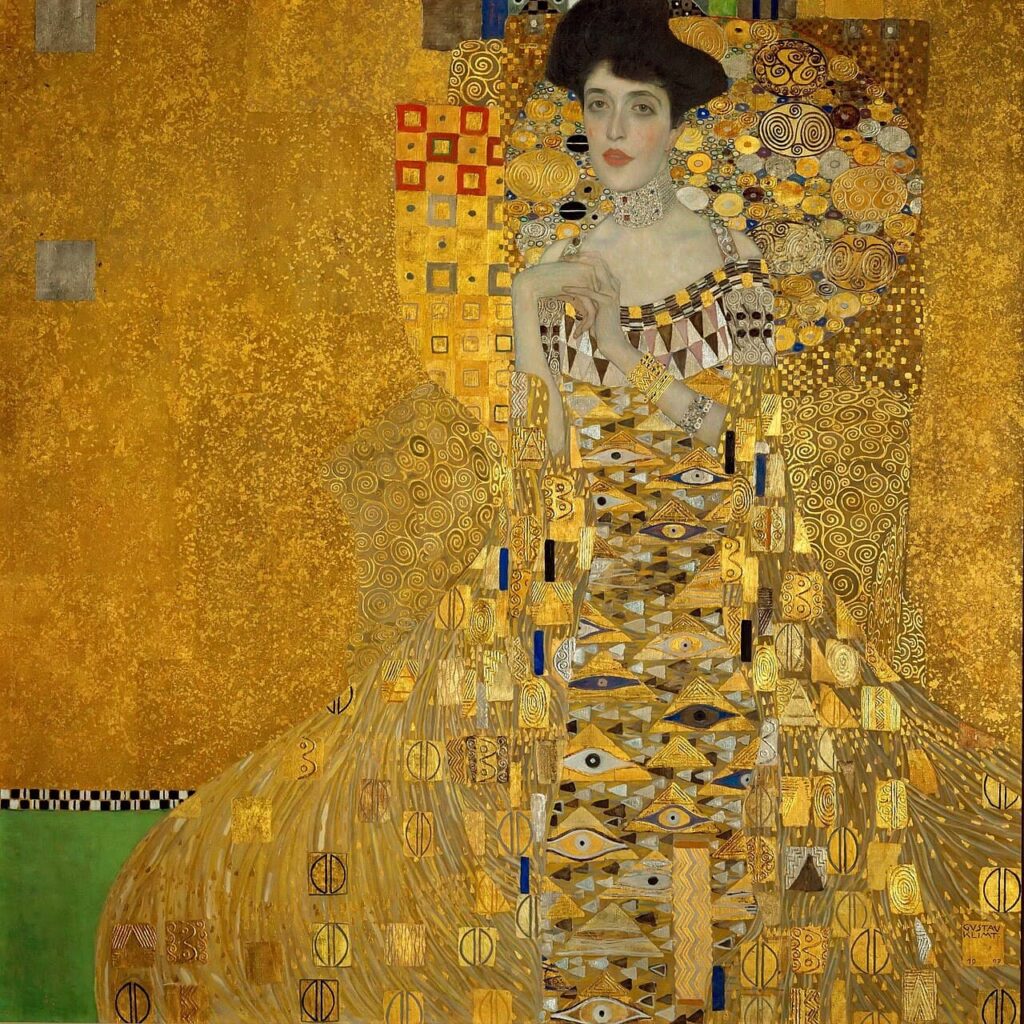
Gustav Klimt — Gold and Desire →A woman emerges from an ocean of gold. With a pale, delicate face, rosy cheeks, dark eyes, and an intense gaze, she appears enveloped in an immense golden adornment, studded with shimmering motifs, which causes her to blend almost entirely into a background of dazzling gold. Only her face, shoulders, and hands rise above this precious tide. This is Gustav Klimt’s Portrait of Adele Bloch-Bauer I —the “Golden Lady,” one of the pinnacles of his Golden Period, and one of the most famous and fascinating portraits in all of modern art.
Painted in 1907, this portrait is the counterpart to *The Kiss*: the same sumptuous gold, the same fusion of figure and ornament, the same transfiguration of the subject into a precious icon. But whereas *The Kiss* celebrates universal love, *The Lady in Gold* immortalizes a real woman, a unique individual: Adele Bloch-Bauer, a socialite and patron of the arts in 1900s Vienna, the only woman Klimt ever painted twice. The portrait thus combines the decorative splendor of the Golden Age with the intense presence of a very much alive face and gaze.
But this masterpiece is not just an artistic marvel: it also tells one of the most moving stories of the 20th century. Seized by the Nazis after the annexation of Austria and exhibited for decades in Vienna under a name that concealed the Jewish identity of its subject, it was at the center of a long legal battle waged by a determined heiress, Maria Altmann, to return it to her family. This quest for justice, which reached all the way to the U.S. Supreme Court and culminated in a sensational outcome, has made *The Lady in Gold* a symbol—one of memory, plunder, and reparations.
This article explores the two facets of this masterpiece—the artwork itself and its fate. We will examine what the painting depicts, how Klimt blends the woman—Adele Bloch-Bauer—into the gold, the genesis of this exceptional portrait, its tragic history and restitution, and its current life in New York.
The Painting — What It Depicts
*Portrait of Adele Bloch-Bauer I* is an oil on canvas, enhanced with gold and silver, in a square format: 138 centimeters on each side. This format, like that of *The Kiss*, contributes to the balance and fullness of the composition and focuses attention on the central figure.
The work depicts a young woman standing—or rather, emerging from—a vast golden field that almost entirely envelops her. Her finely modeled face, with its pale complexion and slightly rosy cheeks, is rendered with delicate naturalism: her features are distinct, her gaze dark and intense, her lips slightly parted. Her hands, also rendered realistically, are clasped in front of her in a somewhat constrained gesture—it has been noted that Adele used this pose to conceal a finger she considered unsightly. These elements of flesh and life—the face, shoulders, and hands—are the only naturalistic parts of the work.
Everything else is gold and ornamentation. Adele is draped in an immense golden gown or ensemble that almost blends into the background, which is also golden. A profusion of motifs unfolds across this dazzling surface: rectangles, spirals, triangles, oval shapes evoking eyes, and symbols drawn from a variety of ornamental traditions. The figure thus appears almost dissolved into a precious mosaic, barely distinguishable from the background. Among the motifs, one can make out intertwined letters suggesting the model’s initials. The armchair on which she is leaning and the space surrounding her have lost all sense of depth: the composition is flat, ornamental, and abstract, like a Byzantine icon.
The contrast is striking between the naturalism of the face and hands, on the one hand, and the golden abstraction that surrounds them, on the other. It is from this tension that the magic of the work arises: a real, living woman, whose gaze fixes on us intensely, captured and seemingly set in a frame of gold and ornamentation. A critic of the time admirably summed up this impression by describing her as an idol in a golden sanctuary.
An idol in a golden shrine
A contemporary critic’s description—an idol in a golden sanctuary—perfectly captures the ambition and impact of this portrait. In it, Klimt transforms a woman from Viennese high society into a true icon, a golden deity. How does he achieve this?
As in *The Kiss*, gold plays a central and symbolic role here. Klimt applies real gold and silver leaf to the canvas, creating a dazzling surface that captures and reflects light. This gold, inspired by the Byzantine mosaics of Ravenna that Klimt had discovered during his travels in Italy, lends the portrait a sacred, precious, and timeless quality. Adele is not merely depicted: she is sanctified, elevated to the status of an idol, like the Byzantine empresses in the gold mosaics. The society portrait becomes an icon.
The ornamental motifs that cover the dress and the background are not mere decorations. Klimt weaves together symbols drawn from various sources: shapes evoking the eyes found in Egyptian art, spirals, and geometric patterns—symbols that dot the surface with a network of enigmatic signs. These motifs, both decorative and symbolic, create a visual universe of inexhaustible richness, where the eye gets lost. Some have even recognized Adele’s initials, discreetly integrated into the design—like a secret signature of the model inscribed within the ornamentation.
Klimt’s genius lies in maintaining, at the heart of this gilded abstraction, the intense presence of a very real face and gaze. Adele is not lost in the ornamentation: she emerges from it, alive and unique, with her pale complexion, her dark gaze, and her expression that is at once haughty and melancholic. This tension between the individual and the icon, between the real woman and the golden goddess, is what makes the portrait so fascinating. Klimt achieves the remarkable feat of transforming a commissioned portrait into an absolute work of art, in which the subject attains a form of eternity without losing any of her human presence.
Adele Bloch-Bauer, the woman
Behind the *Golden Lady* lies a real woman whose life and personality deserve to be known. Adele Bloch-Bauer was one of the leading figures of Vienna’s cultured high society in 1900, and she occupies a unique place in Klimt’s body of work.
Born into a wealthy family of the Viennese Jewish bourgeoisie, Adele had married Ferdinand Bloch-Bauer, a powerful sugar magnate. An intelligent, cultured woman with a passion for art and ideas, she hosted a renowned salon in her home where artists, intellectuals, and prominent figures of modern Vienna gathered. A generous patron of the arts, she supported the artists of her time, particularly Gustav Klimt, whose genius she admired. She belonged to that circle of enlightened Jewish bourgeoisie in Vienna that served as the great patron of modern art—and of which Klimt was one of the principal beneficiaries after he had renounced official commissions.
Adele is the only woman Klimt painted twice: in addition to this 1907 portrait, he painted a second portrait of her in 1912, in a more colorful style, reflecting the evolution of his style after the “Golden Period.” This double portrayal attests to the special bond that united the artist and his model. Some art historians have even speculated that a more intimate relationship may have existed between them, and that Adele’s features may have inspired other figures in Klimt’s work, such as his Judith. These unverifiable hypotheses add to the mystery and fascination surrounding the Woman in Gold.
Adele’s life was short and tragic. In 1925, she died suddenly of meningitis at the age of only forty-two. Her grief-stricken husband, Ferdinand, treasured her portrait, which he displayed in his home as a tribute to his beloved wife. Adele had expressed the wish that the Klimt paintings owned by the couple would one day be returned to the Belvedere Museum in Vienna—a wish that, many years later, would play an unexpected and controversial role in the painting’s history. But when Adele died, no one could have imagined the fate that awaited her gilded portrait.
Klimt’s Longest Portrait
” The Golden Lady ” is not only one of Klimt’s most beautiful portraits; it is also the one that required the most time and meticulous attention to detail. The story of its creation attests to the exceptional ambition the artist poured into this work.
The portrait was commissioned from Klimt by Ferdinand Bloch-Bauer, who wanted a portrait of his wife—a prestigious commission, befitting the couple’s wealth and taste. Klimt worked on it for about four years, from 1903 to 1907, a considerable amount of time for a portrait. He produced hundreds of drawings and preparatory studies, exploring poses, postures, and expressions as he sought the ideal composition. Some of these preparatory drawings have been preserved and allow us to trace the artist’s long journey toward the final work.
This slow creative process marks the height of Klimt’s golden age—the years during which he perfected the art of blending paint and gold. *The Golden Lady* and *The Kiss*, painted just a few months apart, are the twin culminations of this period. In both works, we find the same mastery of gold, the same profusion of ornamentation, and the same transfiguration of the subject into an icon. Adele’s portrait is, in a sense, the “portrait” counterpart to what *The Kiss* is to the “allegory” counterpart: two sides of the same genius at its zenith.
When the portrait was finally unveiled in 1907 and then exhibited in Vienna the following year, it sparked both admiration and debate. Some saw it as a dazzling masterpiece; others found the ornamentation excessive. But no one remained indifferent to this sumptuous image, in which a woman of Viennese high society was elevated to the status of a golden idol. The portrait cemented Klimt’s status as the greatest painter in Vienna of his time, and Adele Bloch-Bauer’s as one of the iconic figures of that glittering society—though neither could have imagined the tragic fate that awaited both the model and her portrait.
Dispossession
The story of *The Lady in Gold* takes a tragic turn with the rise of Nazism and the annexation of Austria. From that point on, the painting’s fate becomes intertwined with that of the persecution and plunder suffered by the Jews of Europe.
In March 1938, Nazi Germany annexed Austria: this was the Anschluss. The persecution of Jews, already underway in Germany, immediately spread to Austria. The wealthy Jewish Bloch-Bauer family was directly threatened. Ferdinand Bloch-Bauer, Adele’s widower since 1925, was forced to flee the country to escape the Nazis; he sought refuge in Switzerland, leaving behind his property and his art collection. His properties, his business, and his art collection—including several paintings by Klimt, foremost among them the portrait of Adele—were looted by the Nazi regime.
The portrait of Adele then underwent a peculiar and revealing transformation. On display at the Belvedere Museum in Vienna, it was renamed “Woman in Gold,” erasing the name of its subject. This change in title was no trivial matter: it was intended to conceal Adele Bloch-Bauer’s Jewish identity and to erase the name of this Jewish family that had been dispossessed. The painting, which had become one of the crown jewels of Austria’s public collections, was thus severed from its true history, its origins, and its model. The work is there, admired, but its history is denied.
Ferdinand Bloch-Bauer died in exile in 1945, at the end of the war, without ever having been able to recover his possessions. In his will, he bequeathed his estate to his heirs—his nieces and nephew. But the Klimt paintings remained in Austria, at the Belvedere, where they would remain on display for nearly six decades, treated as national treasures, under titles that had obscured their origin. The spoliation seemed complete and irreversible. It would take until the end of the century—and the determination of one woman—for justice to begin to be served.
Maria Altmann’s Battle
The return of *The Golden Lady* is one of the most famous cases of restitution of looted art in the history of art. It was the result of the tenacity of one woman, Maria Altmann, and a long legal battle that set a legal precedent.
Maria Altmann was the niece of Adele and Ferdinand Bloch-Bauer. Having herself fled Austria to escape the Nazis, she had sought refuge in the United States, where she had been living for decades. In the late 1990s, two developments reignited hopes for restitution: Austria’s adoption in 1998 of a law on the restitution of looted artworks, and the opening of archives that revealed the true story of how the Austrian government had acquired the paintings. Maria Altmann, then an elderly woman, decided to fight to recover her family’s works of art, including her aunt’s portrait.
The battle was long and fraught with obstacles. Austria initially refused to return the paintings, citing, among other things, Adele’s wish—expressed before her death—that the paintings be returned to the Belvedere. But this argument faced a decisive objection: Adele was not the owner of the paintings. They belonged to her husband, Ferdinand, who had commissioned and paid for them; Adele’s wish was therefore merely a request addressed to her husband, with no legally binding force. And Ferdinand, for his part, had bequeathed his estate to his heirs. Furthermore, the legal fees required in Austria—calculated based on the value of the works—were simply unaffordable for a retiree. Maria Altmann then brought the case before the U.S. courts.
The case, known as Republic of Austria v. Altmann, attracted considerable attention. It raised a complex legal question: Could a private individual sue a foreign state in U.S. courts? In 2004, the U.S. Supreme Court ruled in favor of Maria Altmann, allowing the lawsuit to proceed. Rather than continue with the trial, the parties agreed to arbitration in Austria. In January 2006, the Austrian arbitration panel issued its ruling: the five looted Klimt paintings, including *Portrait of Adele Bloch-Bauer I*, were to be returned to the Bloch-Bauer heirs. After nearly seventy years, justice was served. The decision set a legal precedent and encouraged other efforts to recover looted artworks around the world.
The Golden Lady Today
The 2006 restitution was not the end of the story of *The Lady in Gold*: it marked the beginning of a new chapter, in which the painting achieved worldwide fame and found a new home.
Shortly after the painting was returned, Maria Altmann and her co-heirs decided to sell the portrait. It was purchased in 2006 by Ronald Lauder, an American businessman and collector, for $135 million—one of the highest prices ever paid for a painting at that time. This record-breaking sum made headlines around the world and contributed to the work’s fame. Ronald Lauder donated the painting to the Neue Galerie in New York, a museum he had co-founded and dedicated to early 20th-century German and Austrian art. *The Lady in Gold* has been on permanent display there ever since, available for the public to admire—in a sense, fulfilling the wish that the work remain visible to all.
The story of the painting took one final turn, which ultimately made it world-famous: the movies. In 2015, the film * Woman in Gold*, starring Helen Mirren as Maria Altmann, brought this story of looting and restitution to the screen. The film reached a wide audience and brought the extraordinary story of the “Woman in Gold” and Maria Altmann’s struggle to the attention of people far beyond art circles. The painting had become an icon not only of art, but also of remembrance and morality.
Thus, *The Golden Lady* embodies two inseparable stories: that of an artistic masterpiece—the pinnacle of Klimt’s Golden Period and a sublime portrayal of a woman in turn-of-the-century Vienna— and that of a tragic fate and restitution, a symbol of the looting during the Holocaust and the long struggle for justice and remembrance. Few works so powerfully encapsulate both the beauty of art and the weight of history. This is what makes this portrait, today, one of the most fascinating and moving works in existence—and a deeply moving conclusion to Gustav Klimt’s Golden Period.
How to View the Work Today
” Portrait of Adele Bloch-Bauer I ” is housed at the Neue Galerie in New York, the museum founded by Ronald Lauder and dedicated to early 20th-century German and Austrian art. The painting occupies a place of honor there, in a gallery dedicated to Klimt, where it is on permanent display.
Seeing the work in person allows you to appreciate its full splendor: the radiance of the gold and silver, the delicacy of the motifs, and the intensity of Adele’s face and gaze. No reproduction can fully capture the magic of this precious, shimmering surface. For fans of Klimt and turn-of-the-century Vienna, the Neue Galerie is a must-see, especially since it houses other works by the artist and from his era.
To explore Klimt’s world without crossing the Atlantic, the Belvedere Museum in Vienna—which long housed *The Golden Lady* —presents the world’s largest collection of his works, including *The Kiss* and *Judith I*. Comparing *The Kiss* and the portrait of Adele—even from a distance—allows us to appreciate the two twin pinnacles of his Golden Period. The Musée d’Orsay in Paris, for its part, houses a landscape by Klimt, *Roses Under the Trees*.
Further Reading
Institutional sources cited
- Neue Galerie, New York, description of the *Portrait of Adele Bloch-Bauer I*.
- Google Arts & Culture, a feature on portraiture and its interpretation.
- Case law on Republic of Austria v. Altmann (U.S. Supreme Court, 2004).
Sources and Reference Studies
- Anne-Marie O’Connor, *The Lady in Gold: The Extraordinary Tale of Gustav Klimt’s Masterpiece*, Knopf, 2012.
- Tobias G. Natter, Gustav Klimt: The Complete Paintings, Catalogue Raisonné.
- The 2015 film *Womanin Gold*.
Institutional Documentation
- Neue Galerie, New York — the institution that houses the work.
- Belvedere, Vienna — the largest Klimt collection.
See also on Hors Cadre
- Gustav Klimt — Gold and Desire — A Portrait of the Artist, His Life, and His Art.
- “The Kiss”—Klimt’s golden masterpiece —the other highlight of his “Golden Period,” painted that same year.
- Egon Schiele—the raw body —Klimt’s disciple and the other great name in 1900s Vienna.
— M