The Kiss — Klimt’s Golden Icon
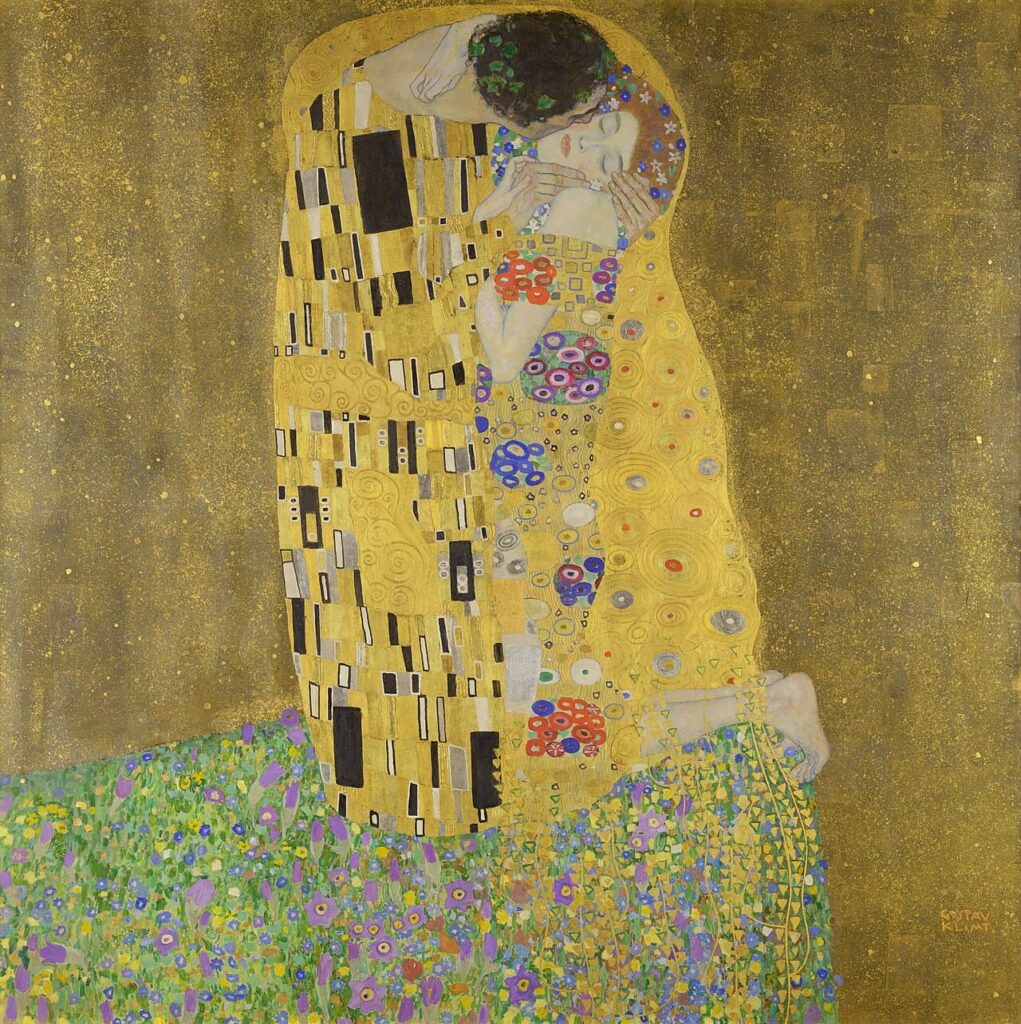
Gustav Klimt — Gold and Desire →Two lovers entwined, kneeling on a carpet of flowers, wrapped in a huge golden cloak studded with patterns: Gustav Klimt’s *The Kiss* is undoubtedly the most famous depiction of love in the entire history of painting. The man, crowned with ivy, tilts his head to kiss the woman’s cheek; she, with her eyes closed and her face turned toward him, surrenders to a peaceful ecstasy. All around them, gold shines brilliantly, erasing the world and suspending time. It is the eternal moment of romantic union, sanctified by the radiance of the precious metal.
Painted in 1907–1908, at the height of Klimt’s “Golden Period,” this large square canvas is the Viennese master’s absolute masterpiece, the quintessence of his art. Everything that defines Klimt’s genius is brought together here: the sumptuous gold inherited from Byzantine mosaics, the fusion of the decorative and the symbolic, the celebration of desire and love, and the union of the carnal and the sacred. *The Kiss* represents the pinnacle of the union of gold and desire that defines Klimt’s entire body of work.
The work captivates with its immediate, dazzling, sensual beauty. But beneath this decorative splendor lies a remarkable depth of meaning and subtlety of composition. Every element—the golden cloak, the patterns on the clothing, the field of flowers, the edge of the precipice, the shimmering background—carries meaning. In it, Klimt explores themes of love, the union of the sexes, desire, fragility, and the eternity of the human embrace. Behind this popular icon lies a work of inexhaustible richness.
This article explores the secrets of this masterpiece—what it represents, the significance of the golden cloak that unites the lovers, the symbolism of the masculine and feminine motifs, the mystery of the precipice at the edge of which they embrace, the Byzantine origins of the gold, the woman’s expression of ecstasy, the probable identities of the models, and how this work has become one of the universal icons of love.
The Painting — What It Depicts
*The Kiss* is a large-scale oil on canvas, enhanced with gold and silver leaf: 180 centimeters high by 180 centimeters wide. This perfectly square, monumental format is essential: it creates a sense of harmony, balance, and fullness, and focuses all attention on the central couple.
The work depicts two lovers embracing, occupying the center and upper part of the composition. They are kneeling—or rather, the woman is kneeling, while the man, leaning over her, towers slightly above her. The man, whose face is seen in profile and three-quarter view from behind, is crowned with ivy leaves; he gently cradles the woman’s face in his hands and leans down to kiss her on the cheek. The woman, her face turned toward the viewer, has her eyes closed in an expression of surrender and ecstasy. Her hands rest gently on the man’s hands and on the nape of his neck. Everything about their poses expresses tenderness, restrained passion, and union.
The two figures are wrapped in a single, immense golden cloak that unites and envelops them, revealing only the woman’s face, hands, and feet. This cloak is covered with sumptuous ornamental patterns, which differ depending on whether they adorn the man or the woman. The couple is kneeling on a bed of multicolored flowers, a lush carpet of vegetation that fills the lower part of the composition. And behind them, all around, stretches an abstract, uniform, shimmering golden background, devoid of decoration or perspective—a space of pure gold, studded with fine particles that glitter like stars.
The work is striking for the contrast between the delicate naturalism of the faces and hands—rendered with realism and sensitivity—and the ornamental abstraction of the rest: the cloak, the patterns, and the golden background. This tension between living flesh and precious decoration, between the individual and the ornament, lies at the heart of Klimt’s art and is what makes the work so unique. The lovers are both flesh-and-blood beings and golden icons.
A Golden Cloak — The Union of Lovers
The most striking and significant element of the work is this unique golden cloak that envelops the two lovers, uniting them into a single form. This cloak is much more than a piece of clothing: it is the very symbol of their union.
By enveloping the two bodies in a single golden adornment, Klimt visually expresses the fusion of the lovers. The man and woman, entwined, form a single unit, a single silhouette, a single radiant form. The cloak eliminates the separation between their bodies, merging the two beings into a single unit. It is an image of love as fusion, as a perfect union, where two beings become one. The overall shape, rounded at the top, evokes a single silhouette rising upward, like a flame or a golden column.
This golden set also has a protective and sacred dimension. The cloak enfolds and protects the lovers, isolating them from the world and creating a precious cocoon around them. It removes them from ordinary time and space, placing them in a world of their own, apart from the rest of the world—the world of their love. Gold, a noble and eternal material, imbues their embrace with a sense of eternity: this moment of the kiss seems destined to last forever, frozen in the precious metal. Love becomes an icon; the embrace becomes eternal.
It has often been noted that the man’s face is almost entirely concealed, turned away, while the woman’s is fully exposed to the viewer’s gaze. This artistic choice, common in Klimt’s depictions of embraces, focuses attention on the woman—on her face, her expression, and her surrender. She is the one being celebrated; she is at the center of the work. The man is almost merely a presence, an enveloping force; the woman is the true subject, the object of desire and veneration. Once again, Klimt places the woman at the heart of his art.
Rectangles and Circles — Masculine and Feminine
The ornamental motifs covering the lovers’ cloak are not mere decorations: they carry specific symbolism, contrasting and uniting the masculine and the feminine. This is one of the most widely discussed subtleties of the work.
Upon close inspection of the cloak, two very distinct patterns emerge. The part covering the man is adorned with rectangular shapes, quadrilaterals, and black, white, and gray blocks, featuring straight lines and sharp angles. The part covering the woman, on the other hand, is covered with round motifs, colorful circles, spirals, and flowers, featuring curved and organic shapes. This distinction is deliberate and systematic.
This contrast in motifs symbolically reflects the differences and complementarity of the sexes. The geometric, angular, structured forms of the man—symbols of strength, structure, rationality, and virility—are counterbalanced by the round, floral, organic forms of the woman—symbols of emotion, nature, fertility, and femininity. In this way, Klimt embeds within the ornament itself a meditation on the male-female duality and on the union of opposites brought about by love. The two opposing principles meet and unite in an embrace.
This symbolism extends to other elements of the work. The flowers scattered across the woman’s garment and the flowerbed where the couple is kneeling are symbols of fertility, nature, and the cycle of life. The floral motifs and open circles also evoke, more subtly, female sexuality and fertility. Klimt, as a painter of desire and life, thus blends the celebration of love with that of fertility and the cycle of nature. For him, ornamentation is never gratuitous: it carries meaning and contributes to the work’s deeper significance. It is this fusion of the decorative and the symbolic that gives *The Kiss* its inexhaustible richness.
On the Brink of the Abyss
One detail of the composition—often overlooked at first glance—adds an unexpected and profound dimension to the work: the couple is kneeling not on a simple meadow, but at the edge of a precipice, a flower-covered cliff that drops abruptly into the void.
If you look closely at the bottom of the painting, you’ll notice that the flowerbed on which the lovers are embracing forms a sort of promontory—a ledge that ends in a steep drop-off. The woman’s feet, visible protruding from her golden cloak, are clenched and curled up at the edge of this void, as if she were holding herself back from falling. The couple is thus placed on the edge of an abyss, in a precarious position, on the brink of the chasm.
This discovery changes the way we interpret the work. Beneath the appearance of peaceful, eternal romantic bliss, Klimt introduces a note of fragility, danger, and precariousness. Love, he seems to suggest, is also a fragile balance, an embrace on the edge of the abyss, a suspended moment that could tip over at any moment. The lovers’ bliss is threatened by the abyss just beyond. This ambivalence—happiness and danger, eternity and precariousness—gives the work a dramatic depth that its decorative splendor might otherwise mask.
This tension is characteristic of Klimt’s vision and of the entire sensibility of Vienna in 1900. Beneath the brilliance and sensuality, there always lies an underlying awareness of fragility, finitude, and death. Love and death, Eros and the end, are inseparable in this culture marked by an acute awareness of the precariousness of all things. The couple in *The Kiss*, in their golden embrace, is both happy and threatened, eternal and precarious. It is this ambivalence that prevents the work from sinking into decorative sentimentality and gives it its true grandeur: a meditation on love as a sublime and fragile moment, snatched from nothingness.
The Gold of Ravenna
Gold, which gives the work its radiance and magic, is not an arbitrary choice. It draws on specific sources that shed light on the meaning Klimt ascribed to it. To understand this gold is to understand the artist’s ambition.
The most important source of inspiration for Klimt’s use of gold is Byzantine art. During his travels in Italy, particularly in Ravenna, Klimt discovered the sumptuous Byzantine mosaics that adorn the city’s churches, such as the Basilica of San Vitale. These mosaics, with their dazzling gold backgrounds and stately, ornately dressed figures depicting emperors, empresses, and saints in sacred splendor, deeply moved him. There he found the inspiration for his “Golden Period”: the idea of using gold to create sumptuous and sacred images that were at once flat and radiant, ornamental and spiritual.
Byzantine gold, in church mosaics, symbolized divine light, eternity, and the sacred. By drawing on this gold, Klimt imbues his secular subjects—love, desire, and women—with that same sacred dimension. In *The Kiss*, the lovers’ embrace is elevated, through the use of gold, to the status of a sacred scene, a venerated icon. Human love acquires the solemnity and eternity once reserved for religious figures. Klimt sanctifies desire, deifies the embrace, and makes carnal love an object of veneration. This is one of the most profound boldnesses of his art: transferring the sacred from the religious realm to love and desire.
In addition to this Byzantine influence, there was Klimt’s personal heritage: as the son of a goldsmith and engraver, he had grown up familiar with the precious metal. His skill with gold leaf, his attention to ornamental detail, and his appreciation for precious materials all stemmed from this background. In *The Kiss*, Klimt works with gold like a goldsmith, applying the leaves, creating reliefs, and playing with shimmer and matte finishes. The canvas becomes a precious object, halfway between a painting and a piece of goldsmithing. Here, the goldsmith’s son creates his golden masterpiece—the culmination of everything Ravenna and his father had passed on to him.
Ecstasy and Desire
At the center of the work, the woman’s face—open and surrendered—concentrates all the emotional and erotic intensity of the painting. It is through this face that Klimt expresses desire, ecstasy, and the surrender of love.
The woman’s face is the only one fully visible, turned toward the viewer, her eyes closed. Her expression is one of total surrender, of peaceful ecstasy. Her closed eyelids, relaxed features, and head tilted back and offered convey pleasure, sensual delight, and a joyful surrender to the embrace of her beloved. Here, Klimt captures with remarkable precision the moment of romantic surrender, the instant when a person gives in to desire and happiness. Every detail—the curve of the bare shoulder, the delicate position of the fingers, the tilt of the face—contributes to this expression of ecstasy.
This celebration of female desire and pleasure was, at the time, remarkably daring. In the stifling society of turn-of-the-century Vienna, where bourgeois conventions suppressed the expression of sexuality, depicting a woman’s voluptuous abandon and the ecstasy of desire in this way was a provocation. Klimt, like Freud at the same time, brought to light the power of desire and the importance of Eros in human life. But whereas his earlier academic paintings had caused a scandal with their crudeness, *The Kiss* sublimates desire through beauty and gold, making it acceptable—even admirable. Sensuality is transfigured, elevated, and sanctified.
That is the essence of Klimt’s art: celebrating desire without demeaning it, expressing Eros without vulgarity. By enveloping the embrace in gold and ornamentation, by placing it in a sacred and timeless space, he imbues desire with nobility, grandeur, and a spiritual dimension. *The Kiss* is not a salacious image: it is a hymn to love and desire, a celebration of the power of Eros, transfigured by art. Klimt thus achieves the synthesis toward which his entire body of work strove: the union of the carnal and the spiritual, of desire and the sacred, of flesh and gold.
Klimt and Emilie Flöge
Who are the lovers in *The Kiss*? The question has intrigued commentators, and the most likely answer adds a touching autobiographical dimension to the work.
According to the most widely accepted theory, the models for *The Kiss* were Klimt himself and Emilie Flöge, his partner. Emilie Flöge was the love of Klimt’s life: a Viennese fashion designer and businesswoman, she shared his life for nearly thirty years, until his death. Although they never married, and despite Klimt’s many other affairs, Emilie held a unique place in his heart and life. They spent their summers together on the shores of Lake Attersee, and numerous photographs show them happy and close.
If this interpretation is correct, *The Kiss* takes on an intimate dimension: it would be a celebration of Klimt’s love for Emilie, an image of their own embrace transfigured by gold and art. The man crowned with ivy would be Klimt, and the woman being embraced would be Emilie. This universal masterpiece of love would also be a portrait of a couple, a personal declaration. This hypothesis gives the work a special resonance: behind the iconic image lies a real-life love story—that of the painter and his partner.
However, we must exercise some caution: the identification is not certain, and Klimt never confirmed it. As was often the case, he left the mystery unresolved, preferring the universal to the particular. And perhaps that is for the best: for the power of *The Kiss* lies precisely in its universal nature. The lovers need not be named; they are all lovers—the man and the woman, the eternal couple. By barely showing the man’s face and portraying the woman as an idealized figure rather than a specific portrait, Klimt created an image with which everyone can identify. *The Kiss* is the embrace of all lovers in the world—and that is what makes it a universal icon.
A Universal Icon
From the moment it was created, *The Kiss* was an instant success, and has continued to grow in fame ever since, becoming one of the most universally recognized and beloved images in the history of art. This exceptional journey deserves to be chronicled.
The work was first presented to the public in 1908 at the Vienna Kunstschau, a major exhibition where Klimt had an entire room to himself. Unlike the paintings he had created for University of Vienna, which had caused a scandal a few years earlier, *The Kiss* was met with immediate and unanimous enthusiasm. Its success was such that the Austrian government purchased the painting even before the exhibition ended, for the considerable sum of twenty-five thousand crowns—an exceptional honor that established the work as a national treasure from the very beginning. After years of controversy, this was a resounding triumph for Klimt.
Since then, *The Kiss* has continued to captivate audiences. Housed at the Belvedere in Vienna, it has become one of the most visited works of art in the world, drawing crowds of visitors who come to admire its golden radiance. But its fame extends far beyond the museum’s walls: the image of *The Kiss* has spread everywhere, appearing on countless posters, reproductions, objects, and merchandise. It has become a universal symbol of love and romance, one of the most reproduced images in the entire history of art. Through this work, Klimt has entered global popular culture.
This extraordinary popularity sometimes has a downside: through constant reproduction and overuse, the work risks being reduced to a mere decorative motif, stripped of its depth. That is why it is so valuable to return to the work itself, to look at it closely, and to rediscover its richness of meaning and subtlety. For *The Kiss* is not merely a pretty golden image: it is a profound masterpiece, a meditation on love, desire, the union of the sexes, the fragility and eternity of the human embrace. Behind this popular icon lies one of the greatest achievements of modern art—the culmination of the union of gold and desire that defines Gustav Klimt’s genius.
How to View the Work Today
*The Kiss* is housed at the Belvedere Museum in Vienna, in the Baroque Upper Belvedere Palace, which is home to the world’s largest collection of Klimt’s works. The painting is displayed in a room dedicated to the artist’s Golden Period, where it is the main attraction.
Seeing *The Kiss* in person is an irreplaceable experience. No reproduction can capture the true brilliance of the gold, the relief of the metal leaves, the shimmer of the surface, or the subtleties of the motifs. Standing before the large square canvas, one can truly appreciate the power of the work, its radiance, and the magic of this gold that seems to emit its own light. It is one of those paintings that you absolutely must see with your own eyes to fully grasp its beauty.
The Belvedere houses other masterpieces by Klimt, including *Judith I* (1901), as well as works by Schiele—among them *Death and the Maiden* and *The Family*. Seeing the works of the master and his disciple together allows visitors to appreciate the dialogue and contrast between these two great artists of turn-of-the-century Vienna. To explore Klimt’s work more broadly, the Musée d’Orsay in Paris houses one of his landscapes, *Roses Under the Trees*.
Further Reading
Institutional sources cited
- Belvedere, Vienna, entry on *The Kiss* (*Der Kuss*).
- Encyclopædia Universalis and Larousse, entries on “Gustav Klimt.”
- Documentation from the Vienna Kunstschau (1908).
Sources and Reference Studies
- Gilles Néret, Gustav Klimt 1862–1918, Taschen, 2015.
- Gottfried Fliedl, Gustav Klimt. The World in Women, Taschen.
- Tobias G. Natter, Gustav Klimt: The Complete Paintings, Catalogue Raisonné.
Institutional Documentation
- Belvedere, Vienna — the institution that houses the work.
- Musée d’Orsay, Paris — to see a landscape by Klimt.
See also on Hors Cadre
- Gustav Klimt — Gold and Desire — A Portrait of the Artist, His Life, and His Art.
- Portrait of Adele Bloch-Bauer I — The Lady in Gold — Klimt’s Other Golden Masterpiece and Its Extraordinary Story.
- Egon Schiele—the raw body —Klimt’s disciple, whose tormented embraces echo the master’s golden harmony.
— M