Mount Sainte-Victoire — A Lifelong Obsession
Paul Cézanne — Consolidating Impressionism →A massif of gray-white limestone, rising above the Provençal plain. A familiar triangular shape, visible from everywhere in the vicinity of Aix-en-Provence, which the southern light colors in turn with shades of blue, ochre, pink, and violet depending on the time of day and the season. For the residents of Aix, it is a daily sight on the horizon. For Paul Cézanne, it was much more:a lifelongobsession, the subject to which he returned tirelessly for nearly a quarter of a century, and which became the laboratory where part of modern art was invented.
Mount Sainte-Victoire is not a single painting, but a series —one of the most extensive and famous in the history of painting. Between 1882 and 1906, Cézanne depicted this Provençal mountain range in a staggering number of works: there are about thirty oil paintings and numerous watercolors, for a total of nearly eighty works devoted to a single subject. No painter before him had focused his artistic exploration to such an extent on a single subject—except perhaps Monet, his contemporary, with his “Haystacks” and “Cathedrals,” created at exactly the same time.
But whereas Monet painted the same cathedral to capture different moments of light, Cézanne soughtthe opposite: not the fleeting, but the permanent. Through his depictions of the mountain, he pursued his quest for a solid, structured style of painting capable of capturing the enduring structure of things beneath the shifting play of light. The immutable and monumental Sainte-Victoire was the ideal subject for this pursuit.
This article explores that obsession —how Cézanne encountered this subject, from which vantage points he painted it, how his treatment evolved from the early descriptive versions (featuring the viaduct and the valley) to the final views of Les Lauves, dissolved into a web of colors on the threshold of abstraction—and how this Provençal mountain became, under his brush, one of the starting points for all of 20th-century art.
A Mountain, An Obsession
Montagne Sainte-Victoire is a limestone massif that towers over the countryside around Aix-en-Provence, rising to just over 1,000 meters. Its distinctive silhouette —a long ridge that rises gently and then drops off abruptly—is visible throughout the Aix region. Cézanne, who was born and died in Aix, had it in view his entire life.
He began painting it around 1882, initially as just one element among others in his Provençal landscape compositions. But starting around 1886, the mountain gradually came to dominate his work: it became the central subject, the dominant motif to which he returned time and again until his death in 1906. Over the course of nearly twenty-five years, Sainte-Victoire becamethe focal point of his artistic exploration.
What is striking about this series is the variety of approaches. Cézanne changes something each time—the viewpoint,the lighting, the season, the composition, orthe atmosphere he seeks to evoke. Each version is stylistically distinct, as scholars have pointed out: each is a different solution to the same pictorial problem, a new attempt to construct the mountain through painting.
This repetition is therefore never monotonous. On the contrary, it is a sign of an inexhaustible quest. For Cézanne, the mountain is not a backdrop to be reproduced but a constant challenge: how can one convey, on a flat surface, the massive presence of a three-dimensional form in space? How can he bring the sky, the rock, the plain, and the trees together into a coherent and enduring composition? Each painting is a provisional answer to this question—and the question itself is never exhausted.
“What a beautiful pattern”
Cézanne’s relationship with Sainte-Victoire was long-standing and deep. As a child, he had roamed the countryside around Aix with his friend Émile Zola, swimming in the Arc River and walking at the foot of the mountain range. The mountain has always been part of his inner landscape.
It was in a letter to Zola dated April 14, 1878, that Cézanne—describing the mountain he saw from the window of the train traveling from Aix to Marseille—wrote this phrase, which sums up his sense of wonder at the scene:
“What a beautiful pattern.”
— Paul Cézanne, letter to Émile Zola, April 14, 1878
Three words, but they say it all. For Cézanne, the mountain is the quintessential motif —in the sense that painters use the term: the subject one paints en plein air, that is, outdoors, facing nature. For him, Sainte-Victoire is the perfect subject: stable enough to allow for prolonged study, monumental enough to embody the permanence he seeks, and familiar enough that he can return to it time and again.
Toward the end of his life, in a letter to his dealer Ambroise Vollard dated January 1903, Cézanne even compared himself to Moses on Mount Sinai—the man who climbed the mountain to receive a revelation, unsure whether he would be able to return to the Promised Land. A revealing image: for Cézanne, painting Sainte-Victoire had become a kind of spiritual quest, a confrontation between the artist and an absolute to be attained.
Three Viewpoints — Bellevue, Bibémus, Les Lauves
Cézanne did not paint Sainte-Victoire from just any vantage point. He primarily used three favored viewpoints, each corresponding to a different period and style.
Bellevue (1880s–1890s). In the early years of the series, Cézanne often painted the mountain from the vicinity of Bellevue, a property belonging to his brother-in-law (his sister’s husband), southwest of Aix. From there, the mountain appears in the distance, towering over the Arc Valley, sometimes with the Aix-Marseille railroad viaduct in the foreground. These versions are the most descriptive and panoramic.
The Bibémus Quarry (late 1890s). Cézanne then rented a small cottage near the old Bibémus quarries, east of Aix—abandoned ochre stone quarries where the rocks had been cut into geometric blocks. From there, he painted the mountain towering over the chaos of the incandescent rocks. These versions are more focused, more structured, and more dramatic: the mountain rises above a foreground of rocks with almost cubic shapes, as if nature itself were offering Cézanne the geometry he sought.
The Lauves Hill (1902–1906). In his final years, Cézanne had his studio built on the Chemin des Lauves, on a hill north of Aix. From the terrace and its surroundings, he discovered a new, unobstructed view of the mountain, seen from the north. It was there that he painted his final series —about eleven versions from this vantage point—the most accomplished and modern of all. These last Sainte-Victoire paintings represent the pinnacle of his work.
Each perspective thus corresponds to a stage in Cézanne’s artistic development: from the descriptive panorama of Bellevue to the dramatic composition of *Bibémus*, and then to the quasi-abstract synthesis of *Les Lauves*.
The Viaduct and the Arc Valley
The earliest versions of the series, painted in the 1880s, are the most clearly visible and descriptive. They depict the mountain in the distance, towering over the Arc Valley, in a sweeping panorama.
One of the most famous of these early versions is Mont Sainte-Victoire with the Large Pine Tree (of which there are several versions, including one at the Courtauld Gallery in London and another at the Phillips Collection in Washington). In these compositions, Cézanne often incorporates two characteristic elements:
The railroad viaduct. The Aix-Marseille line crosses the Arc Valley via a long arched viaduct, which Cézanne frequently placed in the center-right of his compositions. This viaduct —a modern, industrial structure—engages in a dialogue with the eternal mountain. A discreet presence of modernity in a timeless landscape.
The Great Pine. In the foreground of several versions, a tall umbrella pine spreads its branches, whose curves frame and follow the silhouette of the mountain in the background. In this way, Cézanne creates a formal echo between the pine branches in the foreground and the ridge line of the mountain range in the distance—a way of linking the different planes of the composition and holding them together.
These early works remain relatively traditional in their spatial composition: one can clearly distinguish a foreground (the trees, the fields), a middle ground (the valley, the viaduct), and a background (the mountain, the sky). But even here, Cézanne’s signature touch —those small, juxtaposed splashes of color—begins to unify the whole, treating the sky and the rock, the near and the far, with the same painterly texture. The blurring of the planes, which would reach its peak in the final versions, is already in its infancy.
The Construction Phase — Building the Mountain in Stages
Around the turn of the 1890s and 1900s, Cézanne’s style reached full maturity —what art historians call his “constructive phase.” It is here that the essence of his contribution to modern art lies.
In these works, Cézanne reduces the landscape to its essential elements. He simplifies forms, eliminates incidental detail, and emphasizes the underlying structure of the subject. Mountains, fields, trees, and houses are no longer objects to be described but volumes to be constructed.
To achieve this, he employs a distinctive technique: small, almost rectangular strokes of color, juxtaposed like the pieces of a mosaic. These strokes are not merely decorative; they are structural. Each one defines a fragment of space, and their combination creates volume, depth, and light. Cézanne literally builds his painting stroke by stroke, just as a mason lays his stones.
The use of color is crucial here. Cézanne does not use color to imitate the actual appearance of things (green for trees, blue for the sky), but to create space and volume. He understood that variations in color—warm/cool, light/dark—are sufficient to suggest depth and relief, without resorting to traditional perspective or classical modeling through shadow. An area of blue recedes, an areaof ochre comes forward: depth arises solely from the interplay of colors. Cézanne called this “modulating” color.
This discovery—that color can construct space—is one of the most fruitful in the entire history of painting. It liberates color from its purely imitative function and transforms it into an autonomous means of construction. This idea gave rise to both Fauvism (liberated color) and Cubism (reconstructed space).
The Latest Works by Les Lauves — On the Threshold of Abstraction
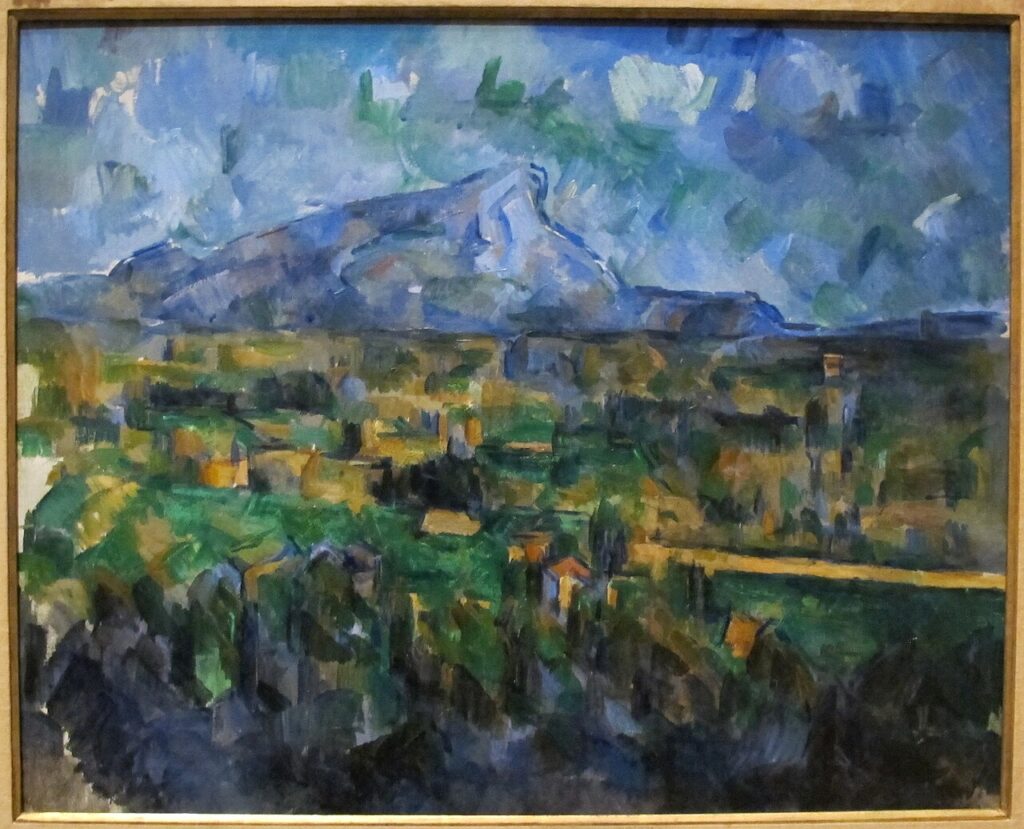
The final “Sainte-Victoire” paintings, created between 1902 and 1906 from the Lauves hill, represent the pinnacle of Cézanne’s work—and one of the most breathtaking moments in the entire history of Western painting. In these works, the painter pushes his exploration to a point that foreshadows abstraction.
In these latest versions, the mountain gradually sheds its descriptive silhouette. It becomes an arrangement of colorful brushstrokes — blues, greens, ochres, purples —that no longer so much depict the subject as they form an autonomous pictorial surface. The mountain’s peak, sometimes left white, contrasts with the dark masses of trees in the foreground. Even the sky loses its “real” color toharmonize chromatically with the plain.
The most striking example of this evolution is *Montagne Sainte-Victoire*, held at the Kunstmuseum in Basel (circa 1904–1906), often considered one of the last in the series. In this painting, the mountain is composed almost entirely of blues and a touch of green; its form dissolves into a magnificent arrangement of brushstrokes that harmonize with those of the plain. The entire landscape is bathed in an unreal light, beneath a sky devoid of natural color. Here we stand on the threshold of abstraction—without ever quite crossing it, for the mountain remains recognizable.
These late works achieve the impossible synthesis that Cézanne had sought all his life: unparalleled freedom in brushwork and color, combined with no less absolute rigor in composition. The subject is at once dissolved and present, abstract and realistic, free and constructed. It is in this tension that Cézanne’s ultimate genius lies. It is said that, in his final years, he himself sensedthe approach of this abstraction—and that he perceived it as a kind of threat, a breaking point toward which his artistic quest was irresistibly drawing him.
Why this obsession? The Mountain as a Pictorial Problem
Why did Cézanne paint the same mountain nearly eighty times? It’s a question worth asking, because this obsession lies at the heart of his art.
The answer lies partly in his method. Unlike the Impressionist, who seeks to capture a moment, Cézanne works slowly and at length, constantly returning to the same subject toexplore it more deeply. Each painting is a new attempt to solve the problem posed by the mountain: how to convey in a painting the presence of volume in space, the structure of a landscape, and the relationships between things. The single motif allows him to focus his exploration: by sticking to the same subject, Cézanne can vary the one thing that truly interests him—the pictorial construction.
The mountain also offers a unique advantage. It is unchanging, permanent, monumental —exactly the solidity that Cézanne seeks to imbue his painting with. Where a river flows, where a cloud passes, where the light changes, the mountain remains. It is the very symbol of what Cézanne aims to achieve: something lasting, stable, and well-constructed —“solid and enduring like the art in museums.”
Finally, there is a personal, almost mystical dimension. Sainte-Victoire is the mountain of his childhood, of his homeland, of his Provençal roots. By painting it tirelessly, Cézanne engages in a dialogue with the landscape that shaped him, with a nature he loves deeply. His comparison to Moses on Mount Sinai is not insignificant: for him, painting the mountain is a way of seeking truth, of striving toward a pictorial absolute that he ceaselessly pursues without ever taking it entirely for granted. “I owe you the truth in painting, and I will tell it to you, ” he wrote to Émile Bernard. Sainte-Victoire was the setting for this quest for truth.
From Cézanne to Modern Art — The Enduring Legacy of the Motif
The ” Montagne Sainte-Victoire ” series is not only a pinnacle of Cézanne’s work; it is one of the starting points for all 20th-century art.
Cubism is its most direct heir. Bibémus’s geometric rocks, the layered composition of the later versions, the way the landscape is broken down into colored facets — Picasso and Braque would take all of this and systematize it beginning in 1908. Braque’s early Cubist landscapes (painted in L’Estaque, in the very same spots where Cézanne had painted) stem directly from the late Sainte-Victoire series. Cubism carries on Cézanne’s legacy: treating reality as a construction of volumes and planes.
Abstraction also draws inspiration from this work. The later versions of *Les Lauves*, in which the mountain dissolves into arrangements of colorful brushstrokes, foreshadow the abstract painting that would emerge in the 1910s (Kandinsky, Mondrian). Cézanne demonstrates that a painting can stand on its own through the interplay of forms and colors alone, regardless of what it depicts. Mondrian, in fact, went through a phase in which he broke down trees into grids of brushstrokes directly inspired by Cézanne, before reaching pure abstraction.
Beyond these two movements, the entire history of modern painting is reflected in *Mont Sainte-Victoire*. The idea that a painting is first and foremost an autonomous construction —an arrangement of forms and colors on a flat surface—rather than simply a window onto the world, is Cézanne’s centrallegacy. And nowhere is this legacy more evident than in this Provençal mountain, painted and repainted until it became the silent manifesto of the art to come.
Sainte-Victoire has thus become, beyond its geographical reality, a place of art history—the mountain where, with patience, a single man invented a new way of seeing.
How to View Art Today
The works in the Sainte-Victoire Mountain series are scattered among the world’s major museums. Paris is home to several of them.
In Paris
Musée d’Orsay — houses several versions of *Sainte-Victoire* as well as the most extensive collection of Cézanne’s works in France (still lifes, portraits, *The Card Players*). Be sure to check them out in the Post-Impressionist galleries.
Musée de l’Orangerie, Tuileries — the Walter-Guillaume Collection features works by Cézanne, in dialogue with other modern artists.
In Provence
In Aix-en-Provence, you can visitthe Lauves studio (Cézanne’s studio), which has been preserved in its original condition, and, above all, discover the scene itself: the Terrain des Peintres, located on the Lauves hill, offers the exact view that Cézanne painted in his later years. The sites at Bibémus and Le Tholonet also allow visitors to experience the painter’s vantage points facing the mountain.
Around the World
The major versions in the series are housed at the Metropolitan Museum (New York, the “Viaduct” version), the Courtauld Gallery (London), the Kunstmuseum Basel (one of the most abstract), the Phillips Collection (Washington), the Pushkin Museum (Moscow), the Philadelphia Museum of Art, the Scottish National Gallery (Edinburgh), the Cleveland Museum of Art, and the Detroit Institute of Arts, among other major international collections.
Further Reading
Institutional sources cited
- Musée d’Orsay, Cézanne Collection and Artwork Descriptions.
- Cézanne Society, resources and digital catalog of the Sainte-Victoire series.
- Encyclopædia Universalis, article “Paul Cézanne.”
Primary sources cited
- Paul Cézanne, Correspondence (letters to Émile Zola dated April 14, 1878; to Ambroise Vollard from January 1903; to Émile Bernard), edited by John Rewald, Grasset, Paris.
Leading Modern Studies
- John Rewald, *The Paintings of Paul Cézanne: A Catalogue Raisonné*, Harry N. Abrams, New York, 1996.
- Alain Madeleine-Perdrillat, Studies on the Sainte-Victoire Mountains (Société Cézanne).
- Philip Conisbee, Denis Coutagne, *Cézanne in Provence*, exhibition catalog, RMN, 2006.
Institutional Documentation
- Musée d’Orsay, Paris — French collection of Cézanne works.
- Cézanne’s Studio, Aix-en-Provence — the Lauves studio and sites that inspired his work.
See also on Hors Cadre
- Paul Cézanne — Consolidating Impressionism — A Portrait of the Artist, His Career, and His Quest for Lasting Composition.
- The Card Players—Cézanne’s “Silent Gravity” —another masterpiece from his mature period, in which Cézanne treats the figures as three-dimensional forms.
- Musée d’Orsay — What to See, Hours, Tickets — A Complete Guide to the Museum That Houses France’s Largest Collection of Cézanne Works.
— M