The Card Players — Cézanne’s Silent Gravity
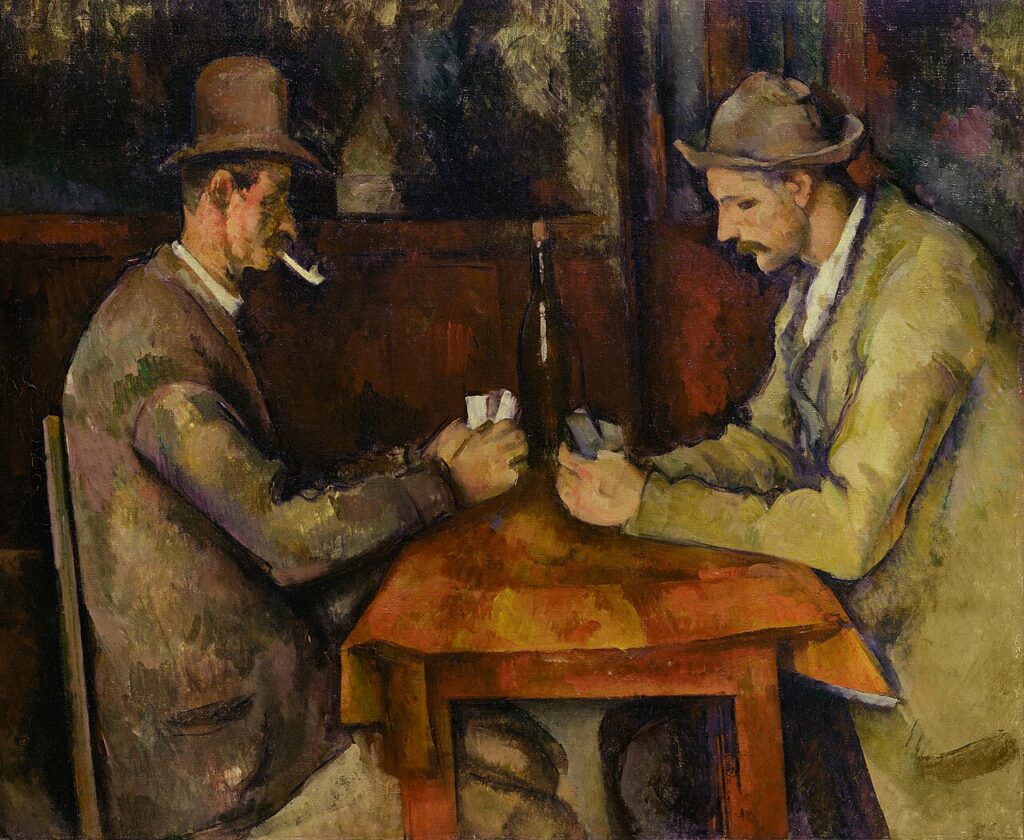
Paul Cézanne — Consolidating Impressionism →Two men sitting across from each other at a small wooden table. They are playing cards. Between them, a bottle stands upright in the center. They do not look at each other, do not speak to each other—each stares at his hand, absorbed, motionless, silent. No anecdotes, no drama, no cheating: just the concentration of two Provençal peasants in the light of a cabaret. And yet, from this utterly mundane scene, Paul Cézanne created one of the most solemn and monumental paintings in the entire history of French art.
The Card Players is one of Cézanne’s most famous works—and, in fact, an entire series. Between 1890 and 1896, in the solitude of his native Provence, Cézanne painted five versions of this same subject, gradually simplifying it by reducing the number of players and the setting until he achieveda monumental,minimalist composition. The version in the Musée d’Orsay (1894–1895), featuring just two players, is considered one of the most stripped-down and accomplished in the series.
The story of this series took a dramatic turn in 2011: one of the five versions was sold tothe State of Qatar for an estimated sum of over $250 million —making it, at the time, the most expensive painting in the world, regardless of the artist. A dizzying twist of history: these anonymous peasants, painted by a solitary, misunderstood artist, became, a century later, the subject of the most expensive art transaction ever recorded.
This article reveals the secrets behind this work—why Cézanne painted five versions of it, who these players were (actual peasants from his family’s estate), which ancient pictorial tradition inspired Cézanne, how he transformed a simple genre scene into a monumental composition reminiscent of a still life, and how this modest series has become both a pinnacle of modern art and an art market record.
A series of five paintings
The Card Players is not a single painting but a series —one of the most famous in the history of art, comparable to Monet’s Haystacks or Cathedrals. Between 1890 and 1896, during his mature period in Aix-en-Provence, Cézanne devoted five oil paintings to this subject, accompanied by numerous drawings and preparatory studies.
The five versions differ in their format, the number of players depicted, andthe scale of the setting. They can be divided into two groups:
Versions with multiple characters (the earliest ones):
- A version in the collection of the Barnes Foundation (Philadelphia)—the largest and most densely populated, featuring several figures and a child watching
- A version in the collection of the Metropolitan Museum of Art (New York)—which also features several figures
The two-player versions (the latest, more streamlined ones):
- A version in the collection of the Courtauld Gallery (London)
- A piece that was long held in a private collection and sold in 2011 (now in Qatar)
- The version at the Musée d’Orsay (Paris)—one of the most minimalist
This progression is essential to understanding Cézanne’s approach. As summarized in the Musée d’Orsay’s exhibition notes and leading scholarly analyses, as he developed the subject, Cézanne reduced the number of figures and simplified the setting, ultimately arriving at a two-figure composition whose character—stripped of all anecdotal detail— evokes a still life. The card players become forms as stable and silent as apples or bottles—which, in Cézanne’s work, is the greatest of pictorial compliments.
Art historians regard the series as a cornerstone of Cézanne’s work in the early and mid-1890s, and as a prelude to his final years, when he painted the great *Bathers* and his last *Mount Sainte-Victoire* paintings.
The Painting — What It Depicts
The version at the Musée d’Orsay is an oil on canvas measuring 47.5 × 57 centimeters —a modest, almost intimate size. It depicts two men sitting across from each other on either side of a small wooden table, engrossed in a card game.
The player on the left is an older man. He is wearing both a jacket and a hat —according to some sources, a curious bowler hat —as well as a starched collar. He is carefully examining his cards while smoking a pipe (a white clay pipe, according to the analyses). His massive, stooped figure occupies the left side of the composition.
The player on the right appears younger and is dressed more simply. Leaning over his game as well, he and his partner form a symmetrical composition —two figures facing each other and balancing one another.
The setting is stripped down to the essentials: the table, a bottle standing upright in the center, and behind the players, we can make out the wood paneling and a glass door. No other customers, no picturesque details, no lively cabaret scene. Cézanne eliminates everything that might distract fromthe silentconfrontation between the two figures.
It is precisely this simplicity that gives the work its power. As the Musée d’Orsay’s description points out:
“Cézanne replaces the subtle interplay of gestures and glances with the massive silhouettes and silent concentration of his figures.”
— Musée d’Orsay
Whereas the tradition of scenes depicting card players—dating back to the 17th century—was rife with anecdotes (cheating, sidelong glances, telltale gestures), Cézanne strips away all narrative. His players do not cheat, do not challenge one another with their gazes, and express no discernible emotion. They stand there, heavy and focused, like pillars. The scene is no longer a genre vignette: it is a meditation on human presence, on the gravity of shared silence.
The bottle, the focal point of the composition
The most subtle element of the composition is also the most unobtrusive: the bottle standing in the center of the table, between the two players. Far from being a mere decorative detail, it plays a crucial structural role.
The bottle formsthe central verticalaxis of the painting. It divides the space into two nearly symmetrical areas —the area of the player on the left and that of the player on the right. This division accentuatesthe contrast between the two figures and their balanced face-to-face stance. The light plays off the glass of the bottle, turning it into a point of light that discreetly draws the eye toward the center of the composition.
This use of an object as a geometric pivot is characteristic of Cézanne’s approach. For him, everything in the painting—the figures, the objects, the space—is part of the same composition. The bottle is no less important than the players: it is one of the volumes that structure the whole, just as much as the massive bodies of the peasants. It is this equal treatment of humans and objects that brings the work closer to still life —a genre in which Cézanne excelled, and whose principles he applied here to a scene featuring figures.
The symmetry of the composition, however, is never rigid. Cézanneenlivens it with subtle asymmetries: the player on the left is more massive, his hat slightly upsets the balance, and the tilt of their bodies is not identical. The work thus maintains a perfect tension betweenorder (symmetry, the central axis) and life (variations, controlled imbalances)—exactlythe balance that Cézanne sought in all his paintings.
The Models — The Peasants of Jas de Bouffan
Who are these two players? Unlike the anonymous or idealized figures in traditional genre painting, Cézanne’s players were real people — peasants and laborers who worked on the painter’s family estate.
The Jas de Bouffan estate, a vast property on the outskirts of Aix-en-Provence that Cézanne’s father had purchased in 1859, employed several day laborers, gardeners, and farmhands. It was from among them that Cézanne recruited his models. A simple man who remained close to his Provençal roots despite his family’s wealth, Cézanne felt at ease with these common folk, whose quiet dignity and rustic presence he appreciated.
Historians have been able to identify two of them:
“Father Alexandre” —the gardener at Jas de Bouffan. According to identifications, he is the one posing as the pipe-smoking gambler in the bowler hat in the Orsay version. His stooped figure, weathered face, and peaceful concentration make him the iconic figure of the series.
Paulin Paulet — another worker on the estate, who is said to have served as the model for several versions in the series.
This choice of subjects is not insignificant. By depicting peasants with such gravity and monumentality, Cézanne elevates humble figures to the status of subjects worthy of great painting. His card players possess the solemnity of altarpiece figures and the presence of statues. He does not caricature them, nor does he render them picturesque or comical (as was often the case in popular genre painting): he treats them with absolute respect, as fully realized human beings. In his own discreet way, this is a profoundly modern and democratic gesture.
An ancient source—the Le Nain brothers
While Cézanne’s style is decidedly modern, the subject of the card players is an old one —and Cézanne was well aware of this. He draws on a pictorial tradition that dates back to the 17th century.
In his hometown ofAix-en-Provence, Cézanne had certainly seen, at the city museum (now the Granet Museum), a painting titled The Card Players , attributed to the Le Nain brothers —those 17th-century French painters famous for their peasant scenes imbued with great dignity. This work most likely inspired Cézanne when he undertook his own series.
Beyond *Le Nain*, the theme of the card player drawsinspiration from Caravaggio. Caravaggio himself had painted, around 1594, *The Cheats* (*I Bari*)—a gambling scene in which a naive man is duped by cheaters. A whole movement in 17th-century European painting (French, Dutch, and Italian Caravaggisti) subsequently produced numerous gambling scenes, generally centered on cheating, trickery, and deception —complete with knowing glances and concealed gestures.
Cézanne is familiar with this tradition and transcends it. He retains the dignity of the folk figures (the *Le Nain* series) and the solemnity of the light (the Caravaggio legacy), but he radically rejects itsanecdotal nature. His card players do not cheat. In his work, there are neither dupes nor rogues, neither knowing glances nor wandering hands. The dramatic subject matter of the tradition (who will win? who is cheating?) disappears entirely in favor of a pure construction of forms and presences. Cézanne takes a narrative theme three centuries old and transforms it into a silent meditation, stripped of all story—a gesture characteristic of his modernity.
From Genre Scenes to Still Lifes
Cézanne’s unique genius in this series lies in his transformation of a genre scene (a category traditionally considered minor in the academic hierarchy) into a monumental composition worthy of the greatest subjects.
Cézanne’s entire approach—what we have called “solidifying Impressionism ”—is at work here. He does not seek to depict a scene or capture a moment: he seeks to construct a lasting, stable, architectural whole. The two players are treated as volumes —heavy masses, shaped by color, placed in space with the same precision as a still life of apples.
Moreover, the connection to still life is no coincidence. Across the five versions, as Cézanne streamlines the composition and reduces the number of figures, the players lose all narrative mobility and take onthe stillness of objects. In the Orsay version, the two men possess the silent permanence of bottles or fruit —which, once again, is, for Cézanne, the mark of the highest pictorial achievement. He used to say that he wanted to paint a head “like a door,” that is, as an object to be constructed, with no hierarchy between the human and the rest of the world.
This approach—treating figures as forms constructed by color,blurring the boundary between portraiture and still life, and seeking the permanent structure beneath appearances—is precisely what would pave the way for Cubism. A few years later, looking at *The Card Players*, the young Picasso and Braque would see how reality could be broken down and reconstructed using only the means of painting. The *Card Players* series is thus one of the laboratories where 20th-century art was quietly invented.
The most expensive version in the world
In 2011, the ” Card Players ” series took a dramatic turn that propelled it into the global spotlight, far beyond the circle of art lovers.
That year, one of the five versions —the one that had remained in a private collection (long owned by the family of Greek shipowner George Embiricos)—was sold tothe State of Qatar. The sale price, kept confidential but estimated by the art press at over $250 million, made it the world’s most expensive painting at the time, across all artists and eras—breaking the records previously held by works by Pollock and Klimt.
This record (since surpassed by other sales, notably the *Salvator Mundi* attributed to Leonardo da Vinci in 2017) has staggering symbolic significance. These anonymous peasants from *Le Jas de Bouffan*, painted by a man whom his contemporaries considered a failure or a half-madman—whose works were rejected by the Salon and mocked by critics—became, a century after their creation, the subject of the most expensive transaction in art history.
There is a lesson here about time and value in art. During his lifetime, Cézanne sold little and struggled to make a living; he did not receive his first recognition until 1895, at the age of 56, thanks to an exhibition organized by the art dealer Ambroise Vollard. He died in 1906, still largely misunderstood by the general public. The fact that one of his works has now reached such heights shows just how much public perception of an artist can change —and how much an era’s judgment of its creators is subject to revision. The version at the Musée d’Orsay, of course, is not for sale: as property of the French government, it is inalienable—and that is all the better.
From the Count of Camondo to the Musée d’Orsay
The story of the Orsay version also illustrates Cézanne’s gradual turn of fortune—and the decisive role that major collectors played in his recognition.
The version now in the Musée d’Orsay was acquired by Count Isaac de Camondo (1851–1911), a banker from a prominent Sephardic family, a visionary collector, and a major patron of the arts in the late 19th century. Camondo was one of the first to recognize the importance of Cézanne and the Impressionists, at a time when most collectors either ignored or scorned them. He assembled an exceptional collection of modern art.
Upon his death in 1911, Isaac de Camondo bequeathed his collection—including *The Card Players* —tothe French government for the national museums. The work thus became part of the public collections and was initially housed at the Louvre.
From 1947 to 1986, the painting was on display at the Galerie du Jeu de Paume in the Tuileries, which at the time housed the government’s Impressionist collections. Then, whenthe Musée d’Orsay opened in 1986 —created to bring together French art from 1848 to 1914 in the former Orsay train station— *The Card Players* was transferred there. The work is now on permanent display there, as part of the finest collection of Cézanne’s works in France.
Through a twist of history, Isaac de Camondo’s act mirrors the fate of so many of Cézanne’s works: saved from oblivion by a few discerning eyes, and brought into museums through the generosity of collectors who, before anyone else, recognized the greatness of a painter whom his own era had failed to understand.
How to View the Work Today
The Card Players (1894–1895 version) is housed at the Musée d’Orsay in Paris. Practical information:
- Address: Esplanade Valéry Giscard d’Estaing, 75007 Paris (Left Bank, across from the Tuileries)
- Metro / RER: Solférino (Line 12) or RER C, Musée d’Orsay station
- Level: Impressionist and Post-Impressionist Gallery (upper level), rooms dedicated to Cézanne
- Complete pricing and hours: musee-orsay.fr — closed on Mondays
Also worth seeing in the same museum:
The Musée d’Orsay houses the largest collection of Cézanne’s works in France, all of which can be seen during a single visit:
- Apples and Oranges (circa 1899) — iconic still life
- The Hangman’s House (1873) — a landscape from the Impressionist period
- The Woman with the Coffee Pot (circa 1895) — a monumental, geometric portrait
- A Modern Olympia (1873–1874)
- Several portraits, still lifes, and depictions of Mount Sainte-Victoire
It is also an opportunity to compare Cézanne with the Impressionists with whom he was close (Monet, Renoir, Pissarro) and whose works are on display in the neighboring galleries—to gaugethe gap that Cézanne widened by seeking to “solidify” their painting.
To view other versions:
The other four *Card Players* are housed at the Barnes Foundation (Philadelphia), the Metropolitan Museum (New York), the Courtauld Gallery (London), and in the State Collection of Qatar (the version sold in 2011, which is rarely exhibited to the public).
Further Reading
Institutional sources cited
- Musée d’Orsay, description of *The Card Players*.
- History of the Arts (Ministry of Culture), feature on the work.
- Encyclopædia Universalis, article “Paul Cézanne.”
Sources and Studies Cited
- Granet Museum, Aix-en-Provence — houses *The Card Players*, attributed to the Le Nain brothers, a likely source of inspiration.
- Trade press coverage of the 2011 sale (estimate of the transaction with the State of Qatar).
Leading Modern Studies
- John Rewald, *The Paintings of Paul Cézanne: A Catalogue Raisonné*, Harry N. Abrams, New York, 1996.
- Nancy Ireson and Barnaby Wright (eds.), *Cézanne’s Card Players*, exhibition catalog, Courtauld Gallery, London, 2010–2011.
- Philip Conisbee, Denis Coutagne, *Cézanne in Provence*, exhibition catalog, RMN, 2006.
Institutional Documentation
- Musée d’Orsay, Paris — the institution that houses the French version.
- Granet Museum, Aix-en-Provence — for the Le Nain brothers’ early work and the context of Aix-en-Provence.
See also on Hors Cadre
- Paul Cézanne — Consolidating Impressionism — A Portrait of the Artist, His Career, and His Quest for a Lasting Artistic Foundation.
- Camille Pissarro—the patriarch of the Impressionists —the mentor who taught Cézanne to paint from life.
- Musée d’Orsay — What to See, Hours, Tickets — A Complete Guide to the Museum That Houses France’s Largest Collection of Cézanne Works.
— M