Moulin Rouge, La Goulue — The Poster That Pioneered an Art Form
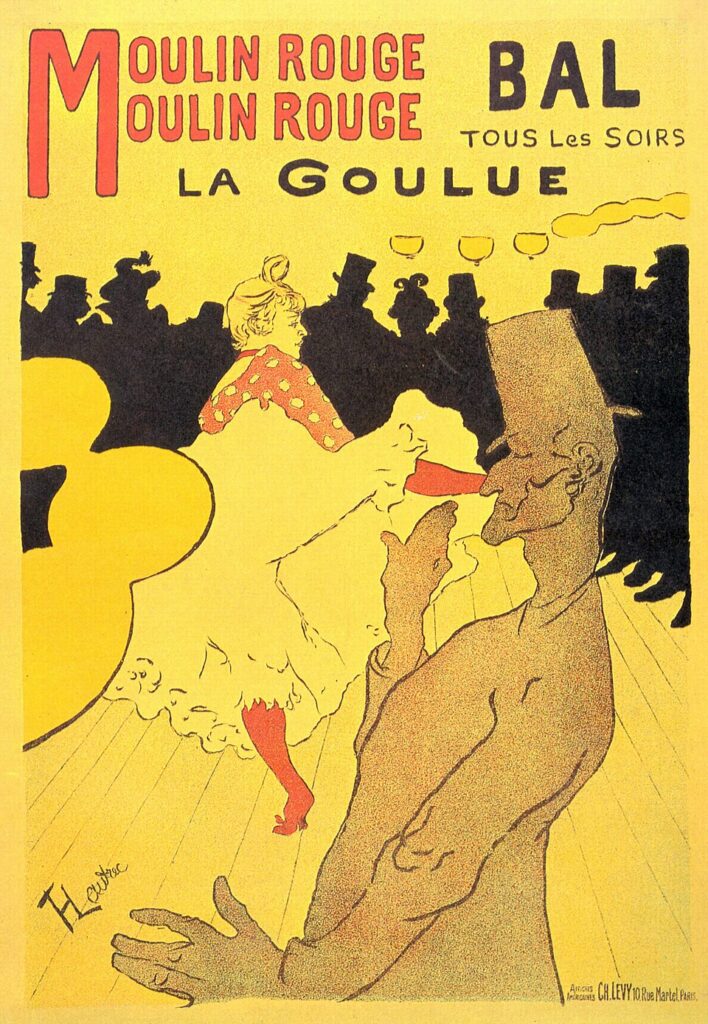
Toulouse-Lautrec — A Nonjudgmental View of the Bohemian Life →In the fall of 1891, Parisians discovered an image on the walls of their city unlike anything they had ever seen. On a large sheet of paper over a meter and a half high, a blonde dancer kicks her leg high amid her white petticoats; in front of her, the strange gray silhouette of a lanky man stands out in the foreground; behind her, a crowd reduced to mere black shadows, punctuated by the yellow orbs of the lamps. With just a few blocks of color and a few lines, everything is conveyed: the movement, the light, the electric atmosphere of the cabaret. This poster is *Moulin Rouge, La Goulue*, Henri de Toulouse-Lautrec’s first poster—and the birth of the modern poster.
Commissioned by the director of the Moulin Rouge to promote the season’s shows and plastered in thousands of copies throughout the streets of Paris, this lithograph caused a sensation. Overnight, it made Lautrec famous. But above all, it forever changed the status of the poster: what had been merely a utilitarian advertising medium laden with text became, under Lautrec’s hand, a work of art in its own right, possessing unprecedented graphic power.
“La Goulue” at the Moulin Rouge is now considered one of the most famous posters in history and a major milestone in modern art. By applying to lithography the principles of Japanese printmaking and the most avant-garde painting of his time—radical simplification of forms, blocks of pure color, sharp contours, and bold composition— Lautrec invented an entirely new visual language that would influence all graphic design and advertising in the 20th century.
This article explores the secrets behind this seminal poster—who are the two dancers it depicts, how Lautrec revolutionized the language of graphic design, what the “crachis” technique he experimented with here entails, why this image breaks so radically with the posters of its time, and how it elevated the poster to the status of a major art form.
The poster, what it shows
*Moulin Rouge, La Goulue* is a large-format color lithograph—approximately 170 centimeters high by 118 centimeters wide—printed on several sheets of paper joined together. In 1891, it was the first poster and the first lithograph created by Toulouse-Lautrec, who until then had been known only as a painter.
The composition is organized around three clearly distinct planes. In the center, bathed in light, dances La Goulue, the Moulin Rouge’s biggest star. She is depicted in the midst of a cancan dance, her leg raised, her white petticoats billowing and lifted, her signature blonde bun perched atop her head. Her light silhouette, rendered almost entirely in the white of the paper and a few lines, stands out vividly in the center of the composition.
In the foreground, silhouetted in gray, stands the slender, angular figure of Valentin le Désossé, her dance partner. Seen in profile, wearing a top hat, he is depicted as a dark, flat mass that frames the scene and, by contrast, accentuates La Goulue’s radiance.
In the background, the cabaret audience is reduced to a frieze of black silhouettes—the gentlemen’s top hats, the outlines of the spectators—punctuated by the yellow spots of light from the globes illuminating the room. This anonymous crowd, rendered as shadow puppets, draws all attention to the two dancers.
Finally, the text is integrated into the image: the name of the cabaret, “MOULIN ROUGE,” is repeated, accompanied by the phrases “CONCERT BAL” and “LA GOULUE.” Far from being a mere addition, the text is part of the graphic composition, playing a role in the overall balance of the piece. The eye, guided by this repetition, is drawn to the central figure of the dancer.
La Goulue and Valentin the Boneless — the star couple
The poster features the Moulin Rouge’s most famous dance duo from the early 1890s, two iconic figures of the Parisian Belle Époque.
La Goulue was the stage name of Louise Weber (1866–1929). Nicknamed “la Gloutonne” (“the Glutton”) for her appetite and her habit of emptying her customers’ glasses, she was the undisputed queen of the cancan and of causing a ruckus. Her uninhibited, sensual, and provocative dance, her brazenness, and her lack of restraint made her the cabaret’s main attraction and the darling of Parisian high society. Lautrec, who admired her and spent time with her, depicted her on numerous occasions. By placing her at the center of this first poster, he helped turn her into a true star. She left the Moulin Rouge in 1895 to pursue a solo career, which was short-lived—she spent the final years of her life in poverty.
Valentin le Désossé was the nickname of Jacques Renaudin (1843–1907). This dancer, with an incredibly supple and limber body—hence his nickname—was the star male performer at the Moulin Rouge. A remarkable detail: in real life, Valentin was not a professional performer but a respectable man who danced purely for pleasure, never accepting payment. Legend credits him with performing a staggering number of dances on the cabaret stage. His tall, angular figure, his beak-like profile, and his lanky movements made him an instantly recognizable character—whom Lautrec stylizes to the extreme here.
By bringing these two figures together, Lautrec did more than simply illustrate an advertising poster: he immortalized the image of the Moulin Rouge and its star couple. It is largely thanks to this poster—and to the works Lautrec dedicated to them—that La Goulue and Valentin have gone down in history, becoming the very symbols of Montmartre’s nightlife and the French can-can.
A Revolutionary Visual Language
What makes *Moulin Rouge, La Goulue* a seminal work is the radical novelty of its visual language. In this piece, Lautrec invents a way of composing an image that breaks with everything that was being done at the time and heralds modern graphic design.
The guiding principle is simplification. Lautrec reduces each element to its essence: a silhouette, a solid color, an outline. He eliminates details, shading, and gradations, retaining only the most expressive forms. The crowd becomes a mass of black silhouettes; Valentin, a gray shadow; La Goulue’s petticoats, a few lines on the white paper. This economy of means gives the image immediate clarity and impact—essential qualities for a poster intended to be seen from a distance, while passing by on the street.
The second principle is the use of flat color. Lautrec uses only a few colors, applied in flat, uniform areas, without any shades or transitions. He borrowed this technique from Japanese printmaking, which was very much in vogue in Paris at the time, and whose methods Western artists were discovering: asymmetrical compositions, flat areas of color, and surfaces delineated by sharp contours. Lautrec, like other artists of his generation, adopted this visual language and applied it to the art of the poster.
The third principle is the outline—the contour. The shapes are defined by sharp lines that set them apart and make them immediately recognizable. This supple, confident line, inspired by Lautrec’s drawings, gives the image its dynamism and clarity.
Finally, the composition itself is bold. Lautrec applies to the poster the off-center and cropped framing techniques he had learned from Degas and photography. Valentin’s silhouette, cropped and placed in the foreground, gives the viewer the impression of being right there in the crowd, among the other spectators, swept up in the action of the ballroom. This technique of drawing the viewer in is one of the image’s greatest innovations.
All of these principles—simplification, solid colors, outlines, and dynamic composition—make up the language of the modern poster. Lautrec did not invent it on his own, but he was the one who gave it its most accomplished and influential form.
Spitting and Mastering Lithography
To create this poster, Toulouse-Lautrec used color lithography, a printing technique that was rapidly gaining popularity at the time. But he did not merely use it: he explored it, enriched it, and introduced innovations that demonstrate his exceptional technical mastery.
Lithography is based on a simple principle: the artist draws on a limestone slab using a fatty substance, and then the ink, applied to the moistened stone, adheres only to the drawn areas. For a color lithograph, one stone is used per color, each carefully marked so that successive prints register exactly on top of one another. *Moulin Rouge, La Goulue* is printed in four colors.
The most remarkable innovation that Lautrec experiments with here is the “crachis” technique. Crachis involves spraying fine droplets of ink onto the lithographic stone using a brush that is made to spatter by running a finger or a blade across its bristles. This technique creates speckled textural effects, subtle gradations, and halftone areas that enrich the range of colors and textures. Thanks to crachis, Lautrec achieves effects that would be impossible to create using flat areas of color alone—for example, the nuances of the ground or the atmosphere.
This technical mastery is essential to understanding Lautrec’s contribution. He did not approach lithography as a mere means of reproduction, but as a true artistic medium, pushing it to its limits. He worked closely with printers, experimented, and took risks. For Lautrec, lithography was not inferior to painting: it was an art form in its own right, capable of unique effects and comparable expressive power. This conviction—that there is no hierarchy among the arts, between painting and printmaking, or between a unique work and a reproduced image—was one of the most modern of his time.
Over the course of his career, Lautrec produced more than three hundred lithographs and about thirty posters, becoming one of the greatest masters of this art form.
A Break from the Posters of That Era
To appreciate the revolutionary impact of *Moulin Rouge, La Goulue*, one must place it within the context of late 19th-century poster art. And there, the contrast is striking.
Before Lautrec, advertising posters were generally cluttered, overflowing with text, and crammed with details; the image, when present, remained subordinate to the written information. Posters of that era were filled with various typefaces, ornamentation, and all sorts of text. They sought to say everything, and ended up drowning the message in their own profusion.
The great master of illustrated posters of that era was Jules Chéret, a prolific creator of colorful and cheerful posters filled with twirling young women—the “chérettes.” Chéret had already turned the poster into a popular and colorful art form, and his influence on Lautrec was undeniable. But his compositions remained more traditional, more ornate, and more decorative.
With *Moulin Rouge* and *La Goulue*, Lautrec took a decisive step forward. He dared to embrace emptiness, minimalism, and radical simplification. Where others piled details on, he pared them away. Where others filled the space, he let the white of the paper breathe. The contrast is striking: the dazzling white of La Goulue’s petticoats—achieved by leaving the paper bare—would have seemed incredibly bold at a time when every centimeter of a poster was covered. This break with the text-saturated posters of his time is one of the keys to Lautrec’s modernity.
The result is an image that makes an immediate impact, is instantly comprehensible, and leaves a lasting impression. Lautrec understood before anyone else the fundamental principle of the poster: seen in passing, on the street, amid the flood of urban distractions, a poster must capture the viewer’s attention in a fraction of a second. And for that, nothing beats the simplicity and power of a stripped-down image.
Posters in Paris — an instant success
The story behind the commission and the poster’s success is worth telling, as it marked a turning point in Lautrec’s career.
In 1891, the Moulin Rouge—which had opened two years earlier—was already a famous venue, but competition among Parisian cabarets was fierce. Its director, Charles Zidler, was looking to make a big splash for the new season. He commissioned a poster from Toulouse-Lautrec—a bold choice, since Lautrec had never designed a poster before, and his style might have seemed risky for a commercial commission.
The gamble paid off beyond all expectations. In the fall of 1891, several thousand copies of the poster—about three thousand, according to estimates—were printed and plastered on the walls and columns of Paris. The effect was immediate and spectacular. Passersby stopped in their tracks, struck by this entirely new image. The poster was the talk of the town. The Moulin Rouge saw a flood of curious visitors.
For Lautrec, this was his moment of triumph. Overnight, the eccentric aristocrat of Montmartre—previously known only to a small circle of people—became a household name throughout Paris. His poster was admired, discussed, and sought after—some enthusiasts even went so far as to peel copies off the walls to add them to their collections. At just twenty-six years old, Lautrec achieved public fame thanks to this first poster.
The success of *Moulin Rouge*, *La Goulue* truly launched Lautrec’s career as a poster artist. Commissions poured in: other cabarets, other artists, and other venues all wanted their own posters designed by Lautrec. In the years that followed, he created some of the most famous posters in history—for Aristide Bruant, for Jane Avril, and for the Divan Japonais—thereby confirming and amplifying the revolution that had begun in 1891.
The Poster Elevated to the Status of Art
Beyond its commercial success, *Moulin Rouge, La Goulue* has considerable historical significance: it marks the moment when the poster ceased to be a mere utilitarian object and became a recognized work of art.
Before Lautrec and his contemporaries, the poster had no artistic status. It was a commercial, ephemeral product, destined to be pasted on a wall, exposed to the elements, covered by other posters, and then destroyed. No one thought to preserve them, much less display them in a museum or study them as works of art.
Lautrec radically changed this perception. The artistic quality of his posters is such that they can no longer be considered mere advertisements. As soon as they appeared, art lovers collected them, dealers sold them, and art magazines reviewed them. The poster found its way into collections, exhibitions, and art history. What Lautrec accomplished was the ennoblement of a minor genre—the elevation of advertising art to the status of high art.
This recognition stems from one of Lautrec’s deepest convictions: his rejection of any hierarchy among the arts. For him, there is no difference in worth between oil painting and lithography, between an easel painting and a street poster, between a unique work and an image reproduced in thousands of copies. All can be art, provided they are driven by genuine vision and mastery. This idea, revolutionary in its time, is now taken for granted—and we owe it in large part to Lautrec.
By elevating the poster to an art form, Lautrec also paved the way for generations of artists who would embrace this medium—the Art Nouveau poster artists, and later the entire field of 20th-century graphic design. Art posters, graphic design, creative advertising: all of these have their roots in this poster plastered on the walls of Paris in 1891.
Legacy — From Art Nouveau to Modern Graphic Design
The influence of *Moulin Rouge*, *La Goulue*, and Lautrec’s posters on 20th-century art is immense. It goes far beyond the realm of mere advertising.
For the time being, Lautrec ushered in the golden age of the illustrated poster, which flourished within the Art Nouveau movement around 1900. Artists such as Alphonse Mucha, Pierre Bonnard, and Eugène Grasset, in turn, developed a refined, decorative style of poster art in which the image took center stage. The late 19th century became the golden age of the poster, which transformed the face of cities and turned the streets into veritable open-air museums.
More profoundly, the graphic language invented by Lautrec—simplification, flat colors, outlines, dynamic composition, and the combination of text and image—became the foundation of modern graphic design. Throughout the 20th century, everything from propaganda posters to album covers, from logos to advertising campaigns, drew on this visual language. In a sense, Lautrec is one of the forefathers of contemporary graphic design.
His influence also extended to painting. His expressive line, his way of defining and simplifying forms, and his use of flat areas of color foreshadowed the experiments of the Nabis and Art Nouveau, and indirectly paved the way for the bold use of color in Fauvism. Lautrec is a vital link between Post-Impressionism and 20th-century art.
Today, *Moulin Rouge, La Goulue* is one of the most recognizable images in the entire history of art. Reproduced countless times, it has become the very emblem of the Moulin Rouge, Montmartre, and the Parisian Belle Époque. But behind its familiarity as an icon, we must remember what it was in 1891: a visual revolution, the moment when a genius painter invented, on a simple poster, an entirely new art form.
How to View the Work Today
Since *Moulin Rouge, La Goulue* is a lithograph printed in runs of several thousand copies, many museums have a copy in their collections. Most of the original copies, which were posted on the streets, have disappeared, but the preserved prints allow us to admire the work.
In Albi
The Toulouse-Lautrec Museum in Albi, the painter’s hometown, houses the world’s largest collection of his works, including his posters and lithographs. It is the premier destination for exploring his entire body of graphic art.
In Paris
The National Library of France holds copies of Lautrec’s posters in its print collection. The Musée d’Orsay, which has a rich collection of Lautrec’s works, also presents his work in the context of the art of his time. And the original poster is on display in the Lautrec Lounge at the Moulin Rouge itself, which is still in operation on Boulevard de Clichy.
Around the World
Prints of *Moulin Rouge*, and *La Goulue* are part of the collections of many major museums: the Museum of Modern Art (MoMA) in New York, the Victoria and Albert Museum in London, the Indianapolis Museum of Art, the Art Institute of Chicago, and many other graphic arts collections around the world.
Further Reading
Institutional sources cited
- Toulouse-Lautrec Museum, Albi, collections.
- Victoria and Albert Museum, London, entries on the Moulin Rouge and La Goulue.
- Encyclopædia Universalis, article “Henri de Toulouse-Lautrec.”
Sources and Reference Studies
- Wolfgang Wittrock, *Toulouse-Lautrec: The Complete Prints*, London, 1985.
- Götz Adriani, *Toulouse-Lautrec: The Complete Graphic Works*, London, 1988.
- Catalog: Toulouse-Lautrec: Resolutely Modern, Musée d’Orsay / RMN-Grand Palais, 2019.
Institutional Documentation
- Toulouse-Lautrec Museum, Albi — the world’s largest collection.
- Musée d’Orsay, Paris — to see some works by Lautrec in the capital.
See also on Hors Cadre
- Toulouse-Lautrec — a nonjudgmental view of bohemian life — a portrait of the artist, his life, and his perspective on Montmartre.
- At the Moulin Rouge—Night According to Toulouse-Lautrec —the masterpiece depicting the cabaret itself, featuring La Goulue and her regulars.
- Musée d’Orsay — what to see, hours, tickets — a guide to the museum, which houses several works by Lautrec.
— M