At the Moulin Rouge — Night Life According to Toulouse-Lautrec
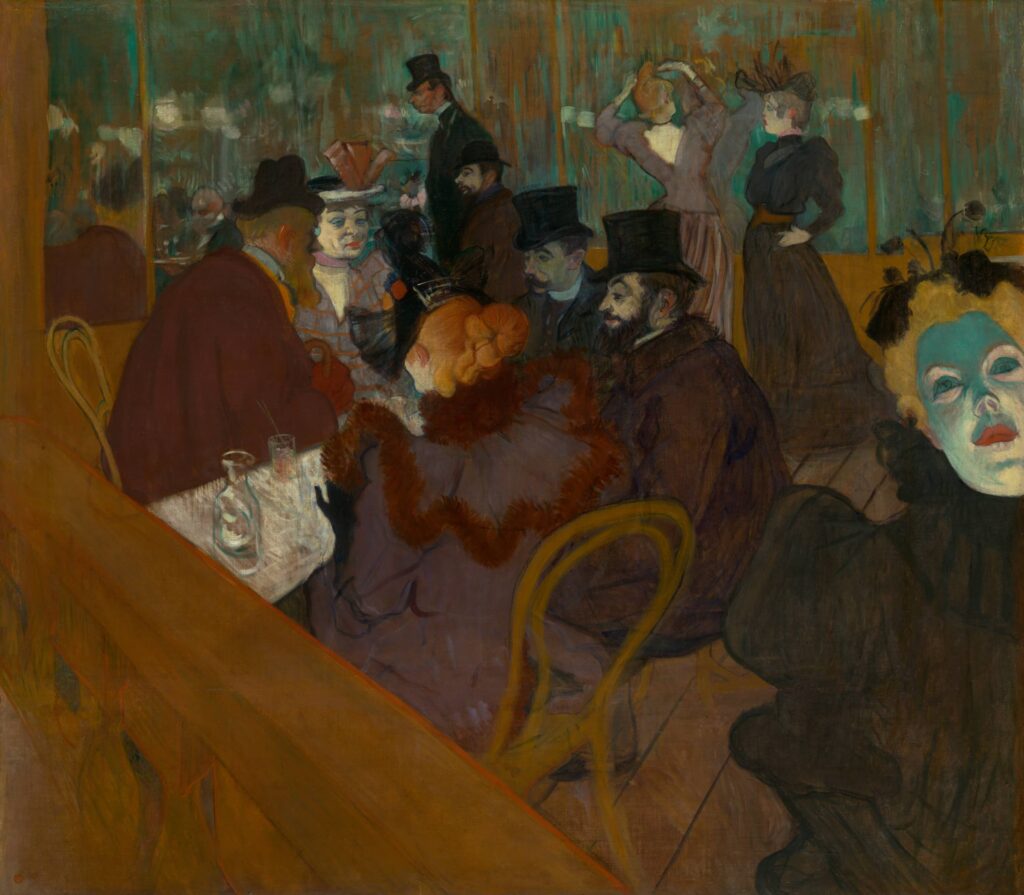
Toulouse-Lautrec — A Nonjudgmental View of the Bohemian Life →In the foreground, emerging from the right edge of the canvas, a woman’s face catches the eye: it is illuminated by an acid-green, almost spectral light, and topped with an insect-like hat. This strange apparition, half-cut off by the frame, seems to be stepping out of the painting and coming toward us. Behind her, in the artificial light of a cabaret, a group of night owls is seated at a table, while in the background, a blonde dancer is fixing her hair in front of a greenish mirror. Welcome to the Moulin Rouge, in the heart of a Parisian night, as only Henri de Toulouse-Lautrec knew how to paint it.
*At the Moulin Rouge*, painted between 1892 and 1895 and housed at the Art Institute of Chicago, is Toulouse-Lautrec’s masterpiece—the most accomplished synthesis of his nocturnal world. Everything that defines his art comes together here: the setting of Montmartre’s most famous cabaret, the cast of its regulars and stars, the bold framing inspired by Degas and photography, the garish colors of the electric lighting, and above all that distinctive gaze which, amid the glitz of the party, manages to discern loneliness.
For this painting is not merely a scene of entertainment. It is a group portrait of a new kind, in which the figures, seated side by side, do not look at one another or speak to one another, their faces frozen and seemingly absent. Beneath the façade of nocturnal merriment, Toulouse-Lautrec paints something deeper and more melancholic: the distance between people, loneliness in the midst of a crowd, and the emptiness behind the party.
This article explores the secrets of this painting—who are the figures gathered around the table, why May Milton’s face is painted green, how Lautrec slipped himself into the painting, why his framing is revolutionary, what the strange history of this canvas—which was once cut up—reveals, and how this Montmartre masterpiece ended up in Chicago.
The Painting — What It Depicts
*At the Moulin Rouge* is a large-format oil on canvas: approximately 123 centimeters high by 141 centimeters wide. It depicts a nighttime scene inside the famous Moulin Rouge cabaret, which opened in 1889 at the foot of Montmartre Hill and where Toulouse-Lautrec was such a regular that he had a table permanently reserved there.
The composition is organized into several planes. In the center, a group of five people is seated at a table on the cabaret floor: three men and two women, sitting side by side. The table is shown in a bird’s-eye view, perpendicular to a long wooden railing that runs diagonally across the canvas and structures the entire space.
In the background, on the left, two figures can be seen walking away, and further away, in front of a large greenish mirror, a blonde dancer is busy fixing her hair. On the right, in the very foreground, a woman’s face, harshly lit, emerges from the edge of the frame, half-cut off, dominating the composition with its unsettling presence.
The atmosphere is that of a late evening at a café-concert. The light is artificial, electric—the Moulin Rouge was equipped with electric lighting, still a novelty at the time—and Lautrec relishes exploiting the harsh, distorting effects of this glow on the faces. The colors are strident: acid greens, orange-reds, garish yellows, and deep blacks. Far removed from the natural light of the Impressionists, Lautrec invents a style of painting centered on the urban night and its artificial lights, which already foreshadows the modernity of the 20th century.
A gallery of nighttime portraits
One of the great appealsof *Au Moulin Rouge* is that it is a group portrait: most of the figures depicted are real people—regulars and cabaret stars whom Lautrec rubbed shoulders with every evening. The painting thus serves as a gallery of the Montmartre scene of the 1890s.
Seated around the table are:
La Macarona, a successful Spanish flamenco dancer at the Moulin Rouge, is seated facing the viewer, wearing a plaid dress. Her round, pale face, strongly lit, is rendered in great detail.
Jane Avril, one of Lautrec’s muses, recognizable by her up-styled red hair and her elegant, slender figure, seen from the back or in profile. Her orange-red hair serves as the colorful focal point of the group.
Paul Sescau, a photographer and friend of the painter; Édouard Dujardin, a poet and critic, a prominent figure in Symbolist circles; and Maurice Guibert, a wine merchant, a close friend of Lautrec’s, and one of his nightlife companions—who also took many photographs of him.
In the background, in front of the mirror, La Goulue (Louise Weber)—the Moulin Rouge’s biggest star in the early 1890s and the queen of the can-can, whose unbridled sensuality had all of Paris in a frenzy—is fixing her hair. Recognizable by her blonde hair and high bun, she left the cabaret in 1895 to pursue a solo career.
This gathering of real-life figures makes the painting a valuable record of the world of Montmartre—but Lautrec does not merely portray his friends. He arranges them in a skillful composition, depicts them with his usual insight, and imbues this scene of everyday nightlife with the power of a true work of art. Each face is a study in character; each pose, an observation.
May Milton’s Green Face
The most striking and mysterious element of the painting is the woman’s face that appears in the foreground, on the far right, half-cut off by the edge of the frame. According to the most widely accepted identification, this is May Milton, an English dancer who had come to Paris with a troupe and whom Lautrec knew well.
This face is rendered in an extraordinary way. Vigorously lit from below, it is painted in a sour, almost bilious green, accentuated by the garish yellow of the hair and contrasting with the dark dress. The effect is ghostly, unsettling, almost monstrous—a nightmarish face emerging from the darkness of the cabaret.
How can this choice be explained? The Art Institute of Chicago cites a technical and aesthetic reason: the Moulin Rouge was equipped with electric lighting—a relatively new technology at the time—and Lautrec reveled in the artistic possibilities of this harsh artificial light. Electric lighting—whether from below or at an angle—distorts faces, deepens shadows, and gives skin an unreal hue. Far from correcting this effect, Lautrec exaggerates it and exploits it for its expressive power.
But this spectral green goes beyond mere realistic depiction. It lends the face a sculptural presence of extraordinary power—to the point that it is this green, and not the figures in the center, that dominates and haunts the entire composition. Some commentators have compared this figure to the unsettling masks of the Belgian painter James Ensor. May Milton’s face functions as an apparition, a unsettling presence that captures the viewer’s gaze and draws them into the painting.
This bold use of arbitrary color in the service of expression foreshadows, in its own way, the artistic explorations of the Fauvists and Expressionists of the early 20th century. Twenty years before Matisse and his green face in *Woman with a Hat*, Lautrec had already dared to paint a face that bore no resemblance to naturalism, yet conveyed an emotional truth more powerful than mere appearance.
Lautrec paints himself
If you look closely at the background of the painting, you’ll discover a delightful detail: Toulouse-Lautrec painted himself into the scene. In the background, among the receding silhouettes, two figures can be seen walking side by side—one very small, the other disproportionately large.
The small figure is the painter himself. Lautrec depicts himself without the slightest self-indulgence, making no attempt to conceal or embellish his height. Walking beside him is his cousin, Dr. Gabriel Tapié de Céleyran, a man of very great stature. The contrast between the two figures is striking—and clearly intentional. By standing next to this towering cousin, Lautrec emphasizes his own small stature through contrast, as if he were playing on his physical difference with lucidity and self-deprecation.
This gesture speaks volumes about Lautrec’s relationship with his body and his art. Rather than hiding himself, he becomes part of the painting—both a witness to and a participant in the nightlife he depicts. He is not an outside observer looking down from above: he is part of the world of the Moulin Rouge, one of its regulars, accepted and embraced by this nocturnal crowd. The painter’s discreet presence within his own work echoes a long tradition, from Velázquez to Courbet—but Lautrec imbues it with a unique tone, a blend of humor and melancholy.
This merciless honesty toward himself is one of the keys to his perspective on others. He, who showed no mercy toward himself and portrayed himself as he truly was, was able to paint the dancers and prostitutes of Montmartre with the same nonjudgmental candor. The way he views the world is, first and foremost, the way he was able to view himself.
A Revolutionary Approach
“At the Moulin Rouge ” is famous for the boldness of its composition—a framing so modern that it breaks with centuries of pictorial tradition. Lautrec owes this modernity to two major influences: Edgar Degas and photography.
From Degas, whom he admired above all others, Lautrec inherited a taste for off-center compositions, unexpected viewpoints, and framing that cuts off the figures. The large balustrade running diagonally across the canvas, the bird’s-eye view of the table, and the off-center placement of the main group—all of this comes from Degas, who himself drew inspiration from Japanese prints. The composition is no longer centered and balanced in the classical manner; it is dynamic, unbalanced, and open.
From photography, an art form still in its infancy, Lautrec drew inspiration from its ability to freeze a moment, to capture a scene on the spot like a snapshot. May Milton’s face, cut off by the edge of the frame, produces exactly this effect: it looks like a photograph taken on the spot, where a passerby enters the frame just as the shutter is released. This technique—cutting off a significant part of a figure at the edge of the frame—was unthinkable in academic painting, which demanded complete and self-contained compositions. Lautrec, however, used it deliberately to create an impression of life captured on the fly, of an unposed reality.
The result is a composition of astonishing modernity. The viewer is not simply presented with a scene staged for their benefit: they are immersed within the cabaret, as if they themselves were seated at a table, their gaze drawn to the face in the foreground and then guided toward the group and the background. This way of drawing the viewer in—of bringing them into the space of the painting—is one of the great innovations of modern painting—and Lautrec is one of its masters.
Loneliness in the midst of the party
Beyond its bold stylistic choices, *Au Moulin Rouge* is striking for its psychological depth. Beneath the guise of an entertainment scene, the painting conveys something serious and melancholic about the human condition.
Let’s observe the figures seated at the table. They are sitting side by side, gathered around the same table, in a place of pleasure and socializing. And yet, they do not look at one another, do not speak to one another, do not communicate. Their faces are frozen, expressionless, as if absent. Each seems trapped in their own solitude, lost in their thoughts, indifferent to the others. The nighttime celebration, meant to bring people together, actually leaves them apart.
This is one of Toulouse-Lautrec’s major themes—and, more broadly, a central theme in paintings of modern life: loneliness amid the crowd, the isolation of individuals in the big city and its entertainment venues. The Moulin Rouge, with its lights, music, and merriment, is merely a backdrop—behind which lies the melancholy of the people. Lautrec thus reveals the unbridgeable gap that separates men and women, artists and the bourgeoisie, despite their physical proximity.
This melancholic quality gives the painting its depth. Lautrec is not merely an amused chronicler of nightlife; he is a lucid observer of the human condition, who knows how to see, behind the spectacle, the truth of the soul. May Milton’s green, ghostly face, looming like a specter in the foreground, further accentuates this unsettling mood: there is something ghostly about the party, and the Montmartre night, beneath its glitter, is also a theater of shadows.
It is this combination of a vibrant form and a melancholic essence that makes*Au Moulin Rouge* so great. The painting first captivates with its colors and composition; it then moves the viewer with what it reveals about the human soul.
The Mystery of the Cut-Up Canvas
“At the Moulin Rouge ” conceals a surprising physical detail that has long intrigued art historians: the canvas was cut up and then reassembled.
Upon closer examination, it becomes clear that the work consists of two joined parts: a main canvas and an additional L-shaped panel attached to the bottom and right edges—precisely the section that contains May Milton’s green face and the foreground. This area was clearly added or reworked at a later stage.
The history of this cut is revealing. At some point in the painting’s history, after Lautrec’s death, the right-hand panel containing May Milton’s striking face is said to have been cut off—perhaps because the figure was deemed too daring, too disturbing, or for commercial reasons, as a more conventional format was considered more marketable. The painting was thus, for a time, stripped of its most striking part.
Fortunately, this damage has been repaired: the two parts have been reunited, restoring the work’s original composition and power. Without this historical correction, we would have lost the most modern and fascinating element of the painting—that green face that makes it so unique.
This episode serves as a reminder of just how much perceptions of an artist’s bold choices can change over time. What Lautrec dared to do that was most innovative—that face distorted by light, cut off by the frame—was initially deemed so excessive that it was removed, before being recognized as a pinnacle of modernity. The reconstructed painting bears the traces of this eventful history.
From the Moulin Rouge to Chicago
The journeyof *Au Moulin Rouge*, from the Parisian cabaret to a major American museum, illustrates the posthumous recognition of Toulouse-Lautrec and the role of major collections in promoting French art.
Painted between 1892 and 1895, the painting was first exhibited in Parisian avant-garde circles—perhaps as early as 1892 in certain exhibitions, under various titles. Like some of Lautrec’s other works, it subsequently circulated among dealers and collectors after the painter’s death in 1901.
The work crossed the Atlantic to become part of a major American collection at a time when art lovers in the United States were passionate about modern French painting. It eventually became part of the collection of the Art Institute of Chicago, one of the most important museums in the United States, which boasts an exceptional collection of Impressionist and Post-Impressionist art.
*At the Moulin Rouge* is now one of his most famous and admired works. The museum also houses another work by Lautrec related to the cabaret, *At the Fernando Circus: The Horsewoman* (1887–88), which was acquired by the owner of the Moulin Rouge to decorate the venue’s lobby. The painting, which immortalized Montmartre’s nightlife in the 1890s, now greets visitors in Chicago, a vivid testament to a Paris that has since vanished.
How to View the Work Today
*At the Moulin Rouge* is housed at the Art Institute of Chicago (United States), where it is on display among the masterpieces of the Impressionist and Post-Impressionist collection.
To see works by Toulouse-Lautrec in Paris:
The Musée d’Orsay houses several major works by Lautrec related to the same nightlife scene— *La Toilette* (1889), *Jane Avril Dancing* (circa 1892), *The Clowness Cha-U-Kao* (1895), *The Bed* (circa 1892), and painted panels for La Goulue’s carnival booth.
The Toulouse-Lautrec Museum in Albi, the painter’s hometown, houses the world’s largest collection of his works, including numerous scenes from cabarets and brothels, as well as his posters.
To continue the exploration, you can also visit the Moulin Rouge itself, which is still in operation at the foot of Montmartre on Boulevard de Clichy—even though today’s cabaret bears little resemblance to the one Lautrec used to frequent.
Further Reading
Institutional sources cited
- Art Institute of Chicago, entry for *At the Moulin Rouge*.
- Panorama de l’art (RMN), a review of *Au Moulin Rouge*.
- Encyclopædia Universalis, article “Henri de Toulouse-Lautrec.”
Sources and Reference Studies
- M. G. Dortu, *Toulouse-Lautrec and His Work*, catalogue raisonné, New York, 1971.
- Toulouse-Lautrec Catalog, National Galleries of the Grand Palais, Paris, 1992.
- Catalog: Toulouse-Lautrec: Resolutely Modern, Musée d’Orsay / RMN-Grand Palais, 2019.
Institutional Documentation
- Art Institute of Chicago — the institution that houses the artwork.
- Musée d’Orsay, Paris — to see some works by Lautrec in the capital.
See also on Hors Cadre
- Toulouse-Lautrec — a nonjudgmental view of bohemian life — a portrait of the artist, his life, and his perspective on Montmartre.
- Edgar Degas—the painter of movement —the master from whom Lautrec inherited bold compositions and scenes of modern life.
- Musée d’Orsay — what to see, hours, tickets — a guide to the museum, which houses several of Lautrec’s masterpieces.
— M