The Slave Trader — Turner
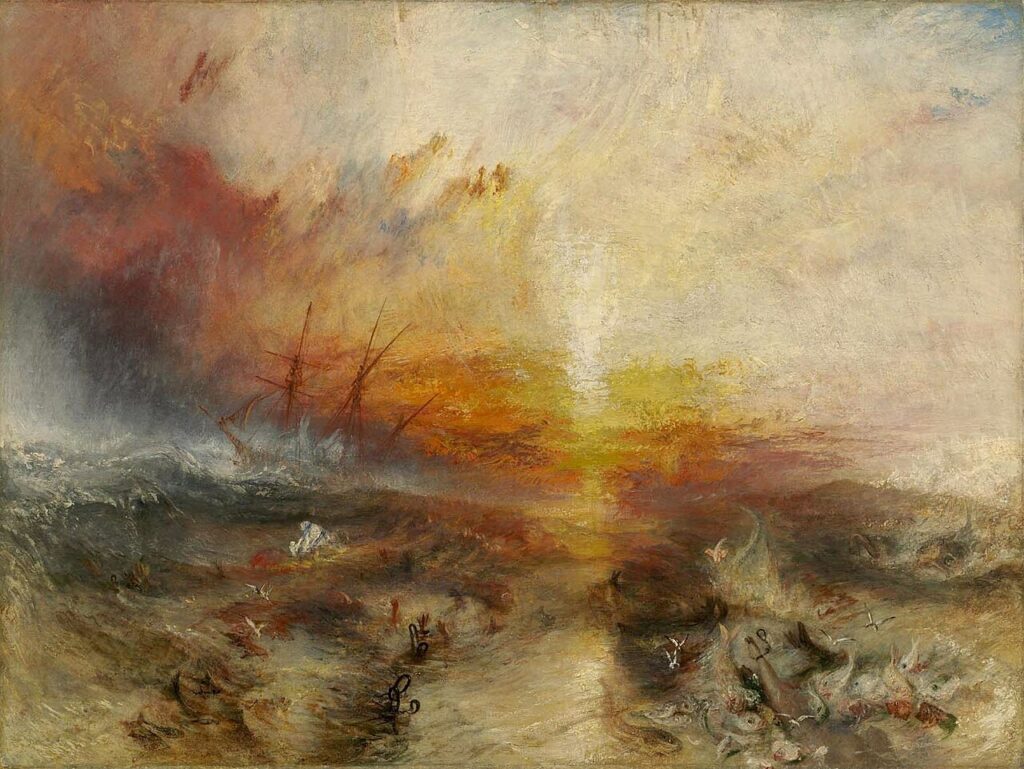
J.M.W. Turner — the painter of light →A sky ablaze with pink, gold, and purple; a raging sea from which a typhoon rises; and, in the foreground, hands reaching toward the surface, chained limbs devoured by monstrous fish: Turner’s *The Slave Ship* is one of the most moving and politically charged works in the entire history of painting. Beneath its dazzling chromatic beauty, the painting condemns one of the most abject crimes in human history: the slave trade.
Painted in 1840, when Turner was sixty-five years old and at the height of his artistic powers, this painting bears a complete and unambiguous title: Slave Traders Throwing the Dead and Dying Overboard—A Typhoon Approaches. It is inspired by a true event, the Zong massacre, and is part of the abolitionist movement that was sweeping Britain at the time. Now housed at the Museum of Fine Arts in Boston, it is universally recognized as one of Turner’s masterpieces and as a major work of socially conscious art.
This article offers an analysis of this powerful work: its subject, the historical crime that inspired it, its moral significance, and the way in which Turner uses the sublime power of nature to protest oppression.
The subject—the result of a crime
The painting does not depict an action as it is unfolding, but rather its terrible consequences. This indirect—and all the more chilling—approach to the subject is one of the keys to its power.
In the distance, in the background, one can make out the slave ship, all sails set, sailing away across a stormy sea as a typhoon approaches. But it is not the ship that first catches the viewer’s attention. It is the foreground that captures the viewer’s attention: the water is strewn with human forms—bodies and limbs—those of the slaves thrown overboard. Hands emerge from the waves, desperately reaching for the surface in a futile attempt to survive; chained legs, still shackled by the irons of slavery, float among the waves; ravenous fish and seabirds swoop down on the bodies. The title suggests slave ships casting the dying into the sea, but Turner does not show the crew at work: he shows the result of their ignominy, scattered in the wake of the fleeing ship.
This choice is one of great subtlety. By not directly depicting the executioners’ actions, but rather their consequences, Turner allows the viewer to piece together for themselves the horror that has just taken place, becoming a witness to a crime whose perpetrators are walking away, unpunished, into the falling night. Without knowing the title of the work, one might almost fail to immediately perceive the nightmare unfolding in the foreground, so completely does the scene blend into the swirl of colors. Then the eye takes it in, and dread sets in.
The composition thus contrasts two scenes: the guilty ship fleeing into the distance, and the agony of the victims in the foreground. Between the two, the sea and the sky, ablaze with color, seem to be part of the drama. The typhoon rising on the horizon seems to herald nature’s punishment of the criminal ship, as if the elements themselves were rising up against the infamy that has just been committed. Turner thus depicts not only a crime, but a form of cosmic justice in motion.
The Zong Massacre
The work is inspired by a real-life event that remains infamous in the history of the transatlantic slave trade: the Zong massacre in 1781. Understanding this tragedy is essential to appreciating the significance of the painting.
The Zong was a British slave ship. In 1781, during a transatlantic crossing, it was carrying a human cargo far exceeding its capacity: approximately four hundred and forty slaves, on a ship designed to hold only half that number. When an epidemic broke out on board, decimating the captives, the captain made a monstrous decision, dictated by a despicable financial calculation. Insurance policies at the time compensated owners for slaves “lost at sea,” but not for those who died of disease on board. To collect this payout, the captain ordered the sick and dying slaves to be thrown overboard. One hundred thirty-three men, women, and children were thus massacred, thrown alive into the waves.
This episode, of unspeakable cruelty, revealed the full inhumanity of the slave system, which reduced human beings to mere insurable commodities. The case, brought before the courts—not for murder, but as part of an insurance dispute—had a profound impact on public conscience in Great Britain. It became one of the founding events of the abolitionist movement, contributing to the creation of the first societies for the abolition of the slave trade. The horror of the Zong embodied, better than any speech, the need to put an end to this infamous trade.
Turner was familiar with this story, particularly through the writings of abolitionist activists, including a seminal work on the history and abolition of the slave trade, which had been reprinted shortly before he painted his picture. By choosing to depict a scene directly inspired by the Zong massacre, Turner was not engaging in mere flights of fancy: he was drawing upon a real, well-documented, and emblematic crime to make it the subject of a great painting. In doing so, he gave an unforgettable visual form to one of the darkest chapters in history, rescuing the victims from oblivion.
A Work of Social Commitment
“The Slave Ship ” is not only a deeply moving work; it is also a work of activism, a clear statement by Turner in the fight against slavery. The context in which it was created bears this out.
The painting is set against a specific historical backdrop. In Great Britain, the slave trade had been banned in the early 19th century, and slavery itself had been abolished in the British Empire a few years before Turner painted this work. But the struggle was not over: abolitionists were now campaigning for the abolition of slavery worldwide. Turner exhibited his painting in 1840, the very year a major international convention against slavery was held in London. This choice was by no means coincidental: the painter deliberately situated his work within the context of the ongoing abolitionist struggle, giving it immediate political resonance.
Turner also accompanied the painting, during its exhibition, with a few verses of his own composition, taken from a long, unfinished poem with a disillusioned tone. These verses evoked the approaching typhoon and the order to throw the dead and dying overboard, before ending with a bitter question about hope. Through this text, Turner clarified the meaning of his work and its role as a social critique. The painting called on the viewer not only to look, but to bear witness—to bear witness to the horror of slavery, the fate of its drowned victims, and the cold cruelty of the slave traders sailing away into the night.
This commitment is what makes the work so unique and magnificent. At a time when history painting readily addressed glorious or edifying subjects, Turner dared to devote a large canvas to denouncing a contemporary crime, putting his art in the service of a moral cause. A critic later described the painting as the embodiment of a massive protest, a powerful voice rising up against human oppression. Turner, at the height of his artistry and confident in his message, turned painting into a weapon in the service of conscience and justice.
The Beautiful and the Horrible
One of the most unsettling aspects of this work is the tension between the dazzling beauty of its craftsmanship and the horror of its subject matter. Far from being a contradiction, this tension lies at the heart of its power.
From a pictorial standpoint, *The Slave Ship* is strikingly beautiful. In it, Turner displays his full mastery of color and light: the sky and the sea blaze with sumptuous pinks, purples, blues, and yellows, layered in vibrant hues; the light of the setting sun merges the sky and the water into an incandescent whirlwind. The forms dissolve into this symphony of color, in the manner characteristic of Turner’s mature period. At first glance, the painting captivates the eye with its splendor, grandeur, and dramatic, sublime atmosphere.
Then the eye discovers the horror lurking within this beauty: the bodies, the hands, the chains, the fish devouring the limbs. The contrast is jarring, almost unbearable. This beauty, which at first seduces and then reveals the unspeakable brutality it conceals, has a deeply unsettling effect. Turner plays on this tension with consummate skill: the magnificence of nature—the blazing sky, the vast sea—serves as a backdrop for human atrocity, making it all the more terrible through contrast. The splendor of the natural world underscores the infamy of the crime committed by men.
This aesthetic falls under what the Romantic era called the sublime: that emotion—a mixture of admiration and terror—evoked by the sight of nature’s immense forces. But here, Turner puts the sublime at the service of a moral purpose. The terrifying grandeur of the storm and the power of the unleashed elements are not merely a spectacle: they seem to herald punishment and express the indignation of nature and the heavens in the face of human crime. The natural sublime becomes an expression of a higher justice, a cosmic protest against oppression. It is this fusion of beauty, horror, and moral force that makes the work a pinnacle of Turner’s art and a powerful meditation on evil.
Ruskin and Posterity
The history of the reception of *The Slave Ship* is inextricably linked to one name: that of John Ruskin, the greatest art critic of the Victorian era, who was the painting’s first owner and one of its most ardent admirers.
Ruskin, a passionate advocate of Turner, received the painting as a gift from his father. He made it one of the jewels of his collection and celebrated it as an absolute masterpiece. In his writings, he asserted that if he had to base Turner’s immortality on a single work, it would be this one—a tribute that speaks volumes about the admiration he had for this painting. Ruskin saw *The Slave Ship* as the pinnacle of Turner’s art, the highest expression of his genius for color, light, and the truth of nature.
Yet Ruskin’s relationship with the work was ambivalent. While he deeply admired its beauty and power, he eventually admitted that the subject matter was too distressing for him to look at on a daily basis. Living constantly in the presence of this scene of horror—these bodies and these chains—became unbearable for him, and he parted with the painting after owning it for many years. This very unease testifies to the work’s power: *The Slave Ship* is not a painting one contemplates with quiet pleasure; it is a work that unsettles, disturbs, and forces one to confront evil. Therein lies its greatness and its demand.
The painting then crossed the Atlantic to join the collections of the Museum of Fine Arts in Boston, where it is housed today. The work’s reception was at times unsettling, both at the time and later, due as much to the boldness of its style as to the harshness of its subject matter. But over time, *The Slave Ship* has established itself as one of Turner’s undisputed masterpieces and as a work of universal significance. Both a pinnacle of his mastery of color and light and a powerful condemnation of one of history’s greatest crimes, it retains, nearly two centuries after its creation, its ability to move, to outrage, and to provoke reflection. It remains a deeply moving testimony and a reminder of the moral conscience that art can embody.
Where to see the artwork
*The Slave Ship* is housed at the Museum of Fine Arts in Boston, in the United States—one of the largest American art museums—where it ranks among the major works in the European painting collection. That is where you must go to view the original of this masterpiece by Turner. To plan a visit or check the artwork’s current display, we recommend consulting the museum’s official website.
Further Reading
Institutional Documentation
- Museum of Fine Arts, Boston — the museum where the painting is housed.
- Thomas Clarkson, on the history and abolition of the slave trade; J.M.W. Turner, reference catalogs.
See also on Hors Cadre
- J.M.W. Turner—the Painter of Light —a portrait of the painter.
- The Last Voyage of the Téméraire — The End of the Age of Sail.
- Rain, Steam, and Speed —Industrial Modernity According to Turner.
— M