The Last Voyage of the Temeraire — Turner (1839)
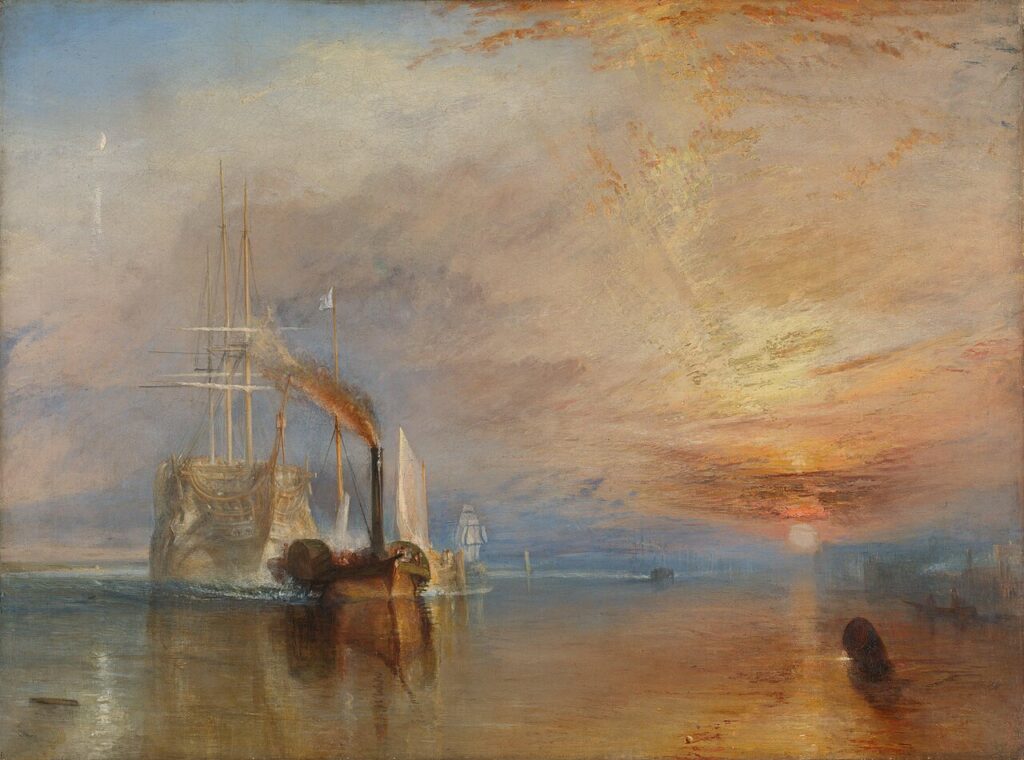
J.M.W. Turner — the painter of light →A ghostly, pale, and majestic tall ship, towed by a small black steamboat toward the shipyard where it will be dismantled, against the backdrop of a fiery sunset: *The Last Voyage of the Temeraire* is one of Turner’s most beloved works and one of the most beautiful paintings in all of British art. In an image of striking poetic power, the painter has captured the melancholy of time passing and the dawn of a new world.
Painted in 1838 and exhibited at the Royal Academy the following year, this painting depicts a real, almost mundane event—the scrapping of an old ship—which Turner transforms into a universal meditation on the end of eras, faded glory, and the inexorable passage of time. Now housed at the National Gallery in London, it was voted, in a famous poll, the most beautiful painting in the collection, such is its profound impact on the public.
This article offers an analysis of this iconic work: its subject, its history, its composition, its meaning, and the liberties Turner took with reality to achieve the poetic truth he sought.
The Topic — The Downfall of a Hero of Trafalgar
To understand the emotion this painting conveys, you need to know the history of the ship it depicts. The Téméraire was no ordinary ship: it was a hero of British naval history.
The HMS Temeraire was a powerful 98-gun warship, launched in the late 18th century. It had covered itself in glory during the Battle of Trafalgar in 1805, where the British fleet commanded by Admiral Nelson crushed the French and Spanish fleets. During that decisive battle, the Temeraire played a prominent role, notably coming to the aid of the Victory, Nelson’s flagship. It thus became, for the British, a symbol of national naval power and of that defining victory.
But by 1838, more than thirty years after her glory days, the Téméraire was nothing more than an old, decommissioned ship. Sold by the Admiralty, she was to be broken up for scrap. In September of that year, she was towed from the Thames Estuary to a shipbreaking yard in Rotherhithe, in southeast London. It was this final voyage—the veteran ship being led to her destruction—that Turner chose to depict. An event that was almost a mere matter of naval administration became, under his brush, a poignant drama and a meditation on destiny.
Turner, who was sixty-three years old at the time, probably did not witness the scene firsthand: he recreated it based on accounts and his own imagination. It doesn’t matter: what interested him was not documentary accuracy, but the symbolic and emotional weight of that final voyage. The glorious old ship, towed to its death by a modest tugboat, offered him the perfect subject to express what haunted him: the passage of time, the end of eras, and the melancholy of lost grandeur.
A composition full of contrasts
The power of this painting lies in its masterful composition, built entirely on contrasts that convey the work’s entire meaning. In it, Turner juxtaposes two worlds, two eras, and two systems of power.
At the center of the painting stands the Téméraire itself, immense and pale, almost white, spectral. Its masts rise toward the sky like the remnants of a bygone splendor. The ship seems to glide across the calm waters like a ghost ship, noble and silent, imbued with a melancholic majesty. Ahead of it, pulling it toward its end, the small steam tugboat forms a striking contrast: dark, low, stocky, utilitarian, it spews black smoke from its tall stack, and its paddlewheels cut through the water. Everything sets the two vessels apart: color—the ethereal white of the sailboat against the solid black of the tugboat; form—the graceful rise of the masts against the compact silhouette of the machine; spirit—the nobility of the past against the efficiency of the present.
The setting heightens this tension. On the right, a blazing sunset sets the sky ablaze and is reflected in the water, bathing the entire scene in a dramatic golden-orange light. On the upper left, a pale crescent moon rises in a still-bright sky, its light reflected in the calm waters. This simultaneous presence of the setting sun and the rising moon—a motif dear to Turner—emphasizes the idea of transition, of moving from one state to another, from day to night, from one era to another. Light, as always in Turner’s work, is the true subject of the painting: it is what creates the atmosphere, the emotion, and the meaning.
This composition, seemingly simple, is in reality extraordinarily rich in symbolism. Turner needs neither a crowd, nor a battle, nor any action: all the tension arises solely from the encounter between the sailboat and the tugboat, between the sun and the moon, between light and shadow. Each element is imbued with meaning, contributing to making this peaceful scene a powerful meditation on time and death.
The End of an Era
Beyond its historical significance, *The Last Voyage of the Téméraire* is a deeply symbolic work that speaks to the end of one world and the dawn of another. This is what gives it its universal significance.
The painting depicts, in the most eloquent way, the transition from the age of sail to the age of steam. The majestic sailing ship, the embodiment of an ancient, glorious, and bygone world, is brought to an end by the steam engine, a symbol of the Industrial Revolution and the new world that is taking shape. Turner, unlike many painters of his time who considered industry “unartistic,” took a keen interest in technological progress and its imagery. Here, he makes it the driving force of a visual drama: steam triumphs over sail; the future drags the past toward its demise. The painting thus captures a pivotal moment in history—that of an irreversible transition.
But the work goes beyond a simple historical observation to take on a meditative and melancholic dimension. This journey toward demolition is also an allegory of the passage of time, of fading glory, and of inevitable death. The old ship heading toward its end evokes the decline of all greatness, the fragility of human affairs, and nostalgia for a vanishing world. The possible parallel between the old ship and the painter himself—who was then elderly, and whose style and generation were beginning to belong to the past—has often been noted. The sunset, a classic image of the end and of death, reinforces this elegiac interpretation.
This dual dimension—historical and universal, a celebration of progress and a mourning of the past—is what gives the work its richness. Turner does not pass a simple judgment: he neither condemns steam nor naively mourns the age of sail. He captures the complexity and melancholy of a moment of transition, where the new is born from the death of the old. This ambivalence and depth explain why the painting resonates so deeply, beyond its specific subject matter. Everyone can find in it their own reflection on time, loss, and change.
Turner’s Poetic Licenses
One of the most revealing aspects of this painting lies in the liberties Turner took with reality. Far from seeking documentary accuracy, he altered the facts to serve the poetic truth of his work.
Several “errors” or inaccuracies have been noted in the painting. The most famous concerns the sunset: a ship sailing up the Thames toward Rotherhithe was heading west and therefore could not have had the setting sun behind it, to the east, as Turner depicts. This deviation from geography, incidentally, sparked a lively debate in the press at the time. Similarly, the Téméraire is depicted with its masts upright and its rigging intact, whereas in reality the ship had been largely stripped of its rigging before being towed. Finally, the tow was carried out by two tugboats, whereas Turner painted only one.
These liberties are not oversights, but deliberate choices made to enhance the effect and meaning. By raising the masts toward the sky, Turner restores the ship’s dignity, its ceremonial verticality, and its spectral and noble presence—he restores in paint the grandeur that reality had taken from it. By placing the setting sun behind the scene, he achieves the dramatic and symbolic blaze that gives the work its emotional power—the image of the twilight of an era. By simplifying the scene to a single tugboat, he focuses the tension on the fundamental contrast between sail and steam.
This approach to reality sheds light on Turner’s entire artistic process. For him, the truth of art lies not in accuracy, but in emotion and meaning. The painter is not a documentarian: he is a poet, free to transform reality in order to reveal its deeper meaning. By sacrificing accuracy for effect, Turner achieves a higher truth—that of feeling and meditation. It is this supreme freedom—this primacy of vision over description—that makes him a forerunner of modern art and gives his works their timeless power.
Reception and Legacy
From the moment it was unveiled, *The Last Voyage of the Téméraire* was a huge success, and its popularity has never waned. Today, the work is one of the most famous and beloved in all of British art.
When he exhibited the painting at the Royal Academy in 1839, Turner accompanied it with a few lines adapted from a patriotic poem, evoking the flag that had weathered battle and storm and no longer belonged to the ship. The work was enthusiastically received by critics and the public alike. The novelist William Makepeace Thackeray, setting aside his usual mocking tone, described it as one of the greatest paintings ever hung on the walls of an academy. The painting was a triumph, unanimously recognized as a masterpiece from the moment it was unveiled.
Turner himself was particularly attached to this work, which he is said to have nicknamed his “darling.” He refused to sell it during his lifetime and bequeathed it to the British nation, along with the rest of his estate. For him, the painting undoubtedly expressed something deeply personal: an awareness of the passage of time and the end of eras. Its legacy was remarkable: in a major poll conducted in the early 2000s, the British public voted *The Last Voyage of the Temeraire* as the most beautiful painting in the National Gallery’s collection, cementing its exceptional place in the hearts of art lovers.
The work has gone far beyond the confines of museums to become part of popular culture. It appeared in a famous film from the James Bond series, where it serves as a vehicle for reflection on the passage of time and the changing of the generations. It has also been featured on British banknotes, an honor that attests to its status as a national icon. Thus, nearly two centuries after its creation, *The Last Voyage of the Temeraire* continues to fascinate and move audiences, remaining true to Turner’s genius and the timeless power of its message about time, glory, and the end of eras.
Where to see the artwork
*The Last Voyage of the Temeraire* is housed at the National Gallery in London, which received it as part of Turner’s bequest to the British nation. There, it is one of the most admired works in the collection, displayed among the masterpieces of British painting. Admission to the National Gallery is free, allowing everyone to come and view this iconic painting. To plan a visit or check the painting’s current display status, it is helpful to consult the museum’s official website.
Further Reading
Institutional Documentation
- The National Gallery, London — the museum where the painting is housed.
- J.M.W. Turner: Monographs and Reference Catalogs.
See also on Hors Cadre
- J.M.W. Turner—the Painter of Light —a portrait of the artist, to contextualize the work within his career.
- Rain, Steam, and Speed —Turner’s other great painting of the modern world.
- “The Slave Trader ” — Turner’s sublime art in the service of moral condemnation.
— M