“The Slander of Apelles” — Botticelli’s Bitter Work
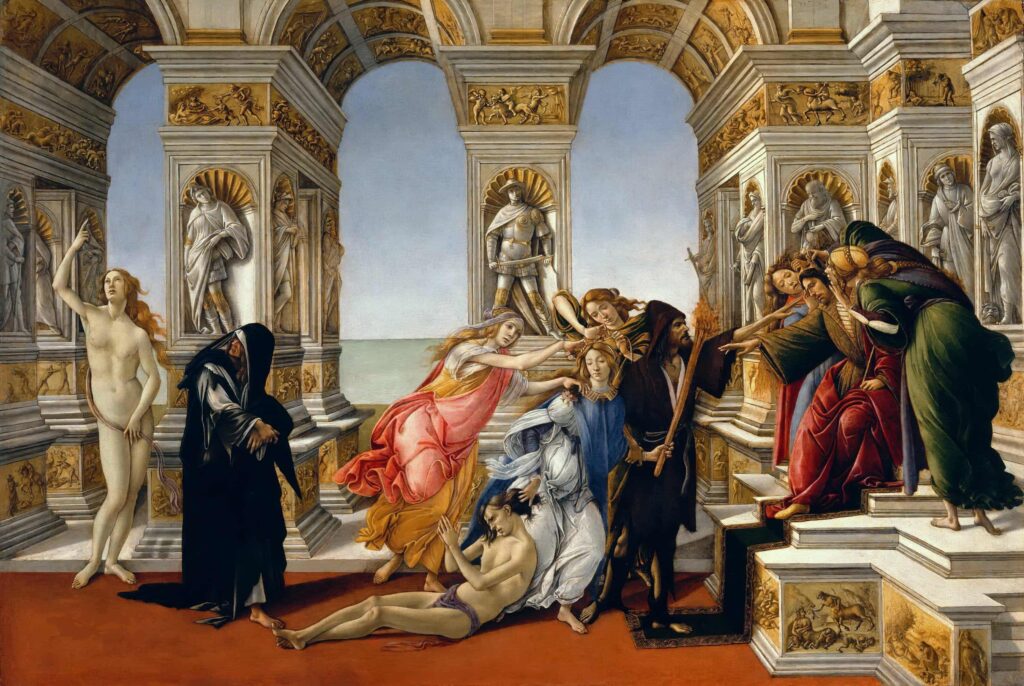
Botticelli — Line and Melancholy →An innocent woman is dragged by her hair before a judge with donkey ears, surrounded by sinister figures—Ignorance, Suspicion, Treachery, and Fraud. Standing apart, an old woman draped in black—Truth—looks up alone toward the sky, naked and helpless. This is Botticelli’s *The Calumny* by Apelles —a strange, tense, bitter work that is disconcerting when encountered after the dreamy serenity of *Spring* and *The Birth of Venus*.
Painted around 1494–1495, during Florence’s darkest years, this small tempera on wood marks a turning point in Botticelli’s art. The painter of Venus’s gardens and smiling goddesses here becomes a critic of injustice, slander, and the persecution of innocence. Grace is tinged with anguish here, and beauty is laden with unease.
The work has another unique feature: it is a reconstruction. Botticelli does not illustrate a living myth, but attempts to bring back to life a lost ancient painting—a famous work by the Greek artist Apelles, lost since antiquity and known only through the description left by an ancient author. It is a challenge for both a scholar and an artist: to bring back to life, through the power of imagination alone, a masterpiece that no one had seen for a thousand years.
This article explores the secrets of this work—what it depicts, the ancient painting it brings back to life, the allegorical procession of its figures, the stark contrast with happy mythologies, and what it reveals about Botticelli in his later years, in Savonarola’s Florence.
The Painting — What It Depicts
Apelles’ *Slander* is a tempera painting on wood of modest dimensions—much smaller than the large mythological works—with an elongated format that suits the procession scene it depicts. This intimate scale makes it a work to be viewed up close, almost like a cabinet piece.
The scene takes place against a sumptuous architectural backdrop: an open hall, adorned with gilded statues and reliefs, with vast arches offering a view of a luminous sky. This magnificent setting, with all its Renaissance opulence, contrasts with the intensity of the drama unfolding within it. The reliefs themselves tell stories, forming what might be called “pictures within a picture.”
On the right, a king sits on a throne. He has donkey ears—a sign of his foolishness—and two women are whispering in his ear: Ignorance and Suspicion. A procession is advancing toward him. A hooded man—Resentment or Hatred—reaches out toward the throne; he drags a figure behind him: Slander, a beautiful young woman who drags her victim by the hair across the ground—a naked, innocent young man with his hands clasped in a gesture of supplication. Two attendants accompany Slander, busy adorning her: they are Treachery and Deceit, who decorate her with flowers and ribbons to make her alluring.
On the far left, set apart from the group, two figures stand out. An old woman wrapped in a black cloak, her face stern: this is Repentance, or Penance, who turns toward a final figure. This figure, naked, a woman with a pale body, raises her arm and her gaze toward the sky: she is Truth, stripped bare according to the ancient formula—the “naked truth”—alone and powerless, with no recourse but to appeal to heaven. Innocence is condemned; only Truth, ignored by all, protests in silence.
Bringing a Lost Painting Back to Life
The origin of the work is as remarkable as its subject: Botticelli did not invent his composition; rather, he sought to reconstruct a painting from antiquity that had been lost for over a thousand years. This ambition speaks volumes about the spirit of the Renaissance.
In ancient times, there lived a Greek painter named Apelles, considered the greatest of all, the painter to Alexander the Great, whose works were celebrated as marvels. None have survived: ancient painting has almost entirely disappeared. But written records preserved the memory of them. According to legend, Apelles—himself the victim of a slanderous accusation that nearly cost him his life—is said to have painted an allegorical work to denounce this scourge. This painting, also lost, was known through the detailed description left by a Greek author, Lucian of Samosata.
It was this description that Botticelli followed. Lucian’s text listed the figures, their attributes, and their arrangement: the judge with donkey’s ears, Ignorance and Suspicion at his side, the beautiful and adorned Slander dragging her victim, Treachery and Fraud, Repentance, and Truth. Botticelli translated this text into images, striving to bring to life through painting what the words had preserved. In doing so, he rivaled the greatest painter of antiquity and took up the challenge of recreating his masterpiece.
This approach is deeply characteristic of the Renaissance. Rediscovering Antiquity, bringing it back to life, and rivaling its models: such was the humanists’ mission. By bringing Apelles’s *The Calumny* back to life based on Lucian’s text, Botticelli performed a quintessentially humanist act—not copying an existing work, but recreating, through scholarship and imagination, a lost work. The painting is thus a manifesto of Florentine culture, a bridge spanning the centuries to the lost art of antiquity.
The Procession of Vices
At the heart of the painting is this allegorical procession, in which each figure embodies a vice or a virtue, forming a veritable anatomy of slander and its ravages. To decipher this procession is to read a moral lesson expressed through images.
The king who passes judgment is the first to be guilty. His donkey’s ears reveal his foolishness, his inability to distinguish truth from falsehood. He lends an ear—literally—to Ignorance and Suspicion, those two women leaning toward him who poison his judgment. The judge is not wicked by nature: he is weak, gullible, and ill-advised. It is through his failings that slander triumphs. Botticelli thus highlights the responsibility of those who, in a position to judge, allow themselves to be misled.
Slander itself is the central and most unsettling figure. Botticelli depicts her as beautiful, young, and seductive—for a lie, in order to convince, adorns itself with the trappings of beauty. She holds a torch, a deceptive symbol of the light she claims to bring, and mercilessly drags her victim by the hair. Around her, Perfidy and Fraud bustle about, styling her hair and adorning her: slander is a collective effort, an enterprise of seduction and dissimulation. The victim, for his part, is a naked, defenseless young man with his hands clasped—an image of defenseless innocence.
At both ends, two figures frame and judge the scene. Resentment or Hatred, at the head of the procession, is the driving force behind the whole affair: it is from her that the slander originates—from that hooded resentment directed at the judge. And at the other end, isolated, Repentance and Truth form the moral counterpoint. Repentance, a somber old woman, turns away, as if overwhelmed; Truth, naked and pure, raises her eyes to the heavens. The message is clear and bitter: truth exists, but it is naked, alone, and powerless in the face of the machine of slander. It can only appeal to a higher justice, since human justice has failed.
The Opposite of Happy Mythologies
What is most striking, given our familiarity with Botticelli’s great mythological works, is the stark contrast presented by *Slander*. This contrast is no accident: it reflects a profound transformation in the artist and his world.
In *Spring* and *The Birth of Venus*, everything was grace, harmony, and serenity. The garden of Venus, the goddess born of the sea foam, and the dancing Graces together formed a world of enchantment, beyond time and evil. Even the melancholy that flickered across their faces remained gentle and dreamy. Beauty reigned supreme there, celebrated for its own sake in a sheltered world.
*La Calomnie* turns all of this on its head. The subject is no longer love and beauty, but injustice, lies, and persecution. The atmosphere is no longer serene but tense, anguished, and dramatic. The gestures, once suspended in a motionless dance, are now brutal: characters drag, grab, whisper, and beg. The line, still pure, no longer serves grace but rather agitation and tension. Beauty itself has become suspect, since Slander appears in the guise of a beautiful young woman.
This shift reflected a change in era and spirit. The joyful Florence of Lorenzo the Magnificent—the Florence of gardens and academies—had given way to a city in crisis, gripped by Savonarola’s prophecies of doom and haunted by sin, death, and judgment. The serene humanism of mythological subjects was no longer in vogue. Botticelli, attuned to this atmosphere, turned his art toward serious, moral, and anxious subjects. *Calumny* is the painting that epitomizes this shift: the same hand that had painted the Garden of Venus now denounces the injustice of the world.
Botticelli in His Later Years
Apelles’ Calumny marks the beginning of Botticelli’s final period—that of the somber and tormented works that followed the turn of the 1490s. To understand this work is to understand the end of an artist and a world.
The years in which *The Calumny* was painted were those of the Florentine crisis: the death of Lorenzo the Magnificent in 1492, the fall of the Medici in 1494, and the rise of the preacher Savonarola, who imposed an austere and fervent moral order on the city. The monk denounced luxury, vanity, and profane images; the bonfires of vanities consumed countless works of art and books. The world that had brought Botticelli glory was crumbling.
According to tradition, the artist was deeply moved by this sermon. It has even been suggested that he was among the monk’s followers and that he may have burned some of his own secular works—the truth of this remains uncertain, but it speaks volumes about the turmoil that gripped him. What is certain is that the nature of his art changed. *Calomnie*, with its moral theme and atmosphere of anguish, is the first major example of this.
The works that followed confirmed this turning point. Botticelli painted intense, sometimes visionary religious subjects. His *Mystical Nativity* bears an enigmatic inscription evoking the turmoil in Italy and the anticipation of the end of time. The compositions become more tightly packed, the figures appear restless, and his inspiration takes on a mystical and anxious quality. The serene grace of his prime has definitively given way to a tormented solemnity.
This development coincided with the artist’s decline. Tastes were changing: the new generation—Leonardo, and soon Michelangelo and Raphael—was establishing a style of painting that was more expansive, more sculptural, and more sophisticated, which made Botticelli’s art seem outdated. His final years were difficult, marked by relative obscurity and some financial hardship. He died in 1510, in a Florence that had already half-forgotten him. *The Calumny* remains the great painting of this twilight period: the work in which the painter of joyful beauty became, with solemnity, a witness to injustice and evil.
How to View the Work Today
Apelles’ *Slander* is housed in the Uffizi Gallery in Florence, in the rooms dedicated to Botticelli, not far from the great mythological paintings. This proximity allows visitors to appreciate, from one room to the next, just how far the artist had come.
Since the painting is small in scale and rich in detail, it calls for close and attentive viewing. You need to take the time to follow the procession, identify each allegorical figure, and examine the gilded reliefs that adorn the architecture—all of which are small secondary scenes that enrich the work’s meaning. It is a work that must be deciphered as much as it must be viewed.
Since the Uffizi is one of Italy’s most visited museums, booking a time slot is strongly recommended. The Botticelli Room, featuring *The Spring* and *The Birth of Venus*, draws large crowds; *Calomny*, a more understated work, often offers a quieter moment of contemplation—if you know where to look.
Seeing *La Calomnie* in the context of the great mythologies is one of the most valuable lessons a visit can offer. At a single glance, one understands that an artist is not a fixed style, but a journey shaped by his era. The same painter who had envisioned Venus’s garden denounced, a few years later, the injustice of the world—and the entire history of Florence, from the golden age of the Medici to the crisis of Savonarola, is reflected in this shift.
Further Reading
Institutional sources cited
- Uffizi Gallery, Florence, description of *The Calumny* by Apelles.
- Lucian of Samosata, description of *The Slander of Apelles*.
- Giorgio Vasari, *The Lives of the Most Excellent Painters* (1568).
Sources and Reference Studies
- Ernst Gombrich, Studies on Botticelli and the Survival of Antiquity.
- Horst Bredekamp, Botticelli. *La Primavera*.
Institutional Documentation
- Uffizi Gallery, Florence — the institution that houses the artwork.
See also on Hors Cadre
- Botticelli—Line and Melancholy —A Portrait of the Artist, His Life, and His Art.
- “Spring”—Botticelli’s “Garden of Venus”— a serene depiction of mythology, of which “Slander” is the exact opposite.
- The Birth of Venus—Botticelli’s pagan dream— the other great painting from those happy years.
— M