“Spring” — Botticelli’s “Garden of Venus”
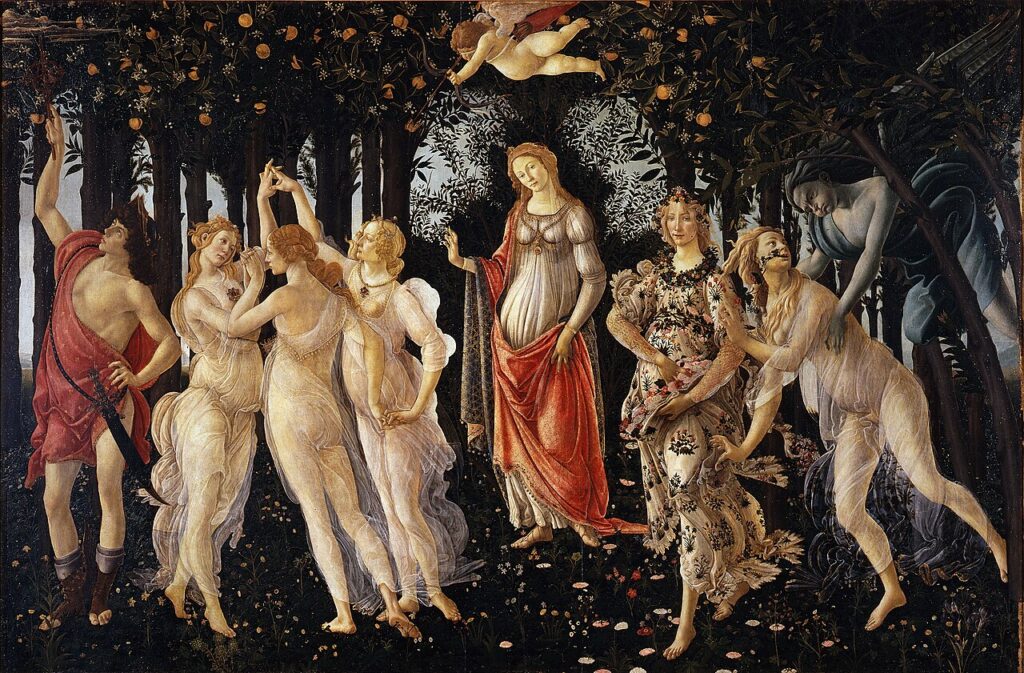
Botticelli — Line and Melancholy →In a grove of orange trees heavy with fruit, nine figures are arranged as if in a frieze. In the center, a woman presides, her hand raised in a gesture of welcome; above her, a blindfolded Cupid shoots an arrow. On the right, a bluish-hued god grasps a nymph from whose mouth flowers spill forth; on the left, three young women dance in a circle, draped in sheer veils. This is Botticelli’s *Spring* —the companion piece to *The Birth of Venus*, and one of the most enigmatic paintings in the entire history of art.
Painted around 1478–1482 for the same branch of the Medici family, this large panel is, along with *The Birth*, the pinnacle of Botticelli’s mythological art. Spanning nearly three meters in width, it depicts an allegory of spring, love, and the fertility of nature, populated by ancient deities rendered with all the linear grace characteristic of the Florentine master.
But *Le Printemps* is also an enigma. For centuries, art historians have debated the precise meaning of its subject matter: a Neoplatonic allegory of love, a celebration of the seasons, an initiatory poem on the purification of desire, or a nuptial tribute? No single interpretation stands out definitively, and it is perhaps this enduring mystery—as much as its beauty—that accounts for the painting’s fascination.
This article explores the secrets of this work—what it depicts, how it should be interpreted, the identity and role of each figure, the meanings that have been ascribed to it, the botanical marvel of its garden, and its place alongside *The Birth of Venus*.
The Painting — What It Depicts
*Spring* is a large tempera painting on wood, measuring approximately 203 centimeters high by 314 centimeters wide. This horizontal format, almost that of a tapestry, arranges the figures in a frieze in the foreground, set against a backdrop of dark trees.
The scene takes place in a garden—a grove of orange trees with dense foliage, laden with golden fruit, forming a sort of living canopy above the characters. The ground is a meadow strewn with a profusion of flowers. Through the tree trunks, a pale sky is visible. The atmosphere is that of an enclosed, protected place, removed from the world—a sacred garden, a dreamlike space.
Nine figures populate this garden, arranged more or less in a straight line in the foreground. In the center, slightly set back and elevated, a richly dressed woman presides over the scene: it is Venus, in her domain. Above her flies her son Cupid, blindfolded, drawing his bow. On the right side of the painting is a group of three figures: a god with a bluish complexion seizing a young woman, who transforms into a third figure covered in flowers. On the left, three young women entwined dance in a circle, and at the very edge, a young man wearing a helmet raises a staff toward the foliage.
All these figures are rendered with Botticelli’s characteristic grace: elongated silhouettes, clean contours, flowing, translucent drapery, and dance-like poses. None of them, with the exception of the god on the right, seem to be moving at all: they stand on the ground, resting on one leg, often on their tiptoes, in a suspended lightness. The entire painting is bathed in a dreamy stillness, a silent music.
How to Read the Table
To understand *Le Printemps*, you need to know which way to read it—because, unlike what we’re used to, it is read from right to left, following a progression that gives the painting its movement and meaning.
It all begins on the far right. There, a god with bluish skin and plump cheeks emerges from the grove: it is Zephyr, the west wind, a warm spring breeze. He rushes toward a young woman who is fleeing, half-naked, her face turned toward him in terror: the nymph Chloris. Flowers are already sprouting from Chloris’s mouth, a sign of the metamorphosis taking place.
This metamorphosis takes place before our eyes in the following illustration. Chloris, united with Zephyr, transforms into Flora, the goddess of flowers—that magnificent woman, dressed in a gown entirely embroidered with flowers, who walks forward, scattering roses drawn from the folds of her garment. The story, adapted from the Latin poet Ovid, thus recounts how the breath of the spring wind fertilizes nature and covers it with flowers: from the wild nymph is born the goddess of blossoming.
In the center stands Venus, goddess of love and mistress of the garden. The gesture of her right hand seems both to welcome the viewer and to point toward the rest of the painting, to the left, inviting the eye to follow. Above her, the blind Cupid aims his flaming arrow at the group of the Three Graces dancing to his left—these three young women entwined, a traditional symbol of beauty, generosity, and fidelity.
On the far left, finally, is a young man wearing a helmet and winged sandals, holding a caduceus: this is Mercury, the messenger of the gods. But he has his back to the scene and raises his caduceus toward the foliage, as if to dispel a few light clouds. He guards the garden, warding off anything that might disturb it, and his gaze rises beyond the painting, toward another world. From right to left, we thus move from Zephyr’s raw desire to Mercury’s serene contemplation—a progression that is not only narrative but also spiritual.
Figures and Their Meanings
Each figure in *The Spring* has been identified with relative certainty, but their arrangement and overall meaning remain a subject of debate. It is this tension between the clarity of the figures and the obscurity of the subject matter that gives the painting its richness.
Venus, in the center, is not here the goddess of carnal love. In the Neoplatonic context that shaped the work, she embodies a higher form of love, a spiritual principle that orders and elevates. She reigns over the garden, presides over the transformation taking place, and directs the actions of the other figures. Her central and elevated position—almost that of a Madonna—has even caused some to hesitate: is this Venus, or a Christianized figure of love? The ambiguity is undoubtedly intentional.
The Three Graces, to his left, form the most admired group in the painting. Entwined in a circular dance, clad in sheer veils that hint at their bodies, they embody beauty and generosity. The arrow Cupid is aiming at them suggests that love will soon touch them—perhaps the one in the center, whose gaze is already turning toward Mercury. Their joined hands and intertwined gestures form an arabesque of musical purity, the pinnacle of Botticelli’s linear art.
The group on the right—Zephyr, Chloris, Flora—symbolizes nature’s fertilization by spring. This is the earthly, sensual, generative aspect of the painting: desire, metamorphosis, and blossoming. Mercury, in contrast, represents the celestial aspect: reason, contemplation, and the elevation of the soul beyond the sensory world. Between these two poles, Venus acts as a mediator, transforming desire into beauty and beauty into spiritual aspiration.
This structure—from the sensual to the spiritual, from right to left, under the auspices of Venus—corresponds to the conception of love developed in the Platonic Academy of Florence. There, love was conceived as a ladder: beginning with physical attraction, it could ascend, step by step, to the contemplation of divine beauty. *The Spring* would depict this ascent in images. But this is only one interpretation among many.
A Persistent Mystery
No Renaissance work has sparked as many differing interpretations as *Spring*. Reviewing these interpretations allows us to appreciate both the richness of the painting and the limits of our knowledge.
The most widely accepted Neoplatonic interpretation views the painting as an allegory of spiritual love, a philosophical meditation on the ascent of the soul. It draws on the intellectual circle of the Medici, the philosophy of Marsilio Ficino, and the very structure of the composition. It is compelling and coherent, but it may attribute to Botticelli a systematic intention that he did not necessarily have.
Other interpretations have been proposed. Some see the painting as a simple allegory of the seasons or months, a celebration of springtime fertility without any deep philosophical underpinnings. Others interpret it as an initiatory poem on the purification of desire, moving from impulse to wisdom. Still others propose a nuptial interpretation: the painting is said to have been commissioned for a wedding in the Medici family and is said to celebrate conjugal love, fertility, and the virtues of the bride.
There are many literary sources, and they do not always agree. Ovid, for the myth of Flora; the poet Lucretius, for the hymn to Venus Generatrix; Angelo Politian and Marsilio Ficino, for the contemporary context. Botticelli clearly drew on several sources, without illustrating any of them literally. He composed rather than illustrated—inventing a scene that exists in no single text, based on elements borrowed from several.
Certain details remain stubbornly elusive. Why does Mercury have his back turned to the scene? Why do the characters’ gazes almost never meet? A recent hypothesis has even suggested that the central figure is not Venus, but Persephone. These lingering uncertainties are not failures of scholarship: they stem from the very nature of the work, conceived for a circle of initiates whose keys to its meaning have been lost. We admire *Le Printemps* as one might contemplate a riddle whose solution has been forgotten—and the painting perhaps gains in its power to inspire reverie.
A garden with five hundred plants
Beyond its mythological theme, *The Spring* is a botanical marvel—a painted garden of astonishing richness and precision, reflecting Botticelli’s attention to the natural world.
The foreground of the painting depicts a flower-filled meadow of extraordinary density. Experts have identified approximately five hundred plant species there, including nearly two hundred different flowers, and more than a hundred of these can be identified with certainty. Roses, irises, hyacinths, forget-me-nots, daisies, violets, cornflowers, and wild strawberries: it is a living herbarium, a catalog of springtime Tuscan flora, painted with remarkable naturalistic precision.
This profusion is not merely decorative. It reinforces the painting’s theme—fertility, flourishing, and the generosity of nature in spring. It also contrasts, through its precision, with the unreality of the figures: the garden is botanically accurate, while the bodies that inhabit it are rendered with a free, fluid line. Botticelli thus combines meticulous observation with poetic idealization.
This aspect of the painting has been compared to the Flemish tapestries known as “mille-fleurs,” which were highly prized in the palaces of the time and featured a background covered with a multitude of plants arranged without perspective. This connection sheds light on the somewhat archaic nature of the composition: the shallow depth of field, the aligned figures, and the ornamental background still belong, in certain respects, to an aesthetic close to the Late Gothic style—a style that the Florentine Renaissance was, however, in the process of moving beyond. Here, Botticelli is not a modern artist in the sense that Leonardo was: he is a man of refinement, a poet, who turns archaism itself into a means of enchantment.
The counterpart to *The Birth of Venus*
*Spring* cannot be fully understood on its own: together with *The Birth of Venus*, it forms a pair of works whose dialogue enriches each one. This connection deserves further explanation.
Both paintings were created for the same younger branch of the Medici family, and Vasari, in the mid-16th century, saw them displayed together in one of the family’s villas. They share a monumental format, a mythological subject, the central figure of Venus, a graceful line, and a dreamlike atmosphere. It was therefore natural to view them in relation to one another, as two parts of the same narrative.
The most commonly proposed framework is both chronological and thematic. *The Birth of Venus* would depict the very first moment: the goddess has just been born from the foam; she steps onto the shore, still naked, about to be clothed. *Spring* would then show her settled in her garden, clothed, reigning over love and blossoming. We would thus move from the birth of beauty to her reign, from the sea to the garden, from nudity to clothing.
Panofsky formalized this interpretation by distinguishing two aspects of the same figure: in *The Birth*, the nude Venus embodies celestial beauty, a spiritual principle; in *Spring*, the clothed Venus presides over earthly beauty, life, and procreation. The two paintings thus explore the two poles of the same deity—the two facets of love according to Florentine Neoplatonism.
We must, however, remain cautious: there is no evidence that the two works were conceived from the outset as a pair, and *Spring* is probably the older of the two. Their juxtaposition may be partly the result of chance in the collections. But whether they were conceived together or brought together later, the two paintings now stand side by side in the same room at the Uffizi, offering visitors one of the most beautiful pairings that painting has ever produced.
How to View the Work Today
“Spring” is housed at the Uffizi Gallery in Florence, in the Botticelli Room, alongside ” The Birth of Venus “—allowing visitors to view the two most famous mythological paintings of the Renaissance side by side.
This room is one of the busiest areas in the Uffizi, which are themselves among the most visited museums in Italy. Booking a time slot is highly recommended, and it’s best to aim for opening time or the end of the day to enjoy a bit of peace and quiet. Since the painting is large and rich in detail, it’s best to allow enough time to get up close and take it all in.
It is up close that *Le Printemps* reveals its treasures: the delicacy of the faces, the transparency of the Graces’ veils, the floral embroidery on Flora’s dress, and above all the incredible flower-filled meadow in the foreground, which no reproduction can truly capture. The true colors—darker and deeper than those in *The Birth*—often surprise visitors.
This room and the following ones showcase the entire Botticelli collection at the Uffizi—the most extensive in the world—including *The Calumny of Apelles*, a late and bitter work that stands in stark contrast to the serenity of *Spring*. Comparing these works is like tracing the artist’s entire career, from mythological enchantment to the turmoil of his final years.
Further Reading
Institutional sources cited
- Uffizi Gallery, Florence, Spring catalog entry.
- Giorgio Vasari, *The Lives of the Most Excellent Painters* (1568).
- Ovid, *Fasti* (on the myth of Flora).
Sources and Reference Studies
- Ernst Gombrich, *The Mythologies of Botticelli* (1945).
- Erwin Panofsky, *The Renaissance and the Renaissances in Western Art*.
- Paul Barolsky, Studies on Botticelli’s Poetic Imagination.
Institutional Documentation
- Uffizi Gallery, Florence — the institution that houses the artwork.
See also on Hors Cadre
- Botticelli—Line and Melancholy —A Portrait of the Artist, His Life, and His Art.
- The Birth of Venus—Botticelli’s pagan dream— the painting associated with it in the same room at the Uffizi.
- “The Calumny of Apelles” — Botticelli’s bitter masterpiece — the dark, late phase of his art.
— M