The Sistine Madonna — Raphael’s Celestial Vision
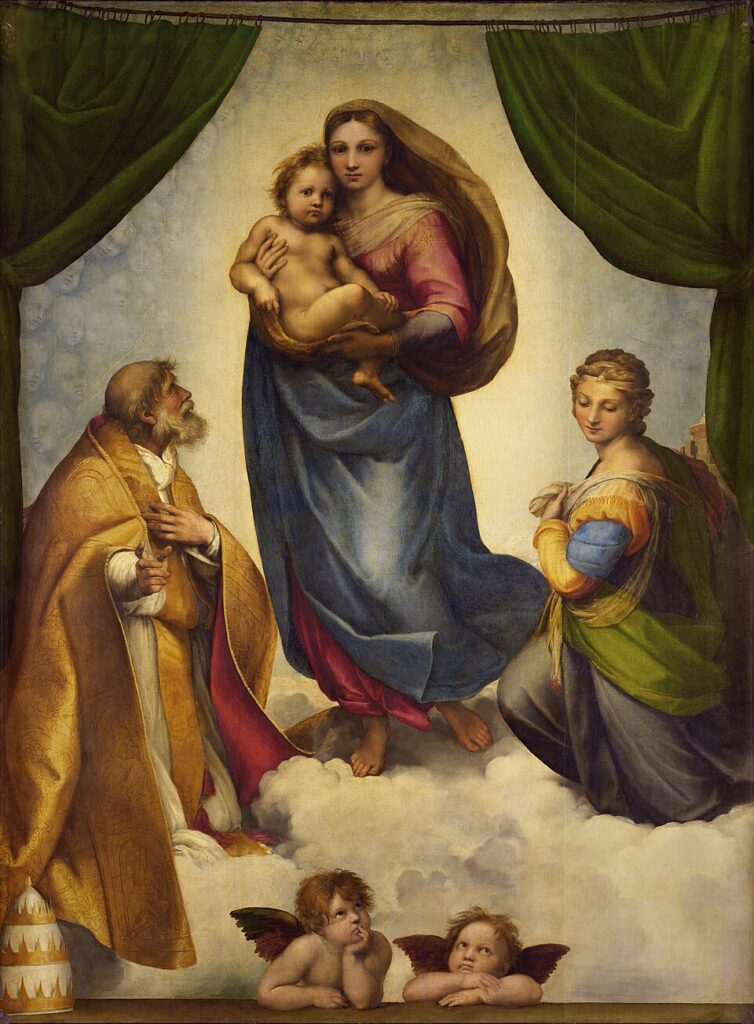
Raphael — Grace and Harmony →Two green curtains part, and a vision appears: the Virgin Mary, holding the Baby Jesus, descends toward us on a bed of clouds, flanked by two kneeling saints. Below, leaning against a balustrade, two dreamy little angels look up, lost in thought. This is Raphael’s Sistine Madonna —one of the most famous and beloved images in all of Christian art, and one of the pinnacles of Raphael’s artistry.
Painted around 1512–1514, this large canvas is one of Raphael’s last and most perfect Madonnas, the culmination of the entire body of work depicting the Virgin and Child that the painter had explored throughout his career. It displays all the grace, tenderness, and harmony that are the hallmarks of the master from Urbino. But it adds a new dimension: that of the apparition, the supernatural, and the heavenly vision, rendered with striking emotion and majesty.
The work also owes part of its fame to a detail that has become universal: the two small angels at the bottom—those dreamy putti leaning on their elbows—have become an icon in their own right, reproduced around the world, detached from their religious context. Few images have achieved such widespread recognition. But these cherubs are only the best-known part of a masterpiece of rare richness and beauty, one that is well worth rediscovering in its entirety.
This article explores the secrets of this work—what it depicts, the art of apparition that characterizes it, the sublime figure of the Virgin, the saints surrounding her, the famous cherubs, and the history of this painting, from its papal commission to its tumultuous fate over the centuries.
The Painting — What It Depicts
The Sistine Madonna is a large oil painting on canvas of impressive dimensions: approximately 265 centimeters high by 196 centimeters wide. This monumental format—that of an altarpiece—makes it a work intended to be viewed from a distance, within the space of a church, with all the solemnity that its subject demands.
The work depicts an apparition. In the center, the Virgin Mary, dressed in a red gown and a blue cloak, with a veil over her head, steps toward the viewer, holding the Infant Jesus in her arms. She appears to be descending from heaven, walking on a bed of clouds, in a movement that is both majestic and light. On either side, two figures are kneeling: on the left, Saint Sixtus, an elderly pope in rich vestments, who looks up toward the Virgin and gestures toward the congregation; on the right, Saint Barbara, a young woman with her head bowed, in an attitude of gentle devotion.
The entire scene unfolds in a celestial space, framed by two large green curtains drawn apart, as if on a theater stage or in a tabernacle. This staging creates the impression of a revelation, a vision that suddenly presents itself to the viewer. Upon closer inspection, the background is filled with a multitude of angelic faces, barely sketched in the golden light, suggesting heavenly choirs. Everything in the composition contributes to the effect of a supernatural apparition, a divine manifestation.
And then, right at the bottom, leaning against a balustrade that frames the composition, are the two little angels—the famous putti. Leaning on their elbows, their chins in their hands, they look up at the scene above them, appearing pensive, dreamy, almost distracted. Their presence, both charming and enigmatic, contrasts with the solemnity of the whole and adds a touch of humanity, tenderness, and familiarity. They have come to be, all on their own, one of the most famous motifs in the entire history of art.
A Celestial Apparition
What sets *The Sistine Madonna* apart from Raphael’s other Madonnas—and what gives it its unique power—is the treatment of the subject as an apparition, a heavenly vision. In this work, Raphael draws upon his full artistic mastery to create an impression of the supernatural and majesty.
The motif of the parted curtains is essential to this effect. By framing the composition with two large green curtains drawn apart on either side, Raphael suggests that a vision is being revealed, that a veil is being lifted to reveal a higher reality. It is as if the viewer were witnessing the very moment of revelation, the instant when the heavens open to reveal the Virgin and Child. This highly effective theatrical device transforms the altarpiece into a true epiphany, a manifestation of the divine.
The bed of clouds upon which the Virgin advances reinforces this impression of an apparition. Mary does not stand on earthly ground but seems to float, descending from heaven, carried by the clouds. This downward movement, this absence of solid ground, situates the scene in a celestial space, outside the earthly world. The Virgin comes down from the heights of heaven to meet humanity, in a gesture of grace and mediation. The background, filled with the faces of angels barely visible in the light, completes this supernatural space, populated by heavenly beings.
This aspect of revelation imbues the work with intense emotion and spirituality. Whereas many of Raphael’s Madonnas evoke a tender, almost familiar intimacy, *The Sistine Madonna* achieves a solemn grandeur, a sacred majesty. It combines the master’s characteristic gentleness with a mystical, visionary dimension that makes it particularly moving. It is this blend of grace and majesty, of tenderness and the sacred, that gives this work—one of Raphael’s most profound—its uniqueness and power.
The Virgin and Child
At the heart of the work, the figure of the Virgin and Child is one of the pinnacles of Raphael’s art. Here, he achieves a beauty, a grace, and a depth of expression that make this Madonna one of the most admired in the entire history of painting.
The Virgin’s face is one of serene and pure beauty, imbued with admirable gentleness and nobility. But this is not a cold or distant beauty: Mary’s gaze, directed toward the viewer, conveys a solemnity, a tenderness, and a restrained emotion that are deeply moving. There is something pensive, almost melancholic, in this face, as if the Virgin were foreseeing her child’s destiny. This psychological depth and inner life elevate the figure far above a mere devotional image.
The Baby Jesus, whom Mary holds in her arms, is depicted with the same precision. Far from the gently smiling child found in so many depictions of the Madonna, he has a serious face and a solemn, almost anxious gaze that echoes that of his mother. Here again, Raphael suggests, beneath the tenderness of the scene, an awareness of the tragic fate that awaits Christ. This shared solemnity of mother and child lends the work a rare emotional depth, an intensity that transcends mere religious representation to touch on the universal.
The figure of the Virgin is also a masterpiece of composition and movement. Her stance as she steps forward above the clouds, the drapery of her cloak billowing as if stirred by a breeze, and the way she holds the Child—all express a movement that is at once majestic and natural. Here, Raphael achieves that perfect balance between grace and grandeur, gentleness and majesty, which is his hallmark. The Virgin in the Sistine Madonna embodies the Raphaelesque ideal in its highest expression: a beauty that is also an emotion, a grace that is also a depth. It is one of the most perfect depictions of divine motherhood that art has ever produced.
The Two Cherubs—the Icon Within the Icon
If there is one detail of *The Sistine Madonna* that the whole world knows, it is the two little angels at the bottom—those dreamy putti resting their elbows on their hands, which have become one of the most reproduced and beloved images in the entire history of art. Their fame deserves a closer look.
At the bottom of the composition, leaning against a balustrade, two winged cherubs look up at the heavenly scene above them. Their poses are charmingly natural and somewhat unusual: one rests his chin on both hands, the other on one arm, and both appear pensive, dreamy, almost distracted, like children whose attention wanders. This spontaneity and tender humanity contrast with the solemnity of the apparition towering above them. They introduce a note of gentleness, familiarity, and emotion that makes the work more accessible and endearing.
These two putti have had an extraordinary fate. Removed from their original context, they have become an icon in their own right, reproduced endlessly—on postcards, posters, and all manner of objects—all over the world. Few artistic motifs have enjoyed such widespread circulation and popularity. This universal fame has sometimes caused people to forget their origin, to the point that many people are familiar with these cherubs without knowing that they come from a masterpiece by Raphael. They are the perfect example of a detail that has become more famous than the work from which it originated.
But these cherubs are not merely a decorative motif: they play a role in the composition and meaning of the work. By their position at the bottom, at the edge of the painting, leaning on a balustrade that separates the heavenly realm from our own, they serve as a link between the world of the apparition and that of the viewer. Their upward gaze guides our eyes toward the Virgin; their human presence draws us into the scene. They are like intermediaries, witnesses to the vision, halfway between heaven and earth. Far from being mere embellishments, they contribute fully to the beauty and depth of a work in which Raphael, like no other, has managed to unite the sublime and the tender.
A papal commission
The story of *The Sistine Madonna* begins with a prestigious commission linked to the great patron who presided over Raphael’s golden age: Pope Julius II. Understanding this origin sheds light on the meaning and title of the work.
The painting was commissioned around 1512 by Pope Julius II, that ambitious pontiff and patron of the arts who was Raphael’s great patron in Rome, and for whom the artist had already painted the frescoes in the Vatican Chambers. The commission was intended for a specific church: the Church of San Sisto—Saint Sixtus—in Piacenza, in northern Italy. The painting was to adorn the altar of this church, which was run by Benedictine monks. This purpose explains the presence in the work of Saint Sixtus, the patron saint of the church and of the pope’s family.
The choice of the two saints flanking the Virgin is therefore no coincidence. Saint Sixtus, the pope of the early Christian centuries, venerated in Piacenza, pays homage to the church for which the painting was commissioned and to Julius II himself, whose family venerated this saint. Saint Barbara, for her part, was also venerated in Piacenza. The two kneeling figures on either side of the Virgin are thus linked to the specific context of the commission, while also fulfilling their role in the composition: framing the apparition and serving as intercessors between the Virgin and the faithful.
This work is part of the prolific series of Madonnas that Raphael painted throughout his career. From the very beginning, the theme of the Virgin and Child had been one of his favorite subjects, which he explored in countless variations, each time achieving admirable grace and tenderness. The Sistine Madonna is one of the culminations of this long meditation on the Marian theme—undoubtedly the most ambitious, the most monumental, and the most profound. It crowns Raphael’s art of the Madonna, adding that dimension of a heavenly apparition that makes it unique. A papal commission and an artistic masterpiece, it combines the grandeur of its origin with the perfection of its execution.
The Fate of the Painting
The journey of *The Sistine Madonna*, from the Italian church for which it was painted to the German museum where it is now housed, is a tumultuous one, marked by the vicissitudes of European history.
For more than two centuries, the painting remained in its place, on the altar of the Church of San Sisto in Piacenza, admired by the faithful and visitors alike. Then, in the 18th century, its fate changed. In 1754, King Augustus III of Saxony, a great art collector, acquired the work for his famous gallery in Dresden. The Sistine Madonna thus left Italy for Germany, joining one of Europe’s finest collections of paintings. In Dresden, it quickly became one of the gallery’s crown jewels, admired by artists, writers, and thinkers. Great minds, from Goethe to Dostoevsky, expressed their awe in its presence.
The 20th century brought further trials for the painting. During World War II, to protect it from the bombings that devastated Dresden, the painting was moved to a safe location. At the end of the war, it was seized by the Red Army and taken to the Soviet Union, where it was preserved and exhibited in Moscow. It was not until 1955, after Stalin’s death, that the painting was returned to Germany, returning to Dresden to the gallery that had housed it two centuries earlier. This return was celebrated as a major event, as the Sistine Madonna regained its place among the city’s treasures.
Today, *The Sistine Madonna* is one of the most famous and most-visited works at the Gemäldegalerie Alte Meister in Dresden, where it is the crown jewel of the collection. Its history—marked by relocations, wars, exiles, and returns—adds to its aura and attests to the exceptional value that has always been recognized in it. Through the centuries and the vicissitudes of history, it has retained its emotional power and beauty intact. It remains one of Raphael’s most beloved masterpieces and one of the most profound depictions of the Virgin and the divine apparition that art has ever produced.
How to View the Work Today
The Sistine Madonna is housed at the Gemäldegalerie Alte Meister—the Gallery of Old Masters—in Dresden, Germany, one of Europe’s most important collections of old master paintings. It is displayed there as the collection’s centerpiece.
Seeing the work in person allows one to appreciate its scale and power: the monumental size, the majesty of the apparition, the beauty of the Virgin’s face, and the tenderness of the cherubs. It is a work that impresses with its grandeur just as much as it moves the viewer with its gentleness. The richly endowed Dresden Gallery also offers an exceptional overview of Italian, Flemish, and German painting, in which the Sistine Madonna holds a place of honor.
To further explore Raphael’s work, the Louvre Museum in Paris houses a fine collection of his works, including several Madonnas and the famous Portrait of Baldassare Castiglione. And in Rome, the Vatican Museums offer visitors the chance to admire his great frescoes, including *The School of Athens*. Thus, from Dresden to Rome via Paris, visitors can trace the career of the “prince of painters” and appreciate the full scope of his genius, from monumental frescoes to his most intimate Madonnas.
Further Reading
Institutional sources cited
- Galerie der Alten Meister, Dresden, entry on *The Sistine Madonna*.
- Giorgio Vasari, *The Lives of the Most Excellent Painters* (1568).
Sources and Reference Studies
- Pierluigi De Vecchi and Jean-Pierre Cuzin, *The Complete Paintings of Raphael*, Flammarion.
- Konrad Oberhuber, Raphael.
Institutional Documentation
- Galerie Alte Meister, Dresden — the institution that houses the work.
- Louvre Museum, Paris — other works by Raphael.
See also on Hors Cadre
- Raphael—Grace and Harmony —A Portrait of the Artist, His Life, and His Art.
- The School of Athens—Raphael’s humanist masterpiece— the great fresco in the Vatican, another of the artist’s masterpieces.
- Leonardo da Vinci—the universal genius —the master of the High Renaissance, whose example Raphael held up as a model.
— M