The School of Athens — Raphael’s Humanist Masterpiece
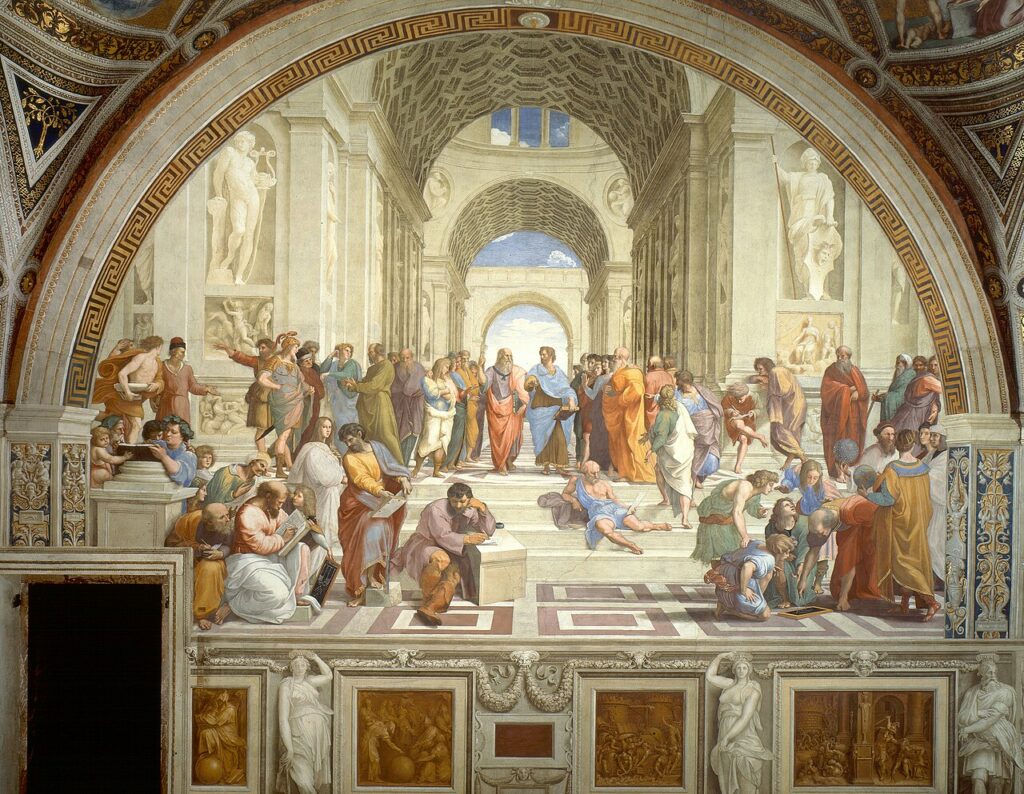
Raphael — Grace and Harmony →Beneath the majestic arches of an imaginary temple, the greatest thinkers of antiquity are gathered, discussing, meditating, and teaching. In the center, two figures step forward toward us: Plato, pointing to the sky, and Aristotle, reaching out toward the earth. Surrounding them is a crowd of philosophers, mathematicians, and scholars, in a composition of sublime grandeur and harmony. This is Raphael’s *School of Athens* —one of the world’s most famous frescoes and a dazzling manifesto of Renaissance humanism.
Painted between 1509 and 1511 for Pope Julius II’s apartments in the Vatican, this monumental fresco is Raphael’s masterpiece and one of the high points of the High Renaissance. It brings together, in an imaginary assembly, the great figures of Greek thought, celebrating philosophy and human knowledge. With its perfectly clear composition, masterful perspective, and supreme harmony, it perfectly embodies the classical and humanist ideal of the Renaissance.
But *The School of Athens* is also a profound and erudite work, rich in meaning. Every figure is identifiable, every gesture carries significance, and the entire composition conveys a vision of knowledge and the world. Raphael pays homage to ancient wisdom, while weaving in allusions to his contemporaries—for hidden beneath the features of certain philosophers are the great artists of his time, beginning with Leonardo da Vinci. The fresco is thus a dialogue between Antiquity and the Renaissance, between the wisdom of the ancients and the genius of the moderns.
This article explores the secrets of this masterpiece—what it represents, the figures of Plato and Aristotle at its heart, the assembly of geniuses surrounding them, the architecture and perspective that magnify them, the scholarly framework within which it is situated, and its significance as a manifesto of humanism.
The mural: what it depicts
The School of Athens is a large fresco, painted directly on the wall, measuring about five meters high and nearly eight meters wide at its base. It adorns one of the walls of the Chamber of the Signature, one of the rooms in the papal apartments of the Vatican Palace, now famous as the Raphael Rooms.
The fresco depicts a vast edifice—a majestic structure with barrel vaults, open to the sky—in which a large gathering of figures has assembled. These are the philosophers, scholars, and thinkers of ancient Greece, brought together in a single, ideal place, outside of time. There are about fifty of them, spread across several planes in lively groups: some are discussing, others are meditating, writing, teaching, or listening. The entire scene exudes intellectual activity, the life of the mind, and the pursuit of truth.
At the center of the composition, at the top of a staircase, two figures stand out, advancing toward the viewer: they are Plato and Aristotle, the two greatest philosophers of antiquity, placed at the heart of the work as the pinnacles of thought. Around them and below, the other thinkers are arranged in groups, each engaged in their own way. Among them, we recognize many famous figures, identifiable by their attributes or their poses. Together, they form a veritable gallery of ancient thought, a celebration of wisdom and knowledge.
The overall impression is one of supreme harmony and majesty. The skillfully arranged composition draws the eye to the central figures; the grandiose architecture frames and magnifies the scene; the light, colors, and rhythms all contribute to an effect of clarity and perfect balance. Nothing is confusing, despite the large number of figures: everything is orderly, clear, and harmonious. It is this mastery of composition, combined with the richness of the subject matter, that makes *The School of Athens* an absolute masterpiece.
Plato and Aristotle — The Heart of Thought
At the center of the fresco, the figures of Plato and Aristotle encapsulate the entire meaning of the work. Through their positions, gestures, and demeanor, Raphael captures the fundamental contrast in Western thought and pays tribute to the two greatest philosophers of antiquity.
Plato, on the left, is depicted as an elderly man with a white beard and a serious, contemplative expression. In one hand, he holds one of his works, the *Timaeus*; with the other, he points his index finger upward toward the sky. This gesture is rich in meaning: it points to the world of Ideas, that higher realm of eternal essences which, according to Plato, constitutes true reality, of which the sensible world is but a reflection. Plato thus embodies idealism, the philosophy that seeks truth beyond appearances, in the intelligible world of Ideas.
Aristotle, on the right, is depicted as a younger man in his prime. He holds his *Ethics* and extends his hand in front of him, palm facing the ground, in a horizontal gesture. This gesture contrasts with that of Plato: it points to the earth, the concrete world, and sensory reality. Aristotle embodies realism—the philosophy that begins with the observation of the world, experience, and nature to attain knowledge. The two gestures—one toward the heavens, the other toward the earth—sum up the opposition between Platonic idealism and Aristotelian realism, the two major schools of thought that have shaped all of Western philosophy.
One detail makes this portrait of Plato particularly moving: according to a widely accepted tradition, Raphael gave him the features of Leonardo da Vinci. By lending the face of the greatest genius of his time to the greatest philosopher of antiquity, Raphael paid a striking tribute to Leonardo, to his wisdom, and to his visionary genius. This choice attests to Raphael’s admiration for his elder, and makes Plato-Leonardo the symbolic pinnacle of the fresco, the embodiment of the highest thought. Thus, at the heart of the work, Antiquity and the Renaissance converge, and ancient wisdom and modern genius merge.
A gathering of geniuses
Surrounding Plato and Aristotle is an extraordinary gathering of the greatest thinkers, scholars, and mathematicians of antiquity. To identify these figures is to trace the entire history of Greek thought—and to discover Raphael’s hidden tributes to his contemporaries.
Among the many figures, experts have recognized a number of famous personalities. We can identify Socrates, discussing and debating, perhaps counting out his arguments on his fingers; Pythagoras, bent over a book, surrounded by disciples, engaged in his mathematical and musical research; Euclid (or Archimedes), leaning toward the ground, drawing a geometric figure with a compass, surrounded by attentive students; Ptolemy, holding a globe, a figure of astronomy; Diogenes the Cynic, lying casually on the steps, off to the side, true to his contempt for convention. Each figure is accurately characterized by his posture, attributes, and expression.
One figure in particular catches the eye: in the foreground, a solitary man sits leaning against a block of marble, lost in somber thought. This is Heraclitus, the philosopher of becoming and melancholy. However, Raphael added this figure later on, and he gave him the features of Michelangelo, who was at the time busy painting the ceiling of the nearby Sistine Chapel. This tribute to his great rival—in a style that, incidentally, evokes Michelangelo’s power—testifies to Raphael’s admiration for his formidable contemporary. Thus, just as Leonardo is depicted as Plato, Michelangelo finds his place in the fresco, in the guise of Heraclitus.
Raphael himself is not absent from this gathering: according to tradition, he depicted himself in the right-hand corner of the fresco, among a group of scholars, as a young man whose gaze is turned toward the viewer, as if to discreetly sign his work. Other figures may also conceal portraits of contemporaries, artists, or patrons. This presence of modern figures among the ancients is not a mere whim: it expresses the profound idea that the Renaissance revives the grandeur of Antiquity, and that modern geniuses are the heirs and equals of the ancient sages. The fresco thus unites the centuries in a single celebration of the human spirit.
Architecture and Perspective
The architectural setting of *The School of Athens* is not merely a backdrop: it is an essential element of the work, which enhances the scene and demonstrates Raphael’s mastery of composition and perspective.
The philosophers are gathered in a magnificent building, a vast classical structure with barrel vaults, adorned with statues and pilasters, and open to the sky. This majestic building, with its harmonious proportions, evokes the grandeur of antiquity and lends the scene an admirable solemnity, nobility, and grandeur. It should be noted that this architecture never actually existed: it is an imaginary, ideal space inspired by the designs of Bramante, the architect who was rebuilding St. Peter’s Basilica at the time. Raphael thus pays homage to the architecture of his time, while creating a setting befitting his subject.
Perspective is one of the work’s greatest triumphs. Raphael constructs the space according to a rigorous perspective, with a single vanishing point located precisely between the heads of Plato and Aristotle. All the architectural lines—the vaults, the cornices, the flooring—converge on this central point, irresistibly drawing the viewer’s gaze toward the two philosophers. This composition creates a striking illusion of depth, a vast and coherent space, and focuses attention on the central figures. Perspective is not merely a technical feat: it serves the work’s meaning, making Plato and Aristotle the geometric and spiritual center of the composition.
This mastery of architecture and perspective attests to Raphael’s compositional genius. He arranges some fifty figures, spread across several planes, within a complex space, with perfect clarity and balance. Each group finds its place, every figure is clearly discernible, and the whole forms a sublime harmony. This mastery of composition—this ability to organize multiplicity within unity—is one of the greatest qualities of Raphael’s art. *The School of Athens* is a striking demonstration of this: a masterpiece of order, clarity, and harmony, where form embraces and serves meaning.
The Chamber of Signatures Program
“The School of Athens ” can only be fully understood when viewed in its context: it is part of an elaborate decorative ensemble, the Chamber of the Signature, whose design celebrates the major fields of human knowledge and their harmony.
The Hall of Signatures was originally Pope Julius II’s private library, a place of study and reflection. Raphael was commissioned to decorate its walls and vault according to a coherent program, developed with the help of learned advisors. This program illustrates the major categories of knowledge and the activities of the human mind, each represented on a different wall. The School of Athens embodies Philosophy; opposite it, The Dispute over the Holy Sacrament represents Theology; another wall, featuring The Parnassus, celebrates Poetry; and the last wall depicts Law and Justice. Together, these frescoes form a panorama of human knowledge in its various dimensions.
This program reflects a profound vision characteristic of Renaissance humanism. It places ancient, pagan wisdom—philosophy, poetry—side by side with Christian truth—theology—suggesting their harmony and complementarity. The thought of the Ancients is not rejected as pagan, but valued as a preparation, a path toward truth. This is the quintessential humanist ideal: the reconciliation of antiquity and Christianity, of secular knowledge and faith, of reason and revelation. By rediscovering Antiquity, the Renaissance sought to integrate it into Christian culture in an ambitious synthesis.
Within this collection, *The School of Athens* holds a prominent place: it celebrates philosophy, the pursuit of truth through reason, and the human mind’s effort to understand the world. In contrast to Theology, it affirms the dignity and value of secular knowledge and the thought of the Ancients. It bears witness to the Renaissance’s confidence in the powers of the intellect, in the greatness of humankind, and in the continuity between ancient wisdom and modern culture. It is this vision—at once scholarly and serene—that Raphael was able to express with incomparable clarity and beauty. The fresco is the visual manifesto of an entire ideal.
A Manifesto on Humanism
Beyond its beauty and artistic merit, *The School of Athens* is a manifesto—the highest and most perfect expression of Renaissance humanism. This is what makes it, beyond a masterpiece of art, a pivotal document on the thought and values of an era.
Humanism, that great intellectual movement of the Renaissance, placed humanity—its reason and dignity—at the center of its worldview. It passionately rediscovered the legacy of Greco-Roman antiquity, seeking in it models of wisdom, beauty, and thought. It believed in the powers of the human mind, in the value of knowledge, and in humanity’s ability to understand the world and elevate itself through knowledge. The School of Athens visually embodies this ideal: by bringing together the great thinkers of antiquity in a majestic celebration of philosophy, it extols the greatness of the human spirit and the value of knowledge.
The fresco also expresses the serene confidence of the Renaissance, its faith in the harmony of the world and of thought. Everything in the work exudes order, balance, and clarity: the composition, the architecture, and the figures. This formal harmony reflects a deeper harmony—that of a worldview in which knowledge, beauty, and truth converge and resonate with one another. Despite the diversity of the philosophers and their sometimes opposing doctrines, the whole forms a serene unity, as if all paths of thought were converging in a single quest for truth. This is humanist optimism in its most accomplished expression.
With this work, Raphael created the very image of the Renaissance, the symbol of its ideal. *The School of Athens* has become the emblem of humanism, the rediscovery of Antiquity, and the celebration of knowledge and reason. No other work expresses with such power and beauty the spirit of an era that believed in humanity and knowledge. That is why the fresco transcends the realm of art history to become a milestone in the history of Western thought—the unforgettable image of a moment when humanity, rediscovering its own greatness, placed its trust in the powers of the mind. Five centuries later, this message retains all its power.
How to View the Work Today
“The School of Athens ” is located in its original setting, in the Sala della Segnatura, one of Raphael’s Rooms in the Vatican Museums in Rome. It cannot be seen anywhere else, since it is a fresco painted directly on the wall.
Raphael’s Rooms are part of the Vatican Museums, one of the most visited museum complexes in the world. The tour takes visitors through the papal apartments decorated by Raphael and his workshop, leading to the Signatura, where one can view The School of Athens in its original setting, alongside the other major frescoes in the series. The thrill of standing before this immense work, in the very place where Raphael conceived it, is truly overwhelming. Since crowds are very large, it is strongly recommended that you make a reservation and plan your visit in advance.
The tour of the Vatican Museums also leads to the nearby Sistine Chapel, with its frescoes by Michelangelo—allowing visitors to compare, in a single location, the two greatest works of High Renaissance art. To further explore Raphael’s work, the Louvre Museum in Paris houses a fine collection of his works, including Madonnas and the famous Portrait of Baldassare Castiglione. Thus, from Rome to Paris, one can appreciate the full extent of the genius of the “prince of painters.”
Further Reading
Institutional sources cited
- Vatican Museums, description of the Raphael Rooms and *The School of Athens*.
- Giorgio Vasari, *The Lives of the Most Excellent Painters* (1568).
Sources and Reference Studies
- Daniel Arasse, Studies on the Italian Renaissance.
- Konrad Oberhuber, Raphael.
Institutional Documentation
- Vatican Museums — the institution that houses the artwork.
See also on Hors Cadre
- Raphael—Grace and Harmony —A Portrait of the Artist, His Life, and His Art.
- Leonardo da Vinci—the universal genius— whose features Raphael borrowed for the figure of Plato at the center of the fresco.
- Caravaggio —the other great Italian master, a century later.
— M