The Sick Child — Munch
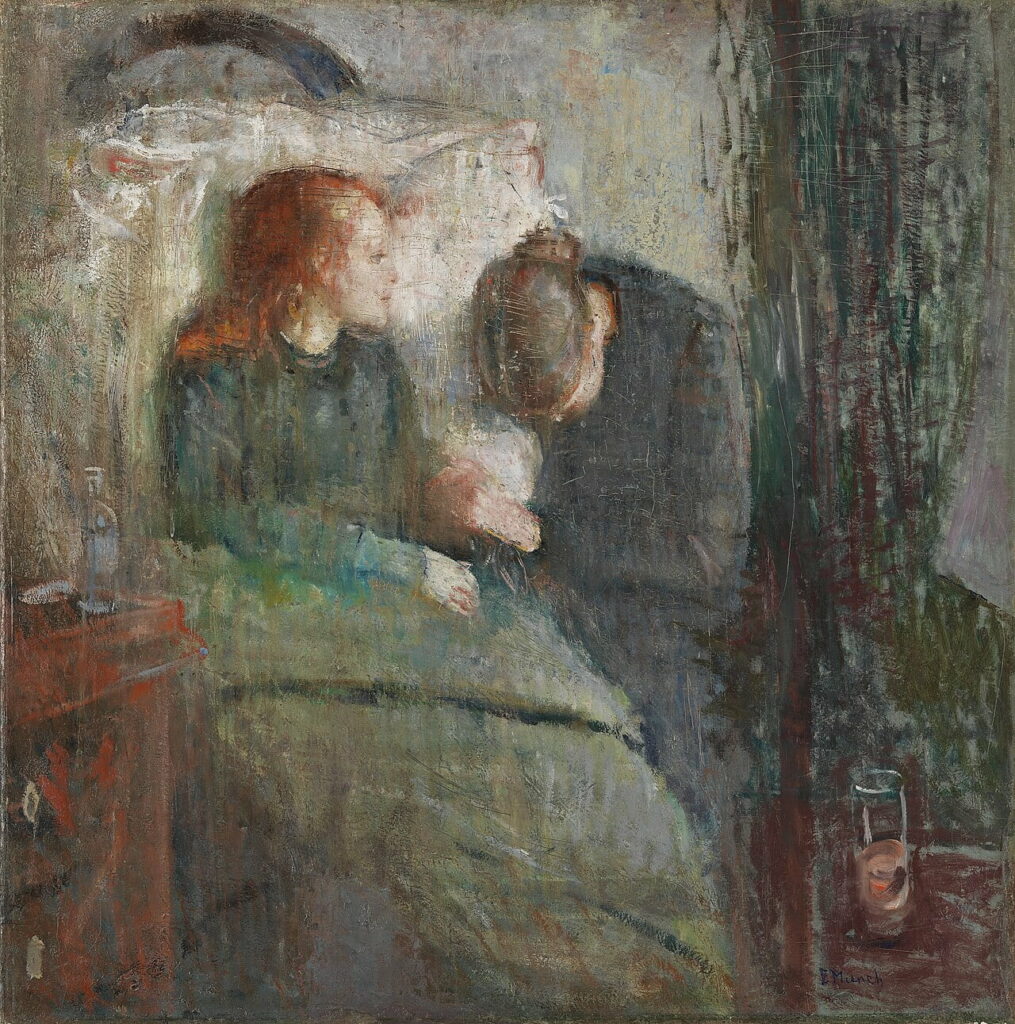
Edvard Munch — Anxiety Transformed into Color →A pale young girl, leaning against a large white pillow, turns her resigned gaze toward a distraught woman who, with her head bowed, holds her hand in silent despair: *The Sick Child* is one of Edvard Munch’s most poignant and significant works. Less famous than *The Scream*, it is nonetheless the foundational work of his entire body of art, the one in which the painter, drawing on the pain of his childhood, found his artistic voice.
Painted between 1885 and 1886, when Munch was in his early twenties, this painting depicts the death of his older sister Sophie, who died of tuberculosis at the age of fifteen. With its bold brushwork, textured and scraped surface, and emphasis on emotion over description, it caused a scandal at its first exhibition—but it also marked Munch’s true emergence as an artist. The painter himself considered it the starting point for his entire body of work.
This article offers an analysis of this deeply moving work: its subject matter, its personal origins in grief, its revolutionary technique, the scandal it sparked, and its decisive role as a breakthrough in Munch’s career.
The Work — A Scene of Mourning
The painting depicts a scene of poignant intimacy and sorrow: that of a sick child, watched over by a loved one overcome with grief. The unadorned composition focuses all the emotion on this silent face-to-face encounter.
At the center of the work, a young redheaded girl with a pale complexion leans against a large white pillow that frames her face and seems to halo her. She is sitting or lying down, her lower body covered by a blanket, in the characteristic position of a bedridden patient. Her face, seen in profile, conveys a gentle solemnity and serene resignation; her gaze is directed toward a woman leaning over her bedside. Some also see her gaze turned toward a dark curtain, often interpreted as a symbol of approaching death.
Facing her—or rather, leaning toward her—an elderly woman bows her head in a gesture of silent grief. We cannot really see her face: her bowed head and dejected posture convey the full weight of her sorrow and helplessness. This woman is Munch’s aunt, Karen, who had taken charge of the family home after the painter’s mother died. She holds the child’s hand in a final gesture of tenderness and comfort, facing an outcome we sense is inevitable. The contrast between the little girl’s face, turned toward the light, and the woman’s bowed head conveys the full tension of the scene: the child seems almost at peace, while the woman watching over her is crushed by grief.
The composition is deliberately sparse, focused on these two figures and their connection. The depth of field is shallow, and the background is indistinct, as if to focus all attention on the emotion. Nothing distracts from the intimate drama unfolding: illness, the approach of death, love powerless in the face of it, and the grief that lies ahead. This economy of means, this focus on the essential, lend the work a striking power and gravity.
Sophie’s Death
“The Sick Child ” draws directly on the most painful experience of Munch’s childhood: the death of his older sister. This deeply personal origin is the key to the work and its emotional power.
From a very young age, Munch was marked by illness and death. His mother died of tuberculosis when he was only five years old. Then, in 1877, his older sister Johanne Sophie, barely older than he was, was also taken by the same disease at the age of fifteen. As a teenager, Munch witnessed this slow agony and the ensuing mourning, which left an indelible mark on him. These successive losses and the ever-present reality of illness and death in his home shaped his painful sensitivity and haunted all his future work.
In painting *The Sick Child*, nearly ten years after Sophie’s death, Munch revisited this formative trauma. The young red-haired girl in the painting is Sophie; the distraught woman at her bedside evokes Aunt Karen, who had raised them. The work is therefore not just another genre scene, but the transposition of a lived memory, of a real and intimate pain. Munch, moreover, emphasized this difference: whereas other painters approached the theme of the sick child from the outside, he had experienced it from the inside, right through to the end of the suffering. It is this personal experience that gives the work its deeply moving authenticity.
The theme of the sick child confined to bed was, it is true, widespread in the painting of the time: several Nordic and European artists, including some of Munch’s compatriots, had addressed this subject, to the point that Munch would later speak, with a touch of irony, of a “time of the pillow.” But whereas these painters remained within a descriptive and realistic style, Munch did something entirely different. He did not seek to faithfully depict a scene, but rather to express an emotion, a memory, a pain. It was this radically new approach that would cause a scandal—and establish the work’s greatness.
A Revolutionary Invoice
What sets *The Sick Child* apart and caused such a scandal is not so much its subject matter as its style. In this work, Munch pioneered a new, daring style that broke with all the conventions of painting of his time and heralded the advent of modern art.
The surface of the painting bears the marks of relentless and unusual labor. Munch painted, scraped, erased, and repainted the canvas almost obsessively for over a year. He diluted his paints, scraped away the paint with the handle of his brush, leaving furrows, scratches, and vertical drips that streak the surface like so many tears. The result is a painting with a deliberately rough, unfinished, sketchy appearance, where the paint itself seems to bear the marks of suffering and effort. This jagged texture, far from being careless, was a deliberate choice made in the service of expression.
For Munch, the goal was not to produce a polished, accurate image, but to convey emotion, atmosphere, and memory. The blurriness, the scraping, and the unfinished appearance convey uncertainty, fragility, the transience of life, and the turmoil of memory and grief. The worked-on material becomes the visual equivalent of pain. This subordination of technique to emotion, this freedom in the treatment of the surface, made the work something radically new.
Because of these choices, *The Sick Child* is considered one of the very first Expressionist paintings. The loose brushstrokes, the lack of depth, and the primacy of emotion over description: all of these elements foreshadow Expressionism, that major 20th-century movement of which Munch was one of the pioneers. By breaking with realism and academicism, and by making the very technique of painting a means of expression, Munch blazed a new trail that modern art would follow in his wake. What appeared to his contemporaries as clumsiness or provocation was, in reality, a major innovation.
The Scandal of 1886
When Munch exhibited *The Sick Child* for the first time in 1886, the work caused an uproar. This scandal, though painful for the young painter, was nonetheless a sign of the radical nature and novelty of his art.
Munch presented the painting at the Autumn Exhibition in Kristiania—now Oslo—when he was only twenty-three years old, under the modest title “Study.” The reaction was remarkably harsh. Critics lashed out, deeming the work crude, unfinished, a failure, and unworthy of exhibition. It was not so much the subject—the death of a child—that was shocking—that theme was accepted—but rather the style: that scratchy, smudged style, that appearance of an unfinished sketch, clashed head-on with the expectations of a public accustomed to polished, realistic painting. In a city with a narrow artistic climate, Munch’s audacity came across as a provocation.
This hostile reception was a trying time for the young painter, whose entire first solo exhibition was, in fact, torn apart by the critics. But the scandal itself drew attention to his work, and a few discerning minds recognized the novelty and power of his art. “The Sick Child” has been described as a “scandalous success”: the work was unsettling, but it did not leave viewers indifferent, and it established Munch on the art scene. In short, the controversy revealed the revolutionary power of his painting.
In hindsight, this scandal appears to be the very hallmark of Munch’s modernity. As is often the case in art history, what was initially rejected as a mistake eventually came to be recognized as a brilliant innovation. His contemporaries’ lack of understanding was, in a way, a measure of how far ahead of his time Munch was. Far from discouraging him for good, this ordeal strengthened the painter’s resolve: shortly thereafter, he received scholarships that allowed him to study in Paris, and, against all odds, he continued his pursuit of an art focused on the expression of emotion and lived experience.
The Breakthrough — The Original Work
Beyond the scandal, *The Sick Child* occupies an absolutely central place in Munch’s oeuvre: it is the seminal painting, the one from which everything else stems. The painter himself never ceased to emphasize this.
Munch regarded this work as a decisive breakthrough, the moment when he had found his own path. He wrote that with *The Sick Child*, he had blazed new trails, opened up a new path, and that most of his later works had sprung from this painting. This shows just how important he considered it to be: not merely one work among many, but the foundation of all his future art. By daring, with this painting, to subordinate technique to emotion and to draw upon his personal experience, Munch had defined the principles that would govern his entire body of work.
This foundational significance is also evident in Munch’s steadfast devotion to this motif. Throughout his life, over a period of more than forty years, he returned to *The Sick Child*, painting six successive versions, as well as numerous drawings and prints. No other subject held his attention for as long or as intensely. Each version bears witness to the evolution of his art, his technique, and his use of color, yet all return to this primordial scene—the memory of the dying child watched over by a distraught woman. This ceaseless return speaks to how deeply this image was linked, for Munch, to the very source of his vocation.
*The Sick Child* is also inextricably linked to the major project that structures Munch’s oeuvre, *The Frieze of Life*, a cycle devoted to the themes of love, anxiety, illness, and death. The painting is one of its origins, one of its starting points. By giving form to the pain of grief and the experience of illness and loss, Munch began his exploration of the great existential themes that would fuel his entire body of work, right up to *The Scream* and beyond. That is why, despite its relative obscurity among the general public, *The Sick Child* deserves to be recognized as one of Munch’s most important works: the one through which a painter was born.
Where to see the artwork
The first version of *The Sick Child*, from 1885–1886, is housed at the Nasjonalmuseet, the National Museum of Norway, in Oslo, where it is considered one of the collection’s major works. The other versions, painted by Munch over the decades, are scattered among several museums: others are also located in Oslo, as well as in Gothenburg, Stockholm, and London. Oslo, Munch’s hometown, remains the best place to experience this work and his entire body of work, between the National Museum and the Munch Museum. When planning a visit, it is helpful to check the museums’ official websites to see the current exhibition schedule.
Further Reading
Institutional Documentation
- Nasjonalmuseet, Oslo — the National Museum of Norway, where the original version is housed.
- Munchmuseet, Oslo — the museum entirely dedicated to the artist.
See also on Hors Cadre
- Edvard Munch — Anxiety in Color — A Portrait of the Painter.
- The Scream — the universal symbol of anguish.
- Madonna — love and death intertwined.
— M