Madonna — Munch
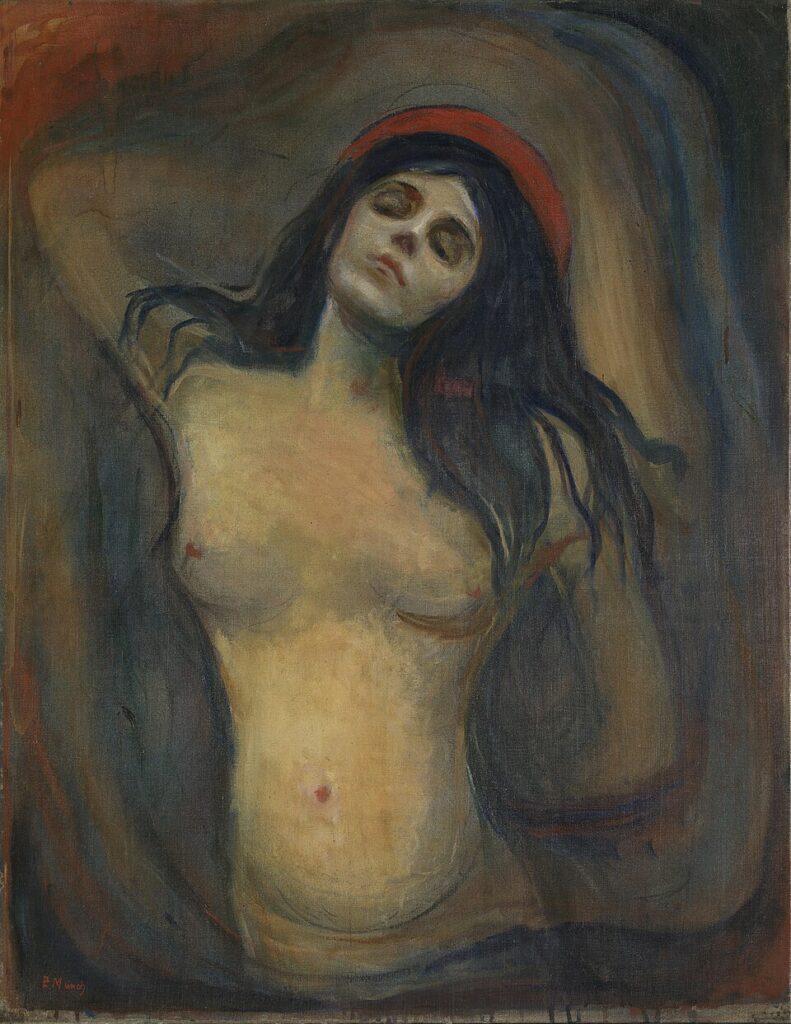
Edvard Munch — Anxiety Transformed into Color →A female figure with closed eyes, her head thrown back in ecstatic abandon, floating in a dark space rippled with undulations, her head encircled not by a golden halo but by a blood-red one: Madonna is one of Edvard Munch’s most fascinating and unsettling works. By giving a sensual nude the most sacred title in Christian art, the painter creates an image of dizzying ambiguity, where desire and death, the sacred and the profane, intertwine.
Painted between 1894 and 1895, at a time when Munch was developing his major series on existence, Madonna lies at the heart of his exploration of love, womanhood, and human destiny. The work exists in several painted versions, as well as in a famous lithograph that elucidates its meaning. Provocative, enigmatic, and possessing a haunting beauty, it ranks among the most powerful and most discussed images in Munch’s entire body of work.
This article offers an analysis of this unique work: its description, the paradox of its title, its significance in relation to conception and the cycle of life, the connection it draws between love and death, and its place within the painter’s body of work.
The Work — An Ecstatic Figure
The painting depicts a woman alone, captured in a moment of abandon and intensity. Her pose, her expression, and the atmosphere surrounding her combine to create an image that is both sensually and spiritually powerful.
The nude female figure is depicted from the waist up, standing out against a dark, indistinct background. Her eyes are closed and her head is tilted back in a gesture of surrender that evokes ecstasy. One arm appears to be folded behind her, exposing her bust to the viewer and accentuating the open, vulnerable, and sensual nature of the pose. Her long, dark hair flows around her, blending with the undulations of the space. The woman appears to be floating, weightless, as if in a dream or a vision, outside of real time and space.
The most striking element is the halo encircling his head. Where sacred iconography would have placed a golden halo—a symbol of holiness—Munch paints a blood-red halo. This color, laden with connotations—passion, blood, life, but also danger and death—radically transforms the meaning of the figure. The red of the halo is reflected in the overall atmosphere of the work, which is dominated by dark, glowing tones contrasted with black. The entire composition is crisscrossed by undulating, sinuous lines that envelop the figure and create a rhythm, a vibration, and a sensation of being enveloped and in a state of ecstasy.
This graphic composition, made up of curves and undulations, is reminiscent of other major works by Munch, such as The Scream, where the lines of the landscape twisted in the same way. Here, these undulations express not anguish, but ecstasy, the rapture of the senses, and the energy of life and desire. The figure, at once powerful and yielding, domineering and abandoned, exudes a magnetic and unsettling presence. As we contemplate her, we realize that she is more than just a nude: she carries a deeper meaning, which the work’s paradoxical title invites us to decipher.
A Paradoxical Madonna
The title of the work, Madonna, lies at the heart of its meaning and its provocative power. By giving this title to a sensual nude, Munch deliberately subverts Christian iconography, which is rich in meaning.
In the tradition of Western art, the Madonna is the representation of the Virgin Mary, a figure of purity, sacred motherhood, and holiness. She is usually depicted clothed, with a golden halo, in a pose of contemplation or maternal tenderness. By titling this figure—a nude woman with closed eyes in a pose of sensual ecstasy— “Madonna,” Munch creates a striking contrast, one that was almost blasphemous for his time. He brings together the sacred and the carnal, holiness and sexuality, within a single image. This daring juxtaposition was intended to shock—and indeed, it did.
This paradox is not merely a gratuitous provocation. It expresses a vision of women and love that is unique to Munch and characteristic of a whole sensibility of the late nineteenth century. For Munch, women embody a fundamental duality: they are at once sacred figures, sources of life, and a disturbing, sensual, and sometimes threatening force. His Madonna brings these two aspects together: she is simultaneously the haloed virgin and the desirable woman, the mother and the lover, the sacred and the profane. This ambivalence—this fusion of opposites—lay at the heart of the Symbolist era’s explorations of the nature of woman and desire.
The image thus fits into a recurring theme in fin-de-siècle art: that of women viewed as beings who are both fascinating and formidable, givers of life and harbingers of death. Munch, marked by complex and painful relationships with women and haunted by the connection between love and death, projects all his ambivalence onto this Madonna. The figure is neither a soothing saint nor a mere seductress: she is a vital and mysterious force, holding life and death in her hands. The religious title, far from being incongruous, underscores this quasi-sacred dimension of woman as the source of life.
The Moment of Conception
Munch imbued this work with a specific meaning, linked to the mystery of the transmission of life. The Madonna is said to represent a woman at the moment of conception—a moment in which, for the painter, the pinnacle of life and the presence of death converge.
According to Munch’s own account, the figure is captured at the moment of love and conception—that instant when a new life can be conceived. The ecstatic pose, the closed eyes, and the body’s surrender evoke this supreme moment. The viewer is implicitly placed in the position of the lover, facing this woman who offers herself: the work draws the viewer into the scene, making contemplation a form of participation in the mystery. This dimension explains the image’s sensual power and unsettling intensity.
This meaning is made explicit in the lithographic version of the work, which Munch produced shortly thereafter. In this print, he surrounds the figure with a border adorned with depictions of spermatozoa, symbolizing the seed and the possibility of new life, while in one corner appears a small figure of a curled-up fetus. These elements, absent from the painted versions, make explicit the theme of conception and the beginning of life. But the fetus, depicted in a pale and unsettling light, also introduces a note of sadness and death, eerily reminiscent of the spectral figure in The Scream. Life that is just beginning already carries within it, Munch seems to say, the shadow of death.
Conceived in this way, The Madonna is part of a meditation on the cycles of female existence—conception, childbirth, and death—that Munch explored in his work. Here, woman is portrayed in her most fundamental and mysterious role: that of giving life. But for Munch, this celebration of life is inseparable from an awareness of death. The moment of conception, the pinnacle of the life force, is also the moment when the cycle leading to the end begins. This thought—somber and dizzying—lends the work its depth and gravity, beyond its apparent sensuality.
Love and Death
As in Munch’s entire body of work, love and death are inextricably linked in Madonna. This association, at the heart of his worldview, gives the work its tragic dimension and universal significance.
For Munch, love is never a simple or happy experience: it is fraught with anxiety, jealousy, and danger, and linked to death. Sensuality in his work is always tinged with unease. The Madonna embodies this vision: in it, the woman is both a source of life and a figure of death; the ecstasy of love coexists with the shadow of the end. The blood-red halo, the presence of the pale fetus in the engraved version, and the dark, murky atmosphere all combine to unite Eros and Thanatos—desire and death—within a single image. This anguished fusion of sexuality and death is one of the most profound hallmarks of Munch’s art.
This perspective is rooted in the painter’s personal history and in the culture of his time. Marked from childhood by the deaths of his mother and sister, and having experienced complex and painful romantic relationships, Munch carried within him an intimate association between love, desire, and loss. He also shared the concerns of his era—the late 19th century—which was fascinated by the connections between sexuality, life, and death, and by the ambivalent figure of women. The philosophy and literature of his time fueled this vision of an existence in which the life force and the death drive intertwine.
“Madonna” is thus an integral part of The Frieze of Life, the grand cycle through which Munch sought to portray human existence in all its dimensions. Within this cycle, the Madonna embodies the essence of love and desire, of the birth of life—yet a love and a birth already marked by the presence of death. It engages in a dialogue with the other works in the cycle, such as The Scream, which expresses its anguish, or the scenes of illness and mourning that speak to its end. Within this body of work, the Madonna represents the mystery of origin, the beginning of the cycle of life, captured in all its fascinating and tragic ambiguity.
Versions and Legacy
As with his other major motifs, Munch created several versions of The Madonna using various techniques, and the work’s fate confirmed its significance both in his own art and in the history of modern art.
Munch produced several painted versions of the Madonna, which are now housed primarily in museums in Oslo and in private collections, as well as a lithograph that helped spread the image and clarify its meaning by adding the border of sperm and the fetus. This practice of revisiting and reinterpreting his work was characteristic of Munch, who constantly returned to his essential motifs, exploring them through painting, drawing, and printmaking. For one of the versions, the painter drew inspiration from a model belonging to the bohemian and intellectual circle he frequented in Berlin—a woman who was well-known in those artistic circles.
Like other masterpieces by Munch, the work had a turbulent history. One of the versions was stolen in a spectacular heist in the early 2000s, along with a version of The Scream, before being recovered a few years later. This widely publicized episode contributed to the work’s fame. Today, The Madonna is recognized as one of the most powerful and provocative images in all of Munch’s art, regularly exhibited and studied, including in the world’s leading international museums.
The enduring legacy of The Madonna lies in its very richness and ambiguity. A work that is both sensual and spiritual, provocative and solemn, it continues to fascinate with the way it unites opposites—the sacred and the carnal, life and death, ecstasy and anguish. It testifies to Munch’s power to give form to the deepest and most turbulent dimensions of human experience. Through this daring exploration of sexuality, desire, and their connection to death, Munch opened up new frontiers for modern art, making The Madonna a pioneering work whose modernity continues to speak to us today.
Where to see the artwork
Versions of Madonna are primarily housed in Oslo, Munch’s hometown. The Nasjonalmuseet, the National Museum of Norway, and the Munchmuseet, which is entirely dedicated to the artist, house versions of the work and offer an unparalleled overview of his creative process. Other versions and prints of the lithograph can be found in various museums around the world. Oslo remains the premier destination for exploring this work and Munch’s world. Given that the works are displayed on a rotating basis, it is recommended that you check the museums’ official websites before your visit to confirm which version is currently on display.
Further Reading
Institutional Documentation
- Nasjonalmuseet, Oslo — the National Museum of Norway.
- Munchmuseet, Oslo — the museum entirely dedicated to the artist.
See also on Hors Cadre
- Edvard Munch—anxiety rendered in color— a portrait of the painter.
- The Scream — the universal symbol of anguish.
- *The Sick Child* —the work that inspired his art.
— M