The Potato Eaters — the work Van Gogh defended throughout his life
Vincent van Gogh — the artist who wrote as much as he painted →Nuenen, Thursday, April 30, 1885. Vincent van Gogh writes a long letter to his brother Theo. He has just completed a painting he has been working on for months, *The Potato Eaters*. The painting is about to be sent to Paris. And already, in the letter, Vincent anticipates the criticism: he knows that Theo will find the work too dark, and that the Parisian art dealers will reject it. So he defends, point by point, what he has done.
This defense would never end. During the five years he had left to live, Van Gogh would continue to insist that *The Potato Eaters* was his best painting. Theo criticized it, his painter friend Anthon van Rappard tore it apart, and the Parisian art market ignored it. Vincent would not back down. Two years later, he wrote about it again to his sister Wilhelmine. Five years later, in Saint-Rémy, he would even attempt to paint a new version of it.
This article tells the story of this work in Van Gogh’s own words. It is a work he meticulously prepared, vigorously defended, and maintained throughout his life as the best thing he had ever created—against everyone else’s opinion.
Nuenen, winter 1884–1885
In the winter of 1884, Vincent van Gogh was thirty-one years old. He was living with his parents at the parsonage in Nuenen, a village in North Brabant in the southern Netherlands, where his father, Theodore, was a pastor. He had returned there in December 1883, after his attempt to settle in Drenthe had failed.
His studio at the rectory was not enough for him. He decided to rent a room in a local home so he could work more closely with the farmers. He stayed with the De Groot-van Rooij family, a poor farming family from Nuenen, to whom he paid a modest rent. It was in their home that he would sketch and paint most of his head studies throughout that winter.
His correspondence with Théo, who was in Paris working for the Boussod, Valadon & Cie gallery (the successor to Goupil), was extensive during this period. Théo sends him a regular monthly allowance. In return, Vincent describes his work in detail, sending him drawings, sketches, and draft letters. He is preparing for a specific project: painting a large canvas depicting peasant figures seated at a table.
Fifty Studies of Heads
Before painting *The Potato Eaters*, Van Gogh produced about fifty studies of peasants’ heads between December 1884 and April 1885. This is documented by the Van Gogh Museum, which houses a large portion of them. These studies are preparatory: Vincent drew and painted the five faces separately, which he would then assemble into the final composition.
This method was unusual for him. Van Gogh rarely worked with such methodical preparatory studies. For this particular painting, he built his composition element by element. First the heads, then the hands, then the whole scene. The Van Gogh Museum has documented this process: Vincent studied, in turn, the faces, the hands, the lamp, and the arrangement of the figures around the table.
Of these studies, only one person identified by name appears in the final painting: Gordina de Groot, a peasant woman from the family with whom he was staying. She is the young woman shown in profile in the center-right of the painting. The four other figures depicted—an elderly man and woman, a young man, and a child seen from behind—are also peasants from Nuenen, but their exact identities have not been established.
Van Gogh thus painted a scene he had actually seen—in the house where he lived—featuring models he knew, but which he reconstructed in his studio based on his studies. As with many of his later works, he combined direct observation with deliberate composition.
The painting—what it depicts
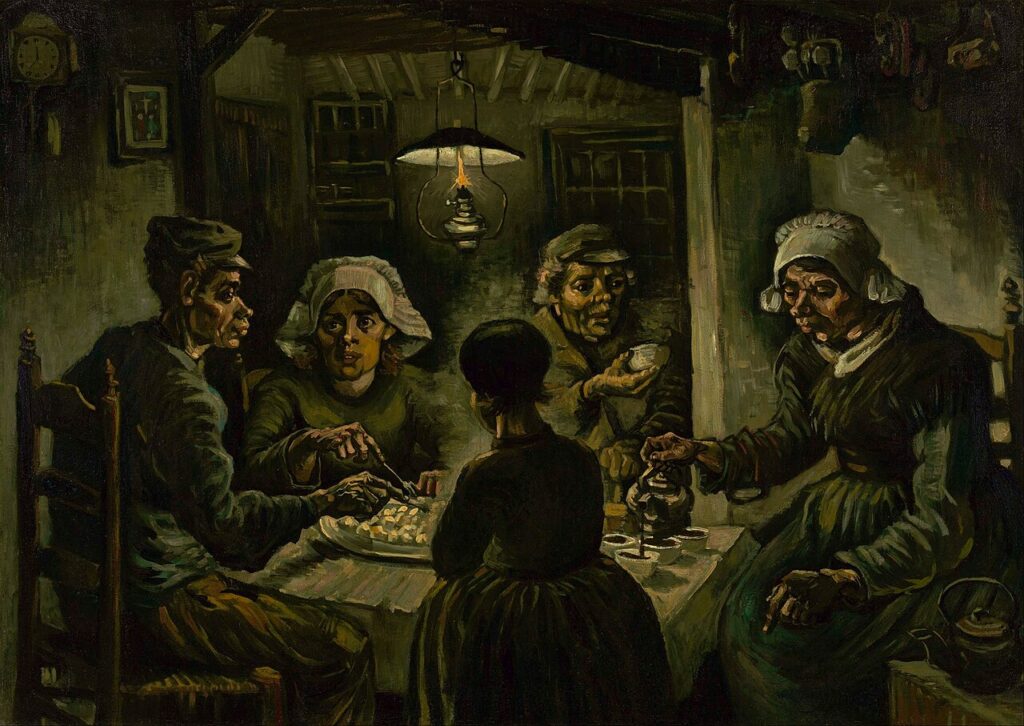
*The Potato Eaters* is an oil on canvas measuring 82 centimeters high by 114.5 centimeters wide. It is a landscape format, monumental for an interior scene—Van Gogh deliberately chose dimensions typical of a “figure painting,” comparable to those used by Salon painters for their large compositions.
The painting depicts five peasants gathered around a wooden table in a dimly lit room illuminated by a kerosene lamp hanging from the ceiling. On the table are a dish of steaming potatoes, cups, and a coffee pot. The figures are eating.
On the left, two figures: an elderly woman seen in profile, and a bearded man facing her. In the center, a young man seen in three-quarter profile, reaching toward the dish. On the right, Gordina de Groot, seen in profile, pouring coffee into a cup. A child, seen from behind, is sitting in the foreground—her head is almost exactly under the lamp.
The faces are angular, weathered, and painted without any softening. The hands are gnarled, thick, and deformed by manual labor. Vincent paints them in shades similar to those of potatoes—a color he describes in Letter 497, dated April 30, 1885, as that of“a potato covered in a thick layer of dirt and, of course, unpeeled.”
The lighting is an intense play of light and shadow, reminiscent of 17th-century Dutch interiors. The ceiling lamp is the only source of light. Everything it does not illuminate is shrouded in dense darkness. The walls behind the figures are barely sketched; shadows obscure their outlines.
The palette is dominated by browns, dark greens, ochres, and Sienna. No bright colors. No pure white. This is precisely the anti-Impressionist palette that Van Gogh embraced in 1885—even as Theo, in Paris, was discovering the bright colors of the Impressionists.
“A painting that smells of bacon and smoke”
On April 30, 1885, in Letter 497, sent to Theo on his brother’s birthday, Van Gogh defends in advance the painting he has just completed. He knows the painting will be controversial. He knows that dark colors are no longer in fashion. He stands by his work.
In this letter—one of the longest in Van Gogh’s entire correspondence, and one of the most detailed regarding the artist’s pictorial intentions—Vincent explains why a painting of peasants must be what it is: earthy, visceral, and sensual in the most material sense. He establishes a principle.
“If a painting of peasants smells of bacon, smoke, and the steam rising from the potatoes, so much the better!”
— Vincent van Gogh, Letter 497 to Theo, Nuenen, April 30, 1885
The passage surrounding this sentence, in the same letter, expands on the idea: a painting of peasants should not smell of perfume. It must not be softened, polished, or made presentable for bourgeois salons. It must retain the scent of what it depicts—the earth, the smoke from the hearth, the potatoes cooking.
Van Gogh articulated this aesthetic stance in 1885 in opposition to all the mainstream painting of his time. At that time, the Paris Salon celebrated neat genre painting, idealized peasant scenes in the style of Bastien-Lepage, and decorative rustic scenes. Van Gogh took the opposite stance: he advocated for a style of painting that did not seduce, did not flatter, but rather rendered reality faithfully.
In the same letter, he explains that the painting cost him “an entire winter of studies depicting heads and hands” —a statement about his method that contradicts any notion of a spontaneous work.
Failure — Théo, van Rappard, the Market
Van Gogh sent *The Potato Eaters* to Theo in Paris in early May 1885, hoping to break into the Parisian art market. The result was immediate: failure.
Théo himself is lukewarm about it. He finds the painting too dark, too far removed from the light colors that Paris is beginning to favor. He expresses his reservations in a letter to Vincent. Nevertheless, he shows the painting to the art dealer Alphonse Portier, a friend of the Impressionists, whose opinion is more nuanced but who does not offer to buy it.
Anthon van Rappard, a Dutch painter and close friend of Van Gogh’s for several years, lambasted the painting in a letter dated May 24, 1885. He deemed the work clumsy, anatomically inaccurate, and poorly composed. Van Gogh was hurt. His reply, in July 1885, was curt: “You had no right to condemn my work the way you did.” The relationship between the two painters would never recover—they would stop corresponding the following year.
The Paris art market, approached by Théo, remains uninterested. No gallery is offering the painting for sale. No collector has come forward. The painting returns to the studio.
For most painters, this threefold criticism—from his brother, his friend, and the market—would serve as an unambiguous warning. Van Gogh pays no attention to it.
Retrospective Defense — 1887, 1890
Two years after his failure, in 1887, Van Gogh was in Paris, living with Theo, and had discovered Impressionism. His color palette had completely transformed. The dark colors of Nuenen had disappeared. And yet, in a letter to his sister Wilhelmine sent from Paris, he continued to defend *The Potato Eaters*.
“The painting of the peasants eating potatoes […] is, after all, the best thing I’ve ever done.”
— Vincent van Gogh, letter to his sister Wilhelmine, Paris, 1887
This persistence is striking. Since then, Vincent has painted dozens of infinitely more captivating works—views of Montmartre, Parisian self-portraits, luminous still lifes. His technique has evolved radically. But when his sister asks for his opinion, he returns to the painting of Nuenen.
Three years later, in 1890 —five years after the original version and just a few months before his own death—Van Gogh was admitted to the Saint-Paul-de-Mausole asylum in Saint-Rémy-de-Provence. While in the asylum, ill and aware that his southern-inspired art had run its course, he wrote to Theo that he was thinking of reworking *The Potato Eaters*. He sketched a new composition depicting a peasant meal. Several drawings from this period, now in the collection of the Van Gogh Museum, bear witness to this attempt.
The project would never come to fruition—Van Gogh died in Auvers-sur-Oise in July 1890 before he could paint this new version. But his intention is well documented. Five years after its critical failure, he still returns to this work as if it were a peak he must reach once more.
How to View the Work Today
“The Potato Eaters ” is housed at the Van Gogh Museum in Amsterdam, as part of the permanent collection. It is one of the museum’s key works and is on permanent display.
Practical Information:
- Address: Museumplein 6, 1071 DJ Amsterdam, Netherlands
- Reservations required: limited time slots; tickets available online on the official website
- Price: around €22 for general admission (free for children under 18)
- Tip: Plan on spending at least half a day visiting the museum. The collection includes about 200 paintings and 500 drawings by Van Gogh, as well as his complete correspondence and the collection of Japanese prints he had assembled.
- Least crowded times: early mornings on weekdays, outside the tourist season
Other documented versions
Van Gogh produced several versions of the subject at different stages:
- Final version (April 1885, 82 × 114.5 cm): Van Gogh Museum, Amsterdam. This is the main work, the one discussed in this article
- Preliminary oil sketch (March–April 1885): held at the Kröller-Müller Museum in Otterlo (Netherlands). The composition is very similar to the final version, but slightly more sketchy
- Lithograph (April 1885, completed in one day, according to Van Gogh in Letter 516): prints held at MoMA in New York, the Van Gogh Museum, and several other public collections
For anyone traveling to the Netherlands, seeing both versions (Amsterdam and Otterlo) in just a few days is one of the most enlightening journeys into the genesis of a work of art that one can take in the field of art history.
Further Reading
Primary sources for the article
- Vincent van Gogh, The Letters, a complete, illustrated critical edition, edited by Leo Jansen, Hans Luijten, and Nienke Bakker, Van Gogh Museum / Huygens Institute / Actes Sud, 2009. The definitive edition.
- Official website: vangoghletters.org — all 902 letters available for viewing, accompanied by a scholarly critical edition.
- Letter 497 to Theo van Gogh (Nuenen, April 30, 1885) — an aesthetic defense of the painting.
- Letter to Wilhelmine van Gogh (Paris, 1887) — a retrospective defense.
Institutional Documentation
- Van Gogh Museum, Amsterdam — the institution that owns the work. Permanent exhibition.
- Kröller-Müller Museum, Otterlo — preservation of the preparatory oil sketch.
- “The Potato Eaters”: Mistake or Masterpiece?, Van Gogh Museum exhibition, 2021 — a scholarly study of the painting’s creation, reception, and fate.
Also check out on Hors Cadre
- Vincent van Gogh—the artist who wrote as much as he painted —a portrait of the painter.
- “The Starry Night”—a depiction of a sky imagined by Van Gogh —a night scene painted in Saint-Rémy in 1889.
- Jean-François Millet — the painter of peasants
- The Sower — the painting by Millet that Van Gogh painted throughout his life
— M