The Origin of the World — Courbet’s Utter Audacity
Gustave Courbet — The Scandal of Reality →Few works in the entire history of art have sparked as much fascination, discomfort, and debate as Gustave Courbet’s *The Origin of the World *. This small painting from 1866, which depicts a woman’s nude body in a radically candid composition, has spanned a century and a half of history while remaining hidden for the most part—behind a curtain, behind another painting, or in the private collections of a few collectors. A famous yet long-hidden work, scandalous yet deeply rooted in the great pictorial tradition, it embodies, more than any other, the absolute radicalism of Courbet’s realism.
With *The Origin of the World*, Courbet takes the principle that underlies his entire art to its extreme: painting reality—all of reality—without veiling or idealizing it. Whereas the academic painting of his time depicted smooth, idealized female nudes draped in mythological pretexts, Courbet dared to present a frontal, unflinching depiction of the body, with a raw realism that broke with all conventions. It is a transgression—but it is also, from a strictly pictorial standpoint, a work of great beauty in its treatment of texture and color, heir to the sensual tradition of the Venetians.
The history of this painting is a story in itself. Commissioned by an Ottoman diplomat and art collector, hidden away for decades, passing through the hands of successive owners who carefully concealed it, and once owned by the famous psychoanalyst Jacques Lacan, the work did not enter the public collections of the Musée d’Orsay until much later, in 1995, into the public collections of the Musée d’Orsay. And the identity of the woman who posed for it remained a mystery for more than 150 years.
This article traces the history and significance of this extraordinary work—the commission by the diplomat Khalil-Bey, the century of concealment it endured, the long-unsolved mystery of its model, the radical nature of its realism, its paradoxical connection to the great tradition, and how this once-secret painting has become one of the most visited and most discussed works at the Musée d’Orsay.
The Painting — What It Depicts
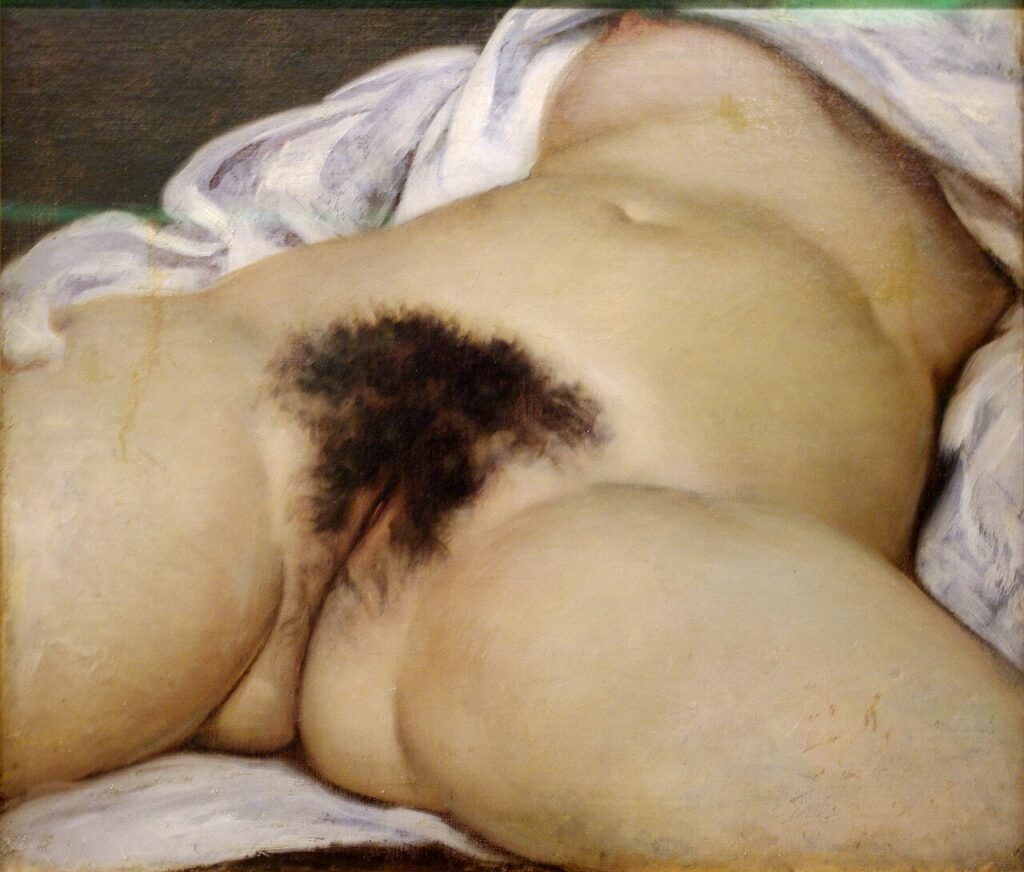
*The Origin of the World* is a small oil-on-canvas painting: approximately 46 centimeters high by 55 centimeters wide. An intimate format, in contrast to large, monumental canvases such as A Burial at Ornans or The Painter’s Studio —a painting size intended not for the Salon, but for the private sphere.
The work depicts, within a deliberately tight frame, the nude body of a reclining woman. The framing is the essential element: Courbet chose to show only part of the body—the torso and lower abdomen—without depicting either the face or the legs beyond the thighs. This absence of a face—this reduction to the body alone—is one of the work’s most striking and most debated artistic choices. The model remains anonymous, reduced to her physical presence alone.
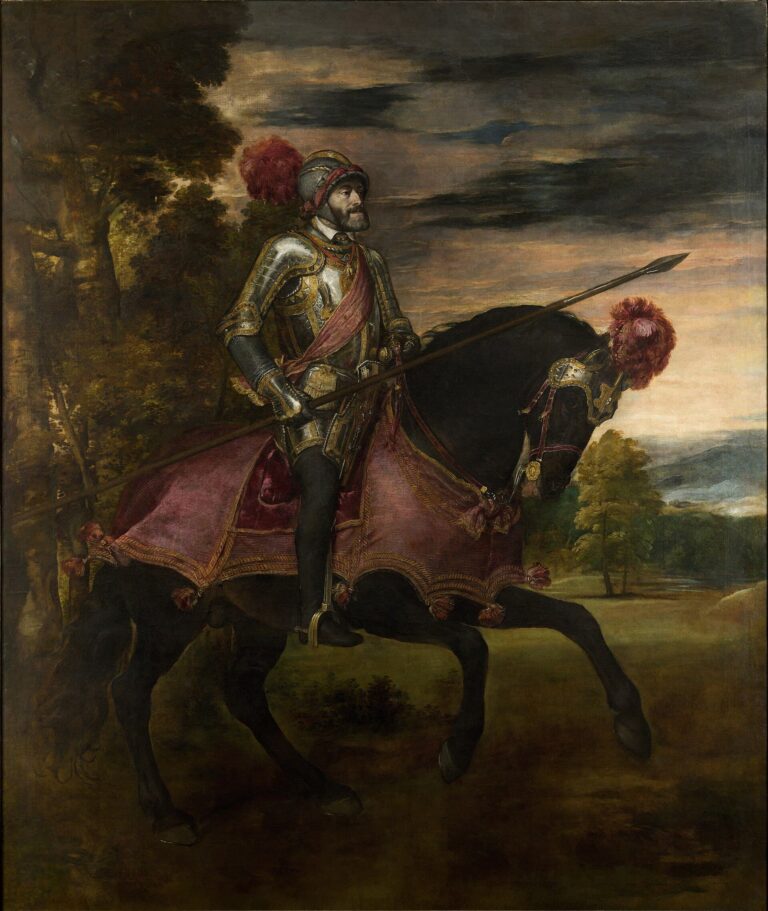
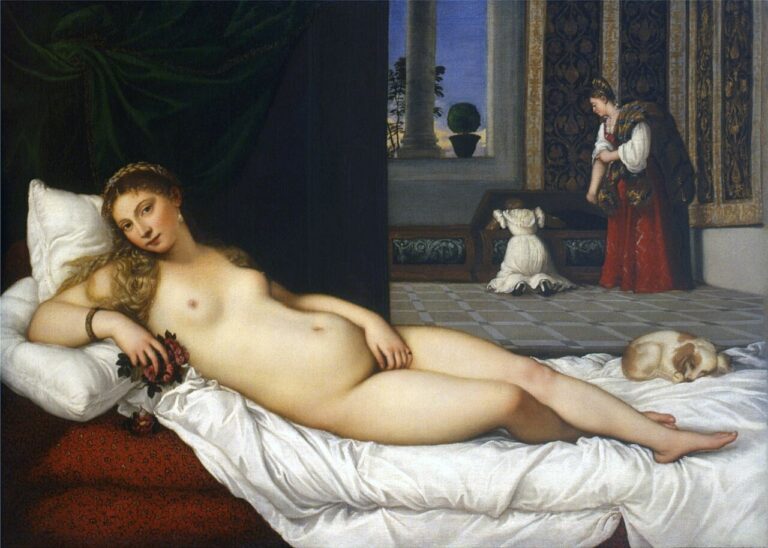
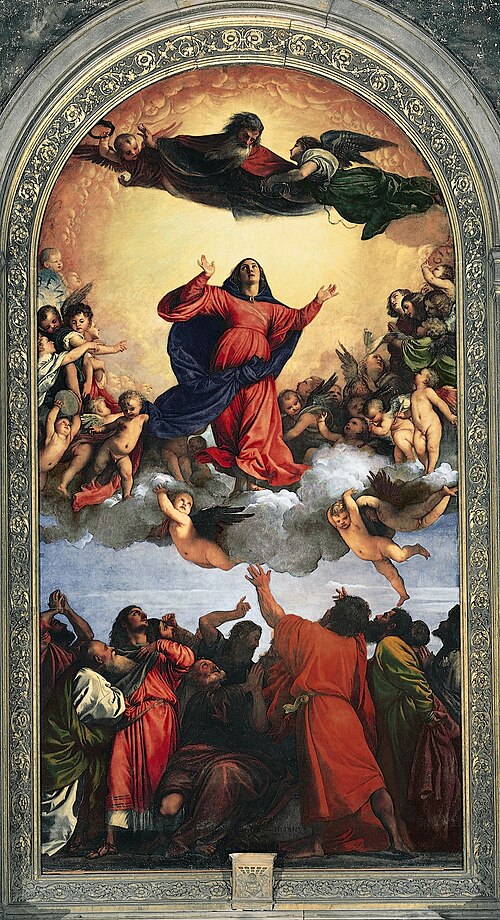
From a strictly pictorial standpoint, the work is remarkable for the quality of its materials and execution. The brushwork is broad and sensual, and the color is rich and nuanced in the rendering of the skin tones and the white drape framing the figure. This technical mastery and this sensual, lyrical treatment of the subject link the work to the great tradition of figure painting—that of the Venetians, Titian, and Correggio, to whom Courbet claimed to belong. His contemporary Edmond de Goncourt, upon discovering the painting, compared it to the flesh in a Correggio, emphasizing its pictorial beauty beyond the boldness of the subject.
The title itself, *The Origin of the World*, adds another layer of meaning to the work. This title—it is unclear whether it was chosen by Courbet or assigned later—elevates the depiction to a meditation on the origin of life and on the female body as the source of all human existence. It transforms what might otherwise be merely an intimate image into a reflection on birth, nature, and the human condition. It is this tension between the raw realism of the painting and the depth of the title that gives the work much of its power to fascinate.
A Private Commission — Khalil-Bey
To understand *The Origin of the World*, one must be aware of the very specific circumstances surrounding its creation: it was a commissioned work, intended not for the public but for the private collection of a remarkable man, the diplomat Khalil-Bey.
Khalil-Bey (or Khalil Chérif Pasha) was a diplomat of Ottoman and Egyptian descent and a former ambassador who settled in Paris in the mid-1860s. A flamboyant figure in Second Empire Parisian high society—wealthy, a socialite, and an inveterate gambler—he was also a great art collector. He had amassed a dazzling, albeit short-lived, collection, part of which was dedicated to celebrating the female form—notably including Ingres’s famous *Turkish Bath *. Introduced to Courbet by the writer Sainte-Beuve, Khalil-Bey commissioned a painting from the artist.
In 1866, Courbet created two works for him: *Le Sommeil* (Sleep), a large canvas depicting two women entwined, and *L’Origine du monde*(The Origin of the World), a smaller-scale work. These works were intended strictly for private use, for the collector’s aesthetic and personal enjoyment. This private purpose is essential: freed from the constraints of the Salon and public propriety, Courbet could afford to be bold in a way that would have been impossible in a work intended for exhibition. Art history shows that works intended for a small, discerning circle have often allowed artists greater freedom to experiment.
Khalil-Bey kept *The Origin of the World* hidden away in the privacy of his apartments—according to contemporary accounts—behind a curtain, perhaps green, which he drew back only for his most distinguished guests. From the very beginning, then, the work was a hidden object, shown only to a select few. This concealment, which would shape its entire history, was inherent in its very nature: a radical painting, meant to be viewed up close, in secret, by a discerning eye. Khalil-Bey’s social career was brief: ruined by his gambling debts, he was forced to sell his collection as early as 1868, and the painting then began its long, clandestine journey.
A Century of Concealment
The fate of *The Origin of the World*, following Khalil-Bey’s downfall, is one of the most extraordinary in the entire history of art: for more than a century, the work traveled from collection to collection, almost always hidden away, known only by hearsay but rarely seen.
After the sale of Khalil-Bey’s collection, the painting passed through the hands of various owners and dealers. The writer Edmond de Goncourt saw it at an antique dealer’s in the late 1880s. In the early 20th century, it was acquired by a Hungarian collector, Baron Ferenc Hatvany, who took it to Budapest. There, too, the work was concealed, hidden behind another painting. During World War II, it underwent a tumultuous series of events, spending some time outside Hungary before returning to the baron, who, while in exile, eventually sold it.
The work’s last private owner was one of the great intellectual figures of the 20th century: the psychoanalyst Jacques Lacan. In 1955, Lacan and his wife, the actress Sylvia Bataille, acquired the painting, which they hung in their country home. Aware of the painting’s power and anxious to keep it out of public view, Lacan asked his brother-in-law, the Surrealist painter André Masson, to design a concealment mechanism: a frame with a double back, fitted with a sliding panel. Masson painted an abstract and evocative work on this panel that echoed the lines of Courbet’s painting without revealing its subject. Hidden in this way, *The Origin of the World* was revealed only to a select few visitors.
This ongoing concealment—from Khalil-Bey to Lacan—makes *The Origin of the World* a unique case: a work famous in the art world, described, discussed, and almost mythical, yet one that almost no one had ever seen with their own eyes. For more than a century, the painting existed primarily as a legend, a rumor, a secret shared among those in the know. It was not until the very end of the 20th century that the work would finally emerge from the shadows and be revealed to the public.
The Mystery of the Model
For more than 150 years, one question has remained unanswered: Who was the woman who posed for *The Origin of the World*? The model’s anonymity—reinforced by the absence of a face in the painting—has fueled speculation and investigations.
Several names have been suggested over the years. The most widely held theory was that of Joanna Hiffernan, known as “Jo the Irishwoman,” a model who was the companion of the American painter Whistler and whom Courbet knew—he had painted her portrait. But this theory posed a problem: Joanna Hiffernan was a redhead with very fair skin, which does not match what is depicted in the painting. Other names were suggested, notably those of famous courtesans in Paris during the Second Empire, such as Jeanne de Tourbey or Cora Pearl, mistresses of influential figures—but these highly visible figures seemed unlikely to have posed for such a work.
The mystery was not solved until 2018—and in an unexpected way. Claude Schopp, an expert on the correspondence of Alexandre Dumas, fils, was working on the letters exchanged between the writer and George Sand. He stumbled upon a reference that, once properly deciphered, identified the model for Courbet’s work: a certain Constance Quéniaux. This discovery, the result of philological scholarship, made it possible to identify with near certainty the woman who posed for the painting.
Constance Quéniaux was a former dancer with the Paris Opera; she was thirty-four years old at the time and was one of the mistresses of Khalil-Bey, the patron who commissioned the work. Constance Quéniaux’s known physical characteristics—notably her dark hair and eyebrows—match what is depicted in the painting, unlike the redheaded Joanna Hiffernan. This identification made it possible to place the work within its specific social context: that of the world of courtesans, dancers, and art collectors in Paris during the Second Empire. The anonymous woman in the painting thus regained a name, a story, and a life—becoming, after her death, a respected figure, far removed from the fantasy of anonymity.
Realistic Radicalism
*The Origin of the World* represents the pinnacle of Courbet’s realism. To appreciate its significance, it must be viewed within the context of 19th-century nude art, of which it constitutes a radical departure.
In the 19th century, the nude was a noble and codified genre of academic painting. Artists depicted Venuses, nymphs, odalisques, and bathers—idealized, smooth, flawless female bodies whose nudity was justified and softened by a mythological, classical, or Eastern pretext. This idealized and veiled nudity was perfectly acceptable, even at the official Salon: it was a form of conventional eroticism, sanctioned by the noble fiction that enveloped it. The propriety of the Second Empire tolerated the nude, provided it remained idealized and justified by a pretext.
Courbet does exactly the opposite. He rejects idealization, mythological pretexts, and disguise. He depicts a real body—without fiction or borrowed nobility—in a composition of unprecedented candor. This is the application of the realist principle to the nude: painting what is, without veiling it. This frankness, this absence of any pretext, constituted a frontal attack on the hypocrisy of bourgeois propriety—which tolerated eroticism only if it was hypocritically disguised, and condemned it as soon as it appeared unmasked. Courbet unmasked this hypocrisy.
This is why *The Origin of the World*, despite being intended for private display, is part of the great aesthetic struggle of Courbet and his era. The nineteenth century witnessed a revolution in the depiction of the nude, in which Courbet and Manet were the principal figures. In the same year, 1865–1866, Manet caused a scandal at the Salon with his *Olympia*, a realistic, full-frontal nude that also broke with idealizing conventions. Both artists, each in their own way, asserted the right to depict the real, contemporary body without distorting it. *The Origin of the World* is the most radical and extreme manifestation of this struggle.
A connection to tradition
While *The Origin of the World* is a transgressive work, it would be reductive to view it merely as a provocation. For, paradoxically, this radical painting also belongs to the greatest tradition of Western painting—that of sensual and lyrical painting.
As we have seen, Courbet trained by copying the old masters at the Louvre. Among his primary models were the Venetians—Titian, Veronese—and Correggio, those Italian Renaissance painters who had brought the art of depicting the flesh, the light on the skin, and the sensuality of the body to its peak. Courbet explicitly claimed to belong to this tradition of sensual, lyrical painting, in which the pictorial material harmonizes with the sensuality of the subject.
*The Origin of the World* carries on this tradition. The broad, sensual brushstrokes, the nuanced rendering of skin tones, the richness of the texture, and the beauty of the color link the work to the great nudes of Western painting. This is what Edmond de Goncourt had perceived when comparing the flesh in the painting to that of a Correggio: beyond the boldness of the subject, he recognized the pictorial mastery, the beauty of the execution, and the work’s place within a prestigious lineage. Courbet does not break with the tradition of painting the human body: he radicalizes it by stripping away its pretexts and veils.
This dual nature—transgressive and traditional, radical and scholarly—lies at the heart of the work’s richness. *The Origin of the World* is neither a mere licentious image nor pure provocation: it is a work of art that pushes the tradition of sensual painting to its extreme, while questioning the limits of what can be depicted. It is this complexity that has earned it, once it emerged from obscurity, recognition as a major milestone in the history of the representation of the body and a masterpiece of 19th-century painting.
From the Lacan Collection at the Musée d’Orsay
The addition of *The Origin of the World* to public collections in 1995 marked the end of its long period in hiding and the beginning of its public life.
Jacques Lacan, the work’s last private owner, died in 1981. His wife, Sylvia Bataille-Lacan, kept the painting until her own death in the early 1990s. It was at that point that the question of the estate arose. The heirs owed substantial inheritance taxes to the French government. However, French law allows, in certain cases, for such duties to be settled not with money but with works of art of major significance: this is the mechanism of payment in kind, which has enabled the government to considerably enrich its collections.
It was through this process that *The Origin of the World* entered the French national collections in 1995 and was assigned to the Musée d’Orsay. For the first time in its history, the once-hidden painting was to be exhibited publicly, on display for all visitors to see. From being an object of private and secret curiosity, it became a national treasure accessible to everyone. The event caused quite a stir: the myth was finally emerging from the shadows.
At the Musée d’Orsay, the work is now on display without any covering, in the galleries dedicated to Realism. Its public display continues to provoke reactions and debates even today—proof that the work has lost none of its power to challenge the viewer’s gaze. It continues to raise, in a unsettling way, the question of how we view the body, nudity, and representation—a question that is all the more pressing in our era, which is highly sensitive to these issues.
A work that challenges the viewer’s perspective
Now that it has become part of the public domain, *The Origin of the World* has lost none of its ability to provoke reflection and debate. Today, it occupies a unique place in culture, far beyond the circle of art lovers.
The work has exerted a considerable influence on modern and contemporary art. Artists from a wide variety of generations and backgrounds have drawn inspiration from it or responded to it, questioning it, reinterpreting it, and commenting on it. It has become a major point of reference for reflections on the representation of the body, the nude, and what is known as the “gaze”—the way in which the painting, and the viewer, look at the depicted body. Feminist movements and artists who explore the relationships between the sexes, desire, and representation have taken a particular interest in it, making the work a subject of debate regarding how the female body is viewed.
Paradoxically, the work has also become a symbol of contemporary censorship issues. Its reproduction and dissemination, particularly on social media, have sparked high-profile controversies: some platforms have censored images of the work, sparking lawsuits and public debates about artistic freedom of expression, the distinction between art and obscenity, and the place of masterpieces in the digital realm. This 19th-century work thus finds itself, in the 21st century, at the center of highly topical issues.
This enduring legacy attests to the work’s lasting power. *The Origin of the World* is not merely a painting: it is a focal point for fundamental questions about art, the body, the gaze, modesty, censorship, and freedom. By pushing realism to its extreme, Courbet created a work that never ceases to challenge those who view it—and which, more than a century and a half after its creation, continues to unsettle, fascinate, and spark debate. This is undoubtedly the hallmark of truly radical works.
How to View the Work Today
*The Origin of the World* is housed at the Musée d’Orsay in Paris, where it is on display in the galleries dedicated to Realism on the ground floor. After more than a century of being concealed, it is now on public display, uncovered. These galleries are accessible through the Orsay entrance; it’s best to book in advance and visit during off-peak hours.
Since the work is small in size, it is advisable to view it up close to appreciate its pictorial qualities—the delicacy of the brushwork, the richness of the texture, and the rendering of the skin tones and drapery—which are largely lost in reproductions. It is up close, in direct confrontation with the painting, that Courbet’s mastery is revealed and the work takes on its full dimension as a painting, beyond the mere boldness of the subject.
To contextualize this work within Courbet’s entire body of work, the Musée d’Orsay houses his other masterpieces— *A Burial at Ornans*, *The Painter’s Studio*, and several other nudes and landscapes. Viewing these works side by side reveals the consistency of his artistic approach: from the grand social statement of*A Burial at Ornans* to the intimate boldness of *The Origin of the World*, Courbet was always guided by the same principle—to paint reality without veiling or idealizing it.
Further Reading
Institutional sources cited
- Musée d’Orsay, description of *The Origin of the World*.
- History Through Images (RMN), *The Origin of the World*, a manifesto of the nude.
- Larousse and Encyclopædia Universalis, entries on “Gustave Courbet.”
Sources and Reference Studies
- Thierry Savatier, *The Origin of the World: The Story of a Painting by Gustave Courbet*, Bartillat, 2015.
- Claude Schopp, *The Origin of the World: The Life of the Model*, Phébus, 2018.
- Michèle Haddad, *Khalil-Bey: A Man, A Collection*, Éditions de l’Amateur, 2000.
Institutional Documentation
- Musée d’Orsay, Paris — the institution that houses the work.
- Gustave-Courbet Departmental Museum, Ornans — the painter’s birthplace.
See also on Hors Cadre
- Gustave Courbet — The Scandal of Realism — A Portrait of the Artist, His Life, and His Art.
- The Painter’s Studio—Courbet’s “real allegory”— the great manifesto in which Courbet also included a nude figure, an allegory of Truth.
- Édouard Manet—the painter of modern life —was another key figure in the 19th-century revolution in nude painting, alongside *Olympia*.
— M