The Painter’s Studio—Courbet’s Real Allegory
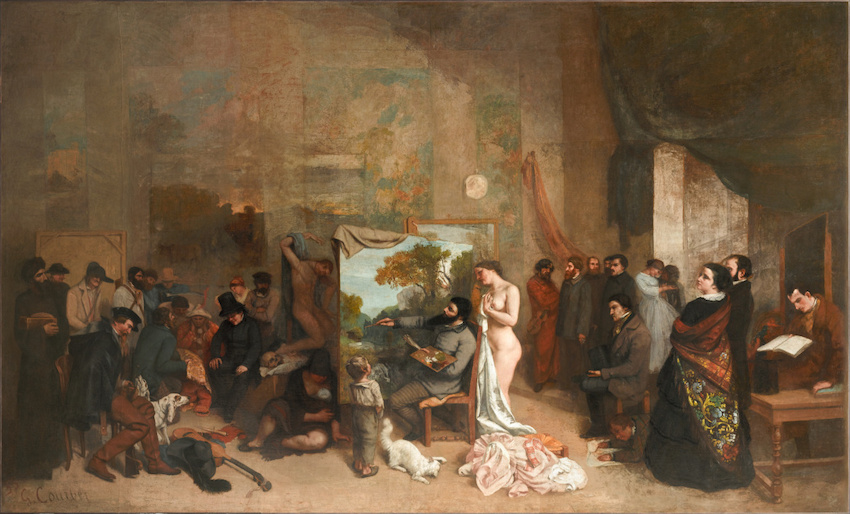
Gustave Courbet — The Scandal of Reality →In the center of a large painting, a painter sits at his easel, painting a landscape. It is Courbet himself. Behind him, a nude woman watches him work; at his feet, a little boy watches him with admiration, and a white cat plays on the floor. To his right stands a group of friends and intellectuals—among them, the poet Baudelaire, who is reading; the philosopher Proudhon; and the patron Bruyas. To his left is a whole other world: the common people, the poor, the powerful, a poacher, a priest, and a beggar woman. This is *The Painter’s Studio*, one of Gustave Courbet’s most ambitious, mysterious, and personal works—his great painted manifesto.
Painted in 1854–1855, this immense canvas—nearly six meters wide—bears an enigmatic and provocative title: The Painter’s Studio. A “real allegory” that defined a seven-year phase of my artistic (and moral) life. “Real allegory”: the expression is a deliberate oxymoron, almost a challenge. How could an allegory—which, by definition, pertains to symbols and ideals—be “real”? This is the very paradox of Courbet, who sought to paint reality while imbuing it with meaning, transforming his own life and studio into a vast metaphor for the world and art.
The painting is both an autobiography and a manifesto. In it, Courbet takes stock of seven years of his life—from the 1848 revolution to that moment in 1855 when he established himself as the leading figure of Realism. He places his entire world around him: his friends and supporters on one side, the social world he depicts on the other, and at the center, himself, the painter, as a mediator between these two worlds. It is a reflection on the artist’s place in society, on the role of painting, and on the meaning of his own artistic approach.
This article explores the secrets of this fascinating work—what it represents, the meaning of its paradoxical title, the significance of the central scene, the identities of the figures in its two halves, the story of its rejection from the World’s Fair and the Pavilion of Realism, its enduring mysteries, and how this painted manifesto came to be part of the Musée d’Orsay’s collection.
The Painting — What It Depicts
*The Painter’s Studio* is an oil-on-canvas painting of monumental dimensions: 361 centimeters high by 598 centimeters wide—nearly six meters long. Along with *A Burial at Ornans*, it is one of Courbet’s largest canvases, and he conceived it, like *A Burial at Ornans*, in the format of a grand history painting, to give his personal subject the greatest possible scope and solemnity.
The scene takes place in the painter’s studio in Paris. But this is not a realistic depiction of a studio: it is a symbolic space, populated by some thirty carefully arranged figures. The composition is organized into three distinct parts, centered around the painter.
In the center, Courbet is seated in front of a large canvas resting on his easel, on which he is painting a landscape—a view of his native Franche-Comté, recognizable by its cliffs and river. Standing beside him are three figures: a nude woman standing behind him, watching him paint; a young child gazing at the canvas; and, on the floor, a white cat. This central group forms the luminous heart and the meaning of the work.
On either side of this central figure, two groups of figures occupy the two halves of the canvas. To the painter’s right are his friends, his supporters, and the world of art and thought. To the left is a cross-section of society—the common people and the powerful—all those whom Courbet depicts in his work. This tripartite structure—the painter in the center, his allies on the right, and the world on the left—is the key to understanding the entire composition. The color palette, dominated by muted, warm tones, focuses the light on the central group, around the painter and the model.
A “real allegory”—the manifest oxymoron
The title Courbet gave his painting is a statement in itself: A Real Allegory Defining a Seven-Year Phase of My Artistic (and Moral) Life. Each term deserves careful consideration, for this title is the key to the work and a manifesto in its own right.
The phrase “real allegory” is an oxymoron, a deliberate contradiction. Traditionally, an allegory is a symbolic, ideal, abstract representation—a figure that embodies an idea (Justice, Liberty, Truth). Yet Courbet, the champion of realism—the painter who rejected idealization and sought to paint only what he saw—pairs this word with the adjective “real.” In doing so, he asserts a paradox: to create an allegory, to give his painting symbolic meaning, but using real elements—real people, observed and identifiable. The figures in *The Studio* are not abstract symbols: they are people Courbet knew, painted from life, but who take on symbolic significance within the painting.
The rest of the title is just as revealing. “Defining a seven-year phase of my artistic and moral life”: Courbet frames his work within an autobiography. The seven years in question span from 1848 to 1855—from the February Revolution of 1848, which had fueled so many hopes, to that moment in 1855 when Courbet took stock of his career and established himself as a leading figure of Realism. The painting is thus a personal reckoning, a meditation on what he experienced, painted, and thought during those decisive years.
This manifesto-like title expresses the work’s boundless ambition. Courbet does not merely want to paint a studio: he wants to synthesize his life, his art, his ideas, and his vision of the world and society. He sought to affirm, in a single monumental canvas, the place and role of the artist—himself—at the heart of the social and intellectual world of his time. It is one of the most ambitious undertakings ever attempted by a painter to explain himself and his art.
The Center—the Painter, the Model, and the Child
The heart of the work—its focal point of meaning and light—is the central group: Courbet painting, the nude woman, the child, and the cat. That is where the painting’s meaning is concentrated.
Courbet depicts himself at work, seated in front of his easel, painting—and what he is painting is revealing: not a studio scene, not the nude model standing right behind him, but a landscape from his native Franche-Comté. This choice is a manifesto: Courbet asserts that the painter draws inspiration from his homeland, from nature, and from observed reality, rather than from academic conventions (which would have required him to paint a nude based on a model). The painter even turns his back on the nude woman to paint nature: the truth of art lies in the real world, not in the conventional poses of the studio.
The nude woman standing behind the painter has given rise to many interpretations. She is most often seen as an allegorical figure: Truth, Nature, or even Inspiration, the Muse. Naked “like Truth,” as the saying goes, she embodies the ideal the painter serves, or the natural beauty that inspires his art. Her benevolent presence and the drapery casually draped at her feet make her a figure that is both real (a model) and symbolic (naked Truth). She is “real allegory” personified.
The child gazing at the canvas with admiration is generally interpreted as a symbol of future generations, of a fresh and innocent perspective—perhaps of posterity, which will judge the work. As for the white cat playing on the floor near the painter, it adds a touch of everyday life and freedom—the independent animal, perhaps a symbol of the artist’s freedom. This central group, bathed in light, affirms Courbet’s central idea: the painter is at the center of the world, a mediator between nature, truth, and humanity, and his art serves an essential social function.
On the right, the world of friends
To the painter’s right—the viewer’s left—Courbet gathered those he called his “shareholders”: his friends, his supporters, and representatives of the worlds of art, literature, and thought who accompanied him on his adventure. This was the world of intellectual and artistic life—the world that shared and nurtured his ideas.
Several of these figures are recognizable, as they are real and famous people. We can recognize the poet Charles Baudelaire, seated at the far right, absorbed in reading a book—a tribute to his friend the writer, a great champion of modernity in art. We can also identify the philosopher Pierre-Joseph Proudhon, the socialist theorist whose ideas had such a profound influence on Courbet. We can also recognize the critic Champfleury, a champion of realism in literature, seated on a stool. And we see the patron Alfred Bruyas, the collector from Montpellier who financially supported Courbet, recognizable by his bearded profile.
Other figures populate this side of the painting. In the foreground, an elegant couple represents art lovers—the enlightened public. Near the window, two lovers embracing evoke free love. A friend who is a violinist, the musician Promayet, is also present. This entire right side forms a circle of close friends, allies, and those who support and understand Courbet’s art. It is a world of the mind, of creation, and of intellectual friendship.
There is a touching story behind this painting. Originally, Courbet had painted, alongside Baudelaire, the figure of Jeanne Duval, the poet’s lover. But after an argument and a breakup between Baudelaire and Jeanne, the poet asked Courbet to remove the young woman from the painting. Courbet complied—but the painting has aged, and today one can make out, like a ghost, the erased silhouette of Jeanne Duval reappearing near Baudelaire. A poignant trace of a broken love story, forever etched into the fabric of the painting.
On the left, the world of life
To the painter’s left—the viewer’s right—lies a completely different world. There, Courbet brought together what he called “the other world of trivial life”: the common people, poverty and wealth, the exploited and the exploiters—all those who make up society and whom the painter takes as his subjects.
This side of the painting is more disparate and more varied than the one depicting the friends. It features a gallery of social types representing the various segments of society during the Second Empire. A hunter or poacher—in whom some have sought to recognize, in disguise, Emperor Napoleon III himself, ironically portrayed as a poacher of the Republic. A laborer, a merchant, a priest, an undertaker, a wretched beggar woman—sometimes identified as an Irishwoman nursing her child. These figures embody the trades, living conditions, powers, and miseries of the era.
Courbet himself summed up this contrast between the two halves of the painting with an illuminating phrase: “It is the world that comes to be painted in his home.” On the right, he said, are his friends, fellow artists, and art lovers; on the left, the other world—that of ordinary life and its contrasts: the people, poverty, wealth, those who live, and those who exploit. The painter, in the center, serves as the link between these two worlds: he observes the social world (on the left) and transforms it into art, supported by his friends (on the right).
This structure gives the painting its character as a social manifesto. Courbet asserts that the artist is not cut off from the world: he is at the heart of society, embracing all its components—from the humblest to the most powerful—and his art’s mission is to represent them all. This is a democratic and socially engaged vision of painting, consistent with Courbet’s republican and socialist convictions. The studio becomes a reflection of the entire world, and the painter, its interpreter.
The Rejection of the World’s Fair and the Realism Pavilion
The history of the exhibition *The Painter’s Studio* is inextricably linked to one of the most significant events in Courbet’s career: the creation of the Pavilion of Realism in 1855.
Courbet had conceived and painted *The Studio* with the intention of presenting it at the 1855 World’s Fair, a major international event that included a significant fine arts section. He submitted several works there. The jury accepted eleven of them—proof that Courbet was now a recognized painter—but rejected the two most ambitious canvases, which were closest to his heart: *The Painter’s Studio * and *A Funeral at Ornans*. These monumental and provocative works were deemed too bulky or too disturbing.
Courbet’s reaction was commensurate with his pride and independence. Rather than bow to the jury’s decision, he decided to exhibit his works himself, at his own expense. With the financial support of his patron Bruyas, he had a building constructed right next to the World’s Fair, which he proudly named the “Pavilion of Realism.” There he presented some forty of his works, including *The Studio* and*The Funeral*, accompanied by a catalog in which he set forth his conception of realism—a veritable manifesto.
This move was unprecedented. It was one of the first times an artist had organized his own solo exhibition, outside of official institutions, to present his vision directly to the public. In doing so, Courbet asserted the artist’s independence and the right to address the public without going through juries and academies. In doing so, he pioneered a new role—that of the autonomous modern artist—and paved the way for the Impressionists, who were in turn rejected, to follow in his footsteps some twenty years later by organizing their own exhibitions. L’Atelier du peintre was thus, from the very beginning, linked to this founding act of artistic freedom.
An enigmatic work
Despite the clues Courbet himself provided, *The Painter’s Studio* remains one of the most mysterious and most debated works in all of 19th-century painting. Its exact meaning continues to be a subject of debate, and that is also what makes it so rich.
There are many interpretations, and they overlap. The painting can be interpreted on several levels: as a genre scene (a painter’s studio), as a large group portrait (friends and social types), as a landscape (the canvas painted by Courbet), as a nude (the model), and as an allegory (each figure carrying a symbolic meaning). This layering of genres and meanings is deliberate: Courbet sought to create a comprehensive work that resists any single interpretation.
Some details remain a mystery. Why does the painter have his back turned to the nude model while painting a landscape? What exactly does the child symbolize? Is the poacher on the left really Napoleon III in disguise, which would make the painting a veiled political critique? Every figure and every detail has been the subject of scholarly and sometimes contradictory interpretations. Courbet, who enjoyed throwing people off the trail and provoking them, provided only partial clues, leaving the mystery unsolved.
This element of mystery did not escape the greatest artists. Eugène Delacroix—though a representative of the Romantic movement that Courbet claimed to be burying—visited the Pavilion of Realism and stood transfixed for a long time before *L’Atelier*. He confided in his Journal that he had discovered a masterpiece there and could not tear himself away from the sight. It was a remarkable tribute from one master to another, transcending the quarrels between artistic schools. For *The Painter’s Studio*, beneath its appearance as a manifesto, is also a work of such pictorial power and depth of meaning that it continues, even today, to fascinate and provoke reflection.
From the Pavillon to the Musée d’Orsay
The journey of *L’Atelier du peintre*, from the Pavillon du Réalisme to the gallery walls of the Musée d’Orsay, was long and eventful—much like the work itself.
After the 1855 exhibition, this immense and hard-to-sell painting remained in Courbet’s possession for a long time, then underwent various twists and turns. It passed through several owners’ hands and even served, for a time, as a backdrop for an amateur theater troupe based in a Parisian townhouse. The work, too large and too unusual, struggled to find a home.
It was not until the early 20th century that its value was finally fully recognized. In 1920, *L’Atelier du peintre* was acquired by the Louvre Museum for a considerable sum raised in part through a public fundraising campaign and with the support of the Friends of the Louvre association, supplemented by a contribution from the government. This method of acquisition—a collective effort to bring the work into the national collections—attests to the importance it had come to hold in the eyes of art lovers and experts alike.
When the Musée d’Orsay was founded in 1986, *The Painter’s Studio* was moved there, along with all of the Louvre’s 19th-century works. It is now on display there in the room dedicated to Courbet’s large-scale works, not far from*A Burial at Ornans*. Brought together in the same museum, these two monumental canvases—the two major manifestos of the 1855 Pavillon du Réalisme—allow us to appreciate the full scope of Courbet’s ambition and genius, and to understand how this son of Franche-Comté peasants revolutionized the painting of his century.
How to View the Work Today
*The Painter’s Studio* is housed at the Musée d’Orsay in Paris, where it is on display in the room dedicated to Courbet’s large-scale works on the ground floor. Its monumental dimensions make it one of the museum’s most impressive works. The Orsay entrance provides access to these galleries; it’s best to book in advance and visit during off-peak hours.
Seeing the work in person is essential to grasping its full richness: only by standing directly in front of this nearly six-meter-long canvas can one take in the thirty or so figures, make out the faces of Courbet’s friends, appreciate the light focused on the central group, and search, near Baudelaire, for the ghost of Jeanne Duval.
To further your exploration, the Musée d’Orsay houses Courbet’s other masterpieces, starting with *A Burial at Ornans*, the other major statement exhibited at the Pavillon du Réalisme, and *The Origin of the World*. And the Gustave-Courbet Museum in Ornans, located in the painter’s birthplace, offers valuable insight into the man and his homeland.
Further Reading
Institutional sources cited
- Musée d’Orsay, entry on *The Painter’s Studio*.
- History of the Arts (Ministry of Culture), entry on *L’Atelier du peintre*.
- Larousse and Encyclopædia Universalis, entries on “Gustave Courbet.”
Sources and Reference Studies
- René Huyghe, Germain Bazin, Hélène Adhémar, *Courbet, The Painter’s Studio: A Real Allegory*, 1855, Plon, 1944.
- Gustave Courbet, letter to Champfleury regarding *L’Atelier* (1854–55).
- Eugène Delacroix, Diary (visit to the Realism Pavilion, 1855).
Institutional Documentation
- Musée d’Orsay, Paris — the institution that houses the work.
- Gustave-Courbet Departmental Museum, Ornans — the painter’s birthplace.
See also on Hors Cadre
- Gustave Courbet — The Scandal of Realism — A Portrait of the Artist, His Life, and His Art.
- A Funeral in Ornans — The Manifesto of Realism — the other major manifesto presented at the Pavilion of Realism in 1855.
- Eugène Delacroix—the torchbearer of Romanticism —the Romantic master who, despite their differences, admired Courbet’s *The Studio*.
— M