The Circus — Seurat’s final, unfinished work
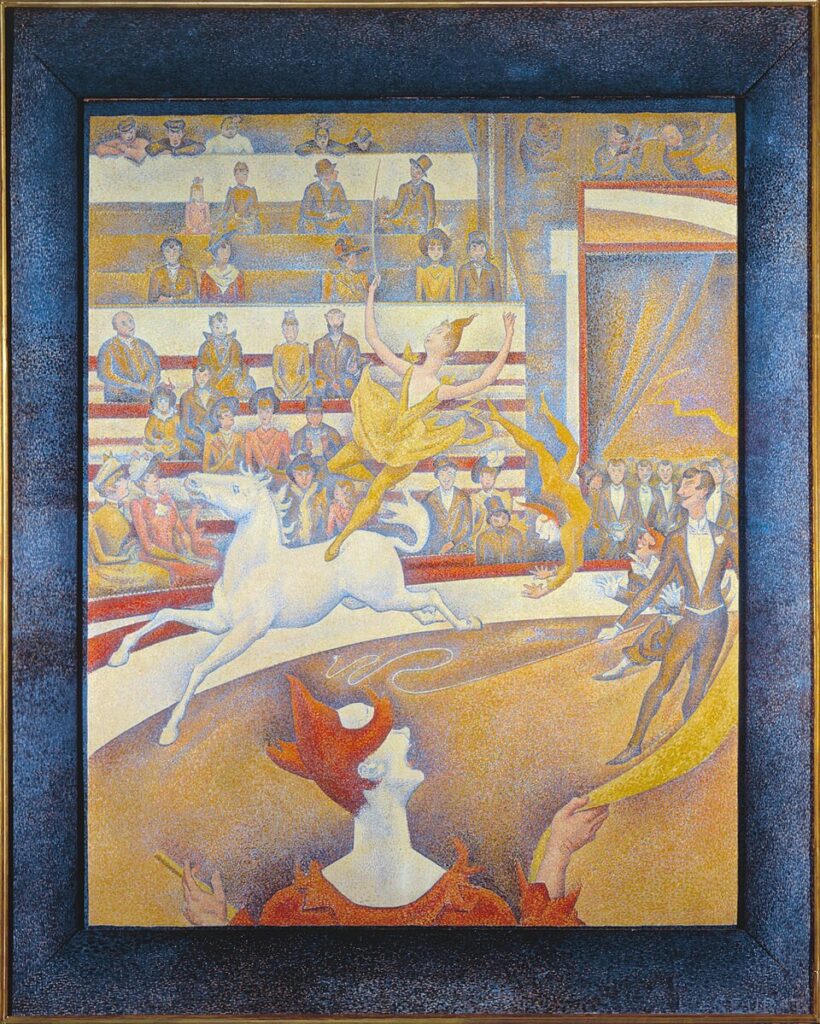
Georges Seurat — The Science of Color →A horsewoman in a yellow tutu stands, balancing, on a white horse galloping at full speed. In the foreground, a clown stands with his back to us, his red silhouette spread out like a curtain. All around, in the tiered stands, the audience watches the show, frozen in place. And everywhere, curves, arabesques, and lines that rise and swirl to express the movement, energy, and joy of the circus. This is *The Circus*, Georges Seurat’s final painting—the one he left unfinished on his easel when he died at the age of thirty-one in the spring of 1891.
*The Circus* is both the culmination and the testament to Seurat’s art. It represents the most advanced application of his mastery of painting: not only the division of color into dots, which he had invented, but also a new science—that of lines and their effects on emotion—which he developed in his final years under the influence of his friend, the scholar Charles Henry. Everything in this painting is calculated to produce a specific sensation: joy.
Housed at the Musée d’Orsay, the work is striking for its boldness and its strangeness. The swirling movement of the dance floor at the bottom contrasts with the solemn stillness of the audience at the top. The predominant orange tones, the ascending lines, and the color contrasts all contribute to a sense of joy. And yet, a subtle melancholy hangs over this celebration—perhaps because we know it was the last work by a man who was about to die, perhaps because the enigmatic clown in the foreground seems to stand watch as a metaphor for the artist himself.
This article explores the secrets of this final work—what it represents, how Seurat applied Charles Henry’s scientific theories on lines and emotion to it, how the contrast between the track and the bleachers structures the entire composition, what the painting reveals about the society of its time, why it remained unfinished, and how this pictorial testament eventually found its way into the collections of the Musée d’Orsay.
The Painting — What It Depicts
*Le Cirque* is a large-scale oil on canvas: approximately 186 centimeters high by 152 centimeters wide. Its vertical format accentuates the layered composition, from the ring at the bottom to the upper tiers.
The scene depicts a circus act, likely inspired by the Cirque Fernando (later known as the Cirque Médrano), a venue in Montmartre frequented by artists and writers of the time. The equestrian act, which was at the heart of 19th-century circus performances, takes center stage in the work.
Let’s take a closer look at the figures. In the foreground, seen from behind, stands a clown with red hair; his silhouette and the flowing ribbon take up the entire bottom of the painting and serve as a threshold between the viewer and the scene. In the center of the ring, a horsewoman in a yellow tutu stands upright, arching her back, on the back of a galloping white horse. On the left, an acrobat is performing a handstand. On the right, in the center of the ring, a ringmaster—the master of ceremonies—stands with a whip in hand, directing the show.
In the background and across the upper portion of the painting, tiers of seats are arranged, filled with spectators reduced to frozen silhouettes. At the very top, the orchestra can be made out, and within the frame of an entrance, a crowd waits. The composition is boldly framed, like a photograph taken from a bird’s-eye view, with the layering of the planes guiding the eye from bottom to top. The entire canvas is bordered by a blue band, painted by Seurat himself, reflecting his usual concern for controlling the edges of the work.
The Science of Lines — Charles Henry and Dynamogeny
If *La Grande Jatte* was a manifesto of the science of color, *Le Cirque* is a manifesto of a new science that Seurat explored in his final years: the science of lines and their effects on emotion. This is what makes this work one of the most theoretically accomplished in the entire Divisionist movement.
In his later works, Seurat had formed a bond with the scholar Charles Henry, a mathematician and theorist who inspired the Neo-Impressionists and studied the relationships between sensations, lines, colors, and emotions. Henry had developed a theory of the “dynamogeny” of lines: according to him, the orientation of lines produces specific psychological effects. Horizontal lines convey a sense of calm and rest; downward-sloping lines, a sense of sadness; and upward-sloping lines and curves, a sense of dynamism, joy, and cheerfulness.
Seurat applies these principles with striking rigor in *The Circus*. The subject—a joyful, dynamic spectacle—called for the expression of cheerfulness. Thus, the painter multiplies the ascending lines and curves: the clown’s undulating ribbon, the arch of the horsewoman’s back, the arabesque of the galloping horse, the diagonals that structure the ring—everything rises, turns, and soars upward. A critic, viewing the painting on display in 1891, admirably summed up this intention: everything in it is combined to evoke cheerful sensations, through the upward movement of the lines and the contrasts in tone.
Added to this science of lines is, of course, the science of color, which Seurat had never abandoned. He continued to apply the division of the brushstroke and the laws of optical mixing established by Chevreul and Rood. *The Circus* is thus the synthesis of all his research: divided color and expressive lines brought together in a single work to produce a comprehensive, entirely calculated effect. It is the culmination of his dream: a painting governed entirely by scientific laws.
The contrast between the track and the bleachers
The circus’s design is based on a fundamental contrast, which is the source of its power: the contrast between the movement of the ring below and the stillness of the bleachers above.
In the lower part of the painting, curves, diagonals, and movement reign supreme. The horsewoman, the horse, the acrobat, the clown, the ribbon: everything exudes dynamism, momentum, and energy. The serpentine, upward-soaring lines capture the action of the performance, the horse’s speed, and the suppleness of the bodies. This is the realm of movement and life.
In the upper part, by contrast, vertical and horizontal lines prevail, along with stability and stillness. The rows of seats are punctuated by the frozen silhouettes of the spectators, lined up, motionless, resembling those hieratic figures that Seurat had already favored in *La Grande Jatte*. The audience does not move; it watches, motionless, the spectacle unfolding before it. This is the realm of rest and anticipation.
This contrast between the bottom and the top, between movement and stillness, between the curve and the straight line, structures the entire painting and creates its balance. The stability of the lines in the background counterbalances the dynamism of the curves in the foreground. Seurat plays on this contrast according to the principle he cherished: harmony through the reconciliation of opposites. The liveliness of the performance and the calm of the audience echo one another and balance each other out, creating a composition that is both animated and orderly—vibrant and controlled.
This duality also reflects two sides of the circus itself: the dazzling spectacle of the ring, and the silent crowd watching it. Seurat captures the spectacle in its entirety—not only the performance, but also the audience’s gaze, the relationship between the stage and those watching it.
A predominantly orange hue—the color of cheerfulness
Color plays an essential role in *The Circus*, as it does throughout Seurat’s entire body of work—and here, too, it serves to convey a sense of joy.
The painting is dominated by a warm, luminous orange hue that bathes the entire scene. This dominant color is no accident: in Seurat’s system, warm colors—and orange in particular—are associated with joy and warmth, as are ascending lines. Color and line work together to create the same emotional effect. The yellow of the horsewoman’s tutu, the ochres and oranges of the track and the bleachers—everything contributes to this sunny, joyful atmosphere.
Seurat creates this dominant color using his usual technique of dividing the brushstrokes: he juxtaposes dots of pure color that, together, produce the desired chromatic vibration. The contrasts are calculated to enhance the colors in relation to one another, according to Chevreul’s laws of simultaneous contrast. At the boundaries between the areas, complementary colors enhance one another.
And here again, Seurat does not overlook the edges. The blue border framing the painting is chosen to contrast in tone and hue with the orange-dominated composition: the cool blue of the border brings out, by contrast, the warm orange tones of the scene. Nothing is left to chance; even the frame contributes to the intended effect. The critic from 1891 noted this well: the dominant orange tones are accentuated by a frame that contrasts with the composition as a whole.
This total mastery of color, used to convey a specific emotion, shows just how much Seurat viewed painting as a rigorous, almost mathematical art—and yet, the result is anything but cold. The warm orange hues of *The Circus* truly convey a sense of celebration and joy. For Seurat, science always leads to the emotional.
The Clown: A Metaphor for the Artist
In the foreground of *The Circus*, this large figure of a clown, seen from behind, which separates the viewer from the stage, has intrigued commentators. Far from being a mere extra, this character has been interpreted as a profound figure—perhaps even as a representation of the artist himself.
The clown is depicted in a unique way. Seen from behind, his red silhouette and flowing ribbon occupy a strategic position: he stands at the edge of the image, between us and the show, like an intermediary, a guide. His form is directly inspired by posters of the era, particularly those by Jules Chéret, the master of colorful posters—evidence of Seurat’s attention to the popular visual culture of his time.
Art historian Françoise Cachin has suggested viewing this clown as a metaphor for the artist: positioned on the fringes of the performance—neither quite an actor nor quite a spectator—he represents the painter himself, who orchestrates the scene without participating in it. Even more subtly, historian Anne Distel observed that the clown’s two hands are rendered differently—one stylized, the other more realistic—and saw in this a reflection of Seurat’s aesthetic, suspended between stylization and observation, between art and nature.
These interpretations, while still mere hypotheses, are compelling. They suggest that *Le Cirque*, beneath its guise of joyful entertainment, is also a reflection on art, on the role of the artist, and on the relationship between creation and reality. The clown, a traditional figure of the melancholic entertainer, becomes in Seurat’s work the painter’s discreet double—the one who, standing back, reveals the spectacle of the world. The fact that this figure appears in Seurat’s final painting—which remained unfinished at the time of his death—adds a poignant resonance to the work.
A Social Perspective — Classes in the Stands
Just as *La Grande Jatte* offered a portrait of Parisian society out for a stroll, *Le Cirque* offers, more subtly, an interpretation of the society of its time—through the tiered arrangement of the spectators in the stands.
If you look closely at the audience, you’ll notice that the spectators aren’t seated at random. The bleachers are tiered, and the seats the spectators occupy reflect their social status. In the front rows—the best seats and the most expensive—one can spot gentlemen in top hats—the affluent bourgeoisie. Further up, in the upper tiers and the general admission sections, the headwear changes: caps and felt hats indicate a more modest audience.
This arrangement was not Seurat’s invention: it reflects the reality of circuses at the time, where ticket prices segregated the audience along social class lines. But Seurat depicts it with such precision that it becomes a subtle social commentary. The overlapping layers of spectators provide an opportunity to illustrate the diversity of society and its inequalities. The circus, a popular form of entertainment that brought together all social classes, also separated them through the way the space was organized.
This social dimension reflects the sensibilities of the time. Seurat moved in anarchist and progressive circles, as did many Neo-Impressionists—Signac and Pissarro shared these ideas. While not a militant work, *The Circus* bears the mark of a keen eye for social realities and for each person’s place in society. Beneath the festive atmosphere, Seurat observes the social order with the same calm lucidity he applied to everything.
An Unfinished Work—The Death of Seurat
*The Circus* holds a special place in Seurat’s body of work: it is his last painting, and it remained unfinished. This tragic circumstance gives the work a unique resonance.
Seurat was working on *The Circus* in 1890–1891. The painting was the third in a series devoted to the spectacles and entertainments of the modern city, following *Circus Parade * and *The Ruckus*. In the spring of 1891, although the work was not yet finished, Seurat nevertheless decided to submit it to the Salon des Indépendants, which opened in March. He helped hang the exhibition, as he did every year with meticulous care.
It was during this exhibition that he suddenly fell ill. A fulminant infection—probably infectious tonsillitis or diphtheria—claimed his life within a few days. Georges Seurat died on March 29, 1891, at the age of thirty-one, before the exhibition featuring his unfinished *Circus* had even ended. The work thus remained as it was, just as death had interrupted it.
If you look closely at the painting, you can see traces of this incompleteness. Some parts are less polished than others; the front legs of the galloping horse, for example, are in an anatomically improbable position, which Seurat would undoubtedly have corrected. Some areas of color remain less refined. But the essence of the composition and the color scheme is there, and the work stands perfectly, in all its power.
There is something deeply moving about contemplating this final work—an image of joy and celebration—left unfinished by the death of a man so young. The painter, who wanted to master everything, calculate everything, and complete everything according to his own rules, was cut short in the midst of his creative momentum; his final painting is frozen for eternity in its unfinished state. Thus, *The Circus* has become, in spite of itself, Seurat’s legacy—a suspended image of what he was seeking, and of what he did not have time to accomplish.
From Signac to Orsay
The material fate of *Le Cirque* is linked to the loyalty of Seurat’s friends and the slow process of recognizing his genius.
Upon Seurat’s death, his work—which had sold very little during his lifetime—was divided among his loved ones. *The Circus* was acquired by Paul Signac, Seurat’s fellow artist and most faithful disciple, who devoted much of his life to preserving the memory and art of his late friend. Signac kept the painting as a testament to his devotion to the founder of Neo-Impressionism.
The painting then passed through the hands of various collectors between 1900 and 1920. In particular, it became part of the famous collection of the American John Quinn, a great lover of modern art. Upon Quinn’s death, the work returned to France: through a series of circumstances and thanks to the desire to add a major Seurat to France’s national collections, *Le Cirque* was acquired for the Louvre in 1927, where it joined the modern art collections.
When the Musée d’Orsay was founded in 1986—a museum dedicated to art from the period 1848–1914— *Le Cirque* was transferred there, along with the Louvre’s entire collection of Impressionist and Post-Impressionist works. It is now on display there, among the masterpieces of Neo-Impressionism, and, together with the studies also held by the museum, forms an exceptional collection of Seurat’s works. It is in Paris—where Seurat was born, lived, and died—that his final painting rests.
How to View the Work Today
*The Circus* is housed at the Musée d’Orsay in Paris, where it is on display among the Neo-Impressionist collections. It is one of the museum’s major works and the key piece for discovering Seurat in France.
The Musée d’Orsay also houses a remarkable collection of works related to this painting: two drawings created for *Le Cirque* (*Le Clown* and *L’Écuyère*), which were added to the collection in 2022, as well as a watercolor and a painted sketch. This body of studies is all the more valuable given that, for *Le Cirque*, very few preparatory works have survived—unlike *La Grande Jatte*, which inspired dozens of them.
At the same museum, visitors can admire other works by Seurat—a study for *La Grande Jatte*, seascapes, *Young Woman Applying Powder*, and superb Conté pencil drawings displayed on a rotating basis. The Orsay is, by far, the best place to discover Seurat’s art.
To place *Le Cirque* within the series to which it belongs, one might look at its two counterparts: *Circus Parade* (1887–88), housed at the Metropolitan Museum of Art in New York, and *Le Chahut* (1889–90), at the Kröller-Müller Museum in the Netherlands. Together, these three works form Seurat’s grand meditation on the spectacles and leisure activities of the modern city.
Further Reading
Institutional sources cited
- Musée d’Orsay, entry on *Le Cirque * and articles on the preparatory studies for *Le Cirque*.
- History Through Images: The Circus, a Popular Form of Entertainment.
- Encyclopædia Universalis, article “Georges Seurat.”
Sources and Reference Studies
- John Rewald, Henri Dorra, Seurat — Paintings, Biography, and Critical Catalog, Paris, 1959.
- Françoise Cachin, Studies on Seurat and Neo-Impressionism.
- Paul Signac, *From Eugène Delacroix to Neo-Impressionism*, Paris, 1899.
Institutional Documentation
- Musée d’Orsay, Paris — an institution that houses *Le Cirque* and several works by Seurat.
See also on Hors Cadre
- Georges Seurat — The Science of Color — A Portrait of the Artist, His Method, and His Invention of Pointillism.
- La Grande Jatte—the manifesto of Pointillism —Seurat’s masterpiece, in which the science of color finds its fullest expression.
- Toulouse-Lautrec—the nonjudgmental portrayal of bohemian life —the other great painter of the circus and the shows of Montmartre, a contemporary of Seurat.
— M