The Bridge of Europe — Iron and the Modern City by Caillebotte
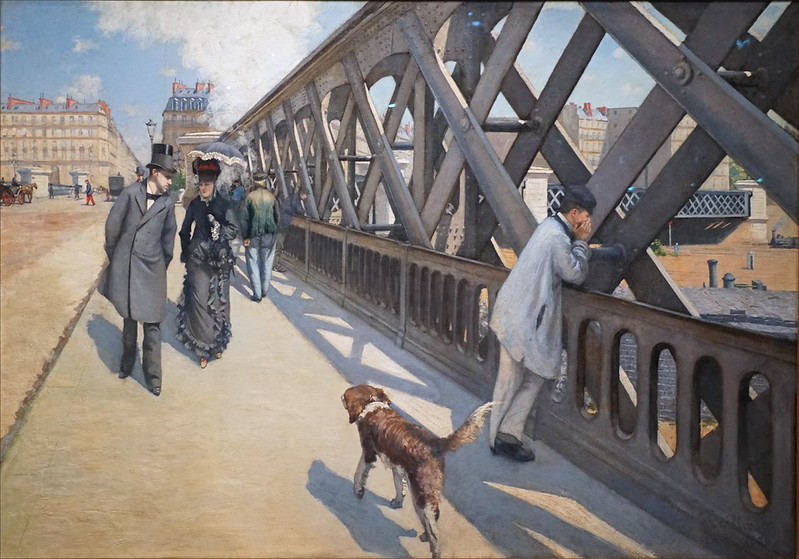
Gustave Caillebotte — the painter of modern Paris →On a metal bridge with massive iron girders, passersby walk near the Saint-Lazare train station. An elegant man in a top hat and a woman with a parasol walk toward the viewer in the foreground; a laborer leaning on the railing gazes down at the railroad tracks below; a dog crosses the bridge at a brisk pace. The long diagonal line of the metal structure stretches toward the background, drawing the viewer’s gaze. This is Gustave Caillebotte’s *The Bridge of Europe* —one of the most beautiful depictions of industrial modernity in 19th-century Paris.
Painted in 1876, this work is, along with *Rue de Paris, Rainy Day*, one of Caillebotte’s two major urban paintings—the ones that established him as the painter of modern Paris. Here, the subject is the modernity of iron and rail: the metal Europe Bridge, that feat of 19th-century engineering, spanning the tracks at Saint-Lazare Station, the beating heart of the industrial city. With a fresh and daring perspective, Caillebotte celebrates the achievements of his time—metal, machinery, the railroad, and the city in motion.
The work captivates with its composition, dominated by the powerful diagonal of the metal structure, which creates a rapid, dizzying perspective that draws the eye toward the background. It also captivates with its figures, who compose a subtle scene of modern urban life, where the different classes of Parisian society intersect without mingling. Here, Caillebotte displays the full extent of his artistry in bold framing and photographic vision.
This article explores the secrets of this masterpiece—what it represents, the modernity of iron and railways that it celebrates, its composition using accelerated perspective, the figures and the society they embody, the boldness of its vision, and its place in the body of work by Caillebotte, the painter of modern Paris.
The Painting — What It Depicts
*The Bridge of Europe* is a large-scale oil on canvas: approximately 125 centimeters high by 181 centimeters wide. Its expansive format is befitting the monumental subject—a large iron bridge in a modern city.
The scene takes place on the Pont de l’Europe, a steel bridge that spanned the many railroad tracks at the Saint-Lazare train station in Paris. Built in the 1860s, this bridge was an engineering marvel of its time, with its massive iron girders forming a distinctive X-shaped structure. Caillebotte depicts a section of this bridge, with its large metal beam running diagonally across the canvas toward the background, and the railing along which passersby are walking. In the distance, one can make out the Haussmann-style buildings of the Quartier de l’Europe.
There are several figures on the bridge. In the foreground, on the left, an elegant man in a top hat is walking toward us with a confident stride; next to him, a distinguished woman holding a parasol appears to be walking by his side. Their eyes may meet. A little further on, leaning against the bridge railing, a man in a work coat—a laborer, or perhaps a stroller from a different social class—gazes down at the railroad tracks below, absorbed in the sight of the trains and machinery. In the foreground, a dog crosses the bridge, striding briskly in the opposite direction from the elegant man.
The atmosphere is that of a beautiful day: the light is bright, the shadows sharp, and the sky clear. The color palette, dominated by grays, blues, browns, and the light tones of stone and metal, creates a bright and fresh ambiance. Everything in this scene exudes the quiet modernity of industrial Paris: the iron, the stone, the urban space, and the passersby going about their business. It is an image of the modern city, captured in an ordinary moment, yet transformed by Caillebotte’s vision and composition.
Iron and Rail — Industrial Modernity
The Bridge of Europe celebrates one of the great achievements of 19th-century modernity: the steel bridge, the railroad, and the industrial city. This is the work’s underlying theme, which makes it a manifesto of modernity.
The Pont de l’Europe was an iconic structure of modern Paris. Built in the 1860s to span the vast network of railroad tracks at the Saint-Lazare train station, it was a technical feat, a testament to the engineering genius of the era. Its iron structure and immense girders embodied industrial modernity—the very spirit that had given rise to train stations, bridges, metal market halls, and, soon, the Eiffel Tower. By choosing this bridge as his subject, Caillebotte affirmed his interest in this modernity of iron and machinery, which he viewed with fascination.
The Saint-Lazare train station, onto which the bridge leads, was itself a symbol of modernity. As Paris’s first major train station and the heart of the western rail network, it was a place of movement, speed, crowds, and modern life. The Impressionists were fascinated by it: Claude Monet, in the same decade, made it the subject of a famous series of paintings, capturing the steam, the light, and the atmosphere of the station. Caillebotte, for his part, focused on the bridge spanning the station—that space of passage and contemplation from which one observes the spectacle of the railroad. The worker leaning on the railing, gazing at the tracks, embodies this fascination with machinery and the railroad.
By celebrating iron and railroads, Caillebotte created a profoundly modern body of work. He brought into his paintings the technical and industrial achievements of his time, which had long been considered unworthy of art. Under his brush, the metal bridge, the train station, and the railroad became noble subjects, worthy of a grand canvas. This focus on industrial modernity—this celebration of iron and machinery—makes Caillebotte one of the great painters of the Industrial Revolution and the modern city. In this sense, *The Pont de l’Europe* is a tribute to the technical genius of his century.
Accelerated Perspective
The composition of *The Bridge of Europe* is dominated by a spectacular element: the large diagonal of the steel beam, which cuts across the canvas and creates a dizzying, accelerated perspective. It is one of the work’s most daring and modern features.
The large iron beam of the bridge runs diagonally across the composition, from the foreground on the left to the background on the right, powerfully drawing the viewer’s gaze toward the vanishing point. This pronounced diagonal creates a swift, dynamic perspective that propels the eye toward the interior of the painting. Nothing stops this movement: the gaze glides along the beam, toward the background, in a continuous flow. This accelerated perspective gives the work energy, dynamism, and a sense of movement that conveys the modernity of the setting.
Several elements reinforce this sense of movement. The dog crossing the bridge in the foreground, walking briskly, draws the eye; the elegant man walking in the opposite direction creates a counter-movement; the lines of the metal structure, the railing, and the ground converge toward the background. The entire composition is organized around this dynamism, this fluid movement that evokes the very function of the bridge: passage, traffic, and the flow of people through the station. The form complements the subject: the accelerated perspective conveys the movement of the modern city.
This bold composition once again demonstrates Caillebotte’s photographic vision. The accentuated perspective, the dynamic viewpoint, and the framing that cuts across the metal structure evoke the view through a camera lens, with which Caillebotte was well acquainted. He uses these techniques not to imitate photography, but to offer a fresh perspective on the city, to convey its dynamism and modernity. This compositional approach, revolutionary for its time, foreshadows the explorations of modern art. The Pont de l’Europe is thus, by its very form, a strikingly modern work of art.
The Flâneur and the Worker
The figures in *The Bridge of Europe* are not mere figures: they form a subtle portrayal of modern Parisian society, where different social classes coexist without truly mixing. Caillebotte weaves into the painting a keen observation of the urban life of his time.
Two groups stand out on the bridge. On one side, the elegant couple in the foreground: the man in a top hat, with a distinguished air, and the woman with a parasol. The man is a “flâneur”—that characteristic figure of nineteenth-century Paris, the elegant, idle man who strolls through the city, observing the urban scene. It has often been thought that Caillebotte modeled him after himself, thus depicting himself as a bourgeois flâneur. On the other side, leaning against the railing, is the man in a smock—a laborer, or a man of the people—who is looking at the railroad tracks, absorbed in the spectacle of trains and machinery.
These two groups embody two worlds, two social classes, that coexist within the modern city. The bourgeois and the worker find themselves on the same bridge, in the same urban space, but they do not mix: they remain separate, each in his own world, with his own attitude. The bourgeois flâneur walks toward a destination, observes, and wanders; the worker stops, contemplates the machine, the work, and industry. Caillebotte thus subtly captures the social reality of the modern city: a shared space where classes rub shoulders without mingling, in a simple coexistence.
This social observation—subtle yet present—adds depth to the work. Beyond celebrating technological modernity, Caillebotte offers a glimpse into the society of his time, its divisions, and the place each individual occupies in the urban landscape. The bridge, a place of passage and encounter, becomes the setting for a meditation on the modern city and its inhabitants. This dimension, combined with the beauty of the composition and the modernity of the perspective, makes *The Pont de l’Europe* a rich and complex work—far more than a simple cityscape. It is an image of modernity in all its dimensions—technical, urban, and social.
Caillebotte’s Modernity
*The Pont de l’Europe, with Rue de Paris, Rainy Day* belongs to the small group of large-scale urban paintings through which Caillebotte established himself as the painter of modern Paris. These works mark a particular moment in his career and hold a special place in the history of Impressionism.
In the second half of the 1870s, Caillebotte devoted himself to these large-scale scenes of modern urban life, captured at street level, featuring life-size figures. The Pont de l’Europe (1876) and Rue de Paris, Rainy Day (1877) are the two masterpieces of this period. These works, with their scale, ambition, and modernity, are unique within Impressionism: no other painter in the group depicted the modern city on this scale, with this rigor, or with such compositional boldness. In them, Caillebotte invented a new way of painting urban modernity.
After this period, Caillebotte’s art evolved. He continued to paint the city, but from a different perspective—often from his balcony, looking down, rather than at street level. Then, beginning in the 1880s, he turned to other subjects: landscapes, gardens, boating scenes, and flowers. The large urban canvases of the mid-1870s thus represent a distinct period, a high point in his art, during which he presented his broadest and most ambitious vision of Parisian modernity. *The Pont de l’Europe* is one of the major works from this period.
Long overlooked, these large-scale urban paintings by Caillebotte are now recognized as masterpieces of modern painting and as the most striking depictions of 19th-century Parisian modernity. They have established Caillebotte—long reduced to his role as a patron—as one of the most original and modern painters of his time. His fresh perspective on the city, iron, crowds, and light strikes us today as surprisingly relevant. *The Pont de l’Europe*, with its dizzying perspective and its celebration of iron and railroads, stands as one of the finest examples of this.
How to View the Work Today
“The Bridge of Europe ” is housed in Geneva, Switzerland, as part of the collection of the Association des Amis du Petit Palais. The work is one of the highlights of a fine collection of 19th- and 20th-century art.
Seeing the work in person allows one to appreciate its power: the scale of the composition, the strength of the metallic diagonal line, the bright light, the presence of the figures, and the richness of the details. It is a work that strikes the viewer with its dynamism and modernity, and one that rewards careful observation of its skillful composition and subtle social scene.
There is a second version of the work, smaller in size and without the dog, housed at the Musée des Beaux-Arts in Rennes—a sketch or variant that illustrates Caillebotte’s work on this composition. To explore Caillebotte’s art more broadly, the Musée d’Orsay in Paris houses several of his major works, including *The Floor Scrapers*, while *Paris Street; Rainy Weather*, his other major urban painting, is located at the Art Institute of Chicago. Together, these works paint a portrait of the great painter of modern Paris.
Further Reading
Institutional sources cited
- Association of Friends of the Petit Palais, Geneva, entry on the Pont de l’Europe.
- Rennes Museum of Fine Arts, description of the version held in Rennes.
- Documentation on Impressionist exhibitions of the 1870s.
Sources and Reference Studies
- Marie Berhaut, Gustave Caillebotte. A Catalog Raisonné of Paintings and Pastels, Bibliothèque des arts, 1994.
- Éric Darragon, *Caillebotte*, *Tout l’art* series, Flammarion, 1994.
Institutional Documentation
- Petit Palais, Geneva — the institution that houses the work.
- Musée d’Orsay, Paris — other works by Caillebotte.
See also on Hors Cadre
- Gustave Caillebotte — the painter of modern Paris — a portrait of the artist, his life, and his art.
- *Rue de Paris, Rainy Day*—Caillebotte’s urban masterpiece —the other great urban scene, painted the following year.
- Claude Monet—the master of Impressionism —who, at the same time, painted the Saint-Lazare train station, the heart of modern Paris.
— M