A Street in Paris on a Rainy Day — Caillebotte’s Urban Masterpiece
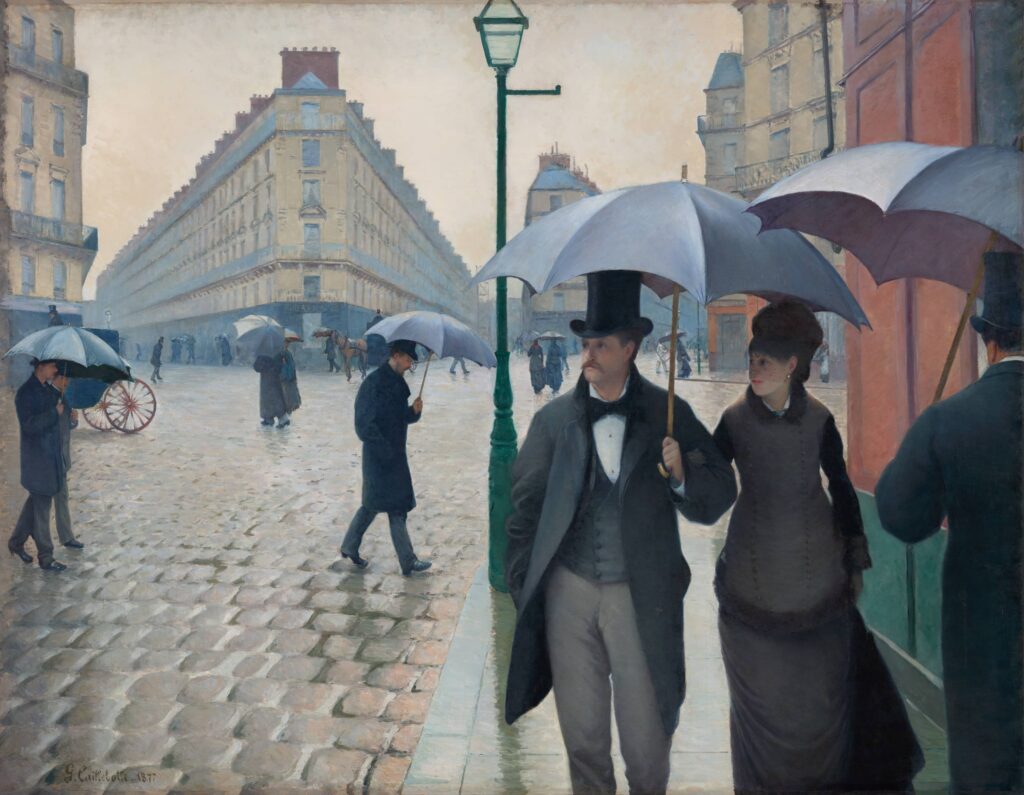
Gustave Caillebotte — the painter of modern Paris →Under a gray sky, at an intersection in Haussmannian Paris, elegantly dressed passersby walk under their umbrellas on cobblestones glistening with rain. In the foreground, a well-dressed couple walks toward us, while on the right, a passerby cut off by the edge of the canvas appears about to cross their path. In the center, a streetlamp divides the composition. This is Gustave Caillebotte’s *Rue de Paris, Rainy Day* —the largest of his canvases and the most famous image of modern Paris in the 19th century.
Painted in 1877, this monumental work—more than two meters high and nearly three meters wide—is Caillebotte’s masterpiece, the one that best embodies his vision of urban modernity. In it, the painter displays the full range of his artistry: his perspective on Baron Haussmann’s “New Paris,” a composition of unrelenting geometric precision, daring framing, and that unique atmosphere—both elegant and melancholic—that characterizes his vision of the big city.
The work captivates with its modernity. First, through its subject matter—Haussmannian Paris, its boulevards, its new buildings, its anonymous passersby—but also through its form: the masterful perspective, the ground-level viewpoint, the life-size figures that seem to step into our space, and the damp atmosphere rendered with rare subtlety. In this work, Caillebotte views the modern city with a fresh, almost photographic eye, which gives the scene a striking presence.
This article explores the secrets of this masterpiece—what it represents, the Haussmann-era Paris it immortalizes, its mathematically precise composition, its characters and the subtle tension that animates them, the atmosphere of the rain, the boldness of its perspective, and the work’s place among the greatest images of urban modernity.
The Painting — What It Depicts
*Rue de Paris, Rainy Day* is a very large oil-on-canvas painting: 212 centimeters high by 276 centimeters wide. This monumental format—typically reserved for grand historical paintings—applied to an ordinary street scene is, in itself, a statement: modern life and the contemporary city deserve the treatment reserved for great subjects.
The scene depicts a crossroads in the Europe district of Paris—specifically, the intersection of Rue de Turin and Rue de Moscou, not far from the Saint-Lazare train station, in a newly built neighborhood where the streets are named after major European cities. It is raining. The pavement is wet and glistening with moisture. New Haussmann-style buildings with light-colored stone facades frame the scene and recede into the distance. In the center, a streetlamp stands tall, dividing the composition vertically.
In this urban setting, passersby move about, all dressed in the bourgeois style—sober and elegant—and all carrying similar umbrellas. In the foreground, on the right, a well-dressed couple—a man in a top hat and an elegant woman—walks toward the viewer under a single umbrella. On the far right, another passerby, cut off by the edge of the canvas, is walking in the opposite direction, so close to us that he seems about to pass the couple. Further away, other figures are scattered across the intersection in the rain, each isolated under their own umbrella.
The atmosphere is that of a rainy day: gray light, subdued and understated tones, an overcast sky, and wet cobblestones reflecting the pale light. The color palette, dominated by grays, blacks, browns, and blues, creates a subdued, somewhat melancholic atmosphere of cool elegance. Everything in this scene exudes the quiet, somewhat distant modernity of Haussmannian Paris. It is an image of the new city, captured in an ordinary moment, yet rendered with a grandeur and mastery that transform it.
Haussmann’s Paris
*Rue de Paris, Rainy Day* is, above all, a tribute to modern Paris—the city that Baron Haussmann had just reinvented, and of which Caillebotte was the great painter. To understand the work is, first and foremost, to understand this new Paris that it celebrates.
During the Second Empire, Paris had undergone a radical transformation. Baron Haussmann, Prefect of the Seine, had cut through wide, straight avenues, erected thousands of new buildings with uniform facades, and created squares, intersections, and thoroughfares. The Europe district, where the scene takes place, was one of these new neighborhoods, built around the Saint-Lazare train station, with streets named after European capitals. It was the Paris of modernity—new, geometric, bourgeois—the one that had replaced the old medieval Paris with its narrow alleys.
Caillebotte was fascinated by this new city, and he made it the central subject of his art. In *Rue de Paris, Rainy Day*, he presents an iconic image of it: the new, uniform buildings, the wide paved spaces, the sidewalks, and modern street furniture such as the streetlamp. He captured the characteristic appearance of this Haussmannian Paris—its order, its regularity, its somewhat cool elegance, and its new scale. The work is a record of the city of his time, but also a meditation on what was new and modern about it.
For Caillebotte does not merely describe; he interprets. His vision of Haussmannian Paris is not merely admiring; it is also tinged with a certain melancholy, a sense of distance. This new, orderly, elegant city is also a place where people pass one another without seeing each other, each isolated under their own umbrella, in a characteristic urban solitude. Caillebotte perceives and captures this ambivalence of modernity: its beauty and its coldness, its elegance and its solitude. This is what gives the work its depth, beyond mere representation.
A cross-shaped arrangement
Beneath the scene’s apparent simplicity lies a composition of extraordinary mathematical precision. This is one of the most fascinating aspects of the work, and one of Caillebotte’s greatest achievements: giving an ordinary street scene a structure of geometric perfection.
The composition is organized around two axes that divide the canvas into a cross. The vertical axis is marked by the streetlight in the center and its reflection on the wet pavement, which extends the line downward. The horizontal axis runs along the horizon line—at eye level with the standing figures—and extends across the bases of the buildings and the heads of the passersby. These two axes divide the work into four parts, creating a structure of remarkable clarity and balance. The central streetlight, in particular, plays a pivotal role, dividing the painting into two halves.
This cross-shaped structure is complemented by a masterful use of perspective. Caillebotte, trained in drawing and passionate about geometry, constructed his space with the precision of an architect—it is known that he drew his vanishing lines with a ruler. The avenues receding into the background follow precise diagonals toward carefully calculated vanishing points. The figures in the background are staggered along these diagonals, while those in the foreground are aligned horizontally. This dual organization—the diagonals of depth and the horizontals of the foreground—ensures the balance and harmony of the composition as a whole.
This structural rigor is not merely a technical exercise: it conveys something about the subject. The geometry of the composition echoes the geometry of the Haussmannian city, with its straight avenues and urban order. The structure of the painting mirrors the structure of the space it depicts. Caillebotte thus makes the composition itself a means of expressing modernity—that new, rational, geometric order that Haussmann had imposed on Paris. Form and subject are one: this is the hallmark of great works of art.
The Couple and the Passersby
In the foreground of *Rue de Paris, Rainy Day*, the figures command our attention—particularly the elegant couple walking toward us and the passerby cut off by the edge of the canvas. Caillebotte has carefully arranged these figures, creating a subtle narrative tension.
The couple in the foreground—a man in a top hat, an elegant woman on his arm, sharing an umbrella—is depicted life-size, with a striking presence. Their closeness, their life-size scale, and their position at the edge of the canvas create a sense of immediacy: they seem on the verge of stepping out of the painting and into our space. This highly modern approach eliminates the distance between the artwork and the viewer, drawing us into the scene. We are no longer standing in front of the painting, but on the street, among the passersby.
A small detail creates a subtle tension. On the far right, another passerby—cut off by the edge of the canvas—is walking in the opposite direction, toward the couple. Their gazes avoid each other: the couple is looking to the left, the passerby is coming from the right; in a moment, they will cross paths, perhaps even collide. This micro-narrative, this minute suspense, brings the scene of quiet everyday life to life. We feel compelled to warn the figures of the impending encounter. This remarkably subtle detail showcases Caillebotte’s artistry: beneath the scene’s apparent banality, he weaves tension, movement, and life.
The passerby, whose figure is cut off by the frame, also plays a special role: he represents us, the viewers. By his position at the edge of the painting, halfway into the scene, he symbolizes our own entry into the space of the work. This technique, borrowed from photography—where the frame arbitrarily cuts off figures—was highly daring for its time. It attests to the modernity of Caillebotte’s vision and his innovative approach to composition, which makes the viewer a participant in the scene. These life-size figures in the foreground, cut off by the frame, are one of the work’s greatest innovations.
Rain and Shades of Gray
The atmosphere in *Rue de Paris, Rainy Day* —that damp, gray, subdued mood—is one of the work’s greatest achievements. In this painting, Caillebotte employs a subtle interplay of tones and effects that lends the scene its unique poetic quality.
It is raining, and the entire work is imbued with this dampness. The sky is overcast, a uniform gray. The wet, cobblestone pavement glistens, reflecting the pale light of day. The open umbrellas shelter passersby and lend rhythm to the composition with their dark, rounded shapes. The atmosphere is that of an ordinary rainy day in Paris, rendered with remarkable accuracy. You can feel the dampness in the air, the coolness, and the subdued light. Without resorting to spectacular effects, Caillebotte manages to make the atmosphere of a rainy day palpable.
This atmosphere is achieved through a subtle mastery of tones. The palette is understated and subdued, dominated by grays, blacks, browns, and bluish hues. There are no bright colors: everything is restrained, muted, and rendered in half-tones. This muted range, far from being dull, creates a refined harmony, with a cool elegance that suits the subject. Caillebotte plays with shades of gray, reflections on wet cobblestones, and veiled light, with a finesse that attests to his great talent as a discreet colorist. For him, rain is not a meteorological phenomenon, but an aesthetic choice that gives the work its unity and poetry.
This gray, damp atmosphere also reinforces the work’s melancholic tone. The rain, the hazy light, the dark tones, and the isolated passersby under their umbrellas come together to create a somewhat sad, somewhat lonely image of the big city. Beneath the scene’s elegance lies a melancholy, a sense of urban solitude, characteristic of Caillebotte’s sensibility. The rain thus becomes an expression of a state of mind as much as a state of the sky—the gentle melancholy of modern man in the city. It is this emotional depth, beneath the formal mastery, that makes the work so great.
The Photographic Eye
*Rue de Paris, Rainy Day* is one of the works in which Caillebotte’s modernity is most clearly evident: his almost photographic eye, his innovative approach to framing and composition, which foreshadows artistic explorations that would come much later.
Several elements of the work reflect this photographic vision. First, the framing, with these foreground figures cut off by the edge of the canvas, just as a photograph’s frame arbitrarily cuts off the figures. Next, the viewpoint—at eye level—which places us on the street, at the level of the passersby. Finally, the perspective, with its precise vanishing lines and constructed depth, evokes a camera lens. All these elements give the work the character of a snapshot—a moment captured on the spot—which is very different from traditional painting.
This connection to photography is no coincidence. Photography was booming at the time, and Caillebotte was drawn to it—his own brother, Martial, was a passionate photographer. Caillebotte clearly reflected on this new way of seeing the world—the framing, the viewpoints, and the snapshots made possible by the camera. But he did not simply imitate photography: he transposed its spirit into his painting, offering a fresh perspective on the modern city. For him, photography was a tool for renewing his vision, not an end in itself.
This modern perspective makes *Rue de Paris, temps de pluie* a surprisingly timely work. Its framing, composition, and perspective foreshadow artistic explorations that 20th-century art would pursue at length—even extending to cinema, which one sometimes feels is foreshadowed in these compositions and staged scenes. As early as 1877, Caillebotte was already viewing the city through the lens of the future. It is this modernity—long misunderstood—that today earns the work its status as a masterpiece and its place among the most famous images in modern painting.
“One of the boldest in the group”
*Rue de Paris, Rainy Day* was first shown to the public in 1877 at the third Impressionist exhibition. Its reception and the views of Caillebotte’s contemporaries on the work shed light on his place within the movement and the innovative nature of his painting.
Caillebotte presented the work at the third exhibition of the Impressionist group in April 1877—an exhibition he himself had helped organize and finance. He displayed several paintings there, including this large *Rue de Paris, Rainy Day*, which occupied a place of honor. With its monumental dimensions and modern subject matter, the painting could not go unnoticed. It strikingly affirmed Caillebotte’s ambition: to make modern life and the contemporary city the subject of a great painting.
The writer Émile Zola, a champion of the Impressionists and a keen observer of the art world, took notice of the work and its creator. He hailed Caillebotte as a bold young painter who did not hesitate to tackle modern subjects on a large scale, and praised the realism of his figures, particularly the couple in the foreground. He saw in him an artist destined for a bright future, one of the most daring members of the group. This assessment, coming from such an influential critic, attests to the impression the work made and to the recognition, even at the time, of Caillebotte’s singular talent.
The work’s subsequent history was one of a long period of obscurity followed by a rediscovery, much like the fate of its creator. Remaining in the artist’s family for a long time, the painting was sold in the mid-20th century and eventually found its way to the Art Institute of Chicago, where it is now one of the most admired masterpieces. The major Caillebotte retrospectives, beginning in the late 20th century, established *Rue de Paris, Rainy Day* as one of the iconic images of Parisian modernity and one of the high points of Caillebotte’s art. The work that Zola had praised in 1877 is now universally recognized as a masterpiece.
How to View the Work Today
*Rue de Paris, Rainy Day* is housed at the Art Institute of Chicago in the United States, one of the country’s largest art museums, which boasts a remarkable Impressionist collection. The work is one of the museum’s most famous and admired pieces, a centerpiece of the collection.
Seeing the work in person allows one to appreciate its grandeur: its monumental dimensions, the life-size figures, the depth of space, and the subtlety of the grays and reflections. It is a work that impresses with its scale and mastery, and one that rewards careful observation of its countless details. Standing before it, you are literally transported to Paris in 1877.
For art lovers who would like to stay in Paris, a preparatory oil sketch of the work, in a smaller format, is housed at the Marmottan Monet Museum—Caillebotte had given it to his friend Claude Monet. This sketch, executed in a freer and more Impressionist style than the final version, allows viewers to trace the development of the masterpiece and offers valuable insight into Caillebotte’s working method. The intersection itself, in the Europe neighborhood (now Place de Dublin), can be visited: the buildings painted by Caillebotte still stand there.
Further Reading
Institutional sources cited
- Art Institute of Chicago, catalog entry and in-depth study of *Paris Street; Rainy Day*.
- Marmottan Monet Museum, description of the preparatory study.
- Émile Zola, Chronicle of the Third Impressionist Exhibition (1877).
Sources and Reference Studies
- Marie Berhaut, Gustave Caillebotte. A Catalog Raisonné of Paintings and Pastels, Bibliothèque des arts, 1994.
- Éric Darragon, *Caillebotte*, *Tout l’art* series, Flammarion, 1994.
Institutional Documentation
- Art Institute of Chicago — the institution that houses the artwork.
- Marmottan Monet Museum, Paris — preparatory study.
See also on Hors Cadre
- Gustave Caillebotte — the painter of modern Paris — a portrait of the artist, his life, and his art.
- The Floor Planers — Caillebotte’s Modern Realism — Caillebotte’s other great masterpiece, straddling realism and modernity.
- The Pont de l’Europe—steel and the modern city —the other major urban setting, showcasing the modernity of rail.
— M