Saint Jerome Writing — Caravaggio to His Savior
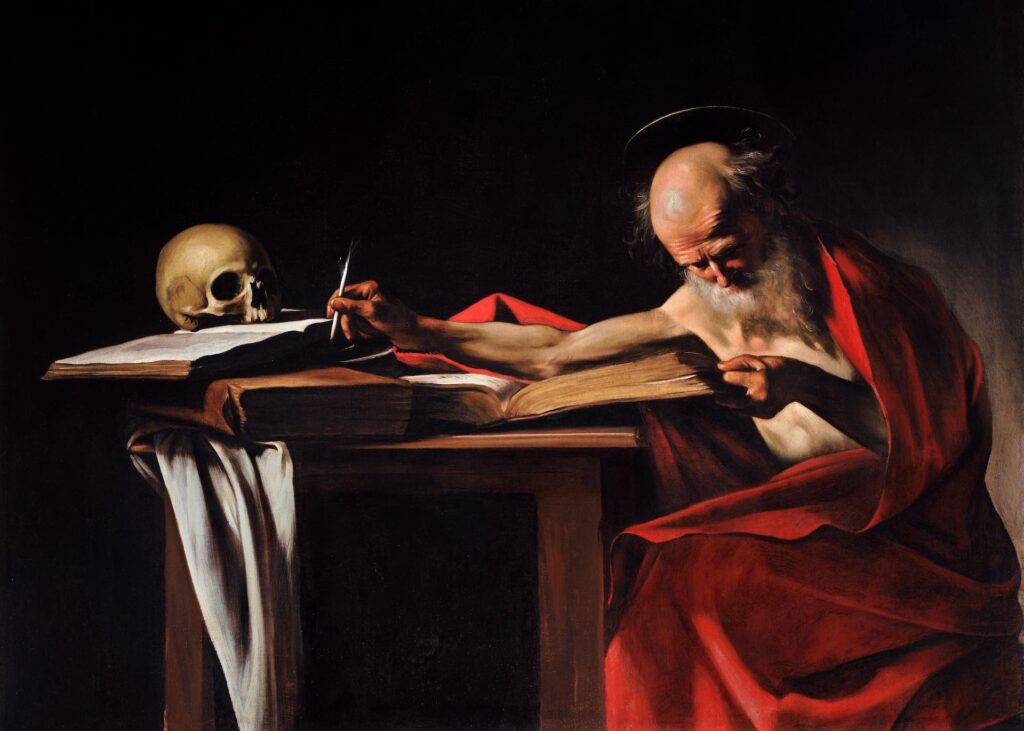
Caravaggio, the painter who depicted a sword at the waist →Toward the end of 1605 or at the very beginning of 1606, Caravaggio painted a horizontal canvas one meter fifty wide for Cardinal Scipione Borghese: Saint Jerome bent over his Scriptures, his hand reaching toward his inkwell, a skull resting beside him. The painting immediately became part of the cardinal’s private collection and would never leave it.
Four years later, in July 1610, it was this same Scipione Borghese who interceded with his uncle, Pope Paul V, to secure a pardon for the painter, who had been on the run since the murder of Ranuccio Tomassoni in May 1606. The pardon came too late. Caravaggio died on the beach at Porto Ercole, feverish and alone, before learning that he had been pardoned.
This *Saint Jerome Writing*, now housed in a room at the Borghese Gallery in Rome, is one of the works that seals the bond between the cursed painter and the man who would later try to save his life. It is also, almost by accident, the work in which Caravaggio depicts his own benefactor as a saint.
Rome, 1605–1606 — a painter at the height of his career, a man on the brink
In the fall of 1605, Caravaggio was thirty-four years old. For the past five years, he had been the most talked-about painter in Italy. *The Calling of Saint Matthew* had made him a celebrity in July 1600. Commissions were pouring in. *The Madonna of the Grooms*, *The Entombment*, *The Death of the Virgin*—in just a few years, he produced a body of work that single-handedly defined the new Roman style of religious painting.
But the man was struggling with a chaotic personal life. The Roman archives from the years 1605 and 1606 are filled with complaints against him: for carrying prohibited weapons, for injuring a notary (the Pasqualone affair, July 1605), and for brawls in taverns. The painter spent his evenings with a sword at his belt, slept fully clothed, and got up in the middle of the night to play jeu de paume. On several occasions, he escaped prison—or worse—thanks to the intervention of powerful patrons.
By this time, one of his patrons was no longer just Cardinal Francesco Maria del Monte, who had taken him in when he was starting out. It was now also a young, ambitious man and an insatiable patron of the arts: Scipione Borghese.
A few months later, in May 1606, Caravaggio would kill Ranuccio Tomassoni one night near the Basilica of San Lorenzo in Lucina and would be forced to flee Rome, never to return. *Saint Jerome Writing* was painted just before this final break. Caravaggio did not know that he was leaving Rome for good. But Scipione Borghese was already, among his circle, the man whose patronage mattered most.
Scipione Borghese, the patron who collected Caravaggio’s works until his death
In 1605, Scipione Caffarelli had just undergone a radical transformation. His maternal uncle, Camillo Borghese, had just been elected pope under the name Paul V (May 1605). A few weeks later, the pope’s nephew was himself created a cardinal and took his uncle’s surname. At the age of twenty-eight, Scipione Borghese became one of the most powerful men in Rome —if not in all of Europe. He enjoyed the considerable ecclesiastical revenues that came with the position of cardinal-nephew, and he harbored a consuming passion for painting, sculpture, and antiquities.
His collection—which would eventually become the collection of the present-day Borghese Gallery—was taking shape. He bought works, had others bought, and exerted pressure to acquire them. He knew a Caravaggio when he saw one. He already owned *The Madonna of the Grooms* (rejected by Saint Peter because its figures were deemed vulgar, but immediately bought back by him for a few scudi).
Seventeenth-century sources are in agreement. Iacomo Manilli, the cardinal’s steward, published a guide to the Villa Borghese in 1650 that describes *Saint Jerome Writing* among the palace’s artworks and explicitly attributes it to Caravaggio. Twenty-two years later, Bellori confirmed in his *Lives of Modern Painters* that the work was indeed painted for Scipione Borghese. Contemporary art historians, including Rossella Vodret, have put forward the strong hypothesis that the painting may have been a gift from the painter to the cardinal in gratitude for a legal favor —although no document formally proves this, but there is also no documentation to contradict it either.
Four years later, in July 1610, it was once again Scipione Borghese who interceded with Pope Paul V to secure a pardon for Caravaggio. The pardon would come too late—Caravaggio died on the beach at Porto Ercole before he could learn of it. But the Caravaggio-Borghese connection, of which *Saint Jerome Writing* is one of the earliest tangible links, runs like a common thread through the last four years of the painter’s life.
The Work—A Saint, a Skull, Two Times
The painting measures 112 centimeters high by 157 wide. It is in a horizontal format, which is unusual for a depiction of a saint in meditation: one would typically expect a vertical, upright format. Caravaggio chose the horizontal format because it mirrors the stretch ofan outstretched arm —that of the saint, which spans the entire canvas to reach the inkwell at the far end of the table.
Saint Jerome is depicted seated on the right, in three-quarter profile, draped in a wide purple cloak. His head, crowned with a discreet golden halo, is bent over the Scriptures. The saint is at work—he is writing the Vulgate, his translation of the Bible from Hebrew and Greek into Latin, which would remain the official version of the Catholic Church for fifteen centuries. His right hand holds the quill, ready to dip into the ink. His left index finger holds open a page of a book—perhaps the original Hebrew text, perhaps an earlier Greek translation (the Septuagint), or perhaps a patristic commentary.
On the table, to the left, resting on top of another open book: a skull. It is the memento mori, the object that painters include in still lifes to remind us that all earthly things are destined to disappear. And this is where the genius of the composition really shines through.
The saint’s head and skull are positioned at the same height, in perfect horizontal symmetry. They face each other at the end of the table, like two participants in the same silent dialogue. Caravaggio thus creates on the canvas a face-to-face encounter between life, which thinks, and death, which watches —between the active flesh of the old man absorbed in his work and the bones of the skull, which have nothing left to say but serve as a reminder of the end.
This symmetry is not merely formal. It is philosophical. Saint Jerome, the translator of the text that saves him, does not look up at the skull. He continues to write. The entire work lies in this refusal: death is there, lying a meter away, clearly visible, but the saint has something more important to finish. The Vulgate is precisely what will survive all of this—the saint, his body, and all personal memory. The translation is what redeems finitude.
On the left side of the painting, a large white sheet crosses the table at an angle. Cool tones contrast with warm tones. White sheet versus cardinal’s purple. The pallor of the linen versus the warmth of the cloak. The painting rests on this simple, masterful chromatic tension.
A coat that speaks to the client
Saint Jerome’s purple cloak is not a trivial detail. In traditional iconography, Saint Jerome is depicted wearing a red cloak or a cardinal’s hat —which is historically inaccurate, since the office of cardinal did not exist in the fourth century, but which Catholic tradition has adopted to signify his dignity as a Church Father.
Caravaggio makes use of this iconographic convention. But he does so twice. The purple cloak is the color of Jerome’s cardinalate—and it is also, exactly, the color of the cardinalate of Scipione Borghese, the patron. Hanging in the cardinal’s apartments, the painting thus became a coded visual compliment: Scipione received a work for his collection in which his own dignity as a man of the Church was symbolically celebrated through the figure of the saint.
This dual interpretation is characteristic of Caravaggio’s subtlety. He never paints a detail without imbuing it with multiple layers of meaning: decorative, narrative, theological, and, in this case, political. The painting speaks to the cardinal’s devotion and his vanity as a prince of the Church.
The Painting’s Fate—Three Centuries of Misattribution
Here is a fact that most French-language articles on this work fail to mention: the painting was misattributed for nearly two centuries.
In the 17th century, no one doubted that the painting was by Caravaggio—Manilli in 1650 and Bellori in 1672 attest to this in their writings. The painting is in the Borghese collection, and everyone knows it is by Caravaggio. The attribution was officially confirmed in 1693 in a formal inventory.
Then, starting in 1790, doubt began to set in. Art critics began to suggest that the painting might not be by Caravaggio but by Jusepe de Ribera, a Spanish painter in the Caravaggio style who was active in Naples. Why the confusion? Because Ribera, who trained in Caravaggio’s circle, did indeed paint austere saints, bearded old men, and unadorned compositions. And because, above all, *Saint Jerome Writing* possesses certain features—the sketched-out beard, the quick brushstrokes—that could be interpreted as “un-Caravaggesque” by critics who expected a polished finish.
Throughout the 19th century, the painting was listed in the Borghese inventories as a work by Ribera. Visitors on the Grand Tour who see it know it by that name. It was not until the turn of the 20th century, as part of the major movement to rehabilitate Caravaggio’s reputation initiated by Roberto Longhi, that the work was attributed to its true creator. Today, the attribution to Caravaggio is unanimous and undisputed among experts.
This story of attribution reveals something important about the fragility of our perspective on art. When a painting changes hands, its meaning changes as well. For two centuries, tens of thousands of visitors viewed this same masterpiece as a Ribera—not a Caravaggio. And what we see always depends, in part, on what we believe we are seeing.
How to View the Work Today
” Saint Jerome Writing ” is housed in the Borghese Gallery in Rome, in the palace named after Cardinal Scipione’s family. It is part of one of the finest Caravaggio collections in the world—six of the painter’s works are on display there.
Practical Information:
- Address: Galleria Borghese, Piazzale Scipione Borghese 5, 00197 Rome, Italy
- Reservations are required: The Borghese Gallery operates on two-hour time slots, with a strictly limited number of visitors per session. You must make a reservation in advance—ideally several weeks in advance during peak season.
- Official booking website: galleriaborghese.beniculturali.it
- Price: about €13 (plus a mandatory €2 reservation fee)
- Tip: The room where *Saint Jerome Writing * hangs also features other major Caravaggio works— *David Holding the Head of Goliath*, *Saint John the Baptist*, *Boy with a Basket of Fruit*, and, of course, *The Madonna of the Grooms*. Allow at least forty-five minutes for this room alone
Further Reading
Primary sources cited in this article
- Iacomo Manilli, Villa Borghese outside Porta Pinciana, Rome, 1650. The first printed guide to Cardinal Scipione Borghese’s collection, and the earliest documented reference to *Saint Jerome Writing* in that collection.
- Giovanni Pietro Bellori, *Le Vite de’ pittori, scultori et architetti moderni*, Rome, 1672. The first analytical biography of Caravaggio, which confirms the attribution and the Borghese commission.
Leading Modern Studies
- Rossella Vodret, *Caravaggio: The Complete Works*, Silvana Editoriale, 2010. A modern, authoritative catalogue raisonné.
- Roberto Longhi, *Quesiti caravaggeschi*, 1920—pioneering studies that restored Caravaggio to art history in the 20th century.
To view the artwork
Borghese Gallery, Rome : Saint Jerome Writing, David Holding the Head of Goliath, Madonna of the Grooms, Saint John the Baptist, Boy with a Basket of Fruit. Reservations required.
Also worth checking out at Hors Cadre
- Caravaggio, the Painter Who Painted with a Sword at His Side —A Comprehensive Portrait of the Artist
- The Calling of Saint Matthew—When Caravaggio Places God in a Tavern —Caravaggio’s Founding Work in Rome
— M