“Luncheon on the Grass” — the painting that made everything possible
Édouard Manet — From the *Luncheon* Scandal to His Last Painting →Paris, Friday, May 15, 1863, Palais de l’Industrie on the Champs-Élysées. Today marks the opening of the Salon des Refusés, established by Napoleon III a month earlier in response to discontent among the Parisian art world over the 3,000 works rejected by the jury of the official Salon. Twelve annex rooms have been set up, and 1,200 works are on display there. In the room where the paintingsof Édouard Manet—a thirty-one-year-old, elegant bourgeois painter already known for his staid Spanish subjects—are hung, a crowd gathers.
Standing in front of a single painting.
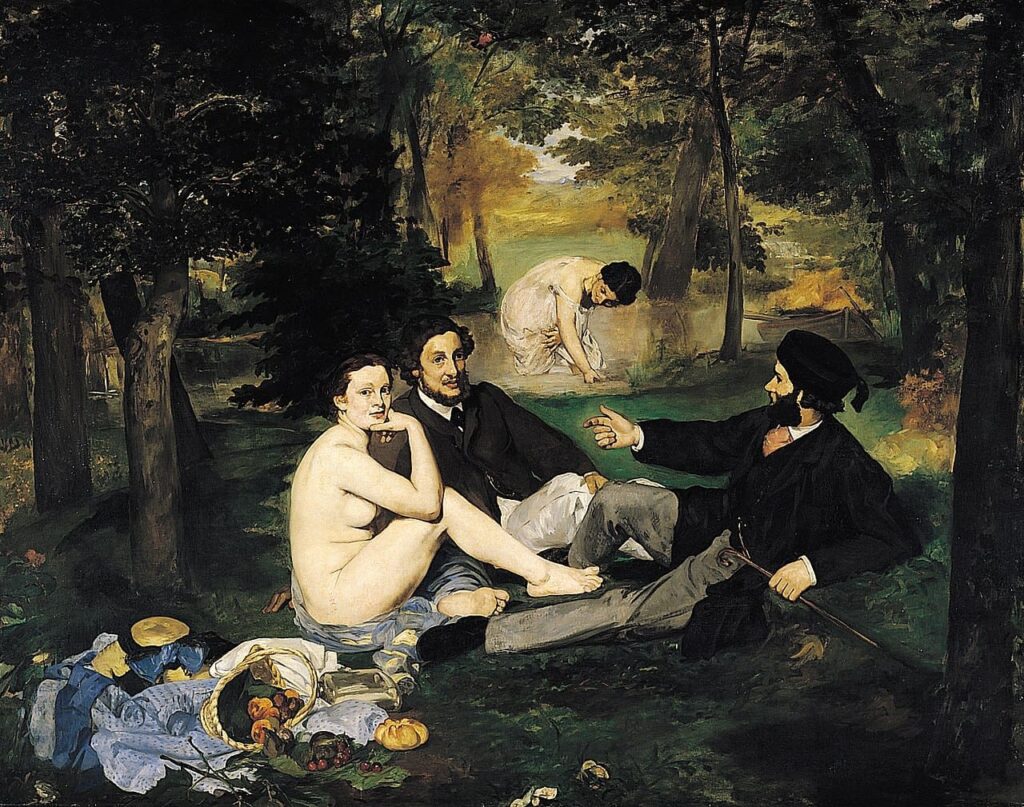
A young, naked woman sits on the grass between two men in contemporary suits. She looks directly at the viewer, unabashed. At her feet lies an overturned basket of fruit. Behind her, a third woman, wearing a white shirt, leans over a river. The official title listed in the program is The Bath. But it would soon come to be known as—and Manet himself would contribute to this— Le Déjeuner sur l’herbe.
The scandal erupts immediately. People laugh. They shout. They hurl insults. The crowd shuttles back and forth between this painting and another Salon—the official one—in the next room. Within a few days, *Luncheon on the Grass* becomes the Parisian event of the year.
Manet doesn’t know it yet, but he has just transformed the entire history of Western painting. Without this painting, exhibited on May 15, 1863, there would have been no Impressionism as we know it, no Fauvism, and no Cubism as Picasso would invent it forty years later. *Luncheon on the Grass* is, as the now-famous saying goes, the painting that made everything possible.
This article traces the genesis of the work, its hidden sources (Titian and Raphael, whom Manet explicitly cites), the precise circumstances of the scandal it provoked, and the extraordinary legacy it has generated—including the twenty-seven variations Picasso painted on this same motif between 1959 and 1962.
Before 1863 — The Beginnings in Gennevilliers
The origins of the painting date back tothe summer of 1862, according to the accountof Antonin Proust (1832–1905)—a childhood friend of Manet’s who went on to become an art critic and later Minister of Fine Arts, and who authored a memoir published in 1897.
Proust recounts a boat ride with Manet on the Seine, nearArgenteuil-Gennevilliers. The painter was watching women bathers emerging from the water. He turned to Proust and said, according to the account: “It seems I have to paint a nude. Well, I’ll paint one of them. Back when we were in the studio, I copied Giorgione’s women—the women with musicians. That painting is dark. The backgrounds have receded. I want to redo it and capture the transparency of the atmosphere.”
The work Manet is referring to is *The Country Concert* (c. 1509, Musée du Louvre), then attributed to Giorgione but now generally attributed to Titian. Manet copied this painting in 1856–1858 during his years of study at the Louvre. Two men dressed in 16th-century Venetian costumes and two nude women in a pastoral landscape. This would serve as the secret inspiration for *Luncheon on the Grass*.
Manet worked on the composition during the winter of 1862–1863 in his studio on Rue Guyot (now Rue Médéric, in the 17th arrondissement). He chose his models from his immediate circle: his muse, Victorine Meurent, and two male relatives. The painting was completed in early 1863. Manet submitted it to the official Salon along with two other works: *Mademoiselle V. in an Espada Costume * and *Young Man in a Majo Costume*. The jury rejected all three.
The painting’s fate took a dramatic turn when Napoleon III, while visiting the Salon’s studio on April 22, 1863, discovered the extent of the rejections. He immediately decreed a parallel Salon reserved for the rejected works. Manet’s *The Bath* would be one of the three thousand works eligible for re-entry. Manet submitted five works, including *The Bath* —which would become the center of attention.
The Painting — What It Depicts
*Luncheon on the Grass* is an oil on canvas measuring 208 centimeters high by 264.5 centimeters wide —or 2 meters by 2.65 meters. A monumental format, comparable to the grand historical masterpieces of the Salon. Manet presents his contemporary subject on the same scale as the Romans of the Decadence by his former master, Couture. Signed “Manet” in the lower left corner.
The composition is built around three figures in the foreground and a fourth figure in the background:
In the center, sitting on the grass: a young woman, completely naked. Her body is smooth, white, without pronounced contours. No shadows lend her flesh the traditional sense of depth. She is seated on the ground, her legs drawn to the side, her left arm folded beneath her chin. She looks directly at the viewer. No modesty. No smile. No conventional seduction. A gaze that is simply present, as if she were expecting to be seen.
On the right, half-reclining, dressed in contemporary attire: a young, bearded man in light-colored pants and a dark jacket, wearing a felt hat. He is making an explanatory gesture with his right hand —as if he were talking with his companions. His gaze is lost in the distance.
On the left, sitting on the grass: another young man, also dressed as a Parisian bourgeois of the 1860s—dark suit, tie, vest, and a flat hat perched on the back of his head. He is leaning on his right arm, looking at the nude young woman as if he were continuing a conversation with her.
In the background, in the river: a second woman, half-clad in a white shirt, is either bathing or drying her feet —the pose is ambiguous. She appears strangely out of proportion with the foreground: too tall for the perspective.
On the floor in the foreground: an overturned wicker basket, scattered fruit (cherries, figs), an uncorked bottle, and bread. The young woman’s clothes —a blue dress, a headscarf, and shoes—are strewn about in disarray.
Above: a large tree, foliage, a clear sky. The landscape is rendered using a decidedly modern palette: cool, dark greens, blue shadows, and diffused light reminiscent of a French forest undergrowth—not the golden Italian light of Titian.
It is this shift— the conventions of Renaissance mythological nudity transposed into a contemporary Parisian setting in 1863 —that caused the scandal.
Hidden Sources — Titian and Raphael
Manet makes no secret of his sources. On the contrary: he openly acknowledges them. According to the official entry for the Musée d’Orsay, two works from the Louvre provide the two essential compositional elements of *Luncheon on the Grass*:
Source 1 — Titian’s *Concert Champêtre* (c. 1509, Louvre Museum, then attributed to Giorgione) This Venetian painting from the early Cinquecento depicts two men dressed in Renaissance costumes and two nude women in a pastoral landscape. This is the source of the general theme of *Luncheon on the Grass*: the juxtaposition of clothed male figures and nude female figures in a natural setting. Manet had been familiar with it since his student years at the Louvre—he copied it around 1856–1858.
Source 2 — *The Judgment of Paris* after Raphael, engraving by Marcantonio Raimondi (c. 1515, Louvre Museum). From this Renaissance engraving, Manet borrows the exact arrangement of the three figures in his central group. In Raimondi’s engraving, three river deities are arranged exactly as Victorine and the two Manet brothers are on the canvas: a seated central figure flanked by two male figures, one leaning to the left, the other gesturing to the right. Manet meticulously reproduces this composition, simply transposing the ancient gods into Parisian bourgeois figures.
This dual reference is essential to understanding Manet’s boldness. He does not subvert the pictorial tradition—he transposes it. He does not say, “Classical painting is dead”; he says, “Classical painting can be infused with contemporary subjects.” This strategy of allusion would be taken up by all the modern artists who followed him, right up to Picasso, who painted *Les Demoiselles d’Avignon* in 1907, directly referencing El Greco and Cézanne.
The Musée d’Orsay fact sheet summarizes how it works:
“In *Luncheon on the Grass*, Manet claims the legacy of the old masters. But the presence of a nude woman among clothed men is not justified by any mythological or allegorical pretext. The modernity of the figures makes this almost surreal scene seem obscene in the eyes of his contemporaries.”
That is exactly how a scandal works: the norm becomes a transgression as soon as its context changes.
The Models — Victorine, the Manet Brothers
The identification of the three main models in *Luncheon on the Grass* has now been extensively documented by Manet’s biographers.
The Nude Woman: Victorine-Louise Meurent (1844–1927), eighteen years old at the time of the sitting in 1862–1863. A professional model whom Manet had met the previous year in Thomas Couture’s studio, she would become his principal muse for eleven years (1862–1873). She appears in nearly all of Manet’s major works from the 1860s— *Mademoiselle V. in an Espada Costume* (1862), *Olympia* (1863), *The Street Singer* (1862), The Railroad (1872–1873). Victorine was herself an amateur painter; she would later exhibit her own paintings at the Salon, notably in 1876—the year Manet was rejected. A historical irony: the nude woman in *Luncheon on the Grass* would be exhibited at the official Salon as a signed artist thirteen years after having been the subject of the Salon des Refusés scandal.
The man on the right, making the gesture: according to most sources, this is Eugène Manet (1833–1892), the painter’s younger brother and Berthe Morisot ’s future husband in 1874. Other biographical sources (notably Tabarant 1947) identify this figure as Ferdinand Leenhoff (1841–1914), the brother of Suzanne Leenhoff (Manet’s partner and later wife in 1863) and thus the painter’s brother-in-law. Uncertainty persists in the scholarly literature.
The man on the left, lying down and looking at Victorine: according to the same sources, this is Gustave Manet (1835–1884), the youngest of the siblings, who would go on to become a lawyer and a radical politician. Other sources identify this figure as Ferdinand Leenhoff —hence the frequent confusion between the two male figures.
The woman in the river in the background: no model has been identified. She is likely a figure Manet reconstructed from a model in his studio.
May 15, 1863 — the scandal
The Salon des Refusés opened on Friday, May 15, 1863, at the Palais de l’Industrie (now demolished; it was replaced by the Petit and Grand Palais in 1900) on the Champs-Élysées. Admission was free. During the first few weeks, thousands of Parisians flocked to the exhibition—far more than at the official Salon next door. Manet was the main attraction.
The Parisian press went wild. Louis Étienne, an art critic, wrote in *Le Pays* in June 1863:
“An ordinary young man, dressed in everyday clothes, is sitting on the grass next to a completely naked woman who is drying off in the open air. This repulsive juxtaposition has everything it takes to draw a crowd and make them burst out laughing.”
— Louis Étienne, “The Jury and the Exhibitors,” *Le Pays*, June 1863*
The article is representative of the prevailing tone of the criticism. *L’Illustration*, *La Gazette de France*, *Le Petit Journal*, *Le Constitutionnel* —all of them launch attacks. They speak of“indecency, ” “bad taste, ” and “a pimp’s farce.” Cartoonists in the satirical press (notably Cham in *Le Charivari*) churned out mocking drawings: they depicted the nude woman offering a sandwich to her companions, or the men turning their backs on the “bather.”
Only a few voices timidly defended Manet: Théophile Thoré (alias W. Bürger) in *L’Indépendance belge*, Zacharie Astruc in his journal *Le Salon*, and Théophile Gautier —although these defenses were still measured in 1863. The major defense would come three years later, in May 1866, penned byÉmile Zola.
Manet took the scandal hard. He wrote to Charles Baudelaire that he felt “insulted” and “dragged through the mud.” He believed—perhaps naively—that his painting would be received as a scholarly homage to the pictorial tradition, in the vein of Titian’s *Concert Champêtre*. On the contrary, it sparked what he would later call a “riot.” His mother and his brother Eugène urged him to leave Paris for a few months to escape the ridicule.
But Manet did not run away. He continued to paint. That same year, 1863, he had already completed *Olympia* —which he kept in his studio for two years before exhibiting it at the official Salon of 1865, sparking an even more intense scandal.
Why exactly is this causing a scandal?
We need to take a closer look at the exact nature of the scandal. Because what shocked Parisians in 1863 about *Luncheon on the Grass* is not what one might assume today.
What is NOT the scandal:
- Not female nudity. At the 1863 Official Salon, at the very moment when Manet was causing a stir with the “Refusés, ” dozens of paintings depicting Venus, nymphs, Diana the Huntress, and odalisques—all completely nude —were exhibited without the slightest protest. Alexandre Cabanel’s *The Sleep of Venus*, painted in 1863, was even purchased by Napoleon III that same year. Female nudity was a fully accepted convention at the Salon.
- Not sexual misconduct. The painting depicts nothing erotic or pornographic. There are no explicit gestures or suggestive poses. Victorine is nude but is not striking a seductive pose.
- Not technical innovation. Manet used modern techniques (a light color palette, flat areas of shadow, and simplified modeling), but none of them was revolutionary in and of itself. Courbet had already been doing this since the 1850s.
What IS the scandal, in three specific transgressions:
- Transgression 1 — Contextual Shift. Female nudity is accepted at the Salon only if it is mythological, allegorical, classical, or Orientalist. Venus, yes. A contemporary Parisian woman, no. *Luncheon on the Grass* depicts a nude woman without any justifying context: no mythological aura, no allegorical attributes, no echoes of antiquity. She is a nude woman among Parisian bourgeois in modern attire. Context changes everything: the same nudity, in a different setting, becomes shocking.
- Transgression 2 — The Direct Gaze. Victorine looks directly at the viewer. Traditionally, the Venuses of the Salon avert their eyes, lower their gaze, or close their eyelids—any posture that keeps the viewer in a dominant position as a respectable voyeur. Victorine’s direct gaze overturns this hierarchy. The nude woman is not an object to be looked at; she is a subject who looks back. It is this gaze, more than the nudity, that is unsettling.
- Transgression 3 — Displayed modernity. The men’s costumes can be dated to the exact day: they reflect the Parisian fashion of 1862–1863. This anchors the scene in the viewers’ immediate present. The mythological Venuses are protected by their timelessness; * The Luncheon* is a contemporary event, almost a news item. The scandal lies in its chronic nature —not in the nudity.
To understand these three transgressions is to understand how Manet managed to cause a scandal without showing anything scandalous. The scandal lay in the form, not in the subject matter.
1867 — Manet exhibited his work at his own expense at Place de l’Alma
Four years after the “Refusés” scandal, in May 1867, Manet made a radical decision.The World’s Fair opened in Paris at the Champ-de-Mars. The exhibition jury rejected his works—as well as those of Courbet. Refusing to accept this new humiliation, Manet had a private pavilion built at his own expense near the World’s Fair, on the Place de l’Alma.
The personal investment was considerable: between 18,000 and 25,000 francs (the equivalent of several years’ income for an average painter of the time). Manet used part of the inheritance he received from his father after Auguste’s death in 1862.
In this pavilion, open from May 24 to November 1, 1867, Manet exhibited fifty works in a retrospective. It was his first true retrospective, organized by himself, without any institutional involvement. At the center was *Le Bain* —now renamed *Le Déjeuner sur l’herbe* — was presented with a new title that played on the mockery of the caricaturists (“Le Déjeuner sur l’herbe” had become a sarcastic phrase in the press in 1863).
The exhibition was a partial commercial failure. Few visitors, few sales. But it marked a symbolic turning point: Manet had just proven that a painter could exhibit outside the official Salon. This precedent would prove decisive. Seven years later, in April 1874, Monet, Pissarro, Renoir, Degas, and their friends organized the first Impressionist exhibition at Nadar’s studio, independent of the Salon. They were continuing exactly the movement that Manet had initiated at the Place de l’Alma in 1867.
A historical irony: Manet refused to participate in this first Impressionist exhibition—or in the seven that followed. He paved the way; he chose not to follow it.
From *The Bath* to *Luncheon on the Grass* — the change in title
The painting has had two successive titles throughout its history.
First Title — The Bath : the official title listed in the catalog of the Salon des Refusés in May 1863. Manet chose this title to emphasize the connection to Titian and *The Country Concert* —the woman in the background is drying off after her bath, which retrospectively justifies Victorine’s nudity. It is also a title that defuses the scandal by framing the scene as an innocent outdoor scene.
Second Title — Luncheon on the Grass : the title used by Manet beginning in 1867 at the exhibition on Place de l’Alma. Probably inspired by the 1863 press cartoons that poked fun at Manet’s “picnic” or “lunch on the grass” —the painter reappropriated the irony to turn it into a title he embraced.
According to Antonin Proust, Manet also colloquially referred to his painting as “la partie carrée” —a 19th-century slang term for a romantic encounter involving four people (two men and two women). This self-coined nickname suggests that Manet was well aware ofthe sexual ambiguity his painting might evoke. He played with it, neither confirming nor denying it.
The title *Le Déjeuner sur l’herbe* became definitively established following the posthumous exhibition held in 1884 at the École des Beaux-Arts, organized by Antonin Proust after the painter’s death. Émile Zola wrote the preface to the exhibition catalog.
From Manet to Picasso — The Legacy of the Painting
The influence of *Luncheon on the Grass* on all of modern Western painting is probably the most significant in the entire history of art at the turn of the 19th and 20th centuries.
On Impressionism: In 1865–1866, Claude Monet painted his own version of a Luncheon on the Grass (two fragments are now in the Musée d’Orsay and the Pushkin Museum in Moscow) as a direct homage to Manet—same title, same monumental format. Although the composition differs (in Monet’s version, all the figures are clothed), the homage is explicit. Camille Pissarro, Pierre-Auguste Renoir, and Berthe Morisot constantly refer to Manet in their writings and correspondence.
On militant realism: Gustave Courbet, thirteen years older than Manet, saw in *Luncheon on the Grass* the culmination of what he had begun with *The Painter’s Studio* (1855) and *A Burial at Ornans* (1849–1850) — the dignity of the contemporary subject on a par with the great historical masterpieces.
On Fauvism: In 1906, Henri Matisse painted *Le Luxe* (Museum of Modern Art, Centre Pompidou) as a direct reinterpretation of Manet. Matisse publicly acknowledged this connection until his death.
On Cubism: Between March 1959 and August 1962, Pablo Picasso painted an exceptional series of twenty-seven variations on Manet’s *Le Déjeuner sur l’herbe *. Twenty-seven canvases. In addition, there are 150 drawings and 27 linocuts. This is the most systematic series of tributes that a great 20th-century painter has ever dedicated to a great 19th-century painter. The paintings are now scattered among several museums, including the Musée Picasso in Paris.
Beyond direct homages, *The Luncheon on the Grass * brought about a structural transformation in Western painting. It paved the way for three essential shifts: the citation of the old masters as a modern strategy (from Manet citing Titian to Picasso citing Manet citing Titian), the breaking of the traditional framework of noble subjects (any contemporary subject can become the subject of a great painting), and the demystification of the Salon as the sole arena for institutional validation (the 1867 exhibition at Place de l’Alma preceded the first Impressionist exhibition by seven years).
Without *Luncheon on the Grass*, the history of Western art would have been radically different. That sentence sums up the issue at hand and explains the title of this article. The painting that made everything possible.
From the Studio to the Musée d’Orsay
The painting’s commercial and museum history is as unique as its critical reception.
1863–1867: Manet kept the painting in his studio on Rue Guyot. No collector was willing to buy it after the scandal.
1867: Exhibition at the pavilion on Place de l’Alma. The painting was likely priced there, but no serious buyer came forward.
1878: *Luncheon on the Grass* was sold for 2,500 francs to composer Jean-Baptiste Faure (1830–1914), a famous baritone at the Paris Opera and a major collector of Impressionist works (he would own more than 60 works by Manet over the course of his life). This was the painting’s first sale, fifteen years after the scandal.
1898: Faure sold the painting to another collector. It passed through several hands in Paris.
1906: The painting became part of the collection ofÉtienne Moreau-Nélaton (1859–1927), heir to an industrial family and a major donor to French museums.
1906 — The Moreau-Nélaton Bequest: Moreau-Nélaton bequeathed his collection—including *Luncheon on the Grass* —to the Louvre in advance. The painting thus entered the French national collections forty-three years after the scandal at the Salon des Refusés.
1934: The painting was transferred to the Musée des Impressionnistes at the Jeu de Paume, which was established to house the Impressionist and Post-Impressionist works from the Louvre.
December 1986: The Musée d’Orsay opened in the renovated former Orsay train station. *Luncheon on the Grass* was moved there and is now on permanent display in the Impressionist gallery, just a few meters from*Olympia* —Manet’s two scandalous works from 1863, finally reunited in the French national pantheon.
The painting is on view there today in Room 29 (Impressionist Gallery, upper level), under inventory number RF 1668.
How to View the Work Today
*Luncheon on the Grass* is housed at the Musée d’Orsay in Paris. Practical information:
- Address: 1 rue de la Légion d’Honneur, 75007 Paris
- Room: Upper Level, Room 29 (Impressionist Gallery)
- Subway: Solférino (Line 12) or RER C (Musée d’Orsay)
- Reservations recommended: limited time slots, online tickets
- Admission: around €16 for general admission; free for EU residents under 26; free on the first Sunday of every month
- Inventory Number: RF 1668
Also on display in the same gallery at the Musée d’Orsay:
- Olympia (1863), Édouard Manet—the second major scandal of that same year
- The Piper (1866), Édouard Manet
- The Balcony (1868–1869), Édouard Manet
- The Portrait of Émile Zola (1868), Édouard Manet — a tribute to his supporter
A one-hour guided tour focused on Manet is available at the Musée d’Orsay: *The Luncheon * → *Olympia* → *The Balcony * → *The Fife Player * → *Portrait of Zola*. It is probably the most informative museum itinerary on the birth of modern painting that one can take in a European museum.
To see other references in this article:
- The Country Concert by Titian (c. 1509): Louvre Museum, Denon Wing, first floor, Room 7
- The Judgment of Paris, engraving by Marcantonio Raimondi after Raphael (circa 1515): Louvre’s Department of Graphic Arts, exhibited periodically
- Luncheon on the Grass by Monet (1865–1866): Musée d’Orsay (two fragments of the original, dismembered painting)
- Picasso Series: Picasso Museum in Paris (several variations from 1959–1962)
Further Reading
Institutional sources cited in this article
- Musée d’Orsay, official entry for *Luncheon on the Grass*. Inventory number RF 1668.
- Denis Rouart and Daniel Wildenstein, *Édouard Manet: Catalogue Raisonné*, Vol. I (Paintings), Lausanne/Paris, La Bibliothèque des arts, 1975, no. 67. The standard reference catalogue raisonné.
- Isolde Pludermacher, Édouard Manet, *Luncheon on the Grass*, BnF Éditions / Musée d’Orsay, Paris, 2025. The most recent authoritative monograph.
- Manet: 1832–1883, exhibition catalog for the Galeries nationales du Grand Palais (April 22–August 1, 1983) and the Metropolitan Museum of Art (September 10–November 27, 1983), Réunion des musées nationaux, 1983, no. 62.
Primary sources cited
- Louis Étienne, “The Jury and the Exhibitors,” *Le Pays*, June 1863.
- Émile Zola, “A New Style in Painting: Édouard Manet,” L’Évènement, May 7, 1866.
- Antonin Proust, Édouard Manet: Memories, Paris, 1897 (published posthumously).
Leading Modern Studies
- Adolphe Tabarant, *Manet and His Works*, Gallimard, Paris, 1947.
- Juliet Wilson Bareau and John House, *The Hidden Face of Manet*, London: The Courtauld Institute of Art, 1986.
- Theodore Reff, *Manet: Olympia*, The Penguin Press, New York and London, 1976 (on the companion work).
Institutional Documentation
- Musée d’Orsay, Paris — institution that has owned it since 1986.
- Picasso Museum, Paris — for Picasso’s variations on *Luncheon on the Grass*.
See also on Hors Cadre
- Édouard Manet—From the *Luncheon* Scandal to His Last Painting —A Portrait of the Painter.
- Claude Monet—the painter who gave his name to Impressionism —was one of the first painters to pay homage to Manet with his own *Luncheon on the Grass* from 1865–1866.
— M