The Guimet Museum — Asia in the heart of Paris
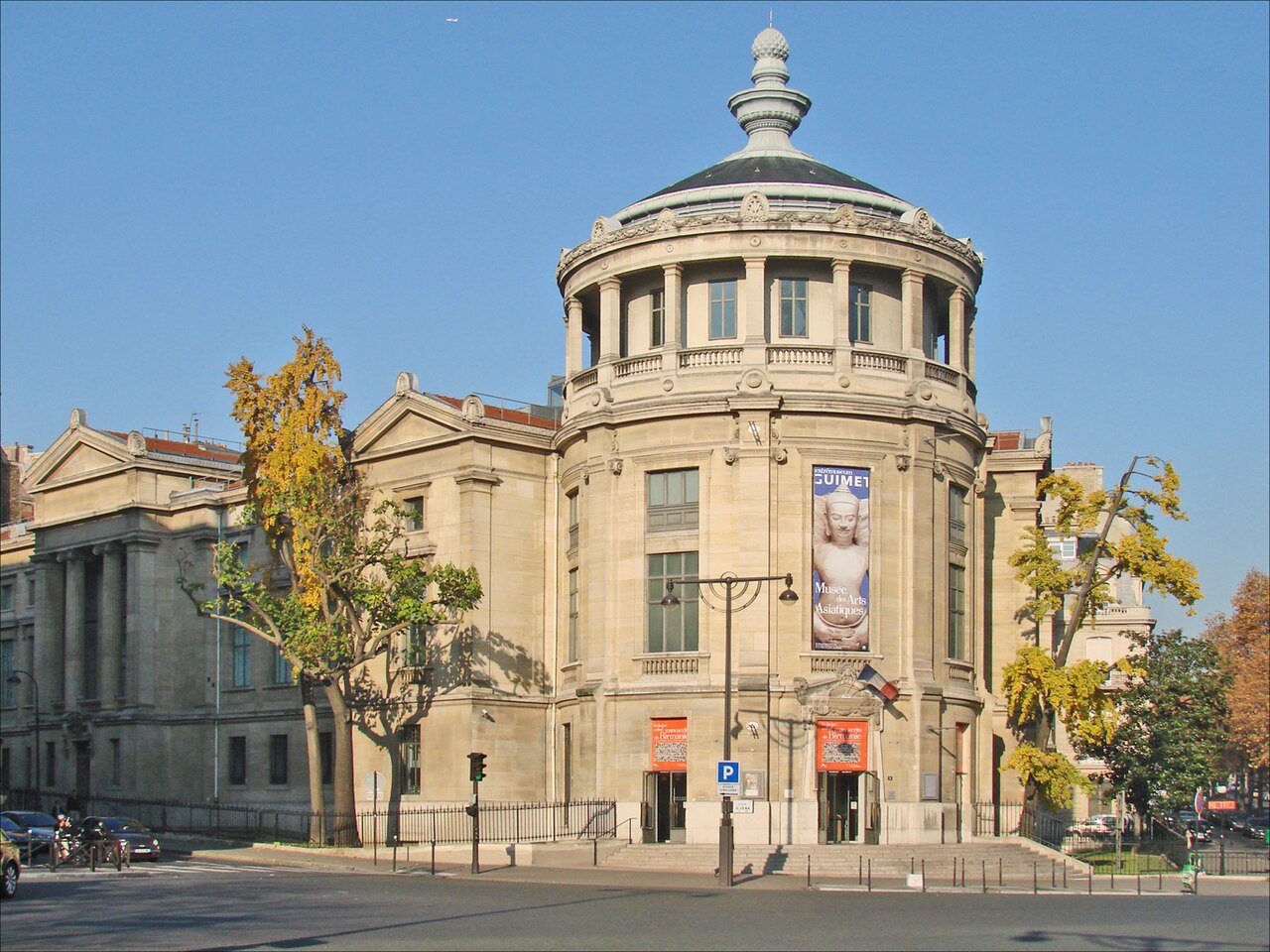
A many-headed serpent rearing at the entrance, guardian of an Angkorian temple; the serene face of a great builder-king of Cambodia; delicate ivories buried for nearly two thousand years in Afghanistan; imperial Chinese porcelain; Japanese prints across which Hokusai’s wave comes crashing. The Guimet Museum, on the Place d’Iéna, brings together five thousand years of Asian art, from Afghanistan to Japan, in one of the most important collections in the world.
France’s national museum of Asian art, Guimet was born of one man’s passion: Émile Guimet, a Lyon industrialist fascinated by the religions of the East, who travelled across Asia at the end of the nineteenth century and founded a museum in Lyon before moving it to Paris in 1889. Enriched throughout the twentieth century by archaeological missions and by the transfer of the Louvre’s Asian collections, it holds, among other treasures, the largest collection of Khmer art outside Cambodia.
It is a museum you can explore like a journey. Floor by floor, you move from India to Southeast Asia, from the Himalayas to China, from Korea to Japan, following the spread of forms, techniques and above all Buddhism, which linked all these civilisations for centuries. The galleries, filled with daylight since the renovation of the early 2000s, lend themselves to a calm, contemplative visit, far from the crowds of the big central museums.
This guide covers the history of the museum, how its collections are organised, five works not to miss and all the practical information you need to plan your visit.
The Guimet Museum at a glance
| Address | 6 place d’Iéna, 75116 Paris |
| Subway | Iéna (line 9), Boissière (line 6) |
| Hours | 10am-6pm every day except Tuesday |
| Rates | €15 full / €12 reduced — free under 18 and for EU residents under 26 |
| Official Website | guimet.fr |
History — the museum of a travelling collector
Émile Guimet was born in Lyon in 1836, the son of a chemist who had made his fortune by inventing an artificial ultramarine blue. A prosperous industrialist, he was also a curious mind, passionate about music, Egypt and above all the history of religions. That passion led him, in 1876, to set off on a great journey around the world that took him to Japan, China and India.
He brought back hundreds of objects — statues, paintings, ritual objects — and above all a project: to create a museum devoted to the religions of Asia that would also be a centre of study. The first Musée Guimet opened in Lyon in 1879. But Guimet wanted to reach a wider public, and he moved his collections to Paris, to a building constructed for them on the Place d’Iéna, inaugurated in 1889, the year of the Universal Exhibition.
The museum quickly became a fixture of Parisian intellectual life, frequented by orientalists and by artists won over by Japonisme. Its famous rotunda library hosted lectures and ceremonies; it was there, in 1905, that a still unknown dancer calling herself Mata Hari gave one of her first public performances.
In the twentieth century the museum changed in nature. The great French archaeological missions in Indochina and Afghanistan brought it major pieces, and in 1945 a sweeping reorganisation of the national museums gave it the Louvre’s Asian collections, while its Egyptian objects went to the Louvre. Guimet thus became the national museum of Asian art. Between 1996 and 2001 it was completely renovated and its galleries opened up to natural light.
A journey across Asia
The collections, covering nearly five thousand years, are presented by major geographical area over several floors.
The ground floor is dominated by Khmer art, the museum’s most spectacular strength. Monumental sculptures, Hindu and Buddhist deities, and architectural elements from Angkor and other great Cambodian sites trace the history of the Khmer empire from the sixth to the thirteenth century. Here too is the art of India, Vietnam, Thailand and Indonesia, with bronzes and carved stone of great refinement.
Upstairs, the route continues to Afghanistan and Pakistan, where the art of Gandhara offers a fascinating encounter between Greek sculpture and Buddhist iconography: Buddhas draped like classical statues, born of the legacy of Alexander the Great. Next come the Himalayas, with the paintings and bronzes of Nepal and Tibet, then Central Asia and the Buddhist paintings of Dunhuang.
China occupies a large place, from archaic ritual bronzes to Tang ceramics, from scroll paintings to imperial porcelain. Korea, too rarely shown in European museums, has galleries of its own. Japan, finally, is represented by its sculpture, screens, lacquerware and prints, which so fascinated the Impressionists. Together they form a panorama without equal in France.
The Hôtel d’Heidelbach and its Japanese garden
A few steps from the museum, at 19 avenue d’Iéna, the Hôtel d’Heidelbach houses the Maison Guimet, an annexe devoted to Buddhism.
Here you will find the Buddhist Pantheon, presenting the religious objects Émile Guimet brought back from Japan on his 1876 journey, displayed much as he intended. Behind the mansion lies a Japanese garden with its tea pavilion, a haven of calm in the heart of the 16th arrondissement.
The mansion can no longer be visited freely: access is by guided tour only, booked in advance, on Thursdays, Saturdays and Sundays at 11am, with an additional Sunday tour at 2.30pm from October to December. The tour also includes access to the main museum’s collections.
The Musée d’Ennery, another annexe, set in the mansion of a nineteenth-century collector on the Avenue Foch, has been closed for works since December 2025.
Must-See Works
Among the museum’s tens of thousands of works, here are five highlights. As ancient works in the public domain, they may be freely reproduced.
1. The Naga balustrade (Khmer art, late twelfth century)
From the atrium onwards, this mythical serpent with its fan of raised heads greets visitors. It once lined the causeway leading to a Cambodian temple, where it symbolised the passage between the world of humans and that of the gods. It is the museum’s emblem.
2. The head of Jayavarman VII (Khmer art, late twelfth – early thirteenth century)
The greatest builder-king of Angkor, founder of the Bayon, shown with half-closed eyes and a face imbued with meditative serenity. This idealised portrait of a Buddhist sovereign is one of the masterpieces of Khmer sculpture.
3. The Begram ivories (Afghanistan, first-second century)
Discovered by French archaeologists in two walled-up rooms of an ancient Afghan city, these carved ivory plaques and statuettes of Indian origin once decorated luxury furniture. Their finesse and sensuality bear witness to the intense exchanges along the Silk Roads.
4. The Chinese porcelain of the Grandidier collection
Thousands of pieces, from celadons to blue-and-white and the “famille verte” and “famille rose” wares of the Qing emperors, given to the Louvre in 1894 by the collector Ernest Grandidier and transferred to Guimet in 1945: one of the finest collections of Chinese ceramics in Europe.
5. The Japanese prints
The museum holds a major collection of ukiyo-e prints, including works by Hokusai and an impression of The Great Wave off Kanagawa. Because they are sensitive to light, they are shown in rotation: check the museum’s website for what is on display before you go.
How to visit the Guimet Museum
The museum can be enjoyed in peace, away from the crowds. Always check the latest information on the official website before you go.
Duration of the visit
Allow two hours to see all the collections, an hour and a half if you focus on a few areas — Khmer art and Japan, for example. Add an hour for the guided tour of the Hôtel d’Heidelbach.
Hours
The museum is open every day except Tuesday, 10am to 6pm. The ticket office closes at 5.15pm. It is closed on 1 January, 1 May and 25 December; on 24 and 31 December the galleries close at 4.45pm.
Admissions
Full price is €15, reduced price €12. Admission is free for under-18s and for EU residents under 26. The guided tour of the Hôtel d’Heidelbach is booked separately.
When to Visit
Guimet is one of the least crowded major museums in Paris: it is easy to get around on weekdays and weekends alike. Mornings remain the most peaceful time.
Access and rules
The museum is served by Iéna (line 9) and Boissière (line 6) metro stations, and by buses 32, 63 and 82, which are accessible to visitors with reduced mobility (Iéna station is not). Suitcases of any size and bulky items are not admitted.
Catering
The museum has a Korean restaurant, Hanok, and in summer a rooftop with views over Paris and the Eiffel Tower.
Practical FAQ
Where is the Guimet Museum?
At 6 place d’Iéna, in the 16th arrondissement of Paris, near the Trocadéro. The nearest metro stations are Iéna (line 9) and Boissière (line 6).
What are the Guimet Museum’s opening hours?
Every day except Tuesday, 10am to 6pm. The museum is closed on 1 January, 1 May and 25 December.
How much does the Guimet Museum cost?
€15 full price, €12 reduced. Admission is free for under-18s and for EU residents under 26.
What should I see at the Guimet Museum?
Khmer art, with the Naga balustrade and the head of Jayavarman VII, the Begram ivories, the Chinese porcelain of the Grandidier collection and the Japanese prints.
Can I see Hokusai’s Great Wave at the Guimet Museum?
The museum holds an impression, but prints are shown in rotation because of their fragility. Check the museum’s website to see whether it is on display before your visit.
Around the Museum
The Guimet Museum stands in one of the richest museum districts in Paris. A few minutes’ walk away, you will find the Palais d’Iéna, the Palais de Tokyo and the Palais Galliera, the fashion museum.
The nearby Place du Trocadéro offers one of the finest views of the Eiffel Tower; the Palais de Chaillot houses the Cité de l’architecture et du patrimoine and the Musée de l’Homme. Across the Seine, over the Pont d’Iéna, the Musée du quai Branly – Jacques Chirac continues the discovery of non-European art, from Africa to Oceania.
For a break, the Trocadéro gardens slope down to the Seine, and the embankments invite a stroll as far as the Pont de l’Alma.
Further Reading
Institutional Documentation
- Musée Guimet — official website — opening hours, exhibitions and tickets.
- Guimet Museum collections — the museum’s main geographical areas and masterpieces.
See also on Hors Cadre
— M