The Louvre Museum — the largest museum in the world
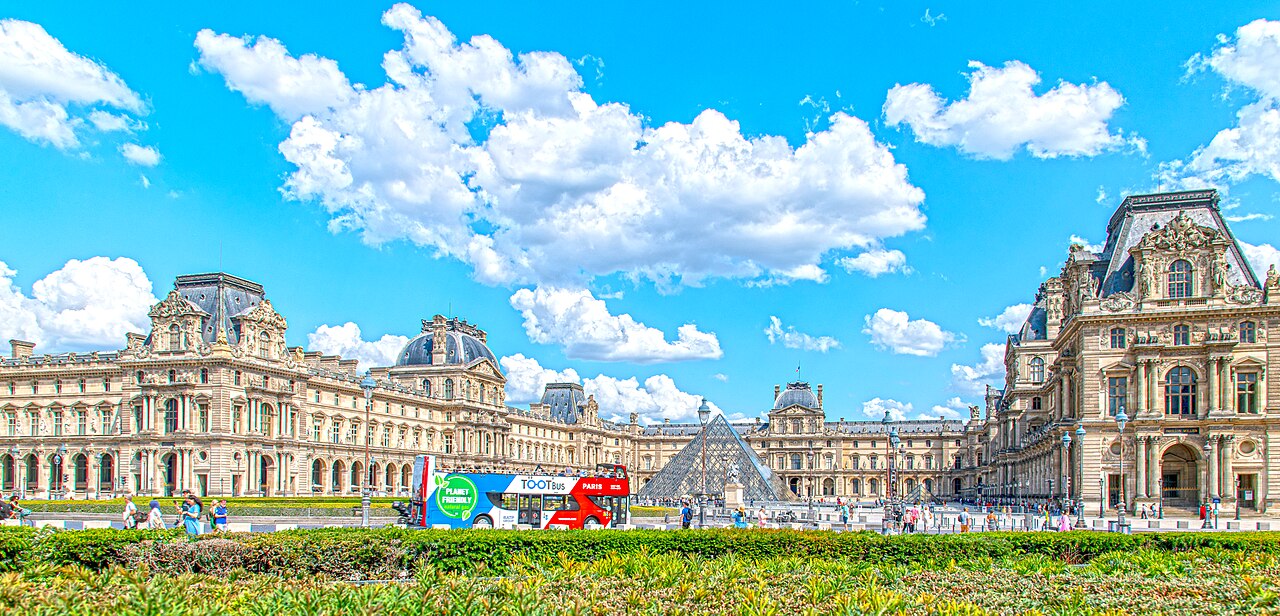
The Louvre Museum is the largest museum in the world, the most visited and the most famous. With encyclopaedic collections spanning millennia of creation, from the ancient Near East to the mid-nineteenth century, the Louvre is a universe in itself — a place where the Mona Lisa meets the Venus de Milo, the pharaohs of Egypt meet the kings of France, and Leonardo da Vinci meets Delacroix. Each year nearly nine million visitors pass through its glass Pyramid to discover some of humanity’s greatest treasures.
But the Louvre is not only a museum: it is also a palace, one of the largest in the world, carrying eight centuries of history. Medieval fortress, residence of the kings of France, seat of power, it was the heart of the monarchy before becoming, at the Revolution, the museum of the nation. Its walls tell the history of France as much as the history of art, and the building itself, with its courtyards, galleries and façades, is a masterpiece in its own right.
To visit the Louvre is to accept getting lost — no one can see everything in one visit. Its thirty-five thousand or so works on display, spread over kilometres of galleries, make it a marvellous labyrinth to which you return without ever exhausting it. It is a place you get to know gradually, in fragments, following your own passions and curiosities.
This guide gives you the essentials: the history of the palace, its architecture and Pyramid, how the collections are organised, five masterpieces not to miss, all the practical information you need to plan your visit, and the major projects shaping its future.
The Louvre Museum at a glance
| Address | Rue de Rivoli, 75001 Paris |
| Subway | Palais Royal – Musée du Louvre (lines 1 and 7) |
| Hours | 9am-6pm, late openings Wednesday and Friday until 9pm, closed Tuesday |
| Rates | €22 (European Economic Area residents) / €32 (non-EEA visitors) — free under 18 and for EEA residents under 26 |
| Official Website | louvre.fr |
History — from fortress to the world’s largest museum
The Louvre’s story begins more than eight centuries ago, not as a museum but as a fortress. Around 1190 King Philip Augustus, before leaving on crusade, had a castle built to defend Paris to the west, on the right bank of the Seine. Its foundations and the base of its keep survive today and can be seen in the museum’s basement — the “Medieval Louvre”, a moving trace of its origins.
Over the centuries the fortress was transformed. In the fourteenth century Charles V made it a royal residence. But it was in the Renaissance that the Louvre became a palace: Francis I had the old keep demolished and commissioned the architect Pierre Lescot to build a new wing in the Italian Renaissance manner. Catherine de’ Medici had the Tuileries Palace built nearby, and a long gallery along the Seine soon linked the two residences. Reign after reign, the Louvre grew larger and more splendid.
The seventeenth century saw the rise of the majestic eastern colonnade designed by Claude Perrault — one of the finest classical façades in Paris. But in 1682 Louis XIV moved the court to Versailles. Abandoned by the king, the Louvre became home to artists, academies and collections, and the idea gradually took shape of showing the royal collections to the public.
That idea became reality with the Revolution. On 10 August 1793 the Republic opened the “Muséum central des arts” in the Grand Gallery, making the royal collections accessible to the public. The Louvre became one of the very first great public museums in history, an expression of the Enlightenment ideal of art for all. Under Napoleon I the museum grew enormously; in the nineteenth century Napoleon III gave the palace its present scale.
The Louvre’s modern history culminates in the “Grand Louvre” project launched by François Mitterrand in the 1980s. The museum took over the entire palace and gained a monumental new entrance: the glass Pyramid by the architect Ieoh Ming Pei, inaugurated in 1989. Controversial at first, it has become one of the most recognisable symbols of Paris.
The palace and the Pyramid
Even before discovering the collections, visitors are struck by the place itself: an immense palace, one of the largest buildings in Europe, laid out around majestic courtyards in the heart of Paris.
The palace is organised around the Cour Napoléon and the Cour Carrée, extended by the long wing that runs along the Seine. Its façades, built over several centuries, offer a compendium of French architecture, from Pierre Lescot’s Renaissance to Perrault’s classicism and the additions of the Second Empire. The courtyards, freely open from 7.30am to 9pm, are an unforgettable walk in themselves.
At the centre of the Cour Napoléon stands the Pyramid, the museum’s main entrance. This structure of glass and metal, with its pure geometric lines, contrasts boldly with the historic façades around it — and its beauty springs from that contrast. Beneath it lies a vast underground hall bathed in light, from which you reach the museum’s three wings.
Knowing these three wings is already knowing how to plan your visit. The Denon wing, to the south along the Seine, houses the most famous works: the Mona Lisa, the Winged Victory of Samothrace, the great French paintings and the Italian masters. The Sully wing, to the east around the Cour Carrée, holds the Medieval Louvre, the Egyptian antiquities and the Venus de Milo. The Richelieu wing, to the north, presents French sculpture, Near Eastern antiquities, decorative arts and the Napoleon III apartments.
The eight departments
The Louvre’s richness lies in the encyclopaedic scope of its collections, organised into eight departments covering millennia of creation, from the ancient Near East to the mid-nineteenth century.
Three departments are devoted to antiquities. Near Eastern Antiquities brings together the treasures of Mesopotamia, Persia and the Levant — including the Code of Hammurabi, one of the oldest law codes in human history, and the winged bulls of Khorsabad. Egyptian Antiquities, among the richest in the world, brings the civilisation of the pharaohs back to life, with the famous Seated Scribe and his inlaid eyes. Greek, Etruscan and Roman Antiquities houses the masterpieces of ancient sculpture.
The Department of Islamic Art, set beneath a spectacular undulating glass roof, presents more than a thousand years of creation from the lands of Islam. The Sculpture department traces the history of European sculpture, with pride of place given to French work. Decorative Arts gathers furniture, goldsmiths’ work, enamels and tapestries, and displays the Crown Jewels in the sumptuous Galerie d’Apollon. Prints and Drawings holds an immense collection shown in rotation because of its fragility.
Finally, the Paintings department holds one of the finest collections in the world, from the Italian primitives to the nineteenth century: Leonardo, Raphael, Titian and Veronese for Italy; Poussin, Watteau, David, Ingres and Delacroix for France; Rubens, Rembrandt and Vermeer for the Northern schools; El Greco, Zurbarán and Murillo for Spain. This is where most of the museum’s most famous pictures hang, from David’s Coronation of Napoleon to Vermeer’s The Lacemaker.
Must-See Works
No one can see everything in one visit. Here are five masterpieces that alone justify the trip. All five are in the public domain and may be freely reproduced.
Mona Lisa — Leonardo da Vinci (c. 1503-1519), Denon wing, Salle des États
The most famous painting in the world, with its enigmatic smile and infinitely subtle modelling, smaller than most people expect. Turn around: facing her hangs the largest canvas in the museum, Veronese’s The Wedding at Cana, too often overlooked.
Venus de Milo (c. 150-125 BC), Sully wing
Discovered on the Greek island of Milos in 1820, this marble statue probably represents Aphrodite. Despite the loss of her arms, she embodies the ideal of beauty and harmony of Greek sculpture.
Winged Victory of Samothrace (c. 190 BC), Denon wing, at the top of the Daru staircase
The winged goddess alights on the prow of a ship, her drapery pressed against her body by the wind: one of the most spectacular sculptures of antiquity, and one of the museum’s most breathtaking settings.
The Raft of the Medusa — Théodore Géricault (1818-1819), Denon wing
The wreck of a French frigate and the despair of the survivors crowded onto a raft, painted on the scale of history: a manifesto of Romanticism, of overwhelming dramatic power.
Liberty Leading the People — Eugène Delacroix (1830), Denon wing
Liberty, tricolour raised, leads the people over the barricades of the July Revolution. Now a universal icon of the Republic, it hangs a few steps from the Raft.
The Louvre today and tomorrow
The Louvre is not a museum set in stone: it is constantly changing, and it is going through a pivotal period.
Its first challenge is overcrowding. Designed at the time of the Grand Louvre for around four million visitors a year, it now receives nearly nine million, and its spaces are saturated, especially around the Mona Lisa. In response, the “Louvre Nouvelle Renaissance” project announced in 2025 plans, by 2031, a new entrance on the side of Perrault’s colonnade, new underground spaces, the renovation of the most outdated galleries and a room dedicated to the Mona Lisa. The work is to be carried out without closing the museum.
2025 was also marked by an event that shocked the whole world: on 19 October, a gang stole eight pieces of the French Crown Jewels from the Galerie d’Apollon in a matter of minutes; the crown of Empress Eugénie, dropped during their escape, was recovered damaged. Suspects were arrested in the weeks that followed. The theft belongs to a long history — from the disappearance of the Mona Lisa in 1911, recovered two years later, to that of Charles X’s coronation sword in 1976 — and reopened the debate on the museum’s security. Its president-director, Laurence des Cars, stepped down in February 2026.
Through these projects and ordeals, the Louvre keeps reinventing itself to remain what it has been for more than two centuries: a museum open to all, guardian of a universal heritage.
How to visit the Louvre Museum
The Louvre is vast and very busy, so a visit needs some planning. Always check the latest information on the official website before you go.
Duration of the visit
Seeing the whole Louvre in one visit is impossible. For an enjoyable visit, allow between two and a half and four hours, focusing on the works and departments that interest you most. A full day is ideal for enthusiasts. It is better to choose a route in advance than to try to see everything.
When to Visit
Crowds peak between 11am and 3pm, at weekends and in high season (June to September). Opt for the morning opening or the Wednesday and Friday late openings, which are far calmer. The quietest months run from October to March. Avoid Mondays: many Paris museums close that day, and the Louvre is packed.
Hours
The museum is open every day except Tuesday, from 9am to 6pm, with late openings on Wednesday and Friday until 9pm. Last entry is one hour before closing. It is closed on 1 January, 1 May and 25 December.
Tickets and Prices
The ticket gives access to the permanent collections, temporary exhibitions and the Musée national Eugène-Delacroix. Since 14 January 2026 pricing has been differentiated: €22 for residents of the European Economic Area and €32 for other visitors. Booking a timed slot online is very strongly recommended, including for those entitled to free admission. Always buy tickets on the official website.
Free admission
Admission is free for under-18s, EEA residents under 26, EEA jobseekers and people on income support, disabled visitors and one companion, and certain teachers. It is also free for everyone on the first Friday of the month after 6pm (except July and August) and on 14 July.
Entrances
The main entrance is through the Pyramid. When it is busy, or if you already have a ticket, the Carrousel entrance (99 rue de Rivoli) is often quicker; the Passage Richelieu is reserved, depending on the period, for certain visitors (groups, members). Beneath the Pyramid, the hall serves all three wings.
Audio guide, accessibility and photography
An audio guide is available to rent, along with guided tours and themed trails. The museum is accessible to visitors with reduced mobility, although the size of the palace makes for long distances. Photography without flash is allowed in the permanent collections for private use; selfie sticks and tripods are forbidden. Leaving the museum is final.
Practical FAQ
Where is the Louvre Museum?
The Louvre is in the 1st arrondissement of Paris, on the banks of the Seine. The nearest metro station is Palais Royal – Musée du Louvre (lines 1 and 7).
What are the Louvre’s opening hours?
The museum is open every day except Tuesday, from 9am to 6pm, with late openings on Wednesday and Friday until 9pm. It is closed on 1 January, 1 May and 25 December.
How much does the Louvre cost?
Since 14 January 2026, €22 for residents of the European Economic Area and €32 for other visitors. Admission is free for under-18s, EEA residents under 26, and for everyone on the first Friday of the month after 6pm (except July and August).
Do I need to book to visit the Louvre?
Yes, booking a timed slot online is very strongly recommended, even for free admission. Book only on the official website.
How long does it take to visit the Louvre?
Allow between two and a half and four hours, focusing on the works that interest you; a full day for enthusiasts.
Where is the Mona Lisa in the Louvre?
In the Denon wing, Salle des États, facing Veronese’s The Wedding at Cana. Signs show the way from the entrance.
What day is the Louvre closed?
Tuesday, as well as 1 January, 1 May and 25 December.
Around the Museum
The Louvre sits at the heart of Paris, in exceptionally rich surroundings. To the west stretch the Tuileries Gardens, linking the Louvre to the Place de la Concorde — an ideal walk after your visit. At the far end of the garden, the Musée de l’Orangerie houses Monet’s great Water Lilies.
Just to the north, the Palais-Royal and its gardens offer a peaceful pause, with their arcades and Buren’s columns. The Musée des Arts Décoratifs, housed in a wing of the palace, extends the visit into furniture, fashion and design. Nearby, the church of Saint-Germain-l’Auxerrois and the Seine embankments are well worth a detour.
On the other bank, the Musée d’Orsay is a few minutes’ walk away across the Passerelle Léopold-Sédar-Senghor. It takes over chronologically where the Louvre leaves off, with the art of the second half of the nineteenth century and Impressionism: together, the two museums offer a continuous panorama of Western art from its origins to the dawn of the twentieth century.
Further Reading
Institutional Documentation
- Musée du Louvre — official website — opening hours, tickets and programme.
- Louvre collections online — records and images for nearly 500,000 works.
See also on Hors Cadre
- The Orsay Museum
- The Wedding at Cana by Veronese — the largest painting in the Louvre, facing the Mona Lisa.
— M