Absinthe — The Visual Representation of Modern Solitude
Edgar Degas — the painter of frozen movement →Paris, Café de la Nouvelle Athènes, Place Pigalle, circa 1875. Edgar Degas jotted down a quick idea in one of his sketchbooks: “Hélène and Desboutin in a café.” This hastily jotted phrase already encapsulates the entire project that would become one of the most controversial paintings of the 19th-century French art world—andthe pictorial invention of what would later be called modern urban solitude.
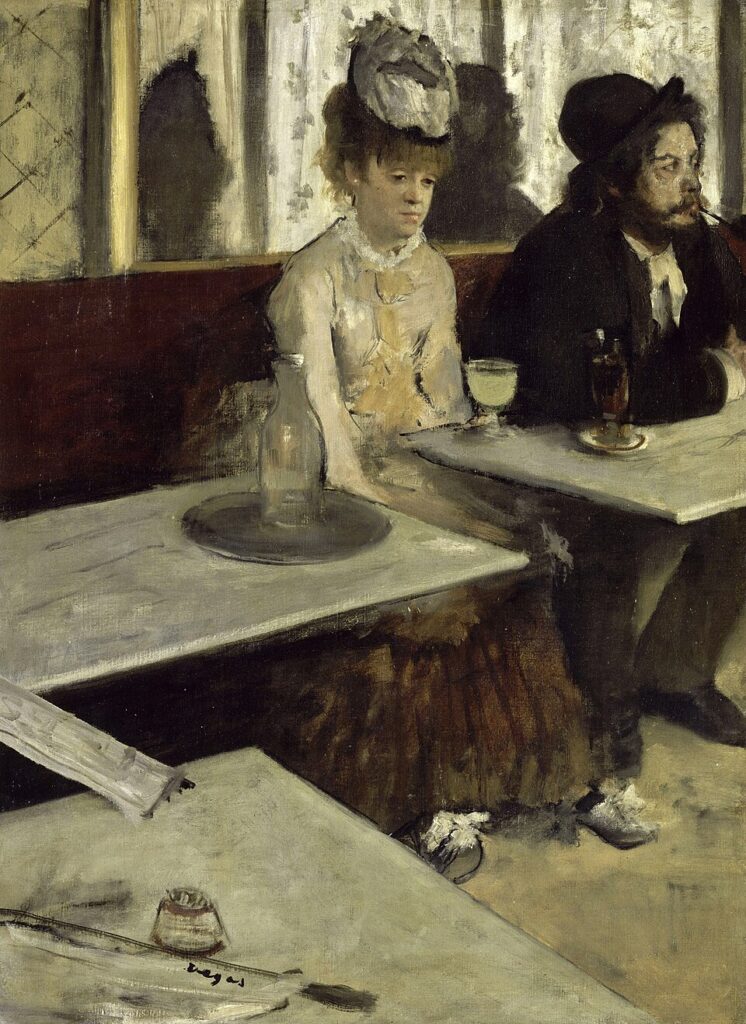
The painting is then called In a Café. It depicts the actress Ellen Andrée, age twenty, and the painter and engraver Marcellin Desboutin, age fifty-two, sitting side by side on the red bench of a Parisian café. In front of the woman is a glass filled with an opaline green liquid:absinthe mixed with water. The man takes a puff on his pipe, his gaze turned to the right, outside the frame. The woman looks down at her glass, her shoulders slumped, her face marked by fatigue. The two figures are physically close but mentally apart —each locked in their own silence.
Presented at the 2nd Impressionist Exhibition in Paris in April 1876, the painting caused a mild scandal. But it was seventeen years later, in London in 1893, that it sparked a second, much more intense scandal —the exhibition of the work at the Grafton Gallery under the new title *L’Absinthe* sparked a moral outcry in the Victorian English press, which turned the painting into a symbol of the ravages of urban alcoholism and, paradoxically, Degas’smost famous work.
This article traces the origins of this pivotal work in modern Western painting—the café in Nouvelle Athènes as a real-life setting for the Impressionist bohemian scene, the two models, Andrée and Desboutin, who posed for several other Impressionists;the invention of a pictorial subject that did not exist before Degas ( urban solitude as a theme in itself); the specific social context of absinthe’s ravages in Paris from the 1870s to the 1890s, and the curatorial journey that took *L’Absinthe* from its controversial debut at the Salon to its current place among the Museum of Orsay’s absolute masterpieces.
The Café de la Nouvelle Athènes — Impressionist Bohemia
The Café de la Nouvelle Athènes, located at 9 Place Pigalle in Paris, was one of the most important venues in Parisian artistic life during the 1870s and 1880s. It succeeded the Café Guerbois (on Avenue de Clichy) as a gathering place for Impressionist painters and the modern artistic bohemian scene.
You’ll regularly find:
- Édouard Manet —a central figure at the café, where he held court almost daily
- Edgar Degas — a devoted and assiduous artist who took notes in his sketchbooks
- Claude Monet, Camille Pissarro, and Auguste Renoir during their stays in Paris
- Émile Zola, the naturalist writer, who observed painters for his novels
- Joris-Karl Huysmans, another naturalist writer
- George Moore, an Irish art critic who lived in Paris in the 1870s
- Marcellin Desboutin, painter and printmaker, a figure in Parisian bohemian circles
- Ellen Andrée, actress at the Théâtre des Variétés and the Palais-Royal
The café is run by the Olivier brothers. A smoky atmosphere, dark wood paneling, red velvet benches along the walls, Venetian mirrors that make the space seem larger, and gas chandeliers. It’s a place that straddles the line between a bourgeois literary café anda working-class tavern —frequented by both financially well-off artists (Manet, Degas) and bohemians of more precarious means (Desboutin, Verlaine, who was just passing through).
Absinthe, the “green fairy, ” isthe iconic spirit of this scene. Invented in the late 18th century in the Val-de-Travers region of Switzerland and popularized in France by colonial soldiers from the 1840s to the 1860s (when it was distributed as a fever-preventing remedy), absinthe became the drink of choice for Parisian artists in the 1870s. Green, bitter, and high in alcohol (up to 72% ABV), it is drunk diluted with cold water over a sugar cube placed on a perforated absinthe spoon. The mixture produces a pale green, milky opalescence —a characteristic visual effect seen in the glass depicted in Degas’s painting.
But absinthe also has a scandalous reputation. The Parisian press in the 1870s and 1880s began to denounce its devastating effects on public health— mass alcoholism, hallucinations, delirium, and epilepsy (wrongly attributed to thujone, a compound found inwormwood, which is used in its production). It was against this specific social backdrop that Degas painted his work.
The Painting — What It Depicts
Absinthe is an oil on canvas measuring 92 centimeters high by 68.5 centimeters wide — a vertical format, slightly taller than it is wide. It is a medium-sized work, neither intimate nor monumental—the size of a piece intended to be viewed at eye level in an exhibition setting.
The composition is built around an off-center diagonal that runs across the entire canvas from the upper right corner to the lower left corner.
In the foreground, occupying the right two-thirds of the canvas, two figures are seated side by side on a red velvet café bench:
— On the left, a woman about 20–22 years old, wearing a simple gray-beige dress, with a flat hat adorned with feathers perched to one side. She is slumped slightly on the bench, her shoulders drooping, her arms hanging limply, her hands clasped on her lap. Her face is pale, marked by an inner weariness. His gaze meets nothing—it is downcast, fixed on a dark spot between the glass and the edge of the table. No dramatic expression. Just a profound emptiness.
— On the right, a middle-aged man (around 50), wearing a soft bowler hat and a full blond beard. He is smoking a pipe. His gaze is directed to the right, outside the frame —he is looking at something or someone the viewer cannot see. He is mentally absent from the scene he shares with the woman.
On the table, in front of the woman: a crystal glass perched precariously, filled with a pale green, opalescent liquid —dilutedabsinthe. In front of the man: a clear carafe and a smaller glass.
Above the table, suspended from a metal rod, a newspaper rack holds a folded Parisian daily. It is on the page of this newspaper that Degas inscribed his signature — “Degas”—in the lower left corner of the painting. This is a unique iconographic detail in his work: Degas never signed his name this way anywhere else. This signature in the newspaper is a mise en abyme —the painting itself is embedded inthe daily news of Parisian life, like just another news item among many.
In the background, behind the figures, Venetian mirrors punctuate the space with floating planes. There is no classical perspective —the mirror vaguely reflects part of the room, but the image is blurred and fragmented. The café’s space is rendered unreadable, enveloping, and claustrophobic.
The color palette is dominated by gray-greens and muted browns. There are no bright colors. The only vivid element in the painting is precisely the glass of absinthe — a pale green opaline that draws the eye like a magnetic center in the midst of a drab setting. The chromatic focus is on the alcoholic symbol —Degas points to what he is criticizing, without needing to comment on it.
The composition is off-center and photographic. The figures are not centered on the canvas. The table cuts off the bottom of the frame. The top edge of the painting cuts off the hats. It is the framing of a snapshot photographer —as if Degas had captured his models by surprise, in passing, without having posed them.
Ellen Andrée and Marcellin Desboutin — the two models
The two figures in the painting are identified with certainty in all official sources.
Ellen Andrée (1856–1933), on the left in the painting, was a French actress born in Paris. She was about twenty years old when she posed for Degas in 1875–1876. Coming from a modest family, she began her career in Parisian popular theater (Variétés, Palais-Royal) and supplemented her income by posing as a model for painters. She posed for several major Impressionist artists of the decade:
- Édouard Manet: At Father Lathuille’s (1879, Tournai Museum of Fine Arts) and The Plum (circa 1878, NGA, Washington) — Manet paints dignified and elegant portraits of her
- Auguste Renoir: Luncheon of the Boating Party (1880–1881, Phillips Collection, Washington) — Ellen Andrée is depicted among the cheerful group of boaters at the table
- Henri Gervex: Rolla (1878, Bordeaux Museum of Fine Arts) — a scandalous work in which Ellen Andrée poses nude as the courtesan Marie in a dawn scene following a night of debauchery
Ellen Andrée was clearly one of the favorite models of the Impressionist painters of the 1870s and 1880s. She brings her real-life appearance to Degas’s painting—a young, petite, dark-haired woman with delicate features, yet marked by a certain expressive weariness.
Marcellin Desboutin (1823–1902), on the right in the painting, was a French painter, engraver, and writer. He was 52 years old when he posed for Degas. A native of Cérilly (Allier), he lived for many years in Italy (particularly in Florence, where he married and had several children), then returned to France in the 1870s, financially ruined after the family business went bankrupt. In Paris, he lived modestly off his engravings —he was one of the innovators of the drypoint technique in the 19th century.
Desboutin was also a popular model for painters. Édouard Manet painted his portrait in *The Artist: Marcellin Desboutin* (1875, São Paulo Museum of Art)—a dignified, respectful work depicting Desboutin standing, palette in hand, with a dog at his feet.
A striking comparison. The same two models were painted around the same time by Manet and Degas. Manet depicts them as dignified figures —each standing, dressed as an artist, gazing directly at the viewer. Degas depicts them as urban wrecks —slumped on a café bench, their gazes lost, a glass of alcohol within reach. The same reality observed, yet two radically different interpretations of the dignity of the modern subject.
According to sources cited later, neither Ellen Andrée nor Marcellin Desboutin were absinthe drinkers. Desboutin was a moderate wine drinker, like most men of his time. Ellen Andrée hardly drank any alcohol at all. The glass of absinthe in front of her is therefore a fictional element added by Degas—a prop, as in a play. But this fictional element would shape the entire critical reception of the painting.
According to a story recounted later, Ellen Andrée herself did not like the painting at all. She reportedly told a friend:
“The world’s turned upside down, isn’t it! And we look like a couple of idiots.”
— Ellen Andrée, later depicted in a painting by Degas
The sentence is revealing. Andrée feels betrayed by Degas. She agreed to pose as a professional actress, and Degas turned her into an alcoholic wreck. The trust between artist and model was broken —though this did not prevent Andrée from continuing to pose for Renoir and Manet afterward.
April 1876 — the second Impressionist exhibition
The painting was shown to the public for the first time at the 2nd Impressionist Exhibition in Paris, held from March 30 to April 30, 1876, at 11 rue Le Peletier, in the gallery of art dealer Paul Durand-Ruel.
The exhibition brings together 20 artists presenting 252 works. Alongside Degas are Monet, Renoir, Pissarro, Sisley, Caillebotte, Berthe Morisot, Boudin, and Cézanne. It was an avant-garde exhibition, more structured than the first one in 1874, but one that remained widely contested by academic critics.
Degas is featured here with 24 works —the largest individual selection in the exhibition. Among these 24 works, In a Café (the original title of *L’Absinthe*) is one of the most notable.
The critical reception was mixed but without any major hostility. Several critics praised the painting’s pictorial quality, the realism of its composition, and the psychological authenticity of the two figures. Others were annoyed by the lowbrow subject matter —painting drinkers in a café was considered trivial by academic critics.
Émile Zola, who was covering the exhibition for the Russian newspaper *Le Messager de l’Europe* (where he published a regular column on the Impressionist painters), defended the painting. He saw in it a rigorous observation of contemporary customs —exactly what he himself practiced in his Naturalist novels. According to Zola, the work is part of the same artistic project as his own novels: to scientifically observe modern society across all its classes and moments, without idealization or moral condemnation.
The following year, in 1877, Zola published *L’Assommoir* — a novel that would expose the ravages of alcoholism among the Parisian working class. The chronological proximity between Degas’s painting and Zola’s novel is no coincidence. Both are rooted in the same rigorous observation of French social reality in the 1870s. Both addressalcohol as a modern social phenomenon.
Following the 1876 exhibition, the painting was purchased by the opera singer and collector Jean-Baptiste Faure, a famous bass at the Paris Opera and the foremost collector of works by Manet and Degas. Faure paid approximately 1,000 francs —a modest sum for such a major work, but a respectable amount for the time and for a painter who was still controversial.
The painting remained in the Faure collection for twenty years. There were no major public scandals during that time. It was not until 1893, in London, that the painting became truly famous.
1893 — The London Scandal and the New Title
The event that definitively changed the painting’s critical fate took place seventeen years after its creation, in London, in February 1893.
The painting was sold by the Faure Collection (probably to a dealer) and then loaned for display at the Grafton Gallery in London during an exhibition of modern French art organized by the art dealer Paul Durand-Ruel. It was during this exhibition that the title was changed. *In a Café* became *L’Absinthe* (a title that appeared in English as “L’Absinthe” and has been retained as such in French ever since).
This change in title is not insignificant. It completely shifts the way the painting is interpreted. *In a Café* suggests a neutral, everyday scene —an observation of an ordinary moment. *L’Absinthe*explicitly identifies the glass of alcohol as the central subject of the painting. The painting automatically becomes a work about alcoholism.
However,Victorian England in the 1890s was swept by a very powerfultemperance movement, which campaigned against alcohol consumption. Temperance societies (such asthe Band of Hope and the British Temperance League) had millions of members. The English middle class was particularly sensitive to any depiction of alcohol-related depravity.
The exhibition of the painting sparked a major moral scandal. Several British art critics denounced the painting. George Moore, an Irish critic and friend of Degas, wrote a passionate defense in the English press. But the detractors outnumbered him:
— Sir Walter Crane denounced the painting as “a detestable moral lesson”
— R.A.M. Stevenson (cousin of the writer Robert Louis Stevenson) refers to “sickening vulgarity”
— The newspaper The Spectator published an editorial calling for the painting to be removed from the exhibition
— An English women’s organization is organizing a petition to shut down the exhibition
Paradoxically, this scandal brought the painting international fame. Beginning in 1893, “L’Absinthe” became Edgar Degas’s most famous work in the English-speaking world. The international press was abuzz with it. American collectors took an interest in it. The painting’s status shifted from that of a minor Impressionist work to that of a cult classic of modern painting.
A historical irony: a painting purchased for 1,000 francs in 1876 by a French collector became, twenty years later, priceless on the international market—simply because of a change in its title and a moral scandal.
The Pictorial Invention of Modern Urban Solitude
Beyond the historical context of the scandal, *L’Absinthe* introduces a major pictorial innovation in 19th-century Western painting: modern urban solitude as a subject in its own right.
Before Degas, Western painting depicted solitude according to two main conventions:
- Religious solitude: hermits in the desert, anchorites in prayer, saints meditating in wild landscapes (Saint Jerome, Saint Anthony, the repentant Mary Magdalene). Solitude chosen as a spiritual path.
- Heroic solitude: defeated warriors, monarchs in exile, philosophers contemplating death (Diogenes, Democritus, Seneca). The meditative solitude of great men in the face of fate.
These two works have one thing in common: solitude is imbued with meaning— noble and significant. The classic solitary figure is a person.
Degas invents a third kind of solitude, one never before addressed in serious painting: ordinary urban solitude. That ofEllen Andrée slumped on her bench in front of her glass of absinthe. A solitude that is neither chosen, nor meaningful, nor noble. Simply the reality of a human being caught up in the modern metropolis, sitting next to another human being, and yet profoundly alone.
This paradoxical solitude — physically surrounded, mentally alone —would soon be recognized as one of the fundamental characteristics of Western urban modernity. Émile Zola, the Goncourt brothers, and Charles Baudelaire (“Les Foules,” in *Le Spleen de Paris*) had theorized it in literature. Degas was the first to depict it in painting.
The influence is immense. Several lineages:
— Henri de Toulouse-Lautrec: Café and Cabaret Scenes of the 1890s — *At the Salon on Rue des Moulins*, *La Goulue Entering the Moulin Rouge* — draw directly from the disillusioned perspective of *L’Absinthe*
— Edward Hopper (1882–1967), American painter: his entire body of work is a meditation on urban solitude, a theme he inherited from Degas. *Nighthawks* (1942, Art Institute of Chicago)—silent patrons in a New York diner at night —is, in fact, a direct descendant of *L’Absinthe*
— Pablo Picasso: The Blue Period (1901–1904), featuring his isolated figures in Parisian bars and cafés
— Egon Schiele, Otto Dix in German Expressionism
— René Magritte, George Tooker, and David Hockney in 20th-Century Painting
Without *L’Absinthe*, without the conceptual shift that Degas brought about regarding modern solitude, an entire dimension of20th-century Western art would be different. It is, in fact,one of the major iconographic innovations of the 19th century.
As art historian Françoise Cachin, former director of the Musée d’Orsay, wrote in her seminal study on Degas (1985):
“These two figures are, in the entire history of 19th-century painting, the first true urban wrecks.”
— Françoise Cachin, A Study of Degas, RMN, 1985
From the Faure Collection at the Musée d’Orsay
The history of *L’Absinthe* after its creation has been more eventful than that of *La Petite Danseuse*.
1876: Degas completed the painting and presented it at the 2nd Impressionist Exhibition. Jean-Baptiste Faure, a bass opera singer and renowned collector of modern art (he had notably purchased several works from Manet, including *Le Déjeuner sur l’herbe*), acquired the painting for approximately 1,000 francs.
1876–1893: The painting remained in the Faure collection in Paris. There were no major public exhibitions during this period. The painting circulated within a private circle of Parisian collectors and art lovers.
1893: Faure (or an intermediary) loaned the painting to the Grafton Gallery in London for an exhibition of modern French art. A scandal erupted in England —the painting became world-famous.
1893–1900: The painting returned to Paris, but its value had increased considerably. Faure sold it to a Parisian art dealer.
Around 1900: The painting entered the collection of Count Isaac de Camondo (1851–1911), a prominent Sephardic Jewish collector and a leading figure in Parisian Impressionist patronage. Camondo already owned several major works by Degas, Monet, Pissarro, Manet, and Cézanne.
1911: Death of Isaac de Camondo. His bequest to the Louvre (which took effect in 1914) included 300 works, among them *L’Absinthe*. The painting thus became part of France’s national collections. It was first displayed to the public at the Louvre and later at the Jeu de Paume.
1986: The Musée d’Orsay opened. *L’Absinthe* was transferred there from the Jeu de Paume. It has been on permanent display there ever since, under inventory number RF 1984.
Today, *L’Absinthe* is one of the most visited works at the Musée d’Orsay; it is usually on display in the Degas Gallery on the museum’s middle level.
How to View the Work Today
Absinthe is on display at the Musée d’Orsay in Paris. Practical information:
- Address: 1 rue de la Légion d’Honneur, 75007 Paris
- Subway: Solférino (Line 12) or RER C (Musée d’Orsay)
- Gallery: Middle Level, Degas Gallery
- Inventory number: RF 1984 (bequest of Isaac de Camondo, 1911)
- For complete pricing and hours: see the article “Musée d’Orsay—What to See, Hours, Tickets” on Hors Cadre
Also in this gallery:
The Musée d’Orsay houses the world’s largest collection of works by Edgar Degas. In the Degas Gallery and the adjacent rooms, you can see:
- The Fourteen-Year-Old Little Dancer (patinated bronze, 1922) — an iconic sculpture exhibited at the 6th Impressionist Exhibition in 1881
- The Dance Class (1873–1876) — a masterpiece of the ballet cycle
- The Star (1876–1877) — monochrome pastel of a dancer
- The Tub (1886) — an iconic pastel from the “Bathers” series
- Ironers (1884) — a scene of modern women at work
- The Bellelli Family (1858–1867) — an early masterpiece
To see other works featuring Ellen Andrée and Marcellin Desboutin:
- Musée d’Orsay — Renoir’s *Luncheon of the Boating Party* by Renoir is not at the Musée d’Orsay (it is in the Phillips Collection in Washington), but several other works by Manet and Renoir featuring Ellen Andrée are on display
- NGA Washington — The Plum by Manet (1878), with Ellen Andrée as the model
- Tournai Museum of Fine Arts — At Father Lathuille’s by Manet (1879)
Further Reading
Institutional sources cited
- Musée d’Orsay, official description of the work.
- Encyclopædia Universalis, article “Edgar Degas (1834–1917).”
- Exhibition catalog for *Degas* (Paris, Ottawa, New York), 1988, edited by Henri Loyrette and Jean Sutherland Boggs.
Primary sources cited
- Ellen Andrée, comments attributed to her regarding the Degas painting.
- Françoise Cachin, A Study of Degas, Réunion des musées nationaux, 1985.
- Notes from Degas’s sketchbooks, circa 1875 — sketch for the painting.
Leading Modern Studies
- Henri Loyrette, *Degas*, Fayard, Paris, 1991. A modern standard biography.
- Richard Kendall, *Degas: Beyond Impressionism*, National Gallery Publications, London, 1996.
- Daniel Halévy, *Degas Speaks*, Éditions de Fallois, Paris, 1995. A primary source on Degas’s remarks.
Institutional Documentation
- Musée d’Orsay, Paris — owned by the institution since 1911 (Camondo bequest) and then since 1986 (transfer to Orsay).
See also on Hors Cadre
- Edgar Degas — the painter of frozen movement — a portrait of the artist, a comprehensive overview of his career.
- The Fourteen-Year-Old Dancer—the ultimate scandal in modern sculpture —Degas’s most iconic sculpture, which was also exhibited amid scandal (1881).
- Musée d’Orsay — What to See, Hours, Tickets — A Complete Guide to the Museum That Houses *L’Absinthe*.
— M