Whistler’s Nocturnes — painting the night
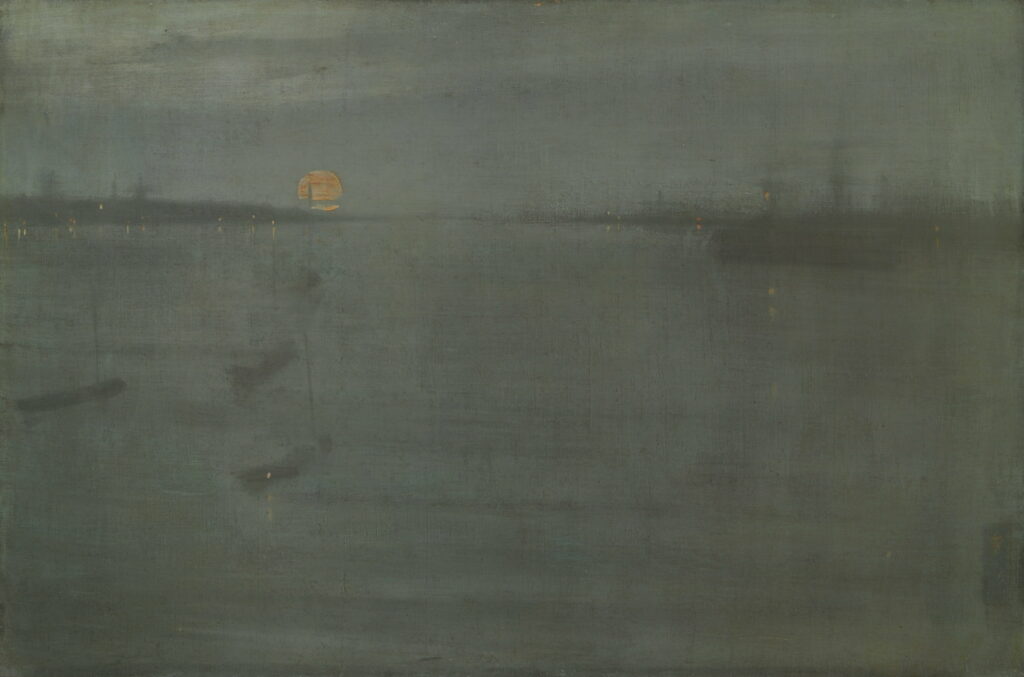
James McNeill Whistler — the American who painted like a composer →Night is falling over an inlet of the sea. Water and sky merge into a single dark blue expanse, barely lighter toward the horizon. Great ships are no more than silhouettes, almost ghosts. Only a few lights are reflected in the water, and a veiled, broken moon pierces the haze. At lower right, resting on the water like one more reflection, a small yellow butterfly: the painter’s signature.
Nocturne: Blue and Gold—Southampton Water shows the approach to the port of Southampton, on the English Channel. Painted in 1872, it has belonged to the Art Institute of Chicago since 1900. It is very probably one of the first two pictures James McNeill Whistler ever exhibited under the name Nocturne.
For about a decade Whistler would paint the night, mostly on the Thames in London. Whistler’s Nocturnes, these almost empty canvases, baffled the public, enchanted a few connoisseurs, and landed their author in court.
A name for moonlights
Whistler had painted his first night scenes in 1866, on a trip to Valparaíso, Chile. Back in London he carried on along the Thames, near his home in Chelsea. He did not yet know what to call these pictures.
The word was supplied by Frederick Leyland, the Liverpool shipowner who was then backing him. In a letter of November 1872, Whistler thanked him warmly for “the name ‘Nocturne’ as a title for my moonlights!” He added that it caused “an irritation” to the critics, to his own delight, and that it did “so poetically say all I want to say and no more than I wish.”
The term came from music, where it described slow, dreamy piano pieces. Applied to painting, it stated Whistler’s ambition plainly: to treat a landscape the way one composes a melody, through harmonies of tone rather than description.
Dudley Gallery, 1872
The public first saw the Nocturnes in 1872, in London, at the Dudley Gallery’s winter exhibition of small oil paintings. Whistler showed two canvases under the new title: a Nocturne in Blue and Silver, now lost, and a Nocturne in Grey and Gold, which the University of Glasgow’s catalogue raisonné very probably identifies as the Chicago picture.
The press was divided. One paper described a technique that seemed simple enough: “one or two broad sweeps of monotint” covering the canvas, then a few lighter and darker strokes. The Builder wondered how mist could hide nearby boats while leaving distant masts visible. The Times praised “subtle studies of moonlight” while accusing the painter of “building up art out of his own imperfections.”
Whistler, for his part, judged his Dudley pictures “a great success.”
Blue on blue
The simplicity of Southampton Water is deceptive. According to the Glasgow catalogue, the very fluid paint is laid on in thin layers over a canvas primed in dark gray. The palette is limited to a few pigments: lead white, cobalt blue, Prussian blue, a touch of vermilion. The brushstrokes, almost all horizontal, stretch water and sky in a single movement.
The moon is built up with more care: a pale yellow paste covered with a thin orange-red veil. Apart from the small lights twinkling on the water, it is nearly the only relief in the picture.
The Art Institute sums up what is at stake: the scene mainly serves to explore muted color harmonies in darkness, and, as an old museum guide puts it, “the specifics of place are inconsequential to it.” You can recognize the approach to Southampton, its ships, its low horizon. But what Whistler is really painting is the moment when forms dissolve into the night.
Painting from memory
Whistler painted his Nocturnes in the studio, from what he had observed, rather than on the spot. Of one of them he said that he had painted it from memory, and that it was not “painted to offer the portrait of a particular place.”
That method explains the freedom of these pictures. Released from detail, Whistler could select, simplify and tune his tones as he wished. It is exactly what he would later set out in his “Ten O’Clock” lecture: the artist does not copy nature, he draws a harmony from it.
It is also what his contemporaries failed to understand. Used to meticulous landscapes, they saw these canvases as sketches, smudges, slapdash work. The Art Institute notes that they were “often misunderstood and sometimes openly ridiculed.”
A falling rocket
Around 1875 Whistler painted an even bolder Nocturne: Nocturne in Black and Gold: The Falling Rocket, now at the Detroit Institute of Arts. Against an almost black background, a shower of golden sparks falls: fireworks over Cremorne Gardens, the popular pleasure grounds of Chelsea.
In 1877 Whistler showed it at the Grosvenor Gallery, London’s fashionable new venue, priced at two hundred guineas. The critic John Ruskin, the towering figure of English art, saw it and responded in Fors Clavigera, his monthly letter, on July 2, 1877. He wrote that he had “never expected to hear a coxcomb ask two hundred guineas for flinging a pot of paint in the public’s face.”
Whistler sued for libel. He sought a thousand pounds in damages.
Whistler v. Ruskin
The case was heard on November 25 and 26, 1878, in London, before Baron Huddleston and a special jury. Ruskin, who was ill, did not attend.
The most famous moment came when Ruskin’s counsel, the Attorney General Sir John Holker, cross-examined Whistler. How long had he spent on The Falling Rocket? “One whole day and part of another,” Whistler replied. So he was asking two hundred guineas for two days’ work? “No. I ask it for the knowledge I have gained in the work of a lifetime.” The retort has endured as one of the finest defenses of the modern artist.
The painter Edward Burne-Jones, called to testify for Ruskin, said: “It would be impossible to call it a serious work of art,” and saw in it “only one of a thousand failures that artists have made in their efforts at painting night.” The jury found for Whistler but awarded him a single farthing, a quarter of a penny, and no costs. In December 1878 Whistler published his own account of the affair in a pamphlet, Whistler v. Ruskin: Art and Art Critics.
A butterfly on the water
In front of Southampton Water, give your eyes time to adjust, as you would in the dark. The ships emerge from the blue little by little, first the masts, then the hulls. Beneath the thin paint, the dark gray ground lends the picture its nocturnal depth, and the moon, the only spot of slightly thicker paint, catches the light.
Then there is the yellow butterfly at lower right. Whistler did not tuck it into a corner: he set it on the water, just where a reflection might be, like one more light. The signature is part of the harmony.
Where to see the painting
Nocturne: Blue and Gold—Southampton Water belongs to the Art Institute of Chicago, on Michigan Avenue. The canvas measures 20 1/16 by 30 3/16 inches (51 × 76.7 cm). It is not currently on view: check the museum’s online record, which shows whether it is hanging in the galleries.
The image, however, is available in high resolution on the Art Institute’s website, which releases reproductions of public domain works under CC0.
The picture has led a quiet life. Sold as early as June 1874 to a Liverpool collector, Alfred Chapman, it crossed the Atlantic at the end of the century and entered the Art Institute in 1900. Whistler had not forgotten it: in 1894 he still wrote that it “is a beauty.” In 1933 it featured in A Century of Progress, the exhibition the museum staged during the Chicago World’s Fair.
To see more Nocturnes, Tate Britain in London holds several Thames views, and The Falling Rocket is at the Detroit Institute of Arts, which acquired it in 1946.
Further Reading
Institutional Documentation
- Nocturne: Blue and Gold—Southampton Water — Art Institute of Chicago — the catalogue record and a high-resolution image.
- Nocturne in Black and Gold: The Falling Rocket — The Paintings of James McNeill Whistler, University of Glasgow — the catalogue raisonné entry, with Ruskin’s text and the trial transcripts.
- Photo Credit : Art Institute of Chicago
See also on Hors Cadre
- James McNeill Whistler — the American who painted like a composer — a portrait of the painter, from Lowell to Paris.
- Symphony in White, No. 1 — Whistler’s woman in white — ten years earlier, the picture that launched the idea of a musical painting.
— M