Street in Venice — John Singer Sargent’s other Venice
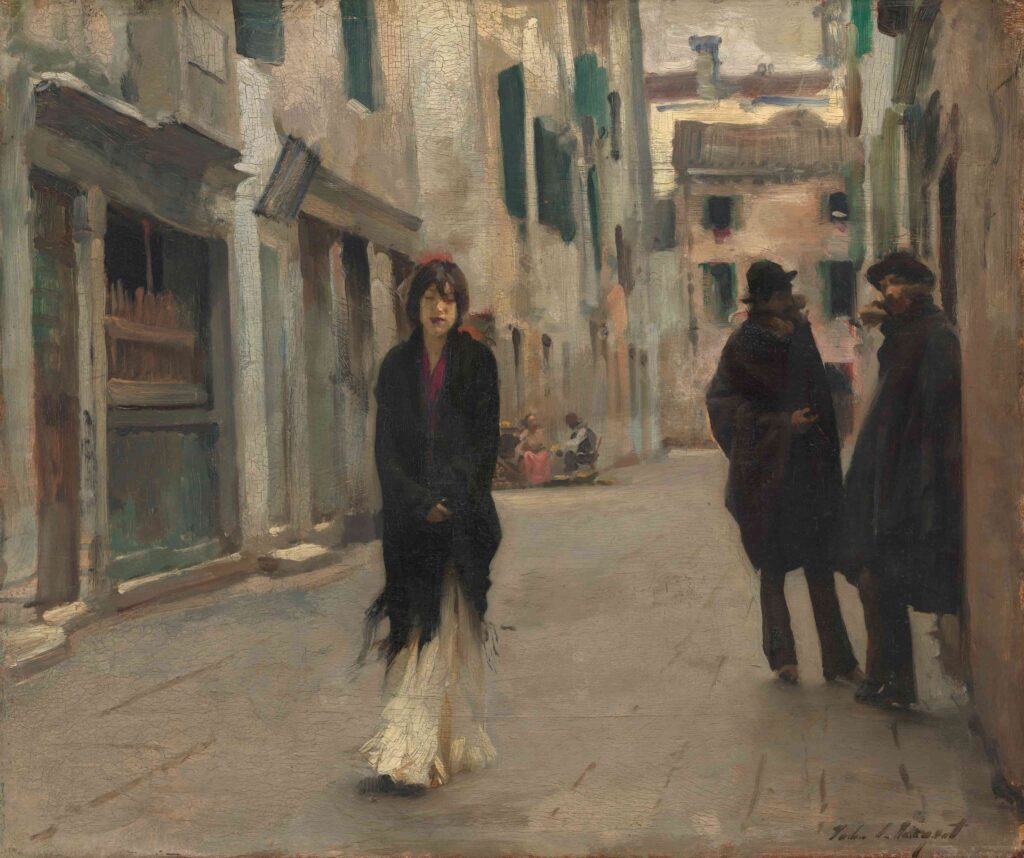
John Singer Sargent — portraitist of the Gilded Age →No gondolas, no palaces, no sparkling lagoon. A narrow alley between two gray walls, worn paving stones, a sky you cannot see. A young woman passes, wrapped in a large black shawl, and glances sideways at two men leaning in the shadows. The moment is suspended, ambiguous, almost unsettling. This is Venice — but a Venice tourists never saw.
Street in Venice, painted by John Singer Sargent in 1882, belongs to a series of Venetian scenes the young painter made in the early 1880s. At the time, Sargent was a rising portraitist in Paris, on the verge of fame. These small pictures, painted for himself, reveal a completely different side of his art: an eye on the city of ordinary people, of working women and dark passageways.
The work, now at the National Gallery of Art in Washington, is one of the subtlest in the series. It says a great deal about what Sargent was looking for at twenty-six, before high-society success absorbed him.
Sargent in Venice
Venice was no tourist’s discovery for Sargent. Born in Florence and raised in Italy, he had known the city since childhood and returned many times over his life.
In the early 1880s he made long stays there, notably in 1880-81 and in 1882. It was a period of intense activity: his first successes at the Paris Salon had given him confidence, and he was looking for new subjects beyond commissioned portraits. Venice, with its light, its contrasts and its street life, offered him an ideal testing ground.
It was also in Venice, in 1881, that he met James McNeill Whistler, the other great American painter in Europe, who had been there to etch his famous views of the city. The two shared a taste for muted harmonies, grays and blacks, and for an intimate rather than monumental Venice.
Sargent also moved in the circle of Americans living in Venice, such as his cousins the Curtises, who would soon buy the Palazzo Barbaro on the Grand Canal, one of the most brilliant centers of the city’s Anglo-American colony. But in his pictures from those years, he chose to paint a very different Venice.
The Venice of back alleys
Sargent’s Venetian scenes of the early 1880s firmly turn their back on the postcard. No sunny Grand Canal, no Saint Mark’s Basilica, no picturesque gondoliers. Sargent painted dim interiors where women string glass beads, run-down courtyards and narrow passages that light barely reaches.
Street in Venice is a perfect example. The scene is set in a quiet alley not far from the Grand Canal. The gray walls, peeling façades and dull paving make a setting with no picturesque appeal at all. The palette is almost monochrome — grays, browns, blacks — with a few lighter accents on the young woman’s face and hands and on the skirt showing beneath her shawl.
The central figure is a young working-class Venetian, perhaps one of the models Sargent used regularly in those years. She is walking, caught in mid-stride, and her glance slides toward the two male figures barely visible in the shadows on the left. The painting does not tell us what is happening between them. A chance encounter, an exchange of looks, a vague threat? Sargent leaves it to the viewer.
That ambiguity is at the heart of the work. This is not an anecdotal genre scene telling a little story, but an atmosphere: that of a real city, with its tensions, its furtive encounters and its poverty.
A painting of the moment
Technically, Street in Venice is a small oil on a wood panel. The intimate format suits a subject caught on the fly.
The method is the one Sargent had learned from Carolus-Duran, his Paris teacher: build forms directly with the brush, in masses of color, without preliminary drawing. The walls are brushed in broad vertical strokes; the black shawl is a single dark mass enlivened by a few highlights; the face is modeled in a handful of perfectly judged strokes.
Above all, the light is remarkably subtle. It does not fall straight into the alley: it comes from above, bounces off the walls, softens as it descends, and fully lights only the young woman’s face and arm. The black shawl — the long wrap worn by working-class Venetian women of the time — absorbs the rest. This indirect, filtered light, peculiar to Venice’s narrow calli, is the real subject of the picture.
The framing, finally, is strikingly modern. The alley recedes into depth, the walls cut across the composition, the figures are off-center. It brings to mind the photography of the period, and the daring of Degas, whom Sargent admired.
Paris, then America
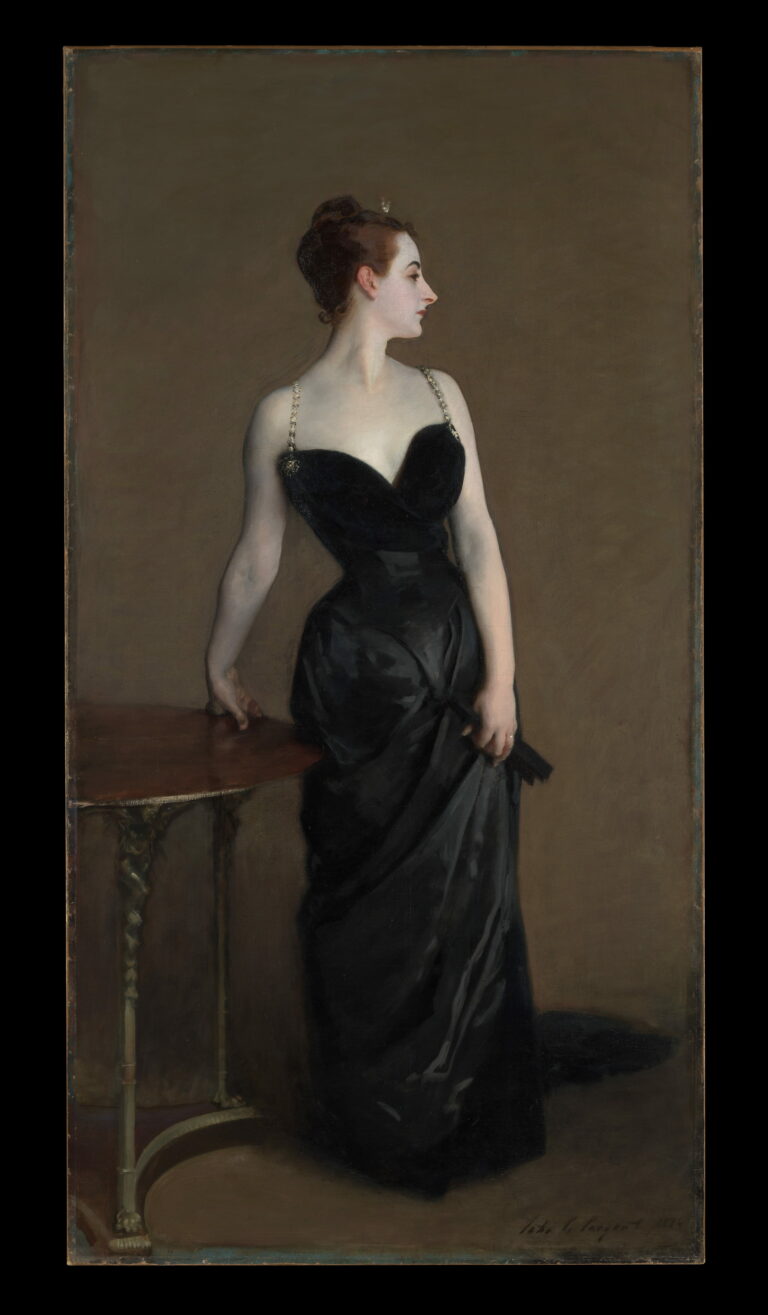
These Venetian scenes were shown in Paris as early as 1882, at the Galerie Georges Petit, one of the city’s leading galleries. For a public used to luminous, picturesque views of Venice, these dark images could be disconcerting. Sargent, soon absorbed by his career as a portraitist and then by the Madame X scandal, did not really pursue the series.
The painting later crossed the Atlantic, passing through several private collections and appearing in major exhibitions — in New York as early as 1892, then in the retrospectives held after the painter’s death, at the Museum of Fine Arts, Boston, in 1925 and at the Metropolitan Museum in 1926.
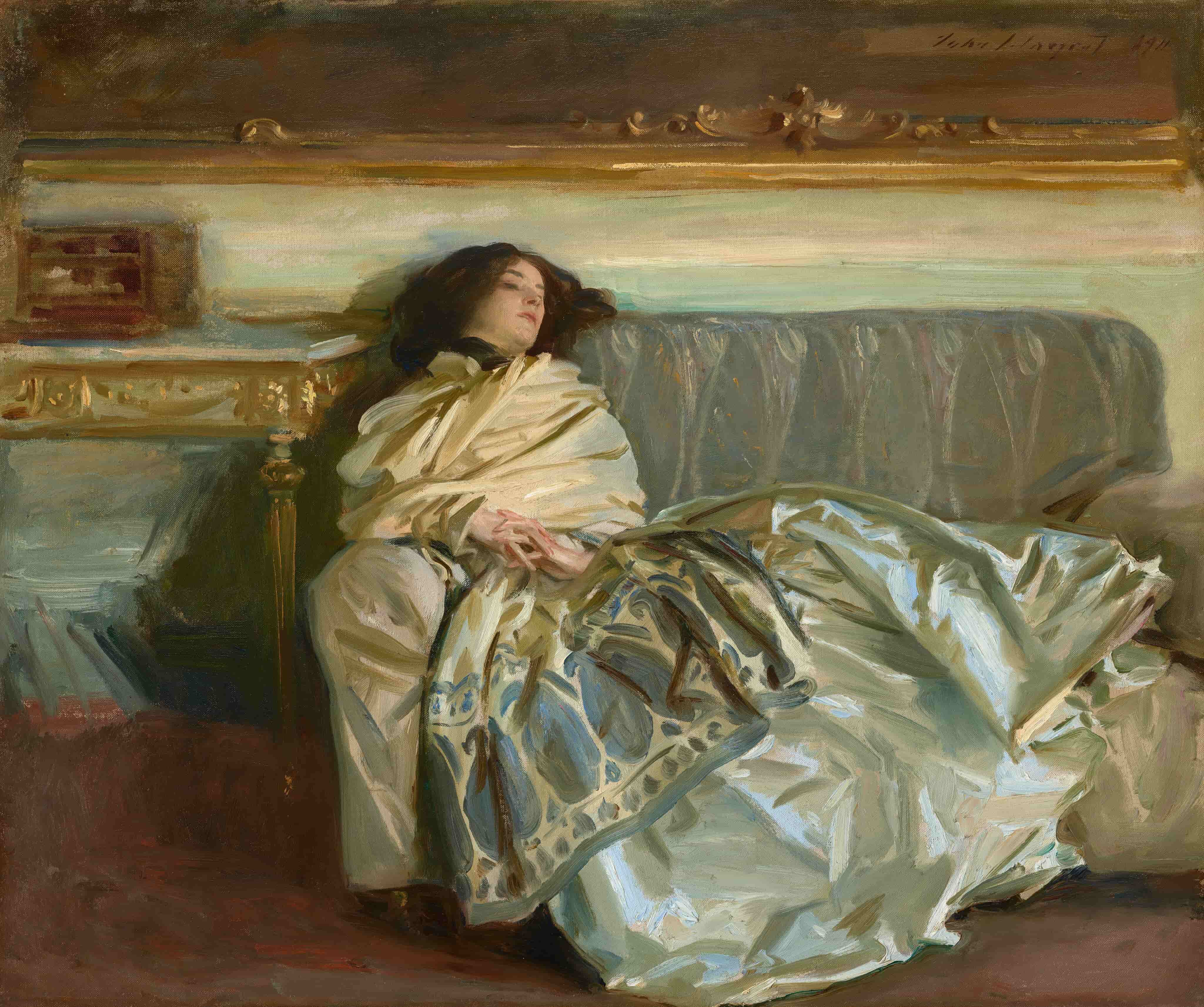
In hindsight, these Venetian scenes look like one of the freest moments in Sargent’s career. Painted without a commission and with no concern to please, they show a painter searching, experimenting and looking at reality with unsentimental curiosity. One can already glimpse the artist who, twenty-five years later, would give up portraiture to return to that freedom.
Where to see the artwork
Street in Venice is in the National Gallery of Art in Washington, on the National Mall. It belongs to the American collections in the West Building, which it entered in 1962 as a gift of the Avalon Foundation.
Admission is free. The National Gallery of Art owns more than 160 works by Sargent — portraits, landscapes, watercolors and drawings — so you can follow his entire career in one place. Before you go, check that the painting is on view, as installations can change.
And if you are in Venice, look for the alleys that lead away from the Grand Canal into Cannaregio: you will find, almost unchanged, the atmosphere Sargent painted more than 140 years ago.
Further Reading
Institutional Documentation
- Street in Venice — National Gallery of Art — the catalogue record and exhibition history.
- John Singer Sargent — National Gallery of Art — biography and the painter’s works in the collection.
- Photo Credit : National Gallery of Art, Washington
See also on Hors Cadre
- John Singer Sargent — portraitist of the Gilded Age — a portrait of the painter, from Florence to London.
- Repose — Sargent’s niece and the end of an era — thirty years later, another picture painted for himself, far from commissions.
— M