Repose — Sargent’s niece and the end of an era
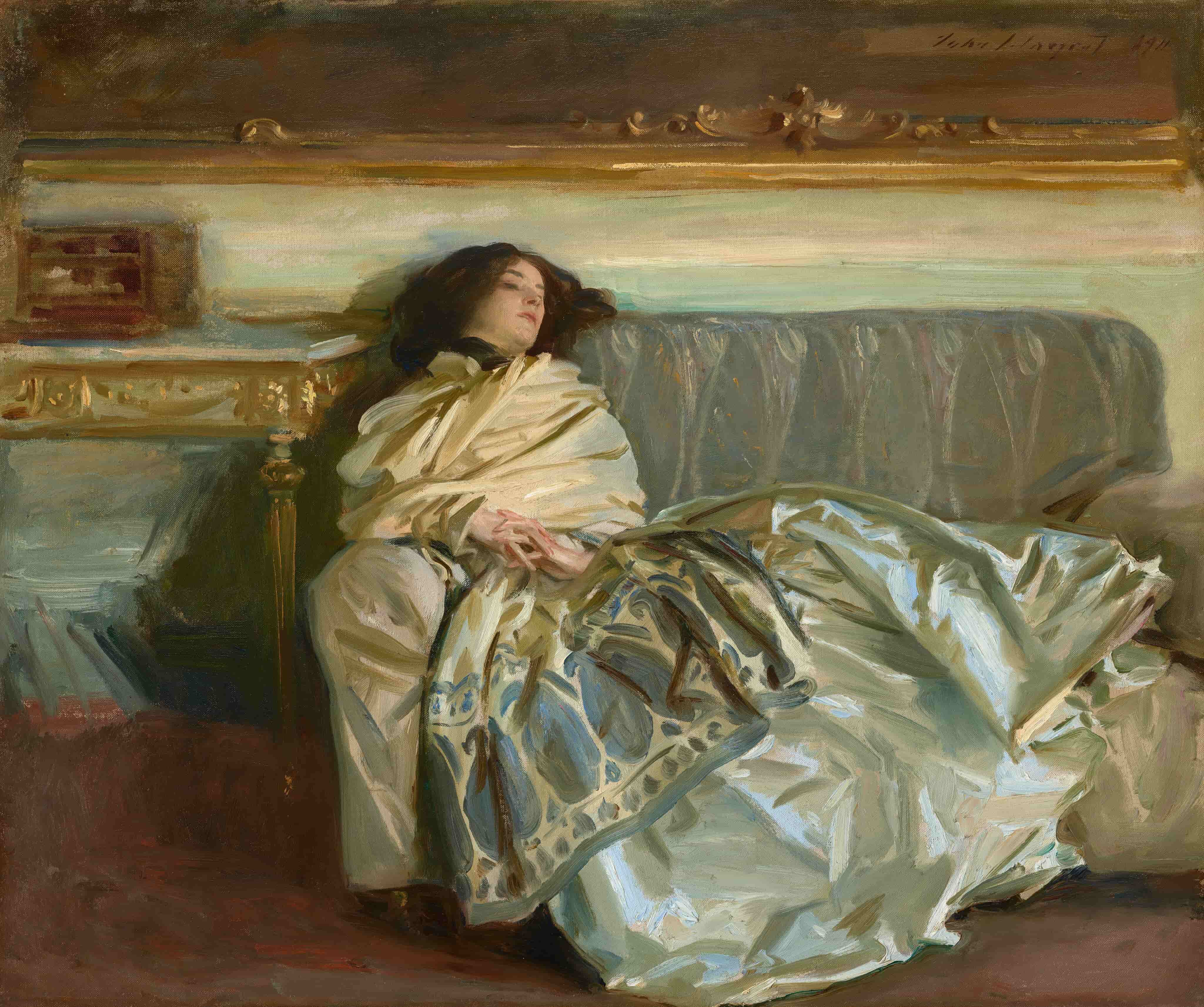
John Singer Sargent — portraitist of the Gilded Age →A young woman lies stretched out on a sofa, her body limp, her head thrown back on a cushion, her eyes half-closed. Her pale satin gown spreads in luminous folds; a dark patterned shawl slips from her shoulders. One hand hangs loose, the other rests on her leg. Everything in this picture speaks of languor, of happy fatigue, of the suspended time of an afternoon with nothing to do.
Sargent painted it in 1911 and gave it a French title, Nonchaloir, an old word meaning nonchalance or idleness. It is also known by its English title, Repose. The sitter is not a client but a member of his family: his niece Rose-Marie Ormond, barely out of her teens.
It is one of the masterpieces of Sargent’s late period, when, freed from commissioned portraits, he painted for himself. In hindsight it is also one of the most melancholy images of pre-1914 painting: a society abandoning itself to rest, three years before a war that would sweep it away — and the sitter with it.
A painter freed from portraiture
Around 1906, Sargent decided to give up commissioned portraits almost entirely. He had painted hundreds and said he was exhausted by them: the endless sittings, the sitters’ demands, the need to please. From now on he wanted to paint what interested him.
This new freedom produced a profusion of watercolors and landscapes, painted on long summer trips to the Alps, Italy and Spain. Sargent traveled with a small group of family and friends — his sister Violet, his nieces, fellow painters — and had them pose in mountain landscapes, beside streams and in the shade of trees, often draped in shawls and fabrics he brought along.
Repose belongs to this intimate world. It is not a portrait in the strict sense: Sargent is not trying to capture his sitter’s personality or social rank, but a state, an atmosphere. The title says it all: the subject is not Rose-Marie Ormond, it is nonchalance.
The canvas is modest in size, 25 1/8 by 30 inches (63.8 × 76.2 cm), far from the grand society portraits of the previous decade. But his technical mastery is at its peak, and it is perhaps here, in works painted without constraint, that Sargent is most fully himself.
Rose-Marie, the muse
Rose-Marie Ormond was the daughter of Violet, Sargent’s younger sister, and her husband Francis Ormond. She grew up close to her uncle, who had no children of his own and lavished deep affection on his nieces.
For about seven years, from her early teens until her marriage, Rose-Marie was one of Sargent’s favorite models. He painted her in the Alps, beside a mountain stream in The Black Brook, reading in the grass at the Simplon Pass, in costume, in evening dress, in bust-length portraits. Her fine features, natural grace and patience in holding a pose made her an ideal model. Those who knew her described a girl of exceptional charm.
In Repose she is barely out of adolescence. Sargent does not show her as a demure young girl but as a figure of languor, almost grown up, in an abandoned pose that would never have been tolerated in a society portrait. There is a freedom here that only family intimacy allowed.
That is surely also why the picture remains so fresh. The sitter is not frozen by the stakes of an official portrait: she is genuinely resting, and the painter captures the moment with a kind of distant tenderness.
A symphony in satin
What strikes you first in Repose is the painting of the dress. Sargent was famous for his ability to render fabrics, and this canvas is one of his most dazzling demonstrations of it.
The satin gown, pale and golden, is built up in broad brushstrokes that follow the folds of the fabric. Each stroke catches a highlight, a shadow, a change in the direction of the light. Up close they are just streaks of paint laid down with astonishing speed; at a distance they become satin itself — its weight, its sheen, its fluidity.
The dark patterned shawl adds a counterpoint of color and texture. The sofa and background, painted in muted tones, let all the light gather on the figure. The diagonal composition heightens the sense of abandon: the body slides, the gaze drifts, nothing stands upright.
Sargent had painted this kind of satin hundreds of times in his society portraits, to dress duchesses and heiresses. Here the same virtuosity serves a completely different purpose: the fabric is no longer a sign of social rank but the very substance of abandon. And the light, which seems to glide over the dress like calm water, recalls the afternoons he had spent at Giverny with Monet nearly twenty-five years earlier.
A tragic fate
The story of Rose-Marie Ormond gives this picture a resonance Sargent could not have imagined when he painted it.
In August 1913, Rose-Marie married Robert André-Michel, a young French historian and archivist. A year later, war broke out. Robert enlisted and was killed near Soissons on 13 October 1914, just weeks into the conflict. Widowed at twenty-one, Rose-Marie became a nurse in Paris, at a hospital caring for soldiers blinded by gas and wounds.
On 29 March 1918, Good Friday, she was in the church of Saint-Gervais in the Marais when a shell fired by the German long-range gun — which Parisians called “Big Bertha” — struck the building. The vault collapsed onto the congregation. Nearly ninety people were killed, Rose-Marie among them. She was twenty-four.
Sargent was deeply affected by her death. A few months later, sent to the front as an official war artist, he would paint Gassed, the procession of soldiers blinded by gas — the very men his niece had nursed. Standing before Repose, it is hard not to think of her fate: the image of a young woman at rest, painted on the eve of a world about to collapse.
Where to see the artwork
Nonchaloir (Repose) is in the National Gallery of Art in Washington, on the National Mall, which received it in 1948 as a gift from Curt H. Reisinger. It belongs to the American collections in the West Building; check before your visit that it is on view, as installations can change.
Admission to the National Gallery of Art is free, as it is at the Smithsonian museums on the Mall. The museum owns more than 160 works by Sargent, so you can see Repose in the context of his whole career, from Belle Époque portraits to the watercolors of his maturity.
The picture’s modest size invites you to come close. At arm’s length, each fold of the dress turns out to be a single brushstroke, laid down without correction.
In Paris, the church of Saint-Gervais-Saint-Protais, in the 4th arrondissement, preserves the memory of the bombardment of 29 March 1918: a memorial, dedicated in 1922, honors the victims.
Further Reading
Institutional Documentation
- Nonchaloir (Repose) — National Gallery of Art — the catalogue record.
- Photo Credit : National Gallery of Art, Washington
See also on Hors Cadre
- John Singer Sargent — portraitist of the Gilded Age — a portrait of the painter, from Florence to London.
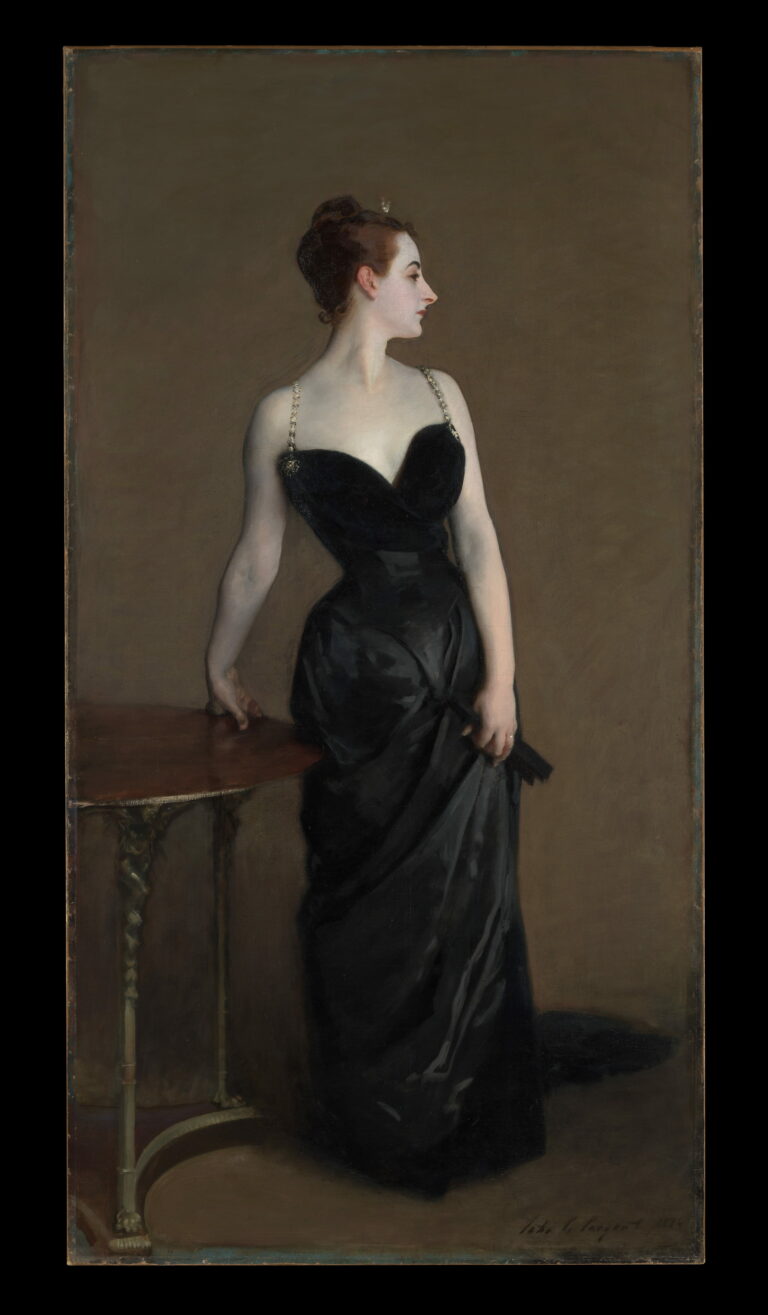
- Madame X — John Singer Sargent’s scandal — Sargent’s other face: the society portrait that scandalized Paris in 1884.
— M