Portrait of Pope Innocent X — Velázquez faces power
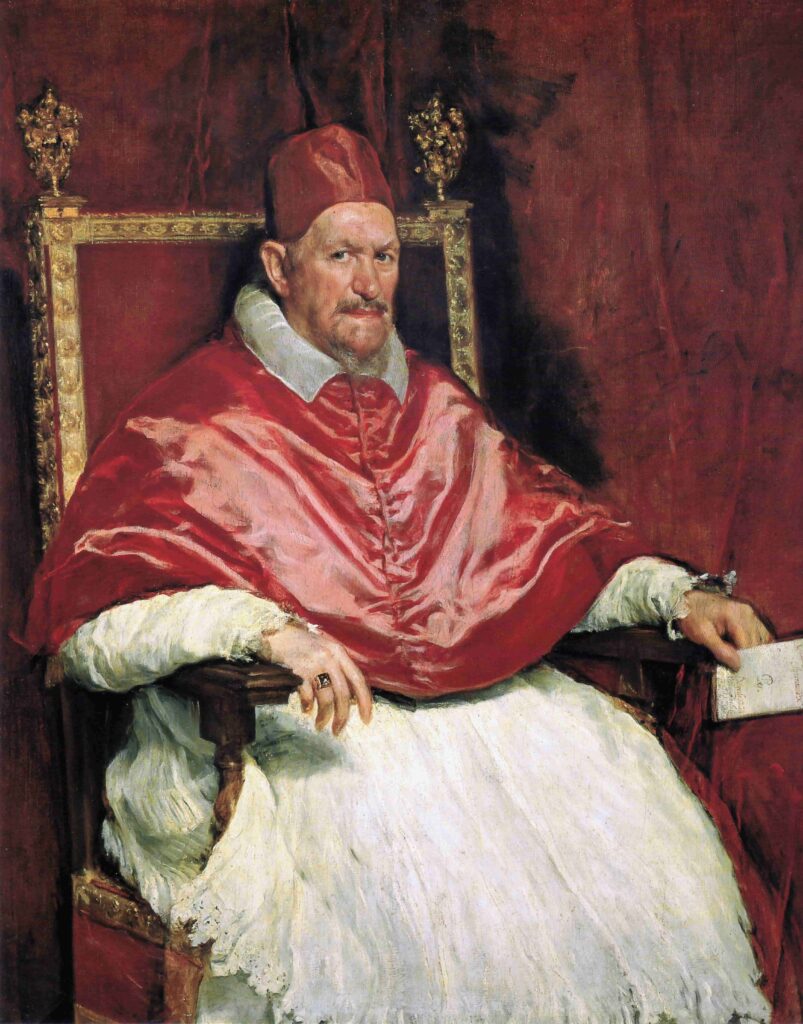
Velázquez — the painter of painters →A heavy-set man sits in a chair upholstered in red velvet, before a red curtain, wearing a red satin mozzetta and a red camauro cap. The only contrasts are the white of his rochet and the pallor of his hands, one bearing the papal ring, the other holding a folded sheet of paper. The flushed face is tense, almost suspicious; the small pale eyes look sideways at the viewer with a sharpness that is unsettling. This is Pope Innocent X, the most powerful sovereign in the Catholic world, as Velázquez saw him in Rome in the summer of 1650.
The portrait is often described as one of the greatest in the whole history of painting. It was painted in a few sittings during Velázquez’s second stay in Italy, and caused an immediate sensation in Rome. A persistent anecdote attributes to the pope himself the reaction “troppo vero” — too true. Whether or not he ever said it, the phrase sums up the picture’s effect perfectly.
Unusually for a work of this rank, the canvas has never left the sitter’s family. It is still in Rome, in the Doria Pamphilj Gallery, the palace of the pope’s descendants, where it occupies a cabinet of its own, facing a bust of the same pontiff sculpted by Bernini.
Rome, 1650: a Spanish painter at the papal court
In 1649 Philip IV sent Velázquez to Italy with a precise mission: to buy paintings and antique sculpture to decorate the royal palaces, and to hire fresco painters. The painter, then about fifty, was at the height of his art and of his career as a courtier.
In Rome he found a pope who had occupied the throne of Saint Peter since 1644: Giovanni Battista Pamphilj, now Innocent X. From a great Roman family, he was over seventy-five, reputed to be suspicious, short-tempered and shrewd, and politically close to Spain — a closeness this portrait would in a sense seal. 1650 was moreover a Holy Year: Rome was full of pilgrims, ambassadors and artists.
Getting a pope to sit for you was no simple matter. Velázquez prepared the ground by first painting a portrait of his assistant, Juan de Pareja, which was exhibited at the Pantheon in March 1650 and won general admiration. The same year the painter was admitted to the Academy of Saint Luke and to the Congregation of the Virtuosi at the Pantheon. With his reputation established, he was at last able to approach the pontiff.
The portrait was painted quickly, in the summer of 1650. Velázquez also made a study of the head, now in London at Apsley House, and the picture was later copied by other hands. But it is the large canvas in the Doria Pamphilj Gallery, measuring 141 by 119 centimetres, that has remained the definitive version.
A symphony in red
The first shock of the picture is one of colour. Velázquez built almost the entire canvas in a single colour, red, in an endless range of shades.
The deep, muted red of the background curtain, the velvety red of the chair, the bright, shifting red of the satin mozzetta, the duller red of the camauro, and even the ruddy red of the face: the painter holds the whole space within a range that could have been monotonous and is instead inexhaustibly rich. Each material — velvet, satin, wool, skin — is rendered by a different way of laying down the same colour.
Against these reds stands out the white of the rochet, the pleated linen tunic covering the pope’s knees. It is painted in broad, rapid strokes, almost brutal close up, which reassemble at a distance into luminous drapery. This is the free brushwork of Velázquez’s maturity, which led his contemporaries to say his pictures seemed painted out of nothing.
This mastery belongs to a precise tradition. The seated papal portrait in three-quarter view had been a codified genre since Raphael’s Portrait of Julius II and Titian’s Portrait of Paul III, which Velázquez knew and admired. He takes up the formula, but radically changes its spirit.
A face too true
For what strikes us, beyond the colour, is the face. And this is where Velázquez departs from the entire tradition of official portraiture.
The pope is neither idealised nor sanctified. Velázquez shows an elderly man with a ruddy complexion, heavy features, a thin beard and a furrowed brow. Above all, the gaze is disturbingly intense: slightly sidelong, wary, like that of a man used to sizing people up and distrusting them. There is nothing of the pastoral kindness or the distant majesty one would expect from a portrait of a supreme pontiff.
It is this frankness that fed the “troppo vero” anecdote. Historians doubt its authenticity, and the pope, far from being offended, seems to have liked the work: according to the painter’s early biographers, he rewarded him for it. But it captures the impression the picture made from the outset, and still makes. One has the feeling of seeing not an office, but a man, with his power and his anxieties.
In his left hand the pope holds a folded sheet on which the painter’s name can be read, as if it were a letter addressed to the pontiff. It is Velázquez’s only signature on the picture, and it is remarkably discreet: the painter presents himself as a respectful petitioner, while signing the most unsparing portrait of his sitter.
From Rome to Francis Bacon
The portrait was an immediate success in Rome, where it was widely copied. But its most spectacular afterlife came three centuries later.
In the nineteenth century, travellers and painters passing through Rome came to see it as one of the absolute masterpieces of portraiture. As early as the eighteenth century, the English painter Joshua Reynolds is said to have regarded it as one of the finest pictures in the city. The Realists and Impressionists, who revered Velázquez, saw it as proof of what painting could achieve with simple means.
In the twentieth century the picture became one painter’s obsession: Francis Bacon. From 1949 and throughout the 1950s, the British artist painted dozens of variations — more than forty-five have been recorded — the most famous of which, Study after Velázquez’s Portrait of Pope Innocent X, dates from 1953. In them he turns the pope into a figure trapped in a cage of lines, his mouth open in a scream. Bacon worked from reproductions, and it is said that he never wanted to see the original, for fear of being overwhelmed by it.
As Bacon’s canvases are protected by copyright, we do not reproduce them. But they have made Velázquez’s pope a familiar image to millions of people who have never set foot in Rome, and one of the icons of modern anxiety.
Where to see the artwork
The Portrait of Innocent X is in Rome, in the Doria Pamphilj Gallery, housed in the family palace on the Via del Corso, a few minutes from Piazza Venezia and the Pantheon.
The gallery is one of the finest private collections in Europe still open to the public, and it still belongs to the descendants of the Pamphilj family. Visitors walk through salons and galleries whose walls are covered with paintings, hung densely in the old manner, with works by Caravaggio, Titian, Raphael and Claude Lorrain.
The portrait of Innocent X occupies a small cabinet dedicated to it, the Velázquez cabinet. There it faces Bernini’s marble bust of the same pope, made around the same time: the confrontation between the sculpted pontiff, more conventional and heroic, and the painted pontiff, more human and more unsettling, is one of the great moments of any visit to Rome.
Before you go, check opening hours and prices on the gallery’s official website. A tip: take time to look at the bust first, then the painting, to measure everything that separates two visions of the same man.
Further Reading
Institutional Documentation
- Galleria Doria Pamphilj, Rome — the official website of the gallery that holds the portrait.
- Museo del Prado, Madrid — the largest group of works by Velázquez in the world.
See also on Hors Cadre
- Velázquez — the painter of painters — a portrait of the painter, from Seville to the court of Philip IV.
- Titian — the prince of painters — the author of the Portrait of Paul III, model for the great papal portrait whose genre Velázquez reinvented.
— M