John Singer Sargent — portraitist of the Gilded Age
A woman in profile, in a black satin gown with a plunging neckline, her skin an almost bluish white, one hand resting on a small table. When this portrait was shown at the Paris Salon in 1884, it caused such a scandal that its author, a twenty-eight-year-old American painter, ended up leaving France. The picture, known as Madame X, is now one of the masterpieces of the Metropolitan Museum of Art in New York. Its author was John Singer Sargent.
An American born in Florence, trained in Paris and settled in London, Sargent became the most sought-after portraitist of his time. English aristocrats, American heiresses, writers, actresses, industrial magnates: the whole of high society in the Gilded Age and the Edwardian era wanted to sit for him. He painted more than nine hundred oils and thousands of watercolors, and his virtuoso brushwork — able to render the sheen of silk or the translucence of a pearl in a few strokes — remains among the most dazzling in the history of painting.
Long dismissed as a society painter, too brilliant to be profound, Sargent has been fully rehabilitated in recent decades. In 2025 the Metropolitan Museum and then the Musée d’Orsay devoted a major exhibition to his Paris years, Sargent and Paris, titled in France Éblouir Paris — “to dazzle Paris”. The phrase captures the ambition of a painter who wanted, above all, to conquer the capital of art.
An American born in Europe
John Singer Sargent was born in Florence on 12 January 1856. His parents were American: his father, FitzWilliam Sargent, was a surgeon from Philadelphia; his mother, Mary Newbold Singer, had inherited a modest fortune. After the death of their first child, the couple had left the United States for Europe, and would never truly return.
Sargent’s childhood was one of perpetual travel. The family moved from city to city with the seasons and the fashions: Florence, Rome, Nice, Switzerland, the Alps, Paris. The boy received an irregular but cosmopolitan education. He spoke fluent French, Italian and German, played the piano well and drew constantly. He did not set foot in the United States until he was twenty.
His mother, an amateur watercolorist, encouraged his gifts early on. He took his first lessons in Rome in 1868, then attended the Academy of Fine Arts in Florence on and off between 1870 and 1873. But it was to Paris, the undisputed capital of painting, that his family decided to send him to become a real painter.
This double identity — American by nationality, European by culture — stayed with Sargent all his life. He remained a United States citizen, to the point of declining a British knighthood that would have required him to change nationality. Yet he lived almost entirely in Europe, and it was in Europe that his career was made.
Paris and the studio of Carolus-Duran
In 1874 Sargent was admitted to the studio of Émile Auguste Carolus-Duran, one of the most fashionable portraitists in Paris. At the same time he took drawing classes at the École des Beaux-Arts. He was eighteen.
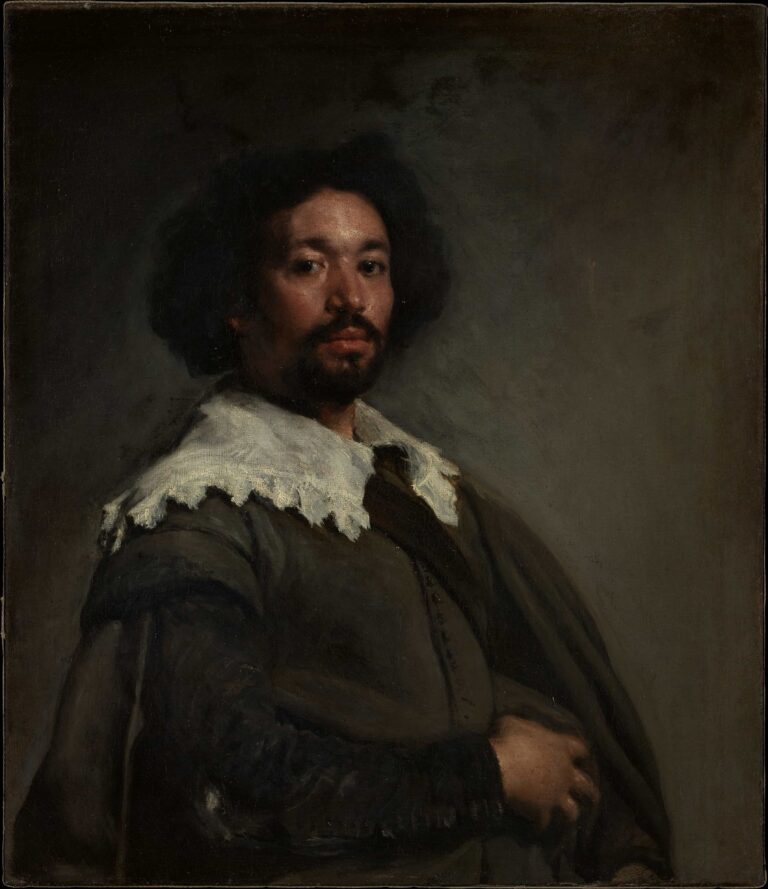
Carolus-Duran taught an unusual method that would mark Sargent for ever. Instead of drawing at length before painting, he had his students build forms directly with the brush, in broad masses of color, starting from the correct values. His absolute model was Velázquez, whose economy of means and free brushwork he revered. Sargent absorbed the lesson so quickly that he astonished his teacher, and within a few years he was the most brilliant pupil in the studio.
In 1877 he exhibited at the Salon for the first time. Two years later he went to Spain and spent weeks at the Prado copying Velázquez; in 1880 he traveled to the Netherlands to study Frans Hals. From these seventeenth-century masters he took boldness of touch, a mastery of blacks and grays, and the ability to capture a presence in a few strokes.
The Paris years were years of ascent. Sargent painted his teacher, a growing number of commissioned portraits, and more personal canvases inspired by his travels: El Jaleo, a flamenco dancer lit from below, triumphed at the Salon of 1882; the same year, The Daughters of Edward Darley Boit, a portrait of four young girls in a vast Paris apartment, paid unmistakable homage to Las Meninas. The young painter seemed destined to become the great portraitist of Paris.
Madame X and the scandal
It was then that he undertook the picture that was to crown his success — and that nearly broke him.
Virginie Amélie Avegno Gautreau was a young American from New Orleans, married to a French banker and famous in Parisian society for her unusual beauty: a sharp profile and skin she powdered a lavender tint. Fascinated, Sargent offered to paint her, without a commission, hoping to make a splash at the Salon. She agreed.
The painting was shown at the Salon of 1884 under a title that withheld the sitter’s name. The public recognized the sitter at once, and the scandal was enormous. The pose was judged provocative, the skin tone corpse-like, and above all the strap of the dress, which Sargent had painted slipping off the shoulder, indecent. The sitter’s mother begged the painter to withdraw the work; he refused, but later repainted the strap in place.
The affair dealt a severe blow to his Paris career. Commissions dried up, and Sargent turned to London, where he was working by 1885 before settling there for good in 1886. His friend the novelist Henry James threw his energy into introducing him to London society. He kept the picture in his studio for more than thirty years, before selling it in 1916 to the Metropolitan Museum, calling it the best thing he had ever done. It was then that he asked for it to be called Madame X, to protect his sitter’s anonymity.
London, master of the portrait
His early years in London were difficult. The English found his manner too French, too daring. But Sargent soon made his mark.
In the summer of 1885, at Broadway, a Cotswolds village where English and American artists gathered, he began a large canvas of two little girls lighting Chinese lanterns at dusk among lilies and roses. He worked on it for two summers running, painting only during the few minutes of evening light. Shown at the Royal Academy in 1887, Carnation, Lily, Lily, Rose caused a sensation and was bought for the nation. The same year he stayed at Giverny with Monet, who had become his friend, and painted outdoors alongside him.
From then on his career was a steady climb. Working from Whistler’s former studio on Tite Street in Chelsea, Sargent became the portraitist of the British aristocracy and upper middle class, but also of the great American fortunes, whose owners crossed the Atlantic to sit for him. He was elected to the Royal Academy in 1897, received the Legion of Honor the same year, and became a member of the National Academy of Design in New York.
His portraits of the 1890s are dazzlingly virtuosic. Gowns of silk, satin and tulle are brushed in broad, rapid strokes; faces are caught with a psychological sharpness that is often underestimated. Sargent excelled at rendering not only his sitters’ appearance but the world they belonged to: an opulent, self-assured society on the eve of its disappearance.
America, Boston and the watercolors
Although Sargent lived in London, his ties to the United States grew ever stronger. From 1887 he made many trips there, painting the elites of New York, Boston and Washington.
Boston held a special place. In 1890 he received the commission for a major mural cycle for the city’s Public Library, devoted to the history of religion. He regarded it as the most ambitious work of his life, and it occupied him on and off for nearly thirty years, until 1919. He then created decorations for the Museum of Fine Arts, Boston, from 1916 until his death, and for Harvard’s Widener Library.
Around 1906, tired of portrait commissions — which he mockingly called “paughtraits” — Sargent decided to give them up almost entirely. He turned to watercolor, which he had practiced since childhood, and to landscapes painted on his travels: Venice, the Alps, the Middle East, Florida. These watercolors, exceptionally free and luminous, are now regarded as an essential part of his work, and several major American museums hold large groups of them.
The First World War inspired one last major work. Appointed an official war artist by the British government, he went to the front in 1918 and brought back an immense canvas, Gassed, completed in 1919: a procession of soldiers blinded by gas, walking with bandaged eyes, each with a hand on the shoulder of the man in front.
Death and rediscovery
John Singer Sargent died in his sleep in London on 15 April 1925. He was still working on the Boston museum decorations and was about to leave for the United States.
His reputation declined immediately after his death. In the age of the triumphant avant-gardes, he was seen only as a painter of wealth, brilliant but shallow, attached to a vanished world. The English critic Roger Fry, champion of Cézanne, did much to bring about this eclipse. For decades Sargent was almost absent from histories of modern art.
Rediscovery began in the 1950s and gathered pace at the end of the twentieth century, with a series of major exhibitions and the publication of his catalogue raisonné. People rediscovered the freedom of his brushwork, the daring of his compositions, the modernity of his watercolors and the intelligence of his portraits, often more ironic and more uneasy than they first appear.
Today Sargent is one of the most popular American painters and one of the best represented in museums across the United States. The double exhibition of 2025, in New York and then Paris, sealed his return to favor, recalling that it was in France — and partly against France — that the most European of American painters was formed.
Where to see his work
Sargent’s work is to be seen above all in the United States, but also in London and Paris.
In the United States
The Metropolitan Museum of Art in New York holds Madame X and an important group of portraits and watercolors. In Boston, the Museum of Fine Arts shows The Daughters of Edward Darley Boit and the decorations of its rotunda; the Isabella Stewart Gardner Museum, El Jaleo; and the Public Library, his great mural cycle. The National Gallery of Art in Washington owns more than one hundred and sixty works by the artist.
In Europe
In London, Tate Britain holds Carnation, Lily, Lily, Rose and the Imperial War Museum Gassed. In Paris, the Musée d’Orsay owns several works by Sargent, including the portrait of the dancer La Carmencita, acquired by the French state as early as 1892.
Further Reading
Institutional Documentation
- National Gallery of Art, Washington — John Singer Sargent — biography and more than 160 works online.
- The Metropolitan Museum of Art — Madame X and Sargent’s works in open access.
- Photo Credit : National Gallery of Art, Washington
See also on Hors Cadre
- Velázquez — the painter of painters — the Spanish master Sargent went to copy at the Prado.
- Orsay Museum
— M