El Greco — the Visionary of Toledo
Bodies stretched beyond the possible, ascetic faces with eyes raised to heaven, acid colours shot through with pallid flashes, tormented clouds that seem to draw the figures upward: El Greco’s art resembles no other. Long dismissed as extravagant, sometimes even taken for the work of a disordered mind, it is now recognised as one of the most powerful and singular bodies of work in the entire history of painting.
Born in Crete around 1541 as Domenikos Theotokopoulos and dead in Toledo in 1614, El Greco — “the Greek”, the nickname the Spanish gave him — followed an extraordinary path. Trained as an icon painter in the Byzantine tradition, he reached Venice, where he discovered Titian and Tintoretto, then Rome, and finally Spain, where he settled for good. From this journey across three worlds he drew an unprecedented synthesis: an art that unites the hieratic gold of Byzantium, Venetian colour and the daring of Mannerism, all in the service of an incandescent spirituality.
What defines El Greco is a deliberate refusal of naturalism in favour of spiritual expression. His elongated figures are neither clumsiness nor caprice: they convey an upward impulse, a yearning towards the beyond, a shedding of matter. His unreal light, his vibrant colours, his compositions that lift the eye from earth to sky make his painting a mystical as much as an aesthetic experience, in perfect accord with the fervent Spain of the Counter-Reformation.
This article retraces the life and work of that solitary creator — the Cretan icon painter, the pupil of Venice, the painter of Toledo, the visionary rediscovered by the moderns. Since El Greco is in the public domain, his works may be freely admired and reproduced; the most striking of them are described here.
Crete, the school of the icon
El Greco was born around 1541 in Candia, present-day Heraklion, on the island of Crete. This origin, long neglected, is in fact the key to his art as a whole.
Crete was then a possession of the Republic of Venice, a singular crossroads between the Orthodox East and the Latin West. Domenikos Theotokopoulos was born there into a modest urban middle-class family, and it was there that he received his first training: that of an icon painter in the post-Byzantine tradition. By 1566 a document records him as a master painter in Candia. At the outset, then, he was an accomplished iconographer, working according to the thousand-year-old canons of Orthodox sacred art.
That early training is no mere biographical detail: it runs through everything he would go on to paint. The art of the icon does not seek to imitate reality but to make the sacred present. It favours frontality, hieratic figures, gold grounds, clean lines, the absence of illusionistic depth. It assumes a deliberate unreality, because its subject is not of this world. El Greco never truly abandoned those principles, even after decades spent in the West.
This explains the radical singularity of his mature art. Where the painters of the Italian Renaissance pursued naturalism, perspective and correct anatomy, El Greco always retained something of the icon’s freedom: the capacity to distort bodies, to ignore verisimilitude, to make light and colour vehicles of the spiritual rather than means of imitation. His celebrated “unrealism” is not a late invention: it comes from Byzantium, from that first Cretan school in which the sacred image counted for its presence rather than its likeness.
Venice, Titian and Tintoretto
Around 1567 the young Cretan painter left his island for Venice, capital of the empire on which Crete depended and, still more, capital of painting. That stay would transform his art from top to bottom.
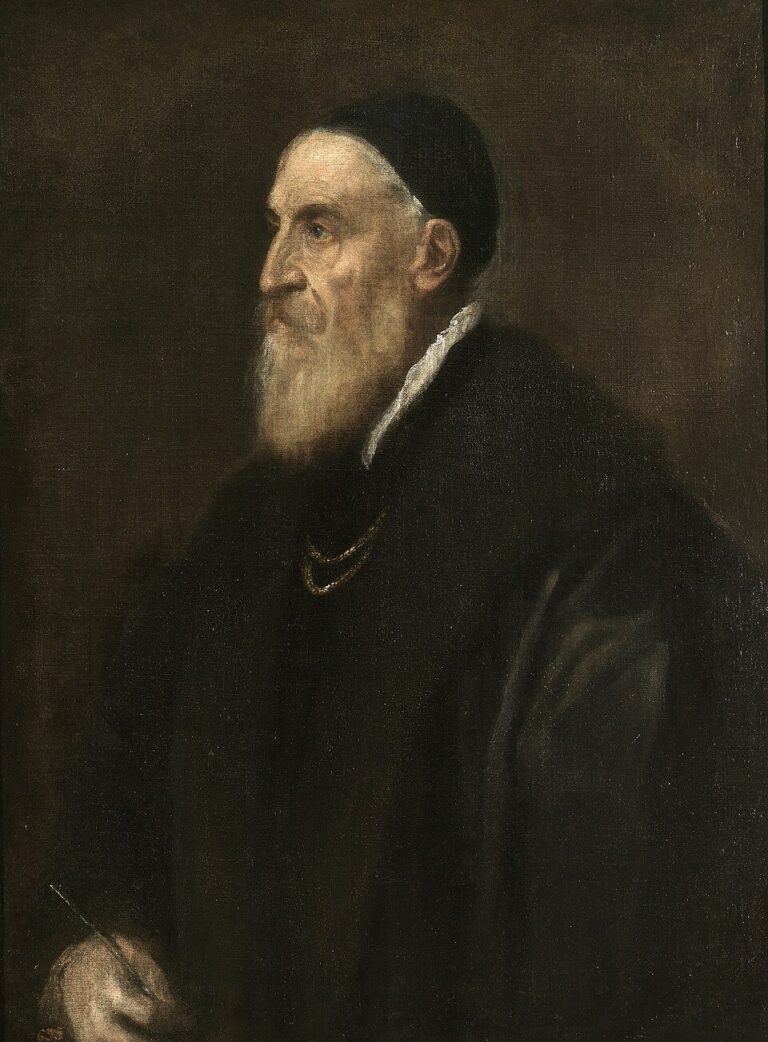
In Venice, El Greco discovered an entirely new pictorial world. He entered, tradition holds, the orbit of Titian, aged by then but still sovereign, and may well have been his pupil in the workshop — he would later be recommended as “the young Candiot, a pupil of Titian”. From Titian he learned colour, glazing, rich and vibrant paint matter, that Venetian art in which form is born of colour rather than of line. For a painter trained in the flat tones and gold of the icon, it was a revelation.
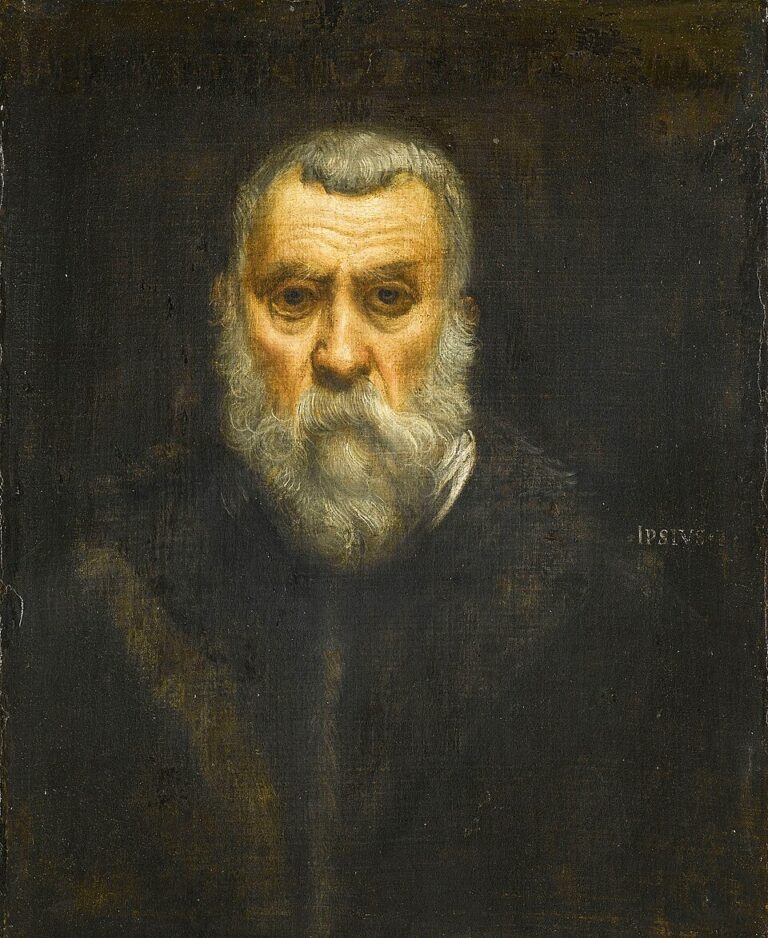
Tintoretto’s influence was perhaps more decisive still. From him El Greco took the dynamism of compositions, powerful diagonals, daring foreshortening, dramatic lighting, that way of setting a scene in motion and staging it through light. Tintoretto’s tormented spirituality, his taste for elongated figures and vertiginous spaces, found a deep echo in the young Cretan. El Greco can be seen as the most radical heir of that dramatic Venetian vein.
Around 1570 he moved on to Rome, where he stayed for several years. He frequented humanist circles, was recommended to the powerful Cardinal Farnese, and joined the Accademia di San Luca. Above all he discovered Roman Mannerism and the legacy of Michelangelo, from which he retained learned compositions, bold poses and the expressive elongation of bodies. Those Italian years produced a body of work that is still little known, in which Byzantine and Venetian influences combine. But El Greco, independent and proud by temperament, never truly made his name in Rome. Another horizon awaited him: Spain.
Toledo, the failure of the Escorial and the chosen city
In the spring of 1577 El Greco arrived in Toledo. He would remain there until his death nearly forty years later. This move, perhaps first conceived as a stepping stone to the court, became the great choice of his life.
What drew him to Spain was doubtless the vast building site of the Escorial, the monastery-palace Philip II was raising near Madrid, which was calling for painters from all over Europe. El Greco saw in it the chance to become the king’s painter. The opportunity came: he was commissioned to paint a large canvas, a Martyrdom of Saint Maurice, completed around 1580. But the work displeased the sovereign profoundly. Too strange, too little narrative, too daring for a royal taste that preferred the more sober Italian Mannerists. The hope of a court career collapsed.
That failure was, paradoxically, a stroke of luck. Spurned by the Escorial, El Greco fell back on Toledo and, as the fine phrase has it, married the city. And Toledo was no ordinary town: a former capital, city of the three cultures, seat of the Primate of Spain, it was a spiritual and intellectual centre of rare intensity, animated by the fervour of the Counter-Reformation and by the great Spanish mystical tradition — that of Saint Teresa of Ávila and Saint John of the Cross. Far from the court, in this city of clergy, scholars and mystics, El Greco found his true milieu.
There he led the life of an independent and learned painter, surrounded by poets and theologians, working for the churches, convents and private patrons of the city. His art, freed from any courtly constraint, could deepen in the direction of inner experience. It was in Toledo, and not in Venice or Rome, that El Greco became fully himself, developing the unique and increasingly radical style that would earn him his posthumous glory. City and painter merged to the point that neither can now be thought of without the other.
A style like no other
What strikes one immediately before a painting by El Greco is the sheer self-evidence of his style: no possible confusion with any other painter. That visual signature rests on a few radical choices.
The elongation of the figures is the most visible. Bodies stretch, proportions distend, faces narrow, hands taper into nervous gestures. This device, inherited from Mannerism, takes on a new meaning in his hands: no longer a formal refinement but the expression of an upward impulse, of a dematerialisation of the flesh. The bodies seem drawn upward like flames. Medical explanations were long sought for this distortion, a defect of eyesight among them; the hypothesis is now discarded, so plainly deliberate and meaningful is the elongation.
Colour and light are equally singular. El Greco uses acid blues and greens, lemon yellows, incandescent reds and strange violets, in often dissonant chords that vibrate with an almost electric intensity. His light is not the light of this world: it comes from no identifiable source but bursts from the figures themselves or from supernatural clouds, carving the forms in pallid flashes. This unreal light, combined with a touch that grew freer and more fragmented over the years, gives his canvases their visionary atmosphere.
His compositions, finally, are designed to raise the eye. They often stack an earthly register and a celestial one, earth and sky answering and communicating with each other. Tormented clouds, drapery in motion and ascending diagonals carry the eye upward. Everything in a canvas by El Greco works towards that spiritual ascent. This avowed refusal of naturalism in favour of expression was not a failure to depict the real: it was a decision, that of painting the invisible rather than the visible.
Mystical painting
El Greco’s art is inseparable from the spiritual climate of the Spain of his time. It may well be its most profound pictorial translation, to the point that one can speak of a properly mystical painting.
Late sixteenth-century Spain was living through an intense religious ferment. The Counter-Reformation deployed its militant fervour there, and Spanish mysticism reached its heights with Saint Teresa of Ávila and Saint John of the Cross, who described the union of the soul with God in terms of ascent, stripping away, night and conflagration. El Greco, a lettered and cultivated painter, friend of poets and theologians, was steeped in that spiritual world. His art offers a striking visual equivalent of it.
His great religious compositions stage the passage between the earthly world and the immaterial. The figures are caught at the instant of transfiguration, bodies lighten, matter is consumed, coloured light floods everything. His saints, his apostles, his visions of the Apocalypse or of the Immaculate Conception convey states of the soul rather than events. He does not narrate: he makes the viewer feel. That is why his art answered so well to the expectations of the Catholic Reformation, which wanted images capable of moving and elevating souls.
His portraits, often admirable, share the same intensity. Whether he depicts a cardinal, a Toledan gentleman or a poet-monk, El Greco captures inner life rather than appearance — the gaze, the tension of the soul. His ascetic faces, with their deep-set eyes, seem turned towards another world. This ability to make a sitter’s spiritual life visible, joined to great psychological accuracy, makes him one of the great portraitists of his century, even if this part of his output remains less well known than his vast religious machines.
Oblivion and rediscovery
El Greco’s posterity is one of the most astonishing in the history of art: celebrated in Toledo during his lifetime, he then fell into almost complete oblivion for nearly three centuries, before being rediscovered and raised to the rank of the very greatest.
In his own lifetime El Greco was recognised and sought after in Toledo, where he received important commissions and lived as an established master. But his manner was too personal, his refusal of naturalism too complete, for him to be classified. After his death in 1614 his art seemed to have no direct heirs: it was soon judged extravagant, bizarre, even diseased. Only the great Velázquez, who admired his work and sought out his paintings, can be considered his true Spanish heir. For the rest, the classical centuries relegated him to the status of a curiosity.
Rediscovery came at the turn of the nineteenth and twentieth centuries. In Spain, the intellectuals of the Generation of ’98 saw in him the embodiment of the Spanish soul and the spirit of Toledo. In France, the writer Maurice Barrès revealed him to the public in a book that remains famous, Greco ou le Secret de Tolède, in 1910. Collectors and artists then hurried to discover this strange painter whose daring suddenly seemed so modern.
For it was modernity that rehabilitated El Greco. The painters of the twentieth century recognised in him a forerunner: Cézanne took an interest in him and reinterpreted one of his paintings; the Expressionists saw in his distortions and colours an ancestor of their own research; Picasso above all studied him closely, and El Greco’s elongated figures count among the sources of the work he pursued in the years leading up to Cubism. This sixteenth-century painter, forgotten for three hundred years, thus found himself at the starting point of modern art.
The Legacy
Today El Greco occupies a place apart in the history of painting: that of a solitary creator, without a school or genuine disciples, whose example has never ceased to fascinate and to nourish creation.
He is regarded as the founding painter of the Spanish school, the artist through whom Spanish painting attained an intensity and a character of its own, before the great century of Velázquez, Zurbarán and Ribera. The last of the Mannerists, he pushed their principles — elongation, chromatic daring, refusal of the natural — to breaking point, giving them a mystical meaning no one else had given them. He is thus at once the culmination of a tradition and the announcement of something wholly new.
His influence on modern art was considerable, precisely because he offered the moderns the example of a total freedom with regard to imitation. By showing that the body could be distorted, light invented and space twisted in the service of expression, he legitimised in advance the audacities of the twentieth century. The Expressionists, the Cubists, all those who broke with realism could claim him as their own. Few old masters have had such an effect on contemporary creation through their rediscovery.
His synthesis of three worlds — the Byzantine icon of his native Crete, the colour of Venice, the fervour of mystical Spain — remains unique in the history of art. No one has brought those legacies together as he did, and no one after him has painted in that way. Visionary of Toledo, painter of the invisible, El Greco remains an unclassifiable and overwhelming figure, whose work continues, four centuries after his death, to exert an undiminished fascination.
Where to see his works
El Greco’s work is to be discovered above all in Toledo and Madrid, though a number of the world’s great museums also hold examples.
In Toledo
Toledo is the place par excellence. The church of Santo Tomé holds The Burial of the Count of Orgaz, his masterpiece, in the very spot for which it was painted. The cathedral sacristy houses The Disrobing of Christ. The Museo del Greco, installed in a house in the Jewish quarter, and the Museo de Santa Cruz complete this itinerary through the city he never left again.
In Madrid and around the world
The Museo del Prado in Madrid holds an exceptional group of his paintings, including The Nobleman with his Hand on his Chest and several large religious compositions. The Metropolitan Museum of Art in New York owns the celebrated View of Toledo. The Louvre, the National Gallery in London and many other European and American museums also display works by the master.
Further Reading
Institutional Documentation
- Museo del Prado, Madrid — the most important group of works by El Greco.
- The Metropolitan Museum of Art, New York — View of Toledo.
See also on Hors Cadre
- Titian — the prince of painters — the Venetian master whose pupil El Greco was, and from whom he took his colour.
- Tintoretto — the fury of Venice — the other Venetian master, whose dynamism and lighting left a deep mark on El Greco.
— M