The Burial of the Count of Orgaz — El Greco’s masterpiece
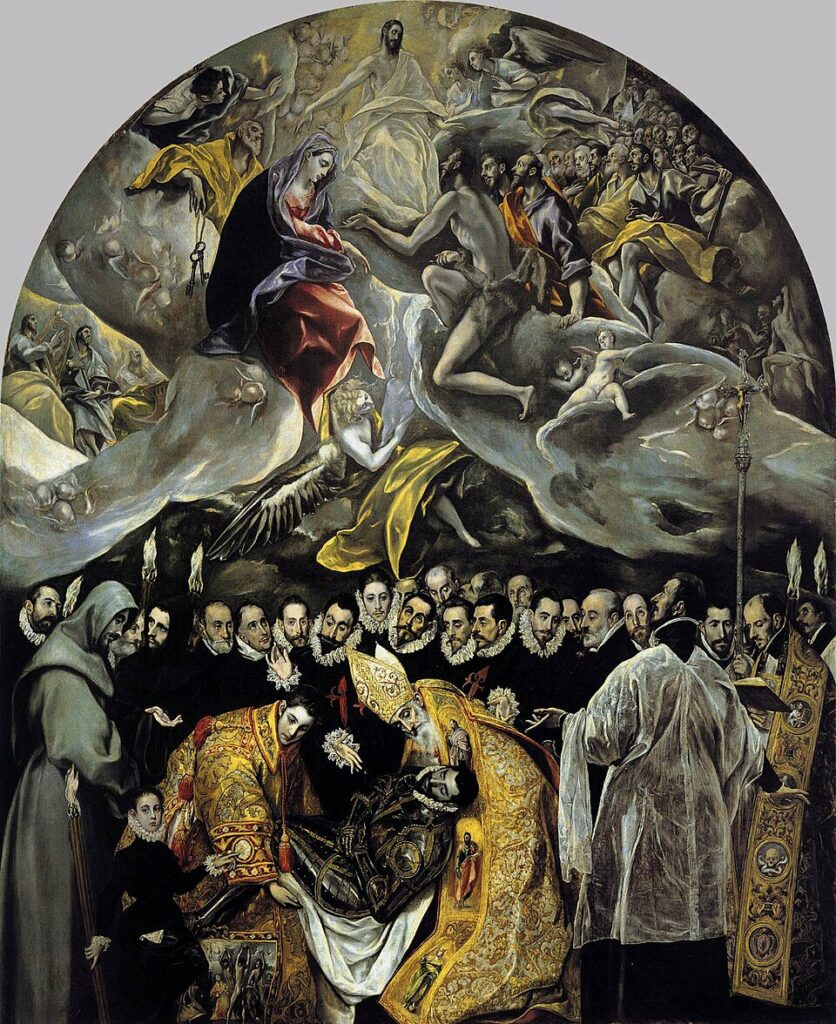
El Greco — the Visionary of Toledo →In the half-light of a small church in Toledo, a canvas almost five metres high fills an entire wall. Below, a row of gentlemen in black, white ruffs at their necks and grave expressions on their faces, attend a burial. Two saints in gold vestments, descended from heaven, lower the dead man’s body with their own hands. And above them the wall of cloud opens onto a celestial glory in which bodies stretch upward like flames. The Burial of the Count of Orgaz is universally regarded as El Greco’s masterpiece, and as one of the summits of all Spanish painting.
The work was commissioned in March 1586 by Andrés Núñez, parish priest of Santo Tomé, for the Lady Chapel of his church. It is still there, in the exact place for which it was conceived — a rare thing for a painting of this importance, and the reason the experience of seeing it on site is so powerful. El Greco completed it between late 1587 and the spring of 1588, after working for nearly two years on a monumental canvas measuring 480 by 360 centimetres.
The subject is a local legend more than two centuries old. What makes the painting a masterpiece, however, lies in the way the painter treated it: by stacking within a single canvas two worlds that look nothing alike — an assembly of contemporaries painted with almost documentary precision, and a celestial vision in which every law of representation comes undone. It is in that coexistence that El Greco’s art plays out.
This article looks at the commission and its legend, describes how the painting is built in two registers, identifies the faces in the Toledan assembly, and explains why, four centuries later, this canvas remains the essential stop on any visit to Toledo.
A parish commission and an old miracle
The story begins with a lawsuit and an unpaid debt. Don Gonzalo Ruiz de Toledo, lord of Orgaz, who died in 1323, had been a benefactor of the parish of Santo Tomé, paying for its enlargement out of his own pocket and leaving it a perpetual annuity. When the townspeople of Orgaz eventually refused to keep paying, the priest Andrés Núñez went to court and won. It was with the proceeds of that case that he decided to have the miracle attached to the benefactor’s memory painted.
For an old tradition held that at the moment of the count’s burial, Saint Stephen and Saint Augustine had come down from heaven in person to lay the body in the tomb with their own hands, before the astonished eyes of those present. The contract, signed on 18 March 1586, specified the subject, required delivery by Christmas 1587 and left the purchase of materials to the painter. The work was to hang above the tomb itself, in the side chapel of the Virgin.
The choice of subject was anything but innocent in Counter-Reformation Spain. It asserted at once the reality of miracles, the intercession of the saints and the efficacy of good works — the three points the Protestant Reformation contested most directly. A church painting, in Toledo in 1586, was also a doctrinal statement.
The affair ended in a dispute of its own. The valuation of the finished painting caused a disagreement between painter and parish, and El Greco, a litigious man well aware of his own worth, finally accepted the lower appraisal of 13,200 reales. In the eyes of posterity he nonetheless gained a good deal more than that sum represented.
Two worlds in a single canvas
The composition is strikingly clear: a horizontal line of cloud divides the canvas into two registers, the earthly below and the celestial above. The whole force of the work lies in the way these two worlds are at once separated and joined.
Below, gravity reigns. The scene unfolds in a compressed space, against an almost uniform ground of black-clad figures. Saint Stephen, in a dalmatic embroidered in gold on which his own stoning can be read, and Saint Augustine, in an episcopal cope, support the body of the count in a steel armour whose reflections catch the light. Around them a row of Toledan gentlemen in black, white ruffs at their necks, contemplate the scene or turn towards the viewer. Everything here is painted with an almost tangible precision: the embroidery, the metal, the fabrics, the faces.
Above, everything changes. Space dilates, bodies elongate, colours turn acid — cold blues, lemon yellows, vibrating reds. Christ presides at the summit, the Virgin and Saint John the Baptist intercede on either side, and an angel carries the dead man’s soul up towards them in the form of a small translucent child, slipped through a narrow passage in the cloud. Nothing in this register obeys the laws of the world below: not the scale, not the light, not the anatomy.
The link between the two is carried by glances and gestures. The priest in his surplice, on the right, lifts his eyes; a gentleman at the centre points to the scene; the angel opens the passage. The viewer’s eye thus rises from the tomb towards heaven, exactly as the work’s spiritual programme intended. It is a machine for lifting the gaze.
All of Toledo assembled
What fascinates in the earthly register is that this is no generic crowd: El Greco painted the Toledan society of his own day, and faces can be recognised in it.
These gentlemen in black are the painter’s contemporaries, members of the city’s clergy, nobility and learned circles, aligned in a frieze of portraits of remarkable psychological acuity. Each has his own expression, his own gaze, his own way of being present at the scene — recollection, curiosity, detachment. The gallery is as much a document on the elite of a Spanish city at the end of the sixteenth century as it is a religious painting.
The painter slipped himself into it: his face is traditionally identified above the knight of the Order of Santiago, looking out at the viewer. His son Jorge Manuel appears on the left, as the boy pointing to the scene; on the handkerchief emerging from his pocket El Greco inscribed his signature in Greek characters together with the child’s year of birth, 1578. An elegant way of signing twice, as painter and as father. Saint Augustine, finally, is said to have borrowed the features of Cardinal Gaspar de Quiroga, archbishop of Toledo.
This presence of Toledo within the painting partly explains the city’s attachment to it. The miracle is not confined to a distant past: it takes place in the middle of an assembly that is the assembly of 1586, before men the parishioners passed in the street. The supernatural settles into the present.
El Greco’s style at its height
The Burial of the Count of Orgaz is the painting in which El Greco’s style reaches its point of perfect balance, between the precision inherited from Venice and the visionary freedom of his maturity.
The lower register reveals an exceptional portraitist, capable of a meticulous rendering of materials — the gold of the embroidery, the burnished steel of the armour, the starched whiteness of the ruffs, the skin of the faces. None of the strangeness usually associated with the painter appears in this part: it is an art of presence, dense, controlled, almost sober.
The upper register, by contrast, deploys everything that makes him singular. Bodies stretch beyond their natural proportions, drapery swirls, light comes from no identifiable source but seems to emanate from the figures themselves. Colours vibrate in dissonant chords. Space itself gives way: the clouds measure nothing, scale is free, depth is abolished. Here one recognises the legacy of Mannerism and of Venice — and, further back still, that of the Cretan icon of his beginnings, in which the sacred image never sought illusion.
This avowed duality is not a compositional weakness: it is the subject of the painting. El Greco paints two orders of reality in two distinct pictorial languages, and their coexistence in a single canvas makes perceptible what words can only state: that heaven opened above a tomb, one day in 1323, in a small church in Toledo.
A work that never moved
One of this painting’s privileges is that it has never left the building for which it was painted. Neither royal collections, nor great museums, nor the accidents of history have detached it from its wall.
The work is therefore seen in the church of Santo Tomé in Toledo, in the side chapel reached through a dedicated entrance. It occupies the wall above the tomb, at the exact height the painter had planned, with the lighting and the viewing distance he anticipated. Four centuries of such continuity are rare, and they change everything: you are not looking at a painting hung in a gallery, you are stepping into a device conceived for one precise place.
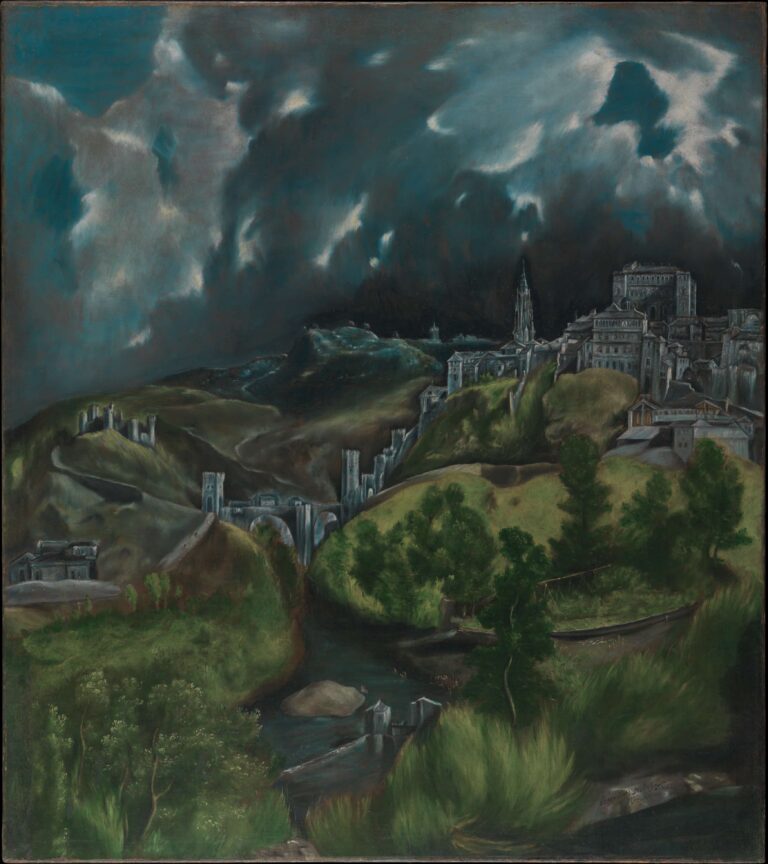
Its fame has made Santo Tomé one of the most visited sites in Spain, and the painting has become, along with the View of Toledo, the city’s visual emblem. The Spanish intellectuals of the Generation of ’98, and then the French travellers of the early twentieth century, saw in it the fullest expression of the Castilian soul. Maurice Barrès made it the heart of his book on the secret of Toledo.
The practical advice remains what it was a century ago: come early or late in the day to avoid the crowds, take the time to let your eye rise from the earthly register towards the sky, and extend the visit with the cathedral sacristy and the Museo del Greco, a few streets away.
Further Reading
Institutional Documentation
- Iglesia de Santo Tomé, Toledo — the official site of the church that holds the painting.
- Museo del Prado, Madrid — the largest group of works by El Greco.
See also on Hors Cadre
- El Greco — the Visionary of Toledo — a portrait of the painter, from Crete to Toledo.
- Tintoretto — the fury of Venice — the Venetian master from whom El Greco took his two-register compositions and dramatic lighting.
— M