The Calling of Saint Matthew—When Caravaggio Puts God in a Tavern
Caravaggio, the painter who depicted a sword at the waist →Rome, July 1600. In a side chapel of the Church of Saint-Louis-des-Français, near Piazza Navona, two immense paintings—just delivered by a twenty-eight-year-old Lombard painter—were unveiled to the public. The reaction was overwhelming. Art lovers flocked to see them. Commissions poured in. Within a few weeks, Caravaggio became the most talked-about painter in Rome.
One of these two paintings is titled *The Calling of Saint Matthew*. Four hundred years later, it still hangs in the same spot—on the left wall of the Contarelli Chapel, a few meters from the altar—and can still be seen today under the same conditions as in 1600. This article tells the story of how it came to be, what it depicts, and why it changed Western painting.
The command that can change everything
In 1599, Caravaggio was twenty-eight years old. He had been living in Rome for several years, first taken in and then introduced to society by Cardinal Francesco Maria del Monte, his most important patron. He painted genre scenes for private collectors— *The Card Sharps*, *The Fortune Teller*, *The Lute Player* —which circulated in scholarly circles. He had a reputation, but he had not yet achieved public fame.
That is precisely what the Contarelli Chapel will offer him.
The story begins with a commission that has been pending for thirty years. Cardinal Matthieu Contarelli (in Italian, Matteo Contarelli)—a Frenchman who took Italian citizenship, who died in 1585—had purchased a side chapel in 1565 at the National Church of France in Rome, Saint-Louis-des-Français, to be buried there. He had stipulated that it be decorated with a cycle depicting the life of his patron saint, the Apostle Matthew. But the artists approached for the project came and went without completing the work. The executors of his will were losing patience.
In 1599, following Cardinal del Monte’s decisive intervention, the commission was finally awarded to Caravaggio. A contract was signed on July 23, 1599: he was to paint the two large side panels for 400 écus—a considerable sum for the time, and the largest commission of his young career. The two paintings were *The Calling of Saint Matthew* and *The Martyrdom of Saint Matthew*. The unveiling was scheduled for the Jubilee Year of 1600.
Caravaggio delivered the work in July 1600. It took him eleven months to paint forty-two square meters of canvas —two monumental scenes, each measuring more than three meters by three and a half meters. The pace was breakneck. So was the quality.
The scene—a frozen moment
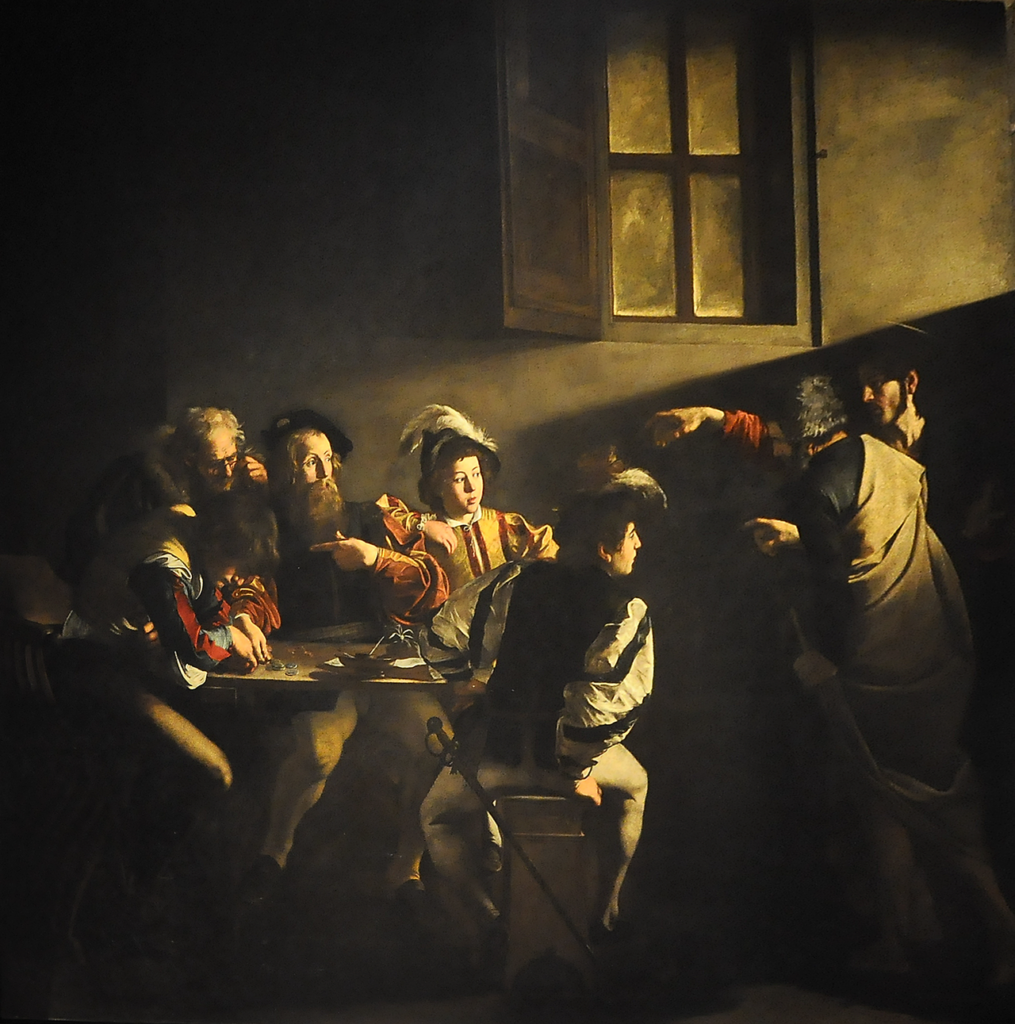
The painting measures 322 centimeters high by 340 wide. It is an oil on canvas, in a nearly square format. It depicts a specific moment described in the Gospel according to Matthew (chapter 9, verse 9), the only passage in the Contarelli cycle taken directly from a biblical text. The account is strikingly concise: as he passed by the tax collector’s booth, Jesus saw a man sitting there named Matthew, and he simply told him to follow him.
Before that moment, Matthew—also known as Levi—was just a tax collector working for Rome.
Despised, wealthy, beyond redemption. After that moment, he would become an apostle, an evangelist, and a martyr. Between the two, there was just one call: “Follow me.” Matthew got up and followed. That’s all.
Caravaggio chose to paint the split second when the call has just been made and the response has not yet been given.
On the left side of the painting, seated around a table, five men are counting money. Coins are spread out, along with an account book and an inkwell. Three of them look up at the new arrivals. Two others, at the far end of the table, remain absorbed in their task—they don’t see, they don’t know. In the center, a bearded man, richly dressed, with a look of surprise, points to himself with his left hand as if to ask, “Me?” ” His right hand has not let go of the coins. He is traditionally identified as Matthew—although an alternative interpretation, advocated since 2012, identifies Matthew as the young man on the far left, his head bowed, still oblivious to the call.
On the right, in the shadows, two figures have just entered: Jesus and Peter. Jesus is almost entirely obscured by Peter—only his head and outstretched arm are visible, his index finger pointing toward Matthew. But his feet are already turned toward the exit: Caravaggio paints a Christ who points and walks away in the same gesture. The call does not wait for a reasoned response—it expects him to be followed.
All the men counting the money are dressed not as biblical figures but as Caravaggio’s contemporaries: embroidered doublets, feathered hats, daggers at their belts, and the elegant attire of late 16th-century Romans. Only Jesus and Peter wear the ancient tunic and walk barefoot. This clash of eras is the painting’s defining feature. Caravaggio transposes the Gospel scene not into an idealized Galilee, but into a Roman tavern that the parishioners of Saint-Louis-des-Français instantly recognize for what it is: their own neighborhood.
The stroke of genius—light as grace
Above the figures, in the upper right corner of the painting, a beam of slanting light cuts through the darkness, grazes Peter’s head, glides across the back wall, and touches Matthew’s face.
This beam of light has no identifiable natural source. There is indeed a window in the painting, but it is further to the left; its shutter is closed, so it isn’t letting any light through. The beam of light comes from higher up and further to the right—from a place that doesn’t exist within the scene.
This is a major theological innovation. Caravaggio rejects the conventions of religious painting of his time: no floating halos, no mystical rays traced in gold, no cherubs carrying scrolls. Divine grace, in *The Calling*, is a light that strikes—like physical light, like something real, like what streams in through a window when you open the shutters in the morning. And yet this light has no visible source. It is at once intensely material and radically spiritual.
The 17th-century critic Giovanni Pietro Bellori—who, despite his dislike of Caravaggio and his preference for the classics—had to acknowledge this. In his *Lives of Modern Painters*, published in 1672—fifty years after the painter’s death—he summed up Caravaggio’s genius with a phrase that has remained famous in art criticism: Caravaggio, he says, had restored blood and flesh tones to painting at a time when color was nothing more than makeup and vanity.
That phrase says it all. Before Caravaggio, Roman religious painting had lost touch with the human body. Mannerist figures had become weightless allegories, drapery with no flesh beneath. Caravaggio restores to painting the carnal weight of things: the weariness on a face, the thickness of a sheet, the light gliding over a sweaty forehead. And it is precisely this rediscovered carnality that makes the theological miracle of *The Calling* possible: grace can strike only real bodies.
Three centuries of obscurity, then Longhi
Here is a fact that most articles on *The Calling* fail to mention: this painting, now considered one of the masterpieces of Western art, was largely forgotten for three centuries.
In the 18th century, tastes changed. The Rococo style, followed by Neoclassicism, took no pleasure in Caravaggio’s tenebrism or his folk realism. Seventeenth-century biographers—Mancini, Baglione, Bellori—had kept his legacy alive, but Caravaggio’s Roman chapels fell into oblivion. “The Calling,” however, remained in place, where it had always been, in the dim light of the Contarelli Chapel. For two hundred years, travelers on the Grand Tour passed through Rome without opening the door of Saint-Louis-des-Français to view it.
It wasn’t until the turn of the 20th century that an Italian historian brought him out of the shadows. Roberto Longhi, then a young art critic, published his pioneering study *Quesiti caravaggeschi* in 1920. In it, he systematically examined Caravaggio’s body of work and restored him to his rightful place in the history of European painting. *The Calling* suddenly became what it should always have been: no longer a curiosity in a Roman church, but a masterpiece that laid the foundation for modern painting.
This rediscovery is no mere detail. It reveals something essential about the fate of works of art: a masterpiece can remain invisible for centuries even while it is physically accessible to everyone, until a single pair of eyes is able to see it anew. That is also why Hors Cadre exists—to offer these perspectives.
How to View the Work Today
“The Calling of Saint Matthew ” has never left the chapel for which it was painted. It is preserved in situ in the Contarelli Chapel of the Church of St. Louis of the French in Rome, just a stone’s throw from Piazza Navona.
Essential practical requirements:
- Address: Piazza San Luigi de’ Francesi, 00186 Rome RM, Italy
- Admission: Free (the church is the French National Church in Rome and is currently in use as a place of worship)
- Hours: Open daily, usually closed between 12:30 p.m. and 2:30 p.m. Check the official website for the most up-to-date hours before visiting.
- Helpful tip: The chapel’s lighting is timer-controlled and can be activated using a coin inserted into the electrical box located nearby. Without a coin, you can hardly see anything. Be sure to bring 1- or 2-euro coins.
- Best time to visit: early in the morning (opens around 9:30 a.m.) or late in the afternoon, to avoid the guided tour groups that fill the chapel by the dozen in the middle of the day
Note: The three Caravaggio paintings in the chapel can be viewed together. *The Calling* is on the left wall, *The Martyrdom of Saint Matthew* on the right wall, and *Saint Matthew and the Angel* (1602) above the altar. Allow at least fifteen to twenty minutes to view them properly.
Further Reading
Primary sources cited in this article
- The Gospel According to Matthew, Chapter 9, Verse 9. The account of the calling, the sole source of inspiration for the painting.
- Giovanni Pietro Bellori, *Le Vite de’ pittori, scultori et architetti moderni*, Rome, 1672. The first major critical overview of Caravaggio, published fifty years after his death. A French edition is available.
- Roberto Longhi, *Quesiti caravaggeschi*, 1920. Pioneering studies that rescued Caravaggio from oblivion in the 20th century.
To view the artwork
Church of Saint Louis of the French, Rome : The Calling of Saint Matthew, The Martyrdom of Saint Matthew, Saint Matthew and the Angel. The series has remained in situ since 1600.
Also check out on Hors Cadre
Caravaggio, the Painter Who Painted with a Sword at His Side —A Comprehensive Portrait of the Artist
Saint Jerome Writing— the work Caravaggio dedicated to his savior—a work by the mature Roman Caravaggio, just before his flight
— M