“Starry Night” — A Study of a Sky Imagined by Van Gogh
Vincent van Gogh — the artist who wrote as much as he painted →Saint-Rémy-de-Provence, Tuesday, June 18, 1889. From a room at the Saint-Paul-de-Mausole asylum, where he had been admitted six weeks earlier, Vincent van Gogh wrote to his brother Theo. In the letter—the 782nd in a correspondence that would total 902—he announces a new painting: “a new study of a starry sky.” The term he uses is precise. Not a “dream,” not a “vision.” A study. A few words from a painter at work.
In art history, this painting has come to be known as *The Starry Night*. Housed at the Museum of Modern Art in New York since 1941, it is today one of the three or four most recognizable paintings in the world. It is also the one that has attracted the most speculative interpretations.
This article takes the opposite approach. It states only what is substantiated: the documented facts, the words Van Gogh wrote in his letters, and what the MoMA and the Van Gogh Museum in Amsterdam confirm in their scholarly publications. The rest is left to the reader’s judgment.
Saint-Rémy, June 1889
Van Gogh arrived atthe Saint-Paul-de-Mausole asylum in Saint-Rémy-de-Provence on May 8, 1889. He voluntarily admitted himself there, six months after the incident in Arles in which he had cut off his left ear. He would remain there for a year.
The institution is headed by Dr. Théophile Peyron. Van Gogh has a room there on the first floor, which faces east toward the Alpilles, and a room on the ground floor that the director allows him to use as a studio. He is not allowed to paint in his room, but he can go out into the park and, when accompanied, into the surrounding countryside.
His time in the asylum would be one of the most productive periods of his life: he produced about 150 paintings and just as many drawings in a single year. He worked at a steady pace, except during the three major crises identified during his stay: mid-July 1889, December 1889, and between February and March 1890. *The Starry Night* was painted before the first of these crises, during a period that, according to the precise dates documented by the Van Gogh Museum, corresponded to a state of relative stability.
In a letter dated June 9, 1889, to Theo, Van Gogh describes the landscape he sees from the asylum: the soft-green countryside, the yellow flowers in the fields, the grayish-green olive trees, and the blue hills that turn purple. Nine days later, he announced that he was working on a study of the starry sky.
The painting—what it depicts
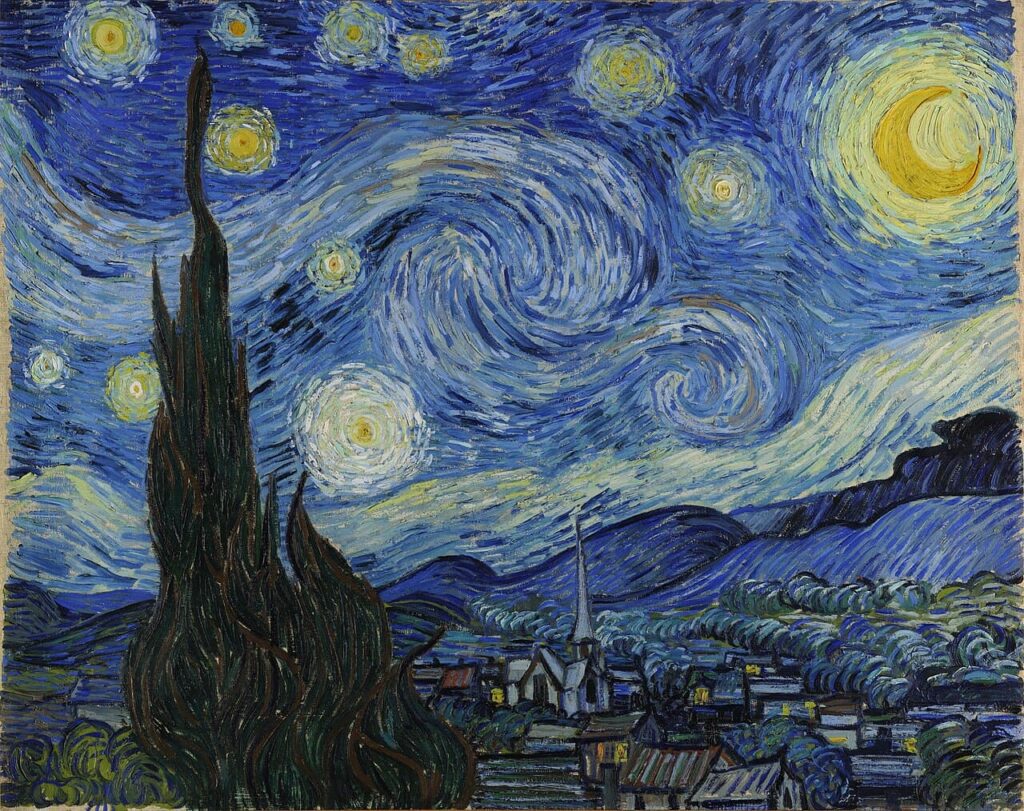
*The Starry Night* is an oil on canvas in landscape format, measuring 73.7 centimeters high by 92.1 centimeters wide. The painting is currently housed at the Museum of Modern Art in New York, where it is on permanent display in Gallery 501 (fifth floor, Alfred H. Barr Jr. Wings).
The painting is dominated by a sky that occupies the top three-quarters of the composition. In it, we can make out:
- A large crescent moon in the upper right, surrounded by a yellow-orange halo
- Eleven stars scattered across the sky, each surrounded by a bright white-yellow halo
- A particularly bright star in the center-left, larger than the others: this is Venus, the Morning Star, identified as such by astronomical studies published by MoMA and confirmed by references to Venus in Van Gogh’s letters
- Spirals and swirls that stretch across the sky from one side to the other, forming undulating lines
On the ground, in the lower half of the painting:
- A village spread out across a valley, with houses featuring dark roofs and windows lit up in bright orange
- A church in the center of the village, whose spire rises above the rooftops
- Hills that frame the landscape in the background
- A large cypress tree in the foreground on the left, painted in dark tones, rises vertically and cuts across the composition from bottom to top, from the ground to the sky
The technique involves the thick brushstrokes characteristic of this period in Van Gogh’s work, applied in smooth, curved lines. The swirls in the sky are composed of parallel streaks that follow the same curvilinear movement.
A partially imagined view
This is where we need to be precise, because the work is often presented as a view from Van Gogh’s window in Saint-Rémy. This presentation is inaccurate.
According to the scientific documentation from the Museum of Modern Art, which houses the work, *The Starry Night* combines observation and invention. MoMA states in its official entry that “Van Gogh included an imaginary village in the composition.” The exhibition catalog *Van Gogh and the Colors of the Night*, co-published by MoMA and the Van Gogh Museum in 2008, confirms and elaborates on this composite nature.
There are several concrete pieces of evidence that allow any viewer to see this for themselves:
The painted bell tower is in the Nordic style. Its pointed silhouette, the simplicity of the spire, and the straight construction: this is the typical form of Protestant bell towers in Holland or Flanders, not classic Provençal architecture. No church in Saint-Rémy-de-Provence or the surrounding villages has this type of bell tower. The village has therefore been imagined or reconstructed based on other memories.
The cypress tree in the foreground was added for compositional purposes. The MoMA explicitly documents this point. The tree was not visible from the window of the asylum.
The hills in the middle do not match the actual view. The Alpilles appear in the distance on the right, consistent with the topography of Saint-Rémy. But the hills closer by seem to have been painted from a different vantage point—facing south—rather than from the east-facing room.
The painting was created in the studio, not outdoors. The MoMA notes in its entry that “the painting, one of hundreds of works Van Gogh produced that year, was created in several sessions throughout the day, under entirely different weather conditions.”
What is depicted, however, is the sky. Astronomical studies of the positions of the celestial bodies in the painting have made it possible to date the celestial configuration depicted: it corresponds precisely to the sky visible from Saint-Rémy-de-Provence on May 25, 1889, at 4:40 a.m., or to similar configurations in the weeks that followed. Venus, in its position in the center-left, is exactly where it was in the Provençal sky that spring, shortly before sunrise.
So Van Gogh didn’t paint what he saw out his window. He painted a sky he had observed and set it against a partly imagined landscape.
“A New Study of a Starry Sky”
It was in Letter 782, written to Theo from Saint-Rémy around June 18, 1889, that Van Gogh first mentioned the painting. In it, he briefly mentions, among his works in progress, that he is working on “a new study of a starry sky.”
“A new study of a starry sky.”
— Vincent van Gogh, Letter 782 to Theo, Saint-Rémy-de-Provence, June 18, 1889
The word “study” deserves some attention. In the vocabulary of 19th-century painters, a study refers to a work of observation, technical research, and the development of a motif. It is a studio term. That is what Van Gogh himself says, in his own words, about this painting: not a vision, not a scream, not a trance— a study.
This word is part of a long-standing obsession. Nearly a year earlier, in a letter to Theo written from Arles in July 1888, Van Gogh had already spoken of his need to paint the stars:
“[…] the sight of the stars always makes me dream […]”
— Vincent van Gogh, Letter 638 to Theo, Arles, July 9 or 10, 1888
This letter, No. 638, written eleven months before the MoMA’s *Starry Night*, predates by a few months the *Starry Night over the Rhône*, painted in Arles in September 1888— another painting, not to be confused with the one discussed here (see below). But it places the work from Saint-Rémy within a continuous exploration of the night sky, a subject that had occupied Van Gogh since Arles for over a year.
When he told Theo on June 18, 1889, that he had just finished a study of a starry sky, he was thus continuing a painting project that had been maturing for a long time. It was not a sudden burst of inspiration, but rather an ongoing exploration.
From the Easel in Saint-Rémy to MoMA
The painting’s provenance is precisely documented in the Van Gogh Museum’s archives.
In the fall of 1889, Van Gogh sent *The Starry Night* to Theo in Paris, as part of a batch of works he had created in Saint-Rémy. The painting is mentioned in correspondence from September 1889. Theo kept it in his Paris apartment until his own death, six months after Vincent’s, on January 25, 1891.
The painting then passed to Johanna van Gogh-Bonger, Theo’s widow, who inherited nearly all of Vincent’s works and set out to make them known to the public. It was she who, in December 1900, sold *The Starry Night* to the Parisian art critic Julien Leclercq. Three months later, in February 1901, the painting was exchanged for another work and passed to Claude-Émile Schuffenecker, a painter and collector who was a friend of Gauguin’s.
Johanna purchased it in 1905, possibly through the Oldenzeel Gallery in Rotterdam. In 1906, she sold it to Georgette P. van Stolk (1867–1963), a Dutch collector living in Rotterdam, who kept it for thirty-two years.
In 1938, the painting was sold to the Paul Rosenberg Gallery in New York through the art historian Jacob Baart de la Faille—the author of the first Van Gogh catalog raisonné, published in 1928.
Three years later, in 1941, the Museum of Modern Art acquired it through the bequest of Lillie P. Bliss, one of the museum’s three founders. It has been on permanent display there ever since.
How to View the Work—and Not Confuse It
“The Starry Night ” is housed at the Museum of Modern Art (MoMA) in New York. Practical information:
- Address: 11 West 53rd Street, New York, NY 10019, United States
- Gallery: 5th floor, Room 501 (Alfred H. Barr Jr. Galleries)
- Reservations: Buy tickets online on the official website; limited time slots available
- Price: about $30 for general admission (free on Friday nights thanks to Free Friday Nights)
- Tip: Room 501 also features other major works of Post-Impressionism. Allow at least an hour to explore this gallery.
Not to be confused with *Starry Night on the Rhône* (Musée d’Orsay)
Van Gogh painted two works known as “Starry Night,” and confusion between the two is one of the most common among the general public.
- *Starry Night on the Rhône* : painted in Arles in September 1888, now in the Musée d’Orsay in Paris. The painting depicts a nighttime view of the Rhône with the city’s gaslights reflected in the water, and a couple in love in the foreground. Serene atmosphere.
- *Starry Night* (the one discussed in this article): painted in Saint-Rémy in June 1889, now in the collection of MoMA in New York. A swirling composition featuring a village with a bell tower and cypress trees in the foreground.
The two paintings were created nine months apart, in two different locations and under two different biographical circumstances. If you visit Paris or New York, you’ll see two different *Starry Nights *.
Further Reading
Primary sources cited
- Vincent van Gogh, The Letters, complete critical and illustrated edition, edited by Leo Jansen, Hans Luijten, and Nienke Bakker, Van Gogh Museum / Huygens Institute / Actes Sud, 2009. The definitive edition, authorized French translation.
- Official website: vangoghletters.org — all 902 letters available for viewing, accompanied by a scholarly critical edition.
- Letter 782 to Théo (Saint-Rémy, June 18, 1889).
- Letter 638 to Théo (Arles, July 9–10, 1888).
Institutional Documentation
- MoMA’s official page on *The Starry Night*: moma.org/collection/works/79802
- Van Gogh and the Colors of the Night, exhibition catalog, Museum of Modern Art / Van Gogh Museum, New York–Amsterdam, 2008. Joint scientific study of Van Gogh’s nocturnal works.
To view the artwork
- Museum of Modern Art, New York — *The Starry Night*, Gallery 501, permanent collection.
Also worth checking out at Hors Cadre
- Vincent van Gogh—the artist who wrote as much as he painted —a portrait of the painter.
- The Potato Eaters — the work Van Gogh defended throughout his life
— M